In This Article
Between the imposition of strict foreign-exchange controls in February 2003 and the collapse of Venezuelan oil revenues a decade later, Venezuela’s multi-tiered currency regime generated one of the largest state-arbitrage and corporate-finance scandals in modern history. Created by President Hugo Chávez under Decree 2,302 on February 5, 2003, the Commission for the Administration of Currency Exchange (*Comisión Nacional de Administración de Divisas*, or CADIVI) fixed the official exchange rate of the Venezuelan bolívar at steep subsidies relative to the parallel market. Rather than preventing capital flight, the widening spread between official rates (2.15, 4.30, and 6.30 strong bolívars per US dollar) and black-market rates enabled well-connected importers, bankers, and state officials to siphon off more than US$20 billion in a single year through phantom briefcase companies (*empresas de maletín*), fueled the November 2009–2010 collapse of more than a dozen “bolibourgeois” private banks and brokerages, and drained billions of dollars from state oil monopoly Petróleos de Venezuela S.A. (PDVSA) through structured notes and sovereign bond-swap schemes. [1]
The CADIVI Exchange Regime and Phantom-Import Arbitrage
Following the December 2002–February 2003 oil-industry strike and capital outflows that depleted international reserves at the Central Bank of Venezuela (BCV), President Hugo Chávez suspended free foreign-exchange convertibility on February 5, 2003 and established CADIVI to centralize every US dollar earned from PDVSA’s petroleum exports. Under this regime, private businesses and individuals could obtain foreign currency legally only by submitting import or travel requests to CADIVI and receiving authorization for Foreign Exchange Acquisition (*Autorización de Adquisición de Divisas*, or AAD). After the 2008 currency redenomination (which removed three zeros to create the *bolívar fuerte*, VEF), the official CADIVI rate stood fixed at 2.15 VEF per US dollar until January 2010—when a dual rate of 2.60 VEF for priority food and medicine imports and 4.30 VEF for general imports was introduced—before being unified at 4.30 VEF in 2011 and devalued to 6.30 VEF in February 2013. [2]
Because domestic money creation and fiscal deficits steadily eroded the bolívar’s purchasing power while CADIVI rationed hard currency, the parallel-market exchange rate climbed to three, five, and eventually more than ten times the official rate. That chasm turned an administrative CADIVI allocation into an instant risk-free windfall: any firm granted US$10 million at 2.15 or 4.30 VEF/USD could immediately sell those dollars on the parallel market—or round-trip a fraction of them back into bolívars—to multiply its capital several times over without producing a single good. [3]
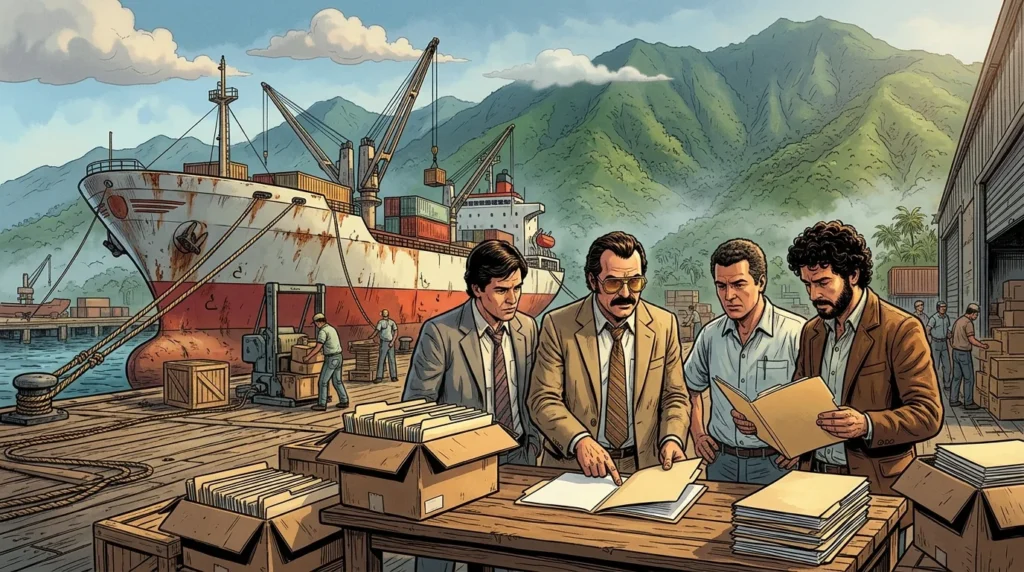
To capture these rents, politically connected intermediaries registered thousands of paper shell corporations known in Venezuela as *empresas de maletín* (“briefcase companies”). Operating in concert with corrupt customs officials, national guard checkpoints, and officials inside CADIVI and the Ministry of Food or Health, these shell firms submitted forged pro-forma invoices for pharmaceutical supplies, industrial machinery, or bulk food staples. In many cases, containers arrived at Venezuelan ports completely empty, carried scrap metal or expired goods, or were billed at ten times their true international market price (over-invoicing). In May 2013, Central Bank President Edmée Betancourt and former Planning Minister Jorge Giordani publicly acknowledged that out of roughly US$59 billion allocated by CADIVI in 2012 alone, an estimated US$20 billion to US$25 billion had been siphoned off through artificial demand and phantom briefcase companies—prompting the government to dissolve CADIVI into CENCOEX in early 2014 even as public records on thousands of investigated companies were sealed from independent audit. [4]
PDVSA Structured Notes and National Treasury Bond Swaps
Alongside phantom merchandise imports, a second financial pipeline transferred billions of dollars from the Venezuelan state to a rising class of regime-aligned financiers—colloquially termed the *boliburguesía* (“bolibourgeoisie”). Between 2004 and 2010, the Venezuelan Ministry of Finance, the Office of the National Treasury (*Oficina Nacional del Tesoro*, ONT), and state oil company PDVSA issued tens of billions of dollars in dollar-denominated sovereign bonds (such as the Bonds of the South / *Bonos del Sur*), PDVSA corporate bonds, and opaque financial instruments known as structured notes (*notas estructuradas*). [5]
Under the mechanics of the bond-swap market (*dólar permuta*), the National Treasury and PDVSA allowed favored domestic commercial banks and brokerage houses (*casas de bolsa*) to purchase dollar-denominated bonds and structured notes using local bolívars valued at the cheap official exchange rate of 2.15 VEF per US dollar. The privileged banks and brokerages then immediately resold the dollar-denominated notes in international secondary markets—or packaged them into structured investment trusts with offshore banks—at the much higher implicit swap exchange rate (5.0 to 7.0 VEF per dollar), pocketing instant capital gains of 100 percent to 200 percent at the expense of PDVSA and the public treasury. [6]
Investigations and criminal prosecutions later carried out by the U.S. Department of Justice in the Southern District of Florida exposed how the National Treasury operated as a tollbooth for these currency-arbitrage fortunes. Alejandro Andrade Cedeño, a former presidential bodyguard who served as President of the Economic and Social Development Bank (BANDES) and as National Treasurer of Venezuela from 2007 to early 2011, admitted in a U.S. federal guilty plea unsealed in November 2018 that he had accepted more than US$1 billion in bribes—including private jets, yachts, Florida horse farms, and Swiss bank transfers—from Venezuelan brokerage owners and media mogul Raúl Gorrín in exchange for steering the allocation of dollar-denominated Treasury bond issues and structured notes. Andrade was sentenced to 10 years in U.S. federal prison and ordered to forfeit US$1 billion, while his successor as National Treasurer (2011–2013), Claudia Patricia Díaz Guillén, and her husband were charged and convicted in U.S. federal court for taking tens of millions of dollars in bribes under the same currency-bond allocation scheme. [7]
The 2009–2010 “Bolibourgeois” Mini-Bank Crisis
The flood of public-sector deposits and structured-note arbitrage profits fueled a speculative takeover binge inside Venezuela’s private banking sector between 2007 and 2009. Financiers enriched by state contracting and bond swaps—most prominently Ricardo Fernández Barrueco, whose Proarepa group supplied subsidized food network Mercal, alongside investment groups led by Arné Chacón (brother of Science and Technology Minister Jesse Chacón), Gonzalo Tirado, and Pedro Torres Ciliberto—acquired a string of small and medium-sized commercial banks, including Banco Canarias de Venezuela, Banco Confederado, Bolívar Banco, Banco Provivienda (BanPro), Central Banco Universal, Banco Real, and Baninvest. [8]
Rather than funding their bank acquisitions with genuine outside equity capital, the new owners engaged in circular self-lending and pyramidal repo financing: they used interbank overnight loans, brokerage repos, and huge deposits placed by state ministries, municipalities, and PDVSA pension funds at one acquired bank to pay for the purchase of the next bank, while pledging overvalued structured notes as capital. When oil prices tumbled in late 2008 and early 2009 and the government curtailed new structured-note issuances and ordered state entities to withdraw public deposits into the state treasury, the interbank pyramid collapsed. [9]
On November 20, 2009, Venezuela’s banking regulator, SUDEBAN (*Superintendencia de Bancos y Otras Instituciones Financieras*), intervened in four banks linked to Ricardo Fernández Barrueco—Banco Canarias, Banco Confederado, Bolívar Banco, and BanPro—after uncovering massive insolvency, undocumented capital increases, and insider self-loans. Ten days later, on November 30, 2009, President Chávez ordered the complete liquidation of Banco Canarias and BanPro after auditors found losses exceeding US$650 million at Canarias alone, while nationalizing Banco Confederado, Bolívar Banco, and Central Banco Universal and merging them with state-owned Banfoandes on December 21, 2009 to create the new state bank Banco Bicentenario. Fernández Barrueco and Arné Chacón were arrested, Minister Jesse Chacón resigned in December 2009, and SUDEBAN subsequently intervened in Banco Real, Baninvest, Bancoro, and Inverunión.
The 2010 Seizure of Banco Federal and Brokerage Crackdown
In mid-2010, the banking and currency crisis entered a second phase. Seeking to choke off the parallel bond-swap market (*dólar permuta*) as the bolívar tumbled past 7 to 8 VEF per dollar, the Chávez government reformed the Illicit Foreign Exchange Law in May 2010, outlawed private bond-swap trading by securities brokerages, and replaced it with a central-bank-controlled bond system (SITME). Regulators simultaneously raided and intervened in more than 35 brokerage houses (*casas de bolsa*), arresting dozens of brokers or driving them into exile.
On June 14, 2010, SUDEBAN intervened in and subsequently liquidated Banco Federal—then Venezuela’s 11th-largest commercial bank with roughly US$3.5 billion in deposits and 4.2 percent of the national market—controlled by banker Nelson Mezerhane, a minority co-owner of opposition television broadcaster Globovisión. Regulators accused Banco Federal of severe liquidity shortfalls, failure to meet minimum capital reserves, and insider concentration, while critics pointed to the simultaneous political crackdown on opposition-linked finance. By the end of 2010, the Venezuelan state had seized, liquidated, or nationalized more than a dozen commercial banks and over 35 brokerages representing roughly 12 percent to 15 percent of national bank deposits—cementing state dominance over banking while leaving the underlying currency-arbitrage distortions of CADIVI and PDVSA intact until Venezuela’s hyperinflationary collapse later in the decade.
Theoretical & Balance-Sheet Transmission Mechanism
In the Kindleberger–Minsky taxonomy of financial instability (Kindleberger, 1978; Minsky, 1986) and Irving Fisher’s (1933) debt-deflation framework, speculative asset booms become systemic crises when credit expansion shifts balance sheets from hedge finance (cash flows covering principal and interest) to speculative and Ponzi finance (relying on rising asset prices and short-term margin roll-overs).
Once monetary tightening or an exogenous shock halts price appreciation, forced margin liquidations trigger Fisherian debt-deflation: fire-sale asset discounts erode bank collateral values, contracting credit supply across the real economy.
Sources and Further Reading
- “ Chávez ordenó el cierre de cuatro bancos que había intervenido“, La Nación, 2009-11-30. Historical & Financial Reference
- “ El Gobierno venezolano cierra cuatro bancos por graves problemas de solvencia“, Cinco Días (El País), 2009-12-01. Historical & Financial Reference
- “ Cadivi, la estafa silenciada“, Armando.info, 2015-05-12. Historical & Financial Reference
- Transparencia Venezuela, “ ¿Y qué pasó con CADIVI?“, Transparencia Venezuela, 2016. Historical & Financial Reference
- U.S. Department of Justice, “ Former Venezuelan National Treasurer Sentenced to 10 Years in Prison for Money Laundering Conspiracy“, U.S. Department of Justice Office of Public Affairs, 2018-11-27. Official / State Archive
- U.S. Department of Justice, “ Former Venezuelan National Treasurer and Her Spouse Charged in Connection with International Bribery and Money Laundering Scheme“, U.S. Department of Justice Office of Public Affairs, 2020-12-16. Official / State Archive
- Manuel Sutherland, “ The process of accumulating wealth in the formation of a new Venezuelan bourgeoisie (2002–2026)“, International Viewpoint, 2026. Historical & Financial Reference
- Irving Fisher — "The Debt-Deflation Theory of Great Depressions," Econometrica 1, no. 4 (FRASER Federal Reserve Archive, 1933): 337–357 Central Bank / Monetary Authority
- Charles P. Kindleberger & Robert Z. Aliber — Manias, Panics, and Crashes: A History of Financial Crises (Palgrave Macmillan) Peer-Reviewed / Academic Research
Cite This Historical Dossier (APA / Chicago)
APA (7th ed.): Ç., S. (Ed.). (2026). Venezuela's CADIVI Scandal, 2009 Bank Closures, and PDVSA Notes. In Forgotten Fortunes Historical Monograph Series (Forgotten Fortunes Editorial Desk). https://forgottenfortunes.net/venezuela-cadivi-currency-arbitrage-2009-banking-crisis-pdvsa/
MLA (9th ed.): Ç., Soner, ed. "Venezuela's CADIVI Scandal, 2009 Bank Closures, and PDVSA Notes." Forgotten Fortunes: Financial & Monetary History Archive, 2026, https://forgottenfortunes.net/venezuela-cadivi-currency-arbitrage-2009-banking-crisis-pdvsa/.
Chicago (17th ed.): Ç., Soner, ed. "Venezuela's CADIVI Scandal, 2009 Bank Closures, and PDVSA Notes." Forgotten Fortunes Historical Monograph Series (Forgotten Fortunes Editorial Desk), September 6, 2026. https://forgottenfortunes.net/venezuela-cadivi-currency-arbitrage-2009-banking-crisis-pdvsa/.
Have an idea for another financial history documentary or article? Request a story →