In This Article
In the winter of 167/166 BCE, an embassy from the island republic of Rhodes appeared before the Roman Senate in a desperate bid to avert fiscal ruin. Just months earlier, following Rome’s decisive victory over King Perseus of Macedon at the Battle of Pydna (168 BCE), the Senate had punished Rhodes for its lukewarm diplomatic neutrality during the Third Macedonian War by stripping the island of its mainland territories in Lycia and Caria and—far more devastatingly—by transferring the sacred Aegean island of Delos to Athenian administration as a duty-free port (ateles), exempt from all harbor customs (portoria). Speaking before the senators in a speech preserved by Polybius (Book 30.31), the Rhodian envoy Astymedes testified that the creation of the Free Port of Delos had instantly gutted Rhodian harbor revenues: where Rhodes had previously leased its 2 percent customs tax (pentekoste) to tax farmers for one million silver drachmas per year, the tax now fetched scarcely 150,000 drachmas—an 85 percent collapse in maritime fiscal yield within a single sailing season. [1]
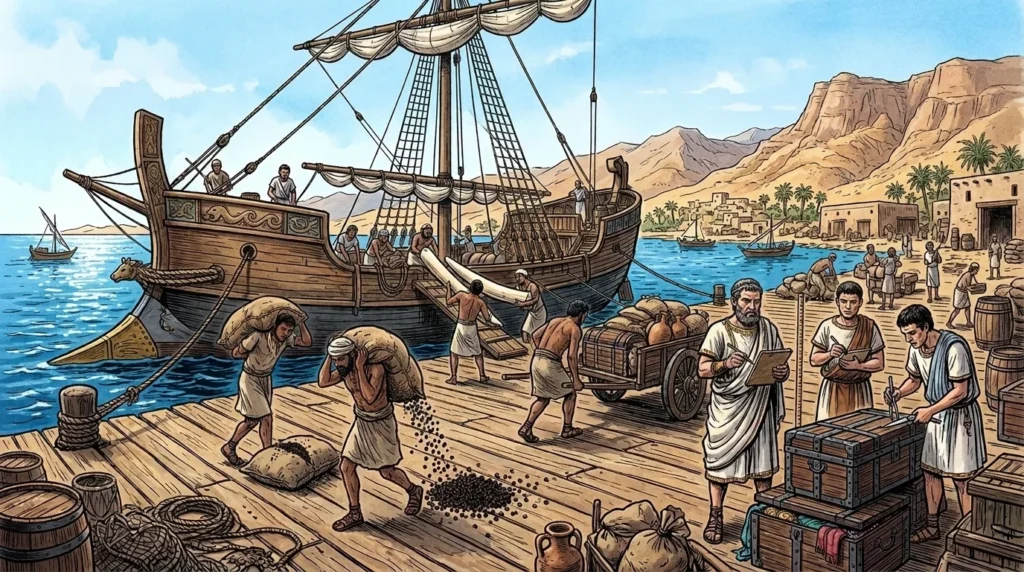
The overnight diversion of eastern Mediterranean shipping from Rhodes to duty-free Delos in 166 BCE encapsulates the commercial revolution of the middle and late Roman Republic (264–27 BCE). Between the outbreak of the First Punic War and the rise of Augustus, Rome conquered the entire Mediterranean basin while maintaining a strict legal taboo against senators engaging directly in large-scale maritime commerce. Codified in the Lex Claudia of 218 BCE, which banned Roman senators and their sons from owning seagoing vessels larger than 300 amphorae in capacity, that aristocratic restriction failed to halt elite profit-seeking. Instead, it spurred sophisticated corporate workarounds—immortalized by Cato the Elder’s 50-ship maritime lending syndicate—while Italian negotiatores at Delos and senatorial vineyard estates such as the Sestii of Cosa flooded the Mediterranean and pre-conquest Gaul with tens of millions of Dressel 1 wine amphorae in exchange for enslaved laborers and raw metals. [2]
The Lex Claudia of 218 BCE and the 300-Amphora Threshold
At the outbreak of the Second Punic War in 218 BCE, the plebeian tribune Quintus Claudius pushed through a landmark plebiscite—the Lex Claudia de nave senatorum—over the fierce opposition of the Roman Senate, where only a single senator, the populist reformer Gaius Flaminius, voted in its favor. As recorded by Livy in Book 21.63 of his Ab Urbe Condita, the statute prohibited any Roman senator, or the son of a senator, from owning a seagoing vessel (navis marinae) capable of carrying more than 300 amphorae. Since a standard Greco-Italic or Roman wine amphora held roughly 26 liters (one quadrantal) and weighed approximately 40 to 50 kilograms when filled with wine or olive oil, a 300-amphora ceiling restricted senatorial hulls to a deadweight cargo capacity of roughly 7 to 8 metric tons (about 12 to 15 tons displacement). [3]
In Livy’s explicit phrasing, a 300-amphora coastal coaster was deemed just large enough to transport the agricultural harvest of a senator’s own Italian country estates to Rome or a nearby river mouth, whereas all profit-seeking commercial shipping (quaestus) was declared unseemly (indecorus) for patrician and senatorial magistrates. By barring the ruling political class from owning deep-sea merchantmen—which routinely carried between 2,000 and 10,000 amphorae (100 to 450 metric tons)—the Lex Claudia aimed both to insulate Roman foreign policy from private shipping disputes and to prevent senators from competing with the rising equestrian order (equites) and public contractors (publicani) who provisioned Roman armies overseas. Despite periodic aristocratic complaints, the Claudian restriction remained binding statutory law right down to the late Republic, when Cicero invoked it in 70 BCE (In Verrem 2.5.45) to prosecute Gaius Verres for illegally building a massive cargo freighter at Messana through provincial extortion. [4]
Cato the Elder’s 50-Ship Maritime Syndicate
How did landowning Roman senators capture the extraordinary returns of second-century BCE Mediterranean shipping without violating the 300-amphora hull limit of the Lex Claudia? The most revealing answer survives in Chapter 21 of Plutarch’s biography of Marcus Porcius Cato (Cato the Elder, 234–149 BCE). In the opening preface of his treatise De Agricultura, Cato famously praised farming as the only wholly honorable vocation while dismissing maritime trade as mortally perilous (mercaturam,rem periculosam) and usury as dishonorable. Yet in his private financial ledger, Plutarch reports, Cato systematically shifted his capital away from weather-exposed agriculture into high-yield commercial assets—ponds, hot springs, fulling mills, pitch works, and, most lucratively of all, bottomry maritime loans (fenus nauticum). [5]
To eliminate both the legal liability of the Lex Claudia and the catastrophic risk of losing an entire loan to a single shipwreck, Cato engineered a diversified proto-corporate shipping syndicate:
- The 50-Partner Risk Pool: Cato required prospective maritime borrowers to form a commercial association (societas) comprising fifty separate partners operating fifty distinct merchant ships across the Mediterranean.
- The Freedman Proxy (Quintio): Rather than holding a partnership share or ship title in his own senatorial name, Cato took a single one-fiftieth equity and credit stake in the entire 50-ship venture through his trusted freedman agent, Quintio, who personally sailed aboard the vessels and supervised the commercial transactions of the borrowers.
- Diversified Maritime Insurance: Because bottomry loans in the ancient Mediterranean carried uncapped interest rates of 20 to 33 percent per voyage precisely because the principal was forgiven only if the ship sank, spreading his capital across fifty separate hulls ensured that Cato risked only 2 percent of his investment on any single vessel while collecting merchant-scale maritime yields across the fleet.
166 BCE: The Free Port of Delos and the Italian Negotiatores
Cato’s maritime syndicates operated in an eastern Mediterranean market transformed by the Roman Senate’s creation of the Free Port of Delos in 167/166 BCE. Located at the geographic center of the Cyclades, the tiny island of Delos had long been revered as the birthplace of Apollo and Artemis, housing a prestigious sanctuary bank and regional market. When the Senate expelled the native Delian population, handed the island to Athens as a cleruchy, and mandated complete exemption from import and export customs duties (ateleia), Delos immediately eclipsed Rhodes and Corinth (which Rome destroyed twenty years later in 146 BCE) to become the premier transshipment clearinghouse linking Italy with Syria, Ptolemaic Egypt, Asia Minor, and the Black Sea. [6]
Epigraphic records and archaeological excavations on Delos reveal that the primary beneficiaries of the duty-free regime were Roman and southern Italian merchants, bankers, and shipowners—collectively styled the Italici or Romaioi—including both freeborn citizens, equestrians, and hundreds of freedmen acting as commercial fronts for wealthy Roman families. Organizing themselves into powerful collegiate guilds aligned with patron deities—the Hermaistai (Mercury), Apolloniastai (Apollo), Poseidoniastai (Neptune), and Competaliastai—Italian merchants financed the sprawling Agora of the Italians (constructed around 110 BCE) alongside the waterfront warehouse district and the establishment of the Syrian merchant guild of the Poseidoniasts of Berytus (Beirut). [7]
As the geographer Strabo recorded in Book 14.5.2 of his Geography, the dominant commodity traded through duty-free Delos was human beings. Driven by the insatiable demand of Roman senatorial latifundia and mines in Italy and Sicily for enslaved agricultural and pastoral labor, Delos functioned as a high-speed human clearinghouse where Cilician pirates and eastern tax-collectors unloaded captives by the thousands. Strabo wrote that the Delian slave market could receive and sell off up to 10,000 enslaved people in a single day, inspiring the grim Greek merchant proverb: “Merchant, sail in, unload your ship, everything has been sold.” Only in 88 BCE, when King Mithridates VI of Pontus ordered his general Archelaus to sack Delos and massacre some 20,000 Italian residents, and again after a pirate raid in 69 BCE, did Delos lose its commercial supremacy to direct Italian ports such as Puteoli (Pozzuoli). [8]
The Sestii of Cosa and the Dressel 1 Amphora Trade with Gaul
While Delos funneled eastern luxuries and enslaved workers into Italy, a massive counter-trade flowed westward from the Tyrrhenian coast of Italy (Etruria, Latium, and Campania) into southern and central Gaul during the second and first centuries BCE. Here, too, Roman senatorial families circumvented the spirit of the Lex Claudia by integrating coastal villa vineyards, ceramic amphora kilns, and maritime shipping hubs. The most famous archaeological case study is the Portus Cosanus below the Latin colony of Cosa in coastal Etruria, operated by the aristocratic Sestius family (including Lucius Sestius and his son Publius Sestius, the Roman senator and tribune defended by Cicero in 56 BCE).
At the nearby villa of Settefinestre and the kiln works of Cosa, the Sestii and neighboring elite proprietors mass-produced wine packaged in heavy, thick-walled cylindrical transport jars classified by archaeologists as Dressel 1 amphorae (subdivided into Dressel 1A, 1B, and 1C, holding roughly 25 to 27 liters each). Stamped on their handles or rims with the family mark SES accompanied by nautical insignia such as a trident, anchor, palm branch, or five-rayed star, thousands of Sestius amphorae have been recovered from the early first-century BCE Grand Congloué shipwreck off Marseille (ancient Massalia) as well as across Gallic oppida from Toulouse and Bibracte to the Rhine frontier.
Quantitative underwater and terrestrial archaeology estimated by André Tchernia and modern researchers indicates that between circa 150 and 50 BCE, Italian producers exported between 40 million and 60 million Dressel 1 amphorae—representing well over 100,000 hectoliters of Italian wine every year—into Transalpine and Comate Gaul. Why did Roman merchants pump millions of gallons of Italian wine up the Rhône, Aude-Garonne, and Saône river corridors into independent Celtic territories before Julius Caesar’s conquest? The Greek historian Diodorus Siculus (5.26.3) recorded the staggering terms of trade: so prized was unmixed Italian wine among Gallic aristocratic feasts that Italian traders routinely exchanged a single Dressel 1 amphora of wine (worth a few silver sesterces at an Italian vineyard press) for one enslaved Gallic youth, turning the western wine trade and the eastern Free Port of Delos into twin engines of late Republican wealth accumulation.
Theoretical & Balance-Sheet Transmission Mechanism
In the Kindleberger–Minsky taxonomy of financial instability (Kindleberger, 1978; Minsky, 1986) and Irving Fisher’s (1933) debt-deflation framework, speculative asset booms become systemic crises when credit expansion shifts balance sheets from hedge finance (cash flows covering principal and interest) to speculative and Ponzi finance (relying on rising asset prices and short-term margin roll-overs).
Once monetary tightening or an exogenous shock halts price appreciation, forced margin liquidations trigger Fisherian debt-deflation: fire-sale asset discounts erode bank collateral values, contracting credit supply across the real economy.
Sources and Further Reading
- Polybius, “The Histories, Book 30.31: The Rhodian Embassy and the Free Port of Delos (trans. W. R. Paton),” Loeb Classical Library / LacusCurtius (University of Chicago), 1927. Peer-Reviewed / Academic Research
- Titus Livius (Livy), “The History of Rome (Ab Urbe Condita 21.63: The Lex Claudia of 218 BCE, trans. Canon Roberts),” Perseus Digital Library, 1912. Historical & Financial Reference
- Plutarch, “Life of Marcus Cato (Cato Major 21.5–8, trans. Bernadotte Perrin),” Loeb Classical Library / LacusCurtius (University of Chicago), 1914. Peer-Reviewed / Academic Research
- Strabo, “Geography, Book 14.5.2: The Slave Trade and Free Port of Delos (trans. Horace Leonard Jones),” Loeb Classical Library / LacusCurtius (University of Chicago), 1929. Peer-Reviewed / Academic Research
- Matthew Poux and Colin Haselgrove (eds.), “Dressel 1 Amphorae,” The Arverni and Roman Wine: Roman Amphorae from Late Iron Age Sites in the Auvergne (JSTOR / Archaeopress), 2014. Peer-Reviewed / Academic Research
- Peter Heather and Andrew Wallace-Hadrill, “Senators and Senates,” The Cambridge Ancient History (Cambridge University Press), 1997. Peer-Reviewed / Academic Research
- Irving Fisher — "The Debt-Deflation Theory of Great Depressions," Econometrica 1, no. 4 (FRASER Federal Reserve Archive, 1933): 337–357 Central Bank / Monetary Authority
- Charles P. Kindleberger & Robert Z. Aliber — Manias, Panics, and Crashes: A History of Financial Crises (Palgrave Macmillan) Peer-Reviewed / Academic Research
Cite This Historical Dossier (APA / Chicago)
APA (7th ed.): Ç., S. (Ed.). (2026). The Free Port of Delos (166 BCE), Cato's 50-Ship Syndicate, and Dressel 1 Wine Trade. In Forgotten Fortunes Historical Monograph Series (Forgotten Fortunes Editorial Desk). https://forgottenfortunes.net/delos-166-bce-free-port/
MLA (9th ed.): Ç., Soner, ed. "The Free Port of Delos (166 BCE), Cato's 50-Ship Syndicate, and Dressel 1 Wine Trade." Forgotten Fortunes: Financial & Monetary History Archive, 2026, https://forgottenfortunes.net/delos-166-bce-free-port/.
Chicago (17th ed.): Ç., Soner, ed. "The Free Port of Delos (166 BCE), Cato's 50-Ship Syndicate, and Dressel 1 Wine Trade." Forgotten Fortunes Historical Monograph Series (Forgotten Fortunes Editorial Desk), September 14, 2026. https://forgottenfortunes.net/delos-166-bce-free-port/.
Have an idea for another financial history documentary or article? Request a story →