In This Article
Around 150 BCE, the Greek historian Polybius of Megalopolis climbed the Capitoline Hill in Rome to inspect the archives housed inside the Treasury of the Aediles adjacent to the Temple of Jupiter Optimus Maximus. Engraved on archaic bronze tablets hanging in the sanctuary, Polybius transcribed a document that overturned later nationalist myths portraying early Rome as an isolated community of subsistence shepherds: a formal commercial and maritime treaty concluded between the newborn Roman Republic and the mercantile empire of Carthage in the first year of the consuls Lucius Junius Brutus and Marcus Horatius (traditionally 509 BCE, twenty-eight years before Xerxes invaded Greece). So ancient was the Old Latin phrasing on the bronze plaques, Polybius noted in Book 3.22 of his Histories, that even the most learned Roman antiquarians of the second century BCE could barely decipher its clauses without careful philological study. Modern historians debate whether the treaty should be dated to 509 BCE or assigned to a later period; Polybius’s date is the ancient tradition, not a universally settled fact. [1]

Together with a second Romano-Carthaginian treaty ratified in 348 BCE (Polybius 3.24; Livy 7.27.2), the Capitoline tablets reveal how early Republican Rome (509–264 BCE) functioned as a strategic commercial hinge between the Etruscan north, the Latin plain, the Apennine pastoral interior, and the Greek and Punic maritime networks of the western Mediterranean. Long before Rome launched its first war fleets in the third century BCE, the city’s prosperity rested on three interconnected economic foundations: control of the lowest fordable crossing of the Tiber River at the Forum Boarium and Tiber Island, monopolization of the coastal salt pans (Salinae) at the river’s mouth feeding the overland Via Salaria, and the fourth-century BCE construction of the fortified port colony at Ostia and the Via Appia highway to Magna Graecia. [2]
The Capitoline Bronze Tablets: The First Treaty of 509 BCE
In the late sixth century BCE, following the expulsion of the Tarquin kings and the dedication of the monumental Capitoline Temple, the fledgling Roman Republic sought immediate diplomatic and commercial recognition from Carthage, whose naval squadrons patrolled the Tyrrhenian Basin alongside Etruscan city-states such as Caere (whose ruler Thefarie Velianas left the famous bilingual Punic-Etruscan gold tablets at Pyrgi around 500 BCE). In Polybius’s account (3.22.4–13), the treaty conventionally dated to 509 BCE established geographic zones of navigation and innovative legal guarantees for cross-cultural trade: [3]
- The Fair Promontory Boundary: Romans and their Latin allies were forbidden to sail in long warships—or for raiding and unmonitored trade—beyond the “Fair Promontory” (Kalon Akroterion, modern Cape Farina or Cape Bon protecting the Gulf of Tunis and the Carthaginian heartland), unless driven past the headland by a storm or hostile ships.
- Emergency Force Majeure Rules: Any Roman crew blown past the Fair Promontory by tempest or enemies was forbidden to purchase or requisition anything ashore except timber, rigging, and provisions strictly required for ship repair or religious sacrifice, and was legally obligated to depart within five days.
- State-Backed Payment Guarantees in Libya and Sardinia: Roman merchants arriving for peaceful commerce in Carthaginian-controlled Libya (North Africa) or Sardinia could conclude binding sales only in the official presence of a state herald (keryx) or town clerk (grammateus). Once a transaction was recorded before the herald or scribe, the Carthaginian state itself guaranteed the price owed to the seller under public faith (demosia pistis)—an extraordinary early mechanism of sovereign commercial credit insurance bridging traders who spoke neither the same language nor shared domestic courts.
- Equal Rights in Western Sicily: In the Carthaginian-administered province of western Sicily, by contrast, Roman merchants enjoyed complete parity of commercial and legal rights with Carthaginian citizens. In return, Carthage pledged not to injure the coastal Latin communities of Ardea, Antium, Lavinium, Circeii, and Tarracina, nor any unsubjugated Latin town, and to hand back intact any Latin city captured in war rather than building fortifications inside Latium.
Tiber Island, the Forum Boarium, and the Sant’Omobono Emporium
Why did sixth-century Carthage negotiate commercial credit guarantees with Rome? Geography made Rome the indispensable customs house of central Italy. Roughly twenty-five kilometers upstream from the Tyrrhenian Sea, volcanic tufa hills converged on a shallow island in the middle of the Tiber River (Insula Tiberina). This island marked the exact intersection of two major transport corridors: it was the lowest natural ford and bridgehead linking Etruria in the north to Latium and Campania in the south, and simultaneously the highest point on the Tiber reachable by shallow-draft seagoing cargo vessels and river barges.
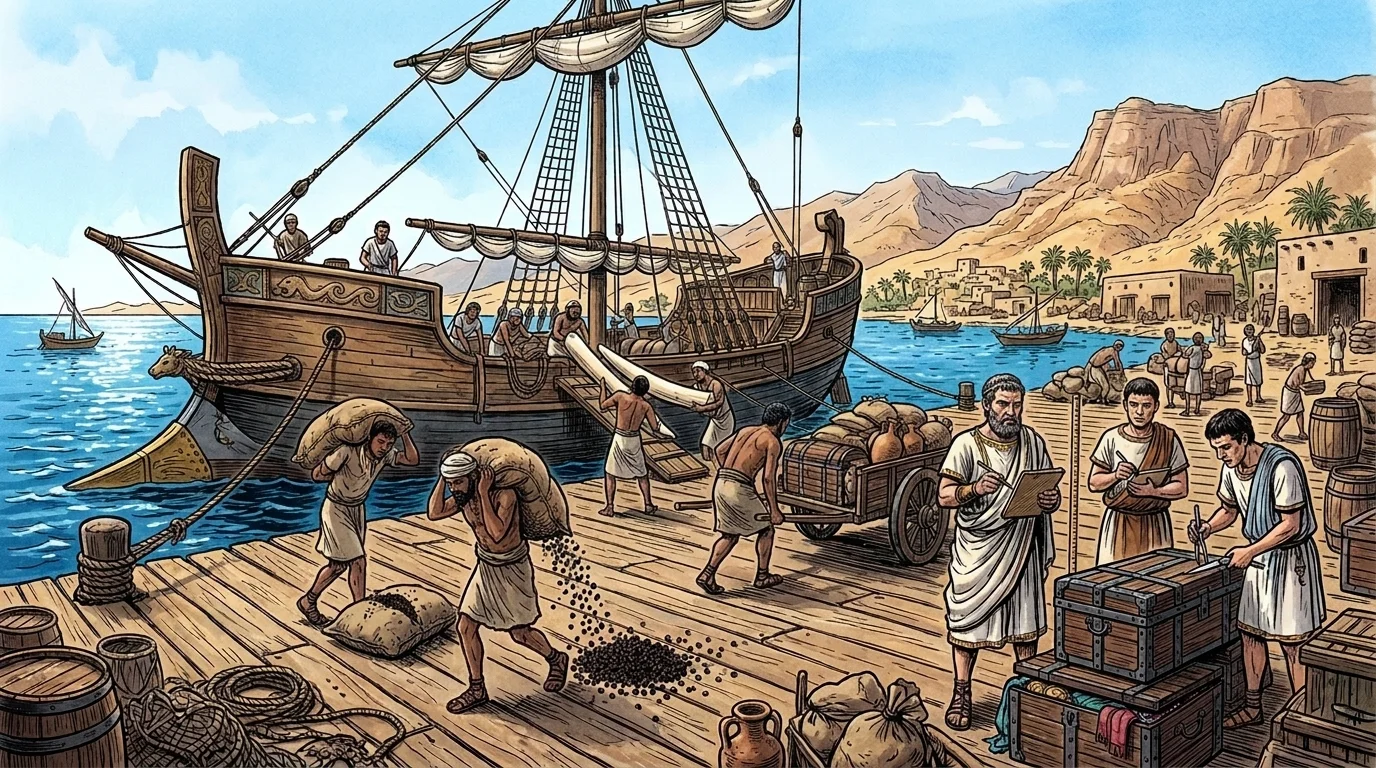
Immediately downstream from Tiber Island, nestled in the low valley between the Capitoline, Palatine, and Aventine hills, lay the Portus Tiberinus (Rome’s river harbor) and the Forum Boarium, the city’s ancient cattle and commodity market, flanked by the Forum Holitorium vegetable market. Here, linked to the venerable cult of the Great Altar of Hercules Invictus (Ara Maxima)—mythologized as the site where Hercules slew the cattle-thief Cacus and established a tithe market for merchants—foreign traders unloaded imported Aegean and Attic pottery, Phoenician glass, Etruscan bronzes, and Sicilian grain under the sacral protection of riverine sanctuaries. Archaeological excavations at the adjacent archaic sanctuary of Fortuna and Mater Matuta at Sant’Omobono have uncovered thousands of sixth- and fifth-century BCE Greek, Etruscan, Laconian, and Ionian ceramic sherds alongside bronze weigh-scale balances and incised ivory hospitality tokens (tesserae hospitales) enabling foreign merchants to claim legal protection in Rome.
White Gold: The Salinae Romanae and the Via Salaria
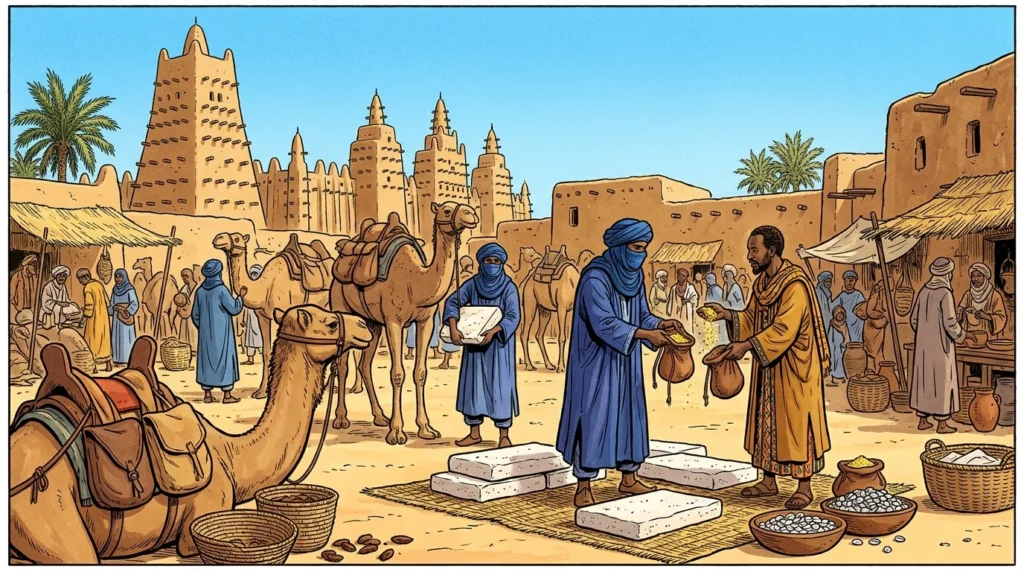
If the Tiber crossing made Rome a natural toll station, the salt marshes at the mouth of the river provided its earliest export commodity. In an era before refrigeration, pastoral tribes across the Sabine hills and the central Apennine mountains depended on massive quantities of marine salt to preserve meat, cure hides, make sheep and cattle cheese, and sustain livestock herds during seasonal transhumance. According to Roman historical tradition preserved by Livy (1.33.9) and Pliny the Elder (Natural History 31.89), already under the regal period associated with Ancus Marcius, Rome seized control of the coastal lagoons on the Tiber delta, engineering evaporation ponds known as the Salinae Romanae. [4]
From the coastal pans, salt was barged upstream to the Salinae warehouse district beside the Porta Trigemina and the southern edge of the Forum Boarium, and then hauled northeast through the Porta Collina along Italy’s oldest commodity highway: the Via Salaria (“Salt Road”), running up the Tiber valley to Reate and across the Apennines toward the Adriatic. So vital was salt to early Republican state finance that when the fledgling Republic faced the siege of the Etruscan king Lars Porsenna around 508 BCE, Livy (2.9.6), writing centuries later, reports that the Senate transferred the right to sell salt from private dealers to public control during the Porsenna crisis. The reported measure is not evidence by itself of an enduring, fully administered salt monopoly or fixed subsidized prices. Control of the Via Salaria allowed Roman merchants to exchange coastal salt and imported Mediterranean metalwork for Sabine cattle, wool, and timber arriving directly in the Forum Boarium. [5]
Fifth-Century Grain Crises and the Second Punic Treaty (348 BCE)
During the fifth century BCE, recurrent wars with the Volsci, Aequi, and Etruscan Veii periodically disrupted local agriculture and drove Rome to rely on emergency maritime grain imports managed through the river port. Recording severe famines in 492–491 BCE, 440–439 BCE, and 411 BCE, Livy describes how Roman envoys sailed with state funds to purchase grain from Etruria, the Pomptine marshes, Cumae on the Bay of Naples, and Greek Syracuse in Sicily. In 440 BCE, the crisis grew so acute that the Senate appointed Lucius Minucius as an extraordinary Prefect of the Grain Supply (Praefectus Annonae), while the wealthy equestrian Spurius Maelius used his private fortune to buy up Etruscan grain through guest-friends and distribute it below market cost—an act of populist patronage that led the patrician establishment to execute him on charges of aspiring to royal tyranny. [6]
Following Rome’s capture of the rival Etruscan city of Veii in 396 BCE and its recovery from the Gallic sack of 390 BCE, the Republic’s commercial footprint expanded rapidly down the Tyrrhenian coast. In 348 BCE, Carthaginian envoys returned to Rome to sign a second formal treaty (Polybius 3.24). Reflecting Carthaginian determination to tighten its western commercial monopoly while acknowledging Rome’s growing regional power, the 348 BCE pact added a second maritime boundary at Mastia and Tarseum near Cartagena in southern Spain, barred Roman merchants from trading or founding settlements in Sardinia and North Africa altogether (except for five-day storm refits), and reaffirmed full reciprocal commercial rights for Roman traders in Carthaginian Sicily and inside the city of Carthage itself. [7]
Ostia’s Castrum, the Via Appia, and the Minting of Bronze and Silver
To protect the mouth of the Tiber and the Salinae from Greek and Etruscan corsairs during this fourth-century commercial resurgence, the Roman Republic constructed a permanent fortified maritime colony at Ostia (Ostia Antica). While Roman literary tradition attributed a proto-settlement at Ostia to King Ancus Marcius, stratigraphic archaeology of the rectangular tufa-walled Castrum at Ostia dates the military fortress—measuring roughly 194 by 125 meters—to the mid-fourth century BCE (circa 380–350 BCE). Ostia served simultaneously as a coastal naval station and as the transshipment staging port where deep-sea merchantmen transferred bulk cargoes onto river boats (naves caudicariae) towed upstream to the Forum Boarium. [8]
By the late fourth century BCE, Rome linked its Tiber emporium directly to the wealthy Greek commercial cities of Campania and Magna Graecia. In 312 BCE, the censor Appius Claudius Caecus initiated construction of the stone-paved Via Appia stretching south from Rome through Tarracina to Capua, while Rome established a network of coastal citizen colonies (coloniae maritimae) at Antium (338 BCE), Tarracina (329 BCE), and Minturnae (295 BCE). As trade with Greek southern Italy intensified, Rome moved beyond the archaic bronze weight-bars (aes rude and aes signatum) and heavy cast bronze aes grave coinage used in the Forum Boarium cattle trade: around 300–280 BCE, the Republic issued its first struck Romano-Campanian silver didrachms inscribed ROMANO, preparing its financial system for the Mediterranean-wide struggle with Carthage that erupted in 264 BCE. [9]
Theoretical & Balance-Sheet Transmission Mechanism
In the Kindleberger–Minsky taxonomy of financial instability (Kindleberger, 1978; Minsky, 1986) and Irving Fisher’s (1933) debt-deflation framework, speculative asset booms become systemic crises when credit expansion shifts balance sheets from hedge finance (cash flows covering principal and interest) to speculative and Ponzi finance (relying on rising asset prices and short-term margin roll-overs).
Once monetary tightening or an exogenous shock halts price appreciation, forced margin liquidations trigger Fisherian debt-deflation: fire-sale asset discounts erode bank collateral values, contracting credit supply across the real economy.
Sources and Further Reading
- Polybius, “ The Histories, Book 3.22–26: The Treaties Between Rome and Carthage (trans. W. R. Paton),” Loeb Classical Library / LacusCurtius (University of Chicago), 1922. Peer-Reviewed / Academic Research
- Titus Livius (Livy), “ The History of Rome (Ab Urbe Condita 1.33, trans. Benjamin Oliver Foster),” Perseus Digital Library / Harvard University Press, 1919. Peer-Reviewed / Academic Research
- Arthur M. Eckstein, “ Polybius, ‘The Treaty of Philinus’, and Roman Accusations Against Carthage,” The Classical Quarterly (Cambridge University Press), 2010. Peer-Reviewed / Academic Research
- Daniel Damgaard, “ Traces of Early Ostia: In Search of the Archaic Settlement,” Ad Ostium Tiberis (JSTOR / Aarhus University Press), 2022. Peer-Reviewed / Academic Research
- Philippe Fleury and Sophie Madeleine, “ Forum Boarium,” La Rome antique: Plan relief et reconstitution virtuelle (Presses universitaires de Caen / OpenEdition Books), 2024. Historical & Financial Reference
- Barthold Georg Niebuhr, “ The Beginning of the Republic and the Treaty with Carthage,” The History of Rome (Cambridge University Press), 2010. Peer-Reviewed / Academic Research
- R. L. Beaumont, “The Date of the First Treaty Between Rome and Carthage,” The Journal of Roman Studies, Cambridge University Press, 1939. https://www.cambridge.org/core/journals/journal-of-roman-studies/article/abs/date-of-the-first-treaty-between-rome-and-carthage1/95E5CEC19C4429BA03556D14796249E5 Peer-Reviewed / Academic Research
- Irving Fisher — "The Debt-Deflation Theory of Great Depressions," Econometrica 1, no. 4 (FRASER Federal Reserve Archive, 1933): 337–357 Central Bank / Monetary Authority
- Charles P. Kindleberger & Robert Z. Aliber — Manias, Panics, and Crashes: A History of Financial Crises (Palgrave Macmillan) Peer-Reviewed / Academic Research
Cite This Historical Dossier (APA / Chicago)
APA (7th ed.): Ç., S. (Ed.). (2026). The 509 BCE Rome-Carthage Treaty, the Via Salaria Salt Trade, and Forum Boarium. In Forgotten Fortunes Historical Monograph Series (Forgotten Fortunes Editorial Desk). https://forgottenfortunes.net/rome-carthage-treaty-509-bce/
MLA (9th ed.): Ç., Soner, ed. "The 509 BCE Rome-Carthage Treaty, the Via Salaria Salt Trade, and Forum Boarium." Forgotten Fortunes: Financial & Monetary History Archive, 2026, https://forgottenfortunes.net/rome-carthage-treaty-509-bce/.
Chicago (17th ed.): Ç., Soner, ed. "The 509 BCE Rome-Carthage Treaty, the Via Salaria Salt Trade, and Forum Boarium." Forgotten Fortunes Historical Monograph Series (Forgotten Fortunes Editorial Desk), September 14, 2026. https://forgottenfortunes.net/rome-carthage-treaty-509-bce/.
Have an idea for another financial history documentary or article? Request a story →