In This Article
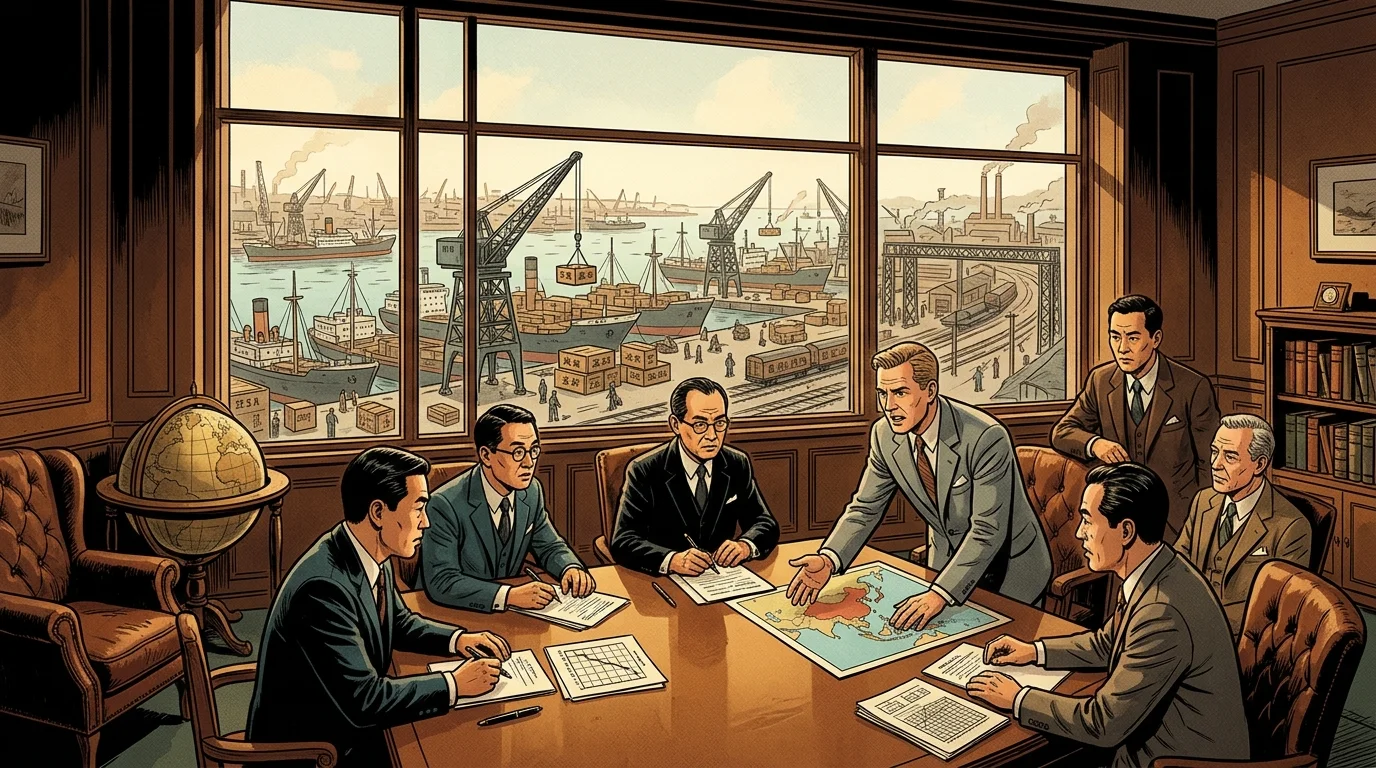
On April 25, 1949, Supreme Commander for the Allied Powers (SCAP) authorities in occupied Tokyo abolished Japan’s tangled web of multiple commodity exchange rates and fixed the value of the Japanese yen at exactly 360 per U.S. dollar. Engineered by Detroit commercial banker Joseph M. Dodge under the stabilization program known as the Dodge Line, the single exchange parity accompanied a draconian fiscal overhaul that eliminated deficit spending, phased out industrial price subsidies, and halted inflationary lending by the state-run Reconstruction Finance Bank (Fukkō Kin’yū Kinko). What began as an emergency anti-inflation shock therapy endured for more than two decades as the monetary cornerstone of Japan’s postwar economic miracle—until President Richard Nixon suspended U.S. dollar convertibility into gold on August 15, 1971, shattering the Bretton Woods parity and forcing the yen toward a new floating regime. [1]

Postwar Devastation and Reconstruction Finance Bank Hyperinflation (1945–1948)
When World War II ended in August 1945, Japan’s industrial capacity lay in ruins, its merchant marine was largely destroyed, and large overhangs of wartime purchasing power chased severe shortages of food, coal, and raw materials. An early currency conversion and deposit freeze in February 1946 provided only fleeting relief. Determined to revive physical output before stabilizing the price level, Prime Minister Shigeru Yoshida’s first administration and Finance Minister Tanzan Ishibashi embraced the “Priority Production System” (Keisha Seisan Hōshiki), designed by economist Hiromi Arisawa. Under this strategy, scarce imported fuel oil was directed into coal mining, increased coal output was channeled to steel mills, and domestic steel was fed back into coal mines and infrastructure. [2]
To finance this industrial revival without adequate tax revenues or private capital markets, the government established the Reconstruction Finance Bank (RFB, or Fukkin) in January 1947. Over the next two years, the RFB served as the primary credit engine for Japan’s coal, electric power, fertilizer, iron, and shipping conglomerates, supplying roughly one-third of all industrial equipment funding in the country. Because private banks could not absorb the vast volume of RFB debentures (*Fukkin債*), the Bank of Japan underwrote roughly 70 to 80 percent of these bonds directly by printing banknotes. Coupled with massive price-differential subsidies paid out of the national budget to keep basic industrial inputs artificially cheap, this monetary monetization fueled runaway “Fukkin inflation.” Between 1945 and early 1949, Tokyo wholesale prices multiplied more than seventy-fold, eroding real wages and distorting foreign trade through an unwieldy multiple exchange-rate system in which yen conversion ratios ranged from less than ¥100 to over ¥600 per dollar depending on the specific imported or exported commodity. [3]
| Documented Figure / Metric | Historical Significance & Archival Context |
|---|---|
| $2 billion | From 1968 onward, Japan recorded persistent, expanding current-account surpluses even during domestic economic expansions, swelling the Bank of Japan's official foreign-exchange reserves from roughly $2 billion in 1967 to $7.9 billion by mid-1971. |
| $35 | By the summer of 1971, the United States faced deteriorating trade balances, Vietnam War fiscal pressures, and accelerating gold outflows as European central banks converted excess dollars into bullion at the official $35-per-ounce parity. |
| 10 percent | Nixon unilaterally suspended the convertibility of the U.S. dollar into gold, imposed an immediate 10 percent temporary surcharge on dutiable imports into the United States, and froze domestic wages and prices for 90 days. |
Joseph Dodge and the Nine-Point Stabilization Directive (1949)
As Cold War tensions intensified in East Asia in 1948, policymakers in Washington concluded that a chronically inflationary Japan dependent on hundreds of millions of dollars in annual U.S. GARIOA (Government Account for Relief in Occupied Areas) and EROA (Economic Rehabilitation in Occupied Areas) subsidies was geopolitically unsustainable. In December 1948, the U.S. government issued the Nine-Point Economic Stabilization Directive to General Douglas MacArthur, demanding immediate fiscal balance, wage and price discipline, tighter credit control, and the rapid establishment of a single unified exchange rate. To enforce the directive, President Harry S. Truman dispatched Joseph M. Dodge—president of the Detroit Bank and previously the architect of the 1948 West German currency reform—to Tokyo with the rank of minister and financial adviser to SCAP. [4]
Arriving in Yokohama in February 1949, Dodge famously diagnosed the Japanese economy as walking on “two stilts”: one leg consisting of domestic government price subsidies, and the other consisting of American foreign aid. If the stilts grew any taller, Dodge warned, the Japanese economy would break its neck when it finally stepped down onto solid market ground. Working closely with Japan’s newly appointed Finance Minister Hayato Ikeda, Dodge rejected gradualist anti-inflation proposals and drafted an uncompromising fiscal blueprint for fiscal year 1949. [5]
The core of the Dodge Line was a “super-balanced budget” encompassing not only the General Account, Special Accounts, and local governments, but also state corporations and government agencies. Rather than merely balancing revenues and expenditures, the FY1949 consolidated budget generated a net fiscal surplus used to retire outstanding government debt held by the Bank of Japan. Dodge simultaneously ordered the immediate suspension of new lending by the Reconstruction Finance Bank in spring 1949, cutting off the tap of central-bank-financed industrial credit, and established the U.S. Aid Counterpart Fund Special Account so that the yen proceeds from selling American aid imports were tightly sequestered for debt redemption and approved infrastructure projects rather than routine deficit spending. [6]
Fixing the Single Exchange Rate at ¥360 per U.S. Dollar
With domestic money creation curtailed, Dodge moved to replace Japan’s multiple commodity conversion ratios—the Price Ratio System that had insulated inefficient domestic producers from international prices—with a single fixed exchange rate. SCAP economists and Japanese Ministry of Finance officials debated parity levels ranging from ¥300 to ¥400 per dollar. While some ministries favored ¥330 to keep food and raw material imports cheap, Dodge insisted on a rate slightly undervalued enough to compel Japanese manufacturers to rationalize costs while remaining viable in export markets without state subsidies. [7]
On April 25, 1949, SCAP Directive (SCAPIN-1997) officially established the unified exchange rate of ¥360 per U.S. dollar. Five months later, when the British pound sterling was devalued by 30.5 percent from $4.03 to $2.80 in September 1949, Japanese exporters and officials lobbied intensely to devalue the yen in tandem to protect sterling-area textile sales. Dodge flatly refused, insisting that Japanese industry absorb the competitive shock through higher productivity and cost reductions rather than currency depreciation. When Japan formally joined the International Monetary Fund and the World Bank in August 1952, the ¥360 parity—equivalent to 2.46853 milligrams of fine gold per yen under the Bretton Woods adjustable-peg system, with an allowed fluctuation band of 1 percent on either side—became Japan’s binding international commitment. [8]
From the Dodge Deflation to the High-Growth Export Miracle (1950–1969)
In the immediate aftermath of the 1949 stabilization, the combination of fiscal surpluses, tight credit, and the sterling devaluation plunged Japan into a severe stabilization downturn known as the “Dodge deflation.” Consumer and black-market inflation evaporated almost overnight, thousands of small and medium-sized enterprises went bankrupt, and major corporations carried out mass layoffs that sparked militant labor disputes across the railway and manufacturing sectors. Yet the deflationary squeeze ended abruptly on June 25, 1950, with the outbreak of the Korean War. Massive U.S. military “special procurements” (tokuju) for trucks, textiles, steel, ammunition, and repair services—totaling roughly $800 million annually at their peak—acted as an external demand windfall that cleared inventories, restored corporate profitability, and allowed Japanese manufacturers to import modern Western machinery.
Throughout the 1950s and early 1960s, the ¥360 parity served as a strict macroeconomic discipline known as the “balance-of-payments ceiling.” Whenever domestic investment booms caused imports of raw materials and capital goods to surge and Japan’s foreign-exchange reserves to dip toward the danger threshold of $500 million to $1 billion, the Bank of Japan raised its official discount rate and tightened “window guidance” (madoguchi shidō) credit quotas on city banks. This swift monetary braking cooled domestic demand, curbed imports, and restored trade surpluses without ever altering the ¥360 exchange rate. After Japan accepted IMF Article VIII current-account convertibility and joined the OECD in 1964, however, the dynamic shifted fundamentally. Powered by modern steel complexes, shipyards, electronics plants, and automobile factories, Japanese labor productivity grew far faster than in the United States, turning the ¥360 rate into an increasingly undervalued export springboard. From 1968 onward, Japan recorded persistent, expanding current-account surpluses even during domestic economic expansions, swelling the Bank of Japan’s official foreign-exchange reserves from roughly $2 billion in 1967 to $7.9 billion by mid-1971.
The August 1971 Nixon Shock and the Smithsonian Revaluation
By the summer of 1971, the United States faced deteriorating trade balances, Vietnam War fiscal pressures, and accelerating gold outflows as European central banks converted excess dollars into bullion at the official $35-per-ounce parity. In Tokyo, Prime Minister Eisaku Satō’s cabinet and the Ministry of Finance launched the “Eight-Point Program to Avoid Yen Revaluation” in June 1971, terrified that upvaluing the currency would inflict a devastating recession on export industries on par with the 1930 gold-embargo depression.
On the evening of August 15, 1971 (August 16 in Tokyo), U.S. President Richard Nixon went on national television from Camp David to announce his New Economic Policy—remembered in Japan as the “Nixon Shock” (Nikuson Shokku). Nixon unilaterally suspended the convertibility of the U.S. dollar into gold, imposed an immediate 10 percent temporary surcharge on dutiable imports into the United States, and froze domestic wages and prices for 90 days. Explicitly aimed at forcing West Germany and Japan to revalue their undervalued currencies, the announcement threw global currency markets into turmoil. While major Western European governments immediately closed their foreign-exchange markets on Monday, August 16, Japanese financial authorities kept the Tokyo foreign-exchange market open at the old ¥360 parity.
Over an extraordinary eleven-day span from August 16 to August 27, 1971, Japanese trading houses (sōgō shōsha) and commercial banks dumped dollars en masse to hedge export receivables. Standing alone as buyer of last resort to defend the ceiling of the ¥360 band, the Bank of Japan purchased approximately $4 billion—including $1.2 billion on August 27 alone—nearly doubling Japan’s official reserves to $12.5 billion before finally capitulating and allowing the yen to enter a managed float on August 28, 1971. Four months later, at the Group of Ten (G10) conference at the Smithsonian Institution in Washington, D.C., on December 18, 1971, Finance Minister Mikio Mizuta agreed to revalue the yen to a new central rate of ¥308 per U.S. dollar—a 16.88 percent appreciation, the largest upward adjustment among major industrial nations—within a widened ±2.25 percent fluctuation band. When the Smithsonian parities themselves collapsed under renewed speculative dollar selling in February 1973, Japan permanently abandoned fixed exchange rates, bringing the monetary architecture forged by Joseph Dodge to its definitive close while leaving behind the domestic liquidity overhang that fueled the great Japanese inflation of 1973–1974.
Theoretical & Balance-Sheet Transmission Mechanism
In the Kindleberger–Minsky taxonomy of financial instability (Kindleberger, 1978; Minsky, 1986) and Irving Fisher’s (1933) debt-deflation framework, speculative asset booms become systemic crises when credit expansion shifts balance sheets from hedge finance (cash flows covering principal and interest) to speculative and Ponzi finance (relying on rising asset prices and short-term margin roll-overs).
Once monetary tightening or an exogenous shock halts price appreciation, forced margin liquidations trigger Fisherian debt-deflation: fire-sale asset discounts erode bank collateral values, contracting credit supply across the real economy.
Sources and Further Reading
- U.S. Department of State, Office of the Historian, “ Nixon and the End of the Bretton Woods System, 1971–1973,” Milestones in the History of U.S. Foreign Relations. Official / State Archive
- Douglas A. Irwin, “ The Nixon Shock After Forty Years: The Import Surcharge Revisited,” National Bureau of Economic Research Working Paper No. 17749, 2012. Peer-Reviewed / Academic Research
- Kumiko Okazaki, Masazumi Hattori, and Wataru Takahashi, “ The Challenges Confronting the Banking System: An Analysis in Light of Japan’s Experience of Financial Liberalization,” Bank of Japan Institute for Monetary and Economic Studies Discussion Paper No. 2011-E-6, 2011. Central Bank / Monetary Authority
- Barry Eichengreen and Mariko Hatase, “ Can a Rapidly-Growing Export-Oriented Economy Smoothly Exit an Exchange Rate Peg? Lessons for China from Japan’s High-Growth Era,” National Bureau of Economic Research Working Paper No. 11625, 2005. Peer-Reviewed / Academic Research
- Tsutomu Yokose and Cheickna Sangare, “ Post-WWII Reconstruction and Economic Growth in Japan,” Japan International Cooperation Agency (JICA) and International University of Japan, 2022. Historical & Financial Reference
- Takatoshi Ito and V. Vance Roley, “ News from the U.S. and Japan: Which Moves the Yen/Dollar Exchange Rate?,” National Bureau of Economic Research Working Paper No. 1853, 1986. Peer-Reviewed / Academic Research
- Irving Fisher — "The Debt-Deflation Theory of Great Depressions," Econometrica 1, no. 4 (FRASER Federal Reserve Archive, 1933): 337–357 Central Bank / Monetary Authority
- Charles P. Kindleberger & Robert Z. Aliber — Manias, Panics, and Crashes: A History of Financial Crises (Palgrave Macmillan) Peer-Reviewed / Academic Research
Cite This Historical Dossier (APA / Chicago)
APA (7th ed.): Ç., S. (Ed.). (2026). The Dodge Line and the 360-Yen Peg: How Postwar Stabilization Built Japan's Export Era. In Forgotten Fortunes Historical Monograph Series (Forgotten Fortunes Editorial Desk). https://forgottenfortunes.net/dodge-line-360-yen-peg-nixon-shock/
MLA (9th ed.): Ç., Soner, ed. "The Dodge Line and the 360-Yen Peg: How Postwar Stabilization Built Japan's Export Era." Forgotten Fortunes: Financial & Monetary History Archive, 2026, https://forgottenfortunes.net/dodge-line-360-yen-peg-nixon-shock/.
Chicago (17th ed.): Ç., Soner, ed. "The Dodge Line and the 360-Yen Peg: How Postwar Stabilization Built Japan's Export Era." Forgotten Fortunes Historical Monograph Series (Forgotten Fortunes Editorial Desk), September 11, 2026. https://forgottenfortunes.net/dodge-line-360-yen-peg-nixon-shock/.
Have an idea for another financial history documentary or article? Request a story →