In This Article
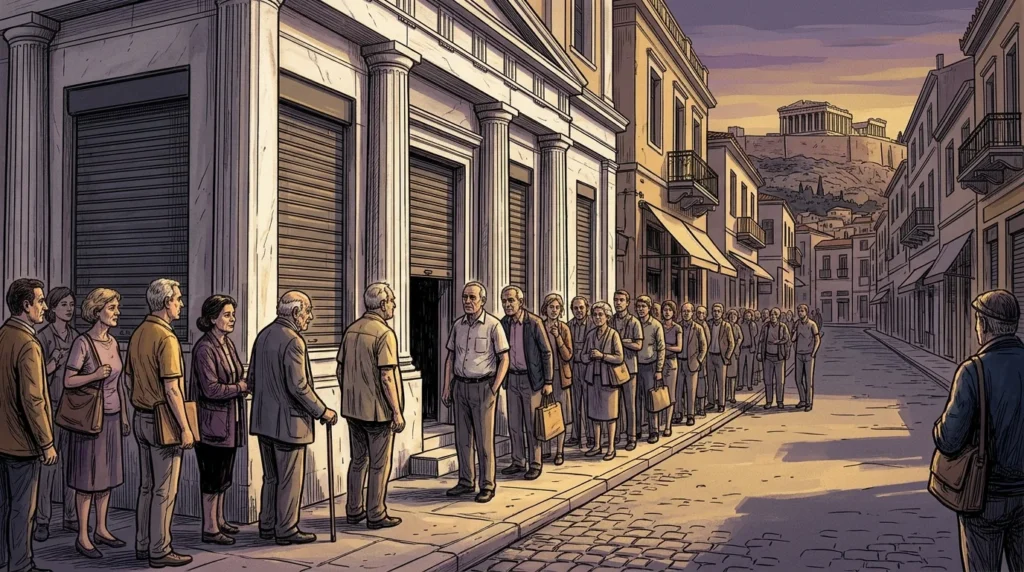
For four decades after the Second World War, the Greek banking system operated under one of the most centralized credit regimes in Western Europe. Devastated by the 1941–1944 Axis occupation hyperinflation that obliterated prewar drachma savings and bank balance sheets, Greece established the supranational-style Currency Committee (Nomismatiki Epitropi) in January 1946 to ration every drachma of credit and rebuild depositor confidence. Once Minister of Coordination Spyros Markezinis executed a 50 percent devaluation of the drachma on April 9, 1953—moving the exchange rate from 15,000 to 30,000 drachmas per US dollar and preparing the 1954 1,000-to-1 currency reform—households gradually returned their gold sovereigns to commercial banks. Under the Currency Committee’s rule until 1982, the National Bank of Greece and the Commercial Bank of Greece functioned as state-directed conduits channeling subsidized funds into manufacturing, agriculture, and shipping. Yet when Greece abolished the Currency Committee in 1982 without constructing modern independent prudential supervision, regulatory blind spots enabled financier George Koskotas to acquire the Bank of Crete (Trapeza Kritis) and embezzle more than 30 billion drachmas ($210 million), triggering the most severe banking and political crisis in post-1974 Greece. [1]
The Post-Hyperinflation Trauma and the Creation of the Currency Committee (1946)
The institutional design of postwar Greek banking was born directly out of monetary collapse. During the Axis occupation of 1941–1944, rampant money printing to pay occupation costs and finance fiscal deficits caused prices in Athens to double every few days, culminating in the November 1944 stabilization under which one new drachma replaced 50 billion wartime drachmas. The hyperinflation wiped out liquid drachma deposits across the entire commercial banking network and ingrained a deep structural habit among Greek households and merchants: hoarding British gold sovereigns (chryses lires) as the sole trusted store of value and unit of account for real estate and commercial contracts. [2]
To halt recurring inflation during the Greek Civil War (1946–1949) and ensure that international reconstruction aid was not squandered, the Greek government enacted Law 1015/1946 in January 1946 following the Anglo-Greek London Financial Agreement. This statute created the Currency Committee (Nomismatiki Epitropi), headquartered inside the Bank of Greece. Chaired by the Minister of Coordination and including the Minister of Finance, the Governor of the Bank of Greece, and—during its formative years—one British and one American financial expert holding veto power through a unanimity rule, the Currency Committee was initially conceived as an emergency stabilization board with an 18-to-24-month lifespan. [3]
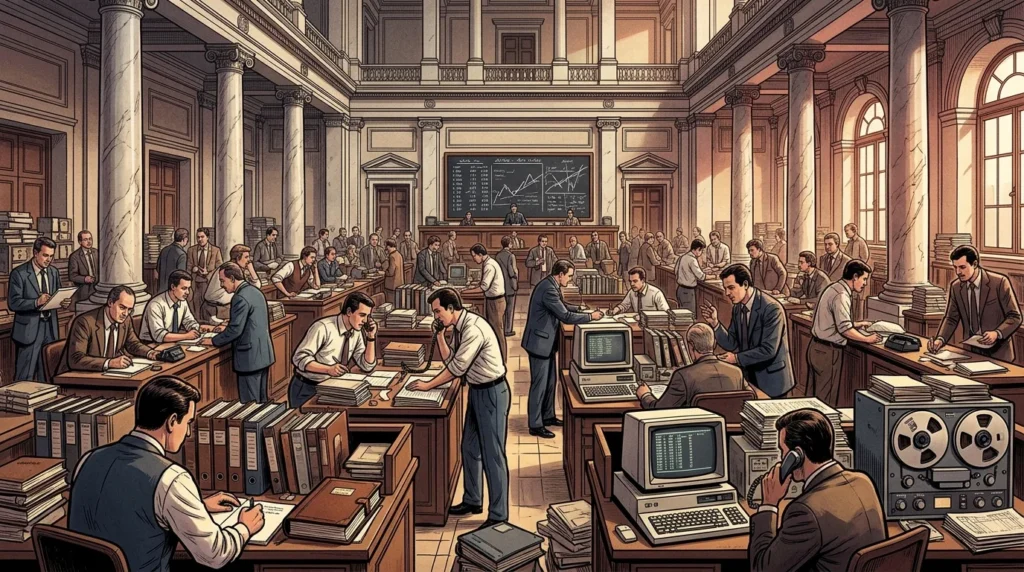
Instead, under Legislative Decree 588/1948 and subsequent extensions, the Currency Committee became the permanent supreme monetary and credit authority of Greece for 36 years. Rather than relying on indirect central bank discount-rate adjustments, the Committee exercised direct administrative command over the money supply, foreign exchange allocations, bank reserve requirements, and the exact interest rates paid on deposits and charged on every category of loan. [4]
Spyros Markezinis’s April 9, 1953 Devaluation and the 1954 New Drachma
During its first seven years, the Currency Committee struggled to revive commercial bank deposits because chronic balance-of-payments deficits and overvalued multiple exchange rates fueled devaluation expectations. Following the November 1952 landslide election victory of Field Marshal Alexandros Papagos’s Greek Rally party, Minister of Coordination Spyros Markezinis engineered a decisive macroeconomic shock to restore external competitiveness and end the gold-hoarding paralysis. [5]
On the evening of April 9, 1953, with the backing of the Bank of Greece, the Currency Committee, and the International Monetary Fund, Markezinis announced an immediate 50 percent devaluation of the drachma. The official exchange rate was moved from 15,000 drachmas to 30,000 drachmas per US dollar. Simultaneously, the government abolished complex export subsidies and special import levies, liberalized quantitative import restrictions, and anchored the drachma to the Bretton Woods par-value system. [6]
Once the April 1953 shock stabilized the external accounts and spurred a surge in agricultural and industrial exports, tourist receipts, and shipping remittances, the government moved to erase the psychological scar of hyperinflation. Under Law 2824/1954, effective May 1, 1954, Greece executed a 1,000-to-1 currency lop, removing three zeros from all prices, wages, bank accounts, and banknotes. One US dollar now exchanged for exactly 30 new drachmas—a parity that held firm for the next two decades until the breakdown of the Bretton Woods system in the early 1970s. Combined with strict anti-inflationary fiscal discipline and tax exemptions on bank deposit interest introduced in the mid-1950s, the 1953–1954 stabilization persuaded Greek savers to trade their gold sovereigns for interest-bearing drachma time and savings deposits, driving a rapid expansion of commercial bank liquidity. [7]
Directed Credit and the Commercial Banking Duopoly (1953–1982)
Although private savings flooded back into the banking system after 1954, commercial banks did not allocate credit through market price discovery. Throughout the high-growth “Greek economic miracle” of the 1950s and 1960s, the Currency Committee and its subcommittees operated an intricate labyrinth of selective credit controls. The commercial banking sector was heavily concentrated: after the 1953 merger of the National Bank of Greece with the Bank of Athens, the National Bank of Greece controlled well over half of all commercial banking assets, while the Commercial Bank of Greece (controlled by the Andreadis family until its nationalization in 1975) held the second-largest share. [8]
The Currency Committee issued hundreds of detailed regulatory decisions specifying more than a dozen distinct administered interest rates and compulsory portfolio quotas. Commercial banks were legally required to hold a fixed percentage of their deposit liabilities in low-yield government treasury bills to finance public investment, while another substantial slice of deposits had to be earmarked for long-term loans to manufacturing exporters, handicrafts, and capital investment at subsidized interest rates. Conversely, credit for domestic retail trade, consumer imports, and real estate construction faced punitive interest rates or outright quantitative ceilings. By keeping deposit and lending rates administratively stable and guaranteeing liquidity to compliant banks through the Bank of Greece, this directed-credit regime prevented a single commercial bank run for over three decades, but at the cost of politicizing credit allocation, suppressing domestic bond and equity markets, and leaving commercial banks with weak internal credit-risk assessment capabilities.
Deregulation Without Supervision: The 1988 Koskotas Bank of Crete Scandal
Following Greece’s accession to the European Economic Community in January 1981 and the election of Andreas Papandreou’s Panhellenic Socialist Movement (PASOK) in October 1981, the postwar administrative apparatus came under pressure to modernize. By Law 1266/1982, enacted in 1982, the government finally abolished the Currency Committee and transferred formal authority over monetary and credit policy back to the Bank of Greece. Over the mid-1980s, authorities gradually began dismantling selective credit rules. However, state influence over the banking system remained pervasive, and bank auditing was hampered by strict banking secrecy rules and political interference.
This institutional vulnerability was exploited by George Koskotas, a 30-year-old Greek-American who had returned to Greece in 1979 after committing tax and forgery offenses in New York. Hired that year as an internal auditor in the foreign-exchange department of the small, privately owned Bank of Crete (Trapeza Kritis), Koskotas covertly embezzled several million dollars inside the bank using forged remittance records and fictitious accounts in New York and London. Instead of being caught, Koskotas used the stolen funds—supplemented by overseas loans—to purchase a controlling equity stake in the Bank of Crete itself in 1984, installing himself as chairman and managing director at age 30.
From 1985 to 1988, Koskotas expanded the Bank of Crete’s branch network aggressively and used stolen bank liquidity to construct a formidable media and sports empire. Establishing the Grammi publishing house, he launched daily newspapers and magazines, acquired conservative flagship dailies including Kathimerini and Vradyni, bought radio stations, and in late 1987 purchased Greece’s most popular football club, Olympiacos F.C. To cover the massive cash drain inside the Bank of Crete, Koskotas cultivated close ties with senior officials in the governing PASOK administration. Under directives and informal arrangements with state executives, major Greek public enterprises and state welfare funds—which traditionally kept their reserves at the Bank of Greece or state-controlled giants—transferred tens of billions of drachmas in high-yielding deposits into Koskotas’s Bank of Crete, accompanied by off-the-books interest kickbacks.
When rival publishers and opposition lawmakers questioned the source of Koskotas’s sudden wealth in 1988, Koskotas initially resisted Bank of Greece inspectors by invoking bank secrecy laws and presenting forged documents purporting to show massive deposits at foreign correspondent banks, including Merrill Lynch and Irving Trust. In October 1988, the Bank of Greece appointed a temporary commissioner to take over the Bank of Crete and ordered a full forensic audit. The audit revealed a gaping hole of 33.5 billion drachmas (more than $210 million) systematically looted from the Bank of Crete’s vaults and state enterprise deposit accounts—with witnesses later testifying before parliamentary investigators that 5,000-drachma banknotes had been carried out of the bank in suitcases and diaper boxes.
While under surveillance awaiting indictment in November 1988, Koskotas slipped out of Greece aboard a private yacht and jetted via Brazil to Massachusetts, where FBI agents arrested him on November 23, 1988. From his Salem, Massachusetts jail cell, Koskotas gave explosive interviews detailing alleged payoffs to cabinet ministers. The scandal triggered a wave of ministerial resignations, brought down the PASOK government in the June 1989 parliamentary elections, led to the 1991–1992 Special Court trials of former ministers, and ended with Koskotas’s extradition in 1991 and conviction to a 25-year prison sentence. Above all, the Bank of Crete trauma forced the Bank of Greece in the early 1990s to complete interest-rate liberalization and establish rigorous, independent capital-adequacy and auditing supervision aligned with European Union banking directives.
Theoretical & Balance-Sheet Transmission Mechanism
In the Kindleberger–Minsky taxonomy of financial instability (Kindleberger, 1978; Minsky, 1986) and Irving Fisher’s (1933) debt-deflation framework, speculative asset booms become systemic crises when credit expansion shifts balance sheets from hedge finance (cash flows covering principal and interest) to speculative and Ponzi finance (relying on rising asset prices and short-term margin roll-overs).
Once monetary tightening or an exogenous shock halts price appreciation, forced margin liquidations trigger Fisherian debt-deflation: fire-sale asset discounts erode bank collateral values, contracting credit supply across the real economy.
Sources and Further Reading
- Bank of Greece, “The Currency Committee Archive Factsheet (1946–1982),” Historical Archives of the Bank of Greece, 2019. Historical & Financial Reference
- Michalis Psalidopoulos, “History of the Bank of Greece, 1928–2008,” Bank of Greece, 2014. Historical & Financial Reference
- Sophia Lazaretou, “Greek Monetary Economics in Retrospect: The Adventures of the Drachma,” Bank of Greece Working Paper No. 2, 2003. Peer-Reviewed / Academic Research
- George Alogoskoufis, “Historical Cycles of the Economy of Modern Greece: From 1821 to the Present,” LSE Hellenic Observatory GreeSE Paper No. 158, 2021. Peer-Reviewed / Academic Research
- Time Magazine, “Scandals: The Looting of Greece,” Time, 1988-12-19. Historical & Financial Reference
- Los Angeles Times, “Banker Linked to Massive Theft in Greece Is Denied Bail in U.S.,” Los Angeles Times, 1988-11-26. Historical & Financial Reference
- Irving Fisher — "The Debt-Deflation Theory of Great Depressions," Econometrica 1, no. 4 (FRASER Federal Reserve Archive, 1933): 337–357 Central Bank / Monetary Authority
- Charles P. Kindleberger & Robert Z. Aliber — Manias, Panics, and Crashes: A History of Financial Crises (Palgrave Macmillan) Peer-Reviewed / Academic Research
Cite This Historical Dossier (APA / Chicago)
APA (7th ed.): Ç., S. (Ed.). (2026). Greece's 1953 Drachma Devaluation, the Currency Committee, and the 1988 Koskotas Scandal. In Forgotten Fortunes Historical Monograph Series (Forgotten Fortunes Editorial Desk). https://forgottenfortunes.net/greece-1953-drachma-devaluation/
MLA (9th ed.): Ç., Soner, ed. "Greece's 1953 Drachma Devaluation, the Currency Committee, and the 1988 Koskotas Scandal." Forgotten Fortunes: Financial & Monetary History Archive, 2026, https://forgottenfortunes.net/greece-1953-drachma-devaluation/.
Chicago (17th ed.): Ç., Soner, ed. "Greece's 1953 Drachma Devaluation, the Currency Committee, and the 1988 Koskotas Scandal." Forgotten Fortunes Historical Monograph Series (Forgotten Fortunes Editorial Desk), September 12, 2026. https://forgottenfortunes.net/greece-1953-drachma-devaluation/.
Have an idea for another financial history documentary or article? Request a story →