In This Article
Between 2010 and 2015, the Greek commercial banking system experienced one of the most severe sovereign-bank doom loops and state-directed consolidations in modern financial history. When Greece executed its historic Private Sector Involvement (PSI) sovereign debt restructuring in March and April 2012—imposing a 53.5 percent nominal face-value haircut (and a net present value loss exceeding 75 percent) on approximately €206 billion of Greek government bonds—Greek commercial banks absorbed €37.7 billion in direct sovereign bond impairments. Overnight, the haircut wiped out the entire Tier 1 equity base of the domestic banking sector. To avert a systemic collapse, the European Union, European Central Bank (ECB), and International Monetary Fund (IMF) earmarked €50 billion under Greece’s Second Economic Adjustment Programme for the Hellenic Financial Stability Fund (HFSF). Over the next two years, the Bank of Greece and the HFSF resolved more than a dozen non-viable lenders—including Proton Bank, T Bank, ATEbank, and TT Hellenic Postbank—and concentrated more than 90 percent of Greek banking assets inside four systemic institutions: National Bank of Greece (NBG), Piraeus Bank, Eurobank, and Alpha Bank. Yet when bailout negotiations between Prime Minister Alexis Tsipras’s government and international creditors broke down in June 2015 after €45 billion in deposit flight, the ECB froze Emergency Liquidity Assistance (ELA), forcing Athens on June 28, 2015 to decree a three-week bank holiday, a €60 per day ATM withdrawal limit, and multi-year capital controls. [1]
The Sovereign-Bank Nexus and the March 2012 PSI Haircut
Unlike the banking crises in Ireland, Spain, or the United States—which originated in private-sector real estate bubbles that subsequently migrated onto sovereign balance sheets—Greece’s banking crisis originated directly from the insolvency of the Greek state. When Prime Minister George Papandreou’s incoming government revealed in late 2009 that Greece’s 2009 fiscal deficit would reach 15.4 percent of gross domestic product (GDP) and public debt was trajectory-bound well past 120 percent of GDP, international bond markets shut Greece out of long-term funding. Crucially, Greek commercial banks were the largest private holders of Greek Government Bonds (GGBs) and state-guaranteed loans, holding roughly €48.6 billion in face value of sovereign debt at the end of 2011—exceeding the entire consolidated core Tier 1 capital of the Greek banking system. [2]
While the May 2010 First Economic Adjustment Programme (€110 billion from the Eurogroup and IMF) initially avoided a sovereign debt write-down out of fear of European financial contagion, Greece’s deep recession rendered its public debt unsustainable by mid-2011. In October 2011 and February 2012, Eurozone leaders and private creditor committees negotiated the Private Sector Involvement (PSI) exchange—the largest sovereign debt restructuring in history. Facilitated by the retroactive insertion of Collective Action Clauses (CACs) into Greek-law bonds via Law 4050/2012 in February 2012, tenders and CAC activations completed in March and April 2012 restructured €199.2 billion out of €205.6 billion in eligible private-sector GGBs (a 96.9 percent participation rate). [3]
Under the PSI terms, private bondholders forfeited 53.5 percent of the nominal face value of their bonds, receiving 15 percent of face value in short-term European Financial Stability Facility (EFSF) notes and 31.5 percent in 20 new long-dated Greek government bonds maturing between 2023 and 2042 with step-up coupons averaging 3.65 percent. Because the new long-term bonds immediately traded at a deep discount on secondary markets, the net present value (NPV) loss exceeded 75 percent. For Greek banks, the Bank of Greece calculated total pre-tax losses from the PSI exchange and related state-guaranteed loan impairments at €37.7 billion (representing roughly 78 percent of the face value of their sovereign holdings), plunging the sector into deep negative equity. [4]
| Documented Figure / Metric | Historical Significance & Archival Context |
|---|---|
| 75 percent | Because the new long-term bonds immediately traded at a deep discount on secondary markets, the net present value (NPV) loss exceeded 75 percent. |
| €14.2 billion | Over a single weekend, the Bank of Greece revoked ATEbank's license, transferred €14.2 billion in healthy assets and all customer deposits to Piraeus Bank alongside €7.5 billion in HFSF funding-gap bonds, and left bad loans inside the liquidated shell. |
| €2.86 billion | National Bank of Greece, Piraeus Bank, and Alpha Bank successfully raised the 10 percent private participation threshold (leaving the HFSF with equity stakes between 81 and 84 percent), whereas Eurobank was temporarily 95 percent recapitalized by the HFSF before raising €2.86 billion in private equity in April 2014. |
Bank Resolutions: Proton Bank, ATEbank, and the “Good/Bad Bank” Split
Even before the final completion of the PSI exchange, the combination of sovereign bond write-downs, rising non-performing loans (NPLs), and steady deposit outflows had pushed several smaller and state-affiliated Greek lenders into insolvency. To prevent disorderly bankruptcies and protect retail depositors up to the €100,000 statutory guarantee without triggering a systemic run, the Greek Parliament amended its banking resolution framework (Law 4021/2011 and Law 3864/2010), empowering the Bank of Greece to split failing institutions into “good” (viable assets and deposits) and “bad” (legacy toxic assets in liquidation) entities, with the funding gap covered by the Hellenic Financial Stability Fund (HFSF) and the Hellenic Deposit and Investment Guarantee Fund (TEKE). [5]
The first use of the resolution tool occurred in October 2011 at Proton Bank, following discoveries of insider lending abuses; its healthy deposits and performing loans were placed into a bridge bank (New Proton Bank, later absorbed by Eurobank). Between late 2011 and 2013, the Bank of Greece resolved 12 commercial and cooperative credit institutions. The largest and most complex resolution took place on July 27, 2012 at the state-controlled Agricultural Bank of Greece (ATEbank), which had suffered devastating PSI losses and chronic agricultural loan defaults. Over a single weekend, the Bank of Greece revoked ATEbank’s license, transferred €14.2 billion in healthy assets and all customer deposits to Piraeus Bank alongside €7.5 billion in HFSF funding-gap bonds, and left bad loans inside the liquidated shell. [6]
In quick succession, the authorities resolved T Bank (absorbed by TT Hellenic Postbank), three regional cooperative banks (Lesvos-Limnos, Achaia, and Lamia), First Business Bank (absorbed by National Bank of Greece), Probank (absorbed by National Bank of Greece), and TT Hellenic Postbank itself, which was split and transferred to Eurobank in January 2013 with a €4.1 billion HFSF resolution contribution. Meanwhile, French banking groups Crédit Agricole and Société Générale exited the Greek market at heavy losses, selling Emporiki Bank to Alpha Bank and Geniki Bank to Piraeus Bank, respectively, while Piraeus Bank also acquired the Greek branch networks of Cyprus Popular Bank, Bank of Cyprus, and Hellenic Bank during the March 2013 Cypriot banking crisis. [7]
The €50 Billion HFSF Envelope and Recapitalization of the “Big Four”
To rebuild the equity of the surviving banking system after the €37.7 billion PSI shock and absorb projected credit losses from Greece’s deepening depression, the Second Economic Adjustment Programme allocated a €50 billion financial envelope—funded via floating-rate EFSF notes—to the Hellenic Financial Stability Fund (HFSF), a private-law entity established in July 2010 under Law 3864/2010 and governed in consultation with the European Commission, ECB, and IMF. [8]
In late 2012, relying on a comprehensive diagnostic audit of domestic loan books conducted by BlackRock Solutions and the Bank of Greece’s Credit Loss Projections (which estimated three-year cumulative loan losses of €32.6 billion on top of the €37.7 billion PSI hit), the Bank of Greece determined that the entire Greek banking sector required €40.5 billion in new capital to maintain a minimum 9 percent Core Tier 1 ratio through 2014. Of that €40.5 billion total, €27.5 billion was required by the four systemic “core” banks—National Bank of Greece (€9.76 billion), Piraeus Bank (€7.34 billion), Eurobank (€5.84 billion), and Alpha Bank (€4.57 billion)—while the remaining funds covered resolution funding gaps for non-core banks.
Executed in spring and summer 2013, the HFSF recapitalization framework offered private shareholders an incentive to prevent full nationalization: if a systemic bank raised at least 10 percent of its capital shortfall from private investors in cash through common stock, the HFSF supplied the remaining 90 percent with restricted voting rights and issued detachable warrants allowing private investors to buy back the HFSF’s shares over four and a half years. National Bank of Greece, Piraeus Bank, and Alpha Bank successfully raised the 10 percent private participation threshold (leaving the HFSF with equity stakes between 81 and 84 percent), whereas Eurobank was temporarily 95 percent recapitalized by the HFSF before raising €2.86 billion in private equity in April 2014. By mid-2014, the “Big Four” controlled roughly 95 percent of Greek banking assets, had returned to international bond and equity markets, and left approximately €11 billion of the €50 billion HFSF envelope unused as a capital buffer.
2015 Deposit Flight, the June 28 Bank Holiday, and the €60 ATM Cap
The fragile recovery of the Greek banking system unraveled in late 2014 and the first half of 2015. Following snap parliamentary elections on January 25, 2015 won by the anti-austerity Coalition of the Radical Left (SYRIZA) led by Prime Minister Alexis Tsipras and Finance Minister Yanis Varoufakis, six months of confrontational negotiations with the Eurogroup, ECB, and IMF over the expiration of Greece’s second bailout program triggered a relentless silent bank run. Between December 2014 and late June 2015, Greek households and businesses withdrew roughly €45 billion in bank deposits—reducing total private deposits from €164 billion to €120 billion (down more than 50 percent from their 2009 pre-crisis peak of €238 billion).
Shut out of interbank repo markets after the ECB suspended the waiver allowing junk-rated Greek government bonds to serve as regular refinancing collateral in February 2015, Greek banks survived solely on Emergency Liquidity Assistance (ELA) provided by the Bank of Greece with the weekly approval of the ECB Governing Council, which ratcheted the ELA ceiling up to €89 billion by late June 2015. Late on Friday night, June 26, 2015, Prime Minister Tsipras stunned European creditors by rejecting their latest reform-for-aid proposal and calling a national referendum for July 5, 2015 on the creditors’ terms, while Greece’s bailout program was set to expire on June 30.
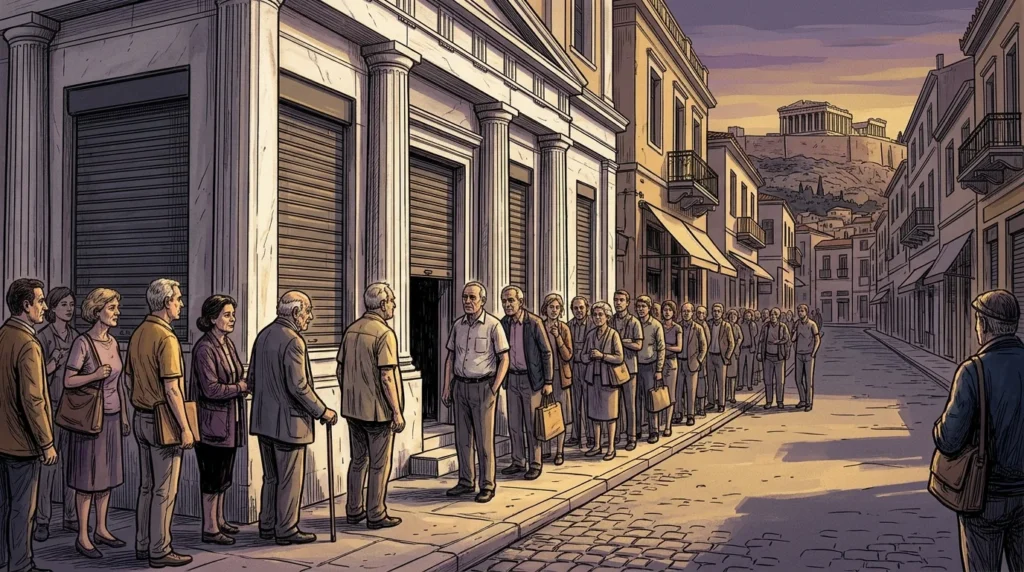
Over the weekend of June 27–28, depositors formed long queues outside bank branches and ATMs across Greece, draining over €1.3 billion in cash inside 48 hours and exhausting more than half of the nation’s functional ATMs. On Sunday, June 28, 2015, the ECB Governing Council announced that it would freeze the ELA ceiling at its existing €89 billion level rather than expanding it to offset accelerating withdrawals. Facing total illiquidity before Monday morning opening, Prime Minister Tsipras and President Prokopis Pavlopoulos issued a Legislative Act on the evening of June 28, 2015 declaring a mandatory bank holiday across all credit institutions in Greece, closing the Athens Stock Exchange, banning cross-border wire transfers without Finance Ministry approval, and capping daily cash withdrawals at €60 per bank card per day at ATMs.
The Third Recapitalization and Long-Term Resolution
The Greek bank holiday lasted three full weeks until branches reopened under strict capital controls on July 20, 2015 (expanded to allow cumulative weekly withdrawals of €420), while the Athens Stock Exchange remained closed for five weeks until August 3, 2015, when banking stocks plunged by the 30 percent daily limit upon reopening. Although 61.3 percent of Greek voters rejected the creditors’ terms in the July 5 referendum, the economic paralysis caused by the bank shutdown and capital controls forced Tsipras to sign a Third Economic Adjustment Programme worth up to €86 billion with the European Stability Mechanism (ESM) in July and August 2015.
Because the 2015 deposit run and economic freeze had driven non-performing exposures (NPEs) toward 49 percent of total loans (exceeding €106 billion), the ECB’s Single Supervisory Mechanism (SSM) conducted a fresh Comprehensive Assessment and stress test in October 2015, identifying a new €14.4 billion capital shortfall across the four systemic banks. Completed in November and December 2015 through €5.3 billion in private share offerings, €3.7 billion in mandatory liability management (bondholder bail-in), and €5.4 billion in HFSF capital injections into Piraeus Bank and National Bank of Greece (via common shares and contingent convertible bonds), this third recapitalization severely diluted existing shareholders once again. Capital controls in Greece remained in place for more than four years until they were fully lifted in September 2019, while the HFSF subsequently utilized the state-guaranteed “Hercules” asset protection scheme (2019–2024) to securitize tens of billions of euros in legacy bad loans before completing the reprivatization of its stakes in the systemic banks by 2024.
Theoretical & Balance-Sheet Transmission Mechanism
In the Kindleberger–Minsky taxonomy of financial instability (Kindleberger, 1978; Minsky, 1986) and Irving Fisher’s (1933) debt-deflation framework, speculative asset booms become systemic crises when credit expansion shifts balance sheets from hedge finance (cash flows covering principal and interest) to speculative and Ponzi finance (relying on rising asset prices and short-term margin roll-overs).
Once monetary tightening or an exogenous shock halts price appreciation, forced margin liquidations trigger Fisherian debt-deflation: fire-sale asset discounts erode bank collateral values, contracting credit supply across the real economy.
Sources and Further Reading
- World Bank Financial Sector Advisory Center (FinSAC), “ Bank Resolution and ‘Bail-In’ in the EU: Selected Case Studies,” World Bank, 2016-12. International Financial Institution
- Eurobank Research, “ Greece Macro Focus: The Recapitalisation of the Greek Banking System,” Eurobank EFG, 2013-01-25. Historical & Financial Reference
- Hellenic Bank Association, “ The Greek Banking System in 2013–2014: Restructuring and Recapitalisation,” Hellenic Bank Association, 2014-03-13. Historical & Financial Reference
- Phillip Inman, “ Greek debt crisis: the key points of Athens bank controls,” The Guardian, 2015-06-29. Historical & Financial Reference
- International Monetary Fund, “ Greece: First Post-Program Monitoring Discussions,” IMF Staff Country Reports, 2019-03. International Financial Institution
- International Monetary Fund, “ Sovereign Debt Restructurings in the Euro Area and the Greek Experience,” IMF Working Papers, 2019-07. International Financial Institution
- Irving Fisher — "The Debt-Deflation Theory of Great Depressions," Econometrica 1, no. 4 (FRASER Federal Reserve Archive, 1933): 337–357 Central Bank / Monetary Authority
- Charles P. Kindleberger & Robert Z. Aliber — Manias, Panics, and Crashes: A History of Financial Crises (Palgrave Macmillan) Peer-Reviewed / Academic Research
Cite This Historical Dossier (APA / Chicago)
APA (7th ed.): Ç., S. (Ed.). (2026). Greece's 2012 PSI Haircut, €50B HFSF Recapitalization, and 2015 Bank Holiday. In Forgotten Fortunes Historical Monograph Series (Forgotten Fortunes Editorial Desk). https://forgottenfortunes.net/greece-2012-psi-bank-crisis/
MLA (9th ed.): Ç., Soner, ed. "Greece's 2012 PSI Haircut, €50B HFSF Recapitalization, and 2015 Bank Holiday." Forgotten Fortunes: Financial & Monetary History Archive, 2026, https://forgottenfortunes.net/greece-2012-psi-bank-crisis/.
Chicago (17th ed.): Ç., Soner, ed. "Greece's 2012 PSI Haircut, €50B HFSF Recapitalization, and 2015 Bank Holiday." Forgotten Fortunes Historical Monograph Series (Forgotten Fortunes Editorial Desk), September 10, 2026. https://forgottenfortunes.net/greece-2012-psi-bank-crisis/.
Have an idea for another financial history documentary or article? Request a story →