In This Article
At 1:00 a.m. on Monday, March 6, 1933—just thirty-six hours after taking the oath of office—President Franklin D. Roosevelt issued Proclamation 2039, declaring a mandatory nationwide Bank Holiday that suspended all banking transactions across the United States [1][4]. For a full week, Americans had no access to commercial banks: institutions were forbidden to pay out deposits, export or earmark gold and silver coin or bullion, deal in foreign exchange, or extend credit [1][4]. The unprecedented freeze brought the financial system of the world’s largest economy to a standstill in order to halt a month-long run on currency and gold that had pushed the Federal Reserve System to the edge of its statutory reserve limits [4][6][8].
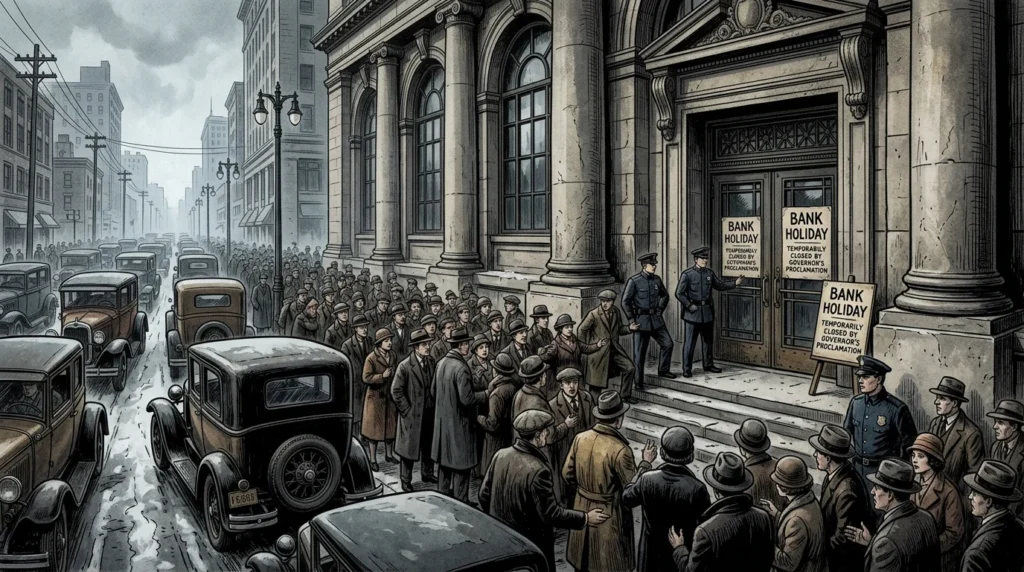
When licensed banks began reopening the following week on March 13, the panic had broken [3][6]. Rather than lining up to empty vaults, depositors stood outside branches to return hoarded cash, redepositing roughly $1.2 billion—two-thirds of the currency drained since early February—by the end of March [3][6][8]. As economic historians have shown, the dramatic reversal rested not merely on presidential rhetoric during Roosevelt’s first Fireside Chat, but on the Emergency Banking Act passed by Congress on March 9, 1933, which paired strict solvency inspections and Reconstruction Finance Corporation (RFC) capital injections with unlimited asset-backed Federal Reserve currency—creating de facto 100 percent deposit insurance in every bank permitted to reopen [3][6][7].
Structural Fragility and the 1930–1932 Banking Panics
The crisis that paralyzed the United States in early 1933 grew out of structural weaknesses embedded in the pre-Depression American banking system [5]. When a wave of commercial bank runs began in November 1930—turning what had initially resembled a fifteen-month business contraction into the Great Depression—the nation had more than 24,000 commercial banks: over 8,000 belonged to the Federal Reserve System, while nearly 16,000 state-chartered institutions operated outside the system [5]. Under fractional-reserve banking, commercial banks kept only a small fraction of deposits in vault cash while committing the bulk of their resources to longer-term loans and securities.
Two institutional flaws amplified the vulnerability of this fragmented system during panics [5]. First, banks routinely counted checks in the process of collection—”float”—as part of their cash reserves, meaning that the same uncollected check was simultaneously counted in the reserves of both the bank where it was deposited and the bank on which it was drawn [5]. The buildup of these “fictitious reserves” during the 1920s left the banking system as a whole with far less actual cash in emergencies than balance sheets implied [5]. Second, nonmember country banks held most of their reserves not as vault cash, but as interbank deposits at city correspondent banks [5]. When rural depositors panicked and demanded cash en masse, country banks pulled balances from regional correspondents, which in turn drew on money-center banks in Chicago and New York—transmitting localized runs up the reserve pyramid [4][5].
Whereas annual U.S. bank suspensions between 1921 and 1928 had remained below 1,000 per year, waves of regional banking panics starting in late 1930 drove thousands of banks into insolvency over the next three years [4][5]. Each round of failures destroyed household savings, contracted the money supply, and deepened public distrust of paper deposits relative to physical cash and gold [4][5].
| Documented Figure / Metric | Historical Significance & Archival Context |
|---|---|
| $10 million | Upon taking office, incoming Treasury Secretary William Woodin and federal officials briefly weighed issuing temporary government scrip to keep commerce moving—going so far as to print $10 million worth before Woodin abandoned the plan out of concern that the public would discount scrip below face value. |
| 90 percent | By March 15, five days after the licensing executive order took effect, nearly 11,000 of the nation's more than 18,000 commercial banks—controlling 90 percent of total U.S. banking resources—had received permission to resume normal operations. |
| 15.34 percent | On March 15, 1933, when the New York Stock Exchange reopened after its extended holiday suspension, the Dow Jones Industrial Average surged by 15.34 percent, still the largest single-day percentage price advance in the exchange's history. |
The February 1933 Michigan Moratorium and the Gold Drain
The final and most severe wave of the Great Depression banking crisis erupted in mid-February 1933 [8]. On February 14, 1933, amid severe depositor runs and liquidity strains in Detroit, the governor of Michigan proclaimed an eight-day statewide banking holiday covering all banks and trust companies in the state [8]. Far from containing the panic within Michigan’s borders, the sudden freeze of deposits in a major industrial state triggered immediate contagion across the country [8]. Fearful that governors in neighboring states would impose similar moratoria, businesses and households rushed to convert bank balances into currency and gold coin, while corporations transferred funds across state lines [4][8].
As depositor runs cascaded from state to state, state governors were forced to declare their own banking holidays or impose sharp caps on deposit withdrawals [8]. Across February and early March 1933, the public withdrew roughly $1.78 billion to $1.8 billion in currency and gold from American banks—with nearly two-thirds of that massive outflow concentrated in the single week ending Friday, March 3, 1933 [3][8]. By March 3, twenty-five of the forty-eight states had enacted bank holidays or withdrawal restrictions, shifting enormous pressure onto the money-center banks of New York City, which held interbank correspondent balances for institutions nationwide [4][8].
Compounding the domestic run was an acute drain on Federal Reserve gold reserves [4]. Under the Federal Reserve Act, Reserve Banks were legally required to hold gold reserves equal to at least 40 percent of the Federal Reserve Notes they issued [4]. As both foreign central banks and domestic savers lost faith in paper dollars and redeemed currency for physical gold at an alarming pace, the gold reserve ratio at the Federal Reserve Bank of New York fell below the statutory 40 percent floor [4]. On March 1, 1933, New York Fed President George L. Harrison sent an urgent message to Federal Reserve Board Governor Eugene Meyer and outgoing Treasury Secretary Ogden Mills warning that he would “no longer take responsibility” for operating the New York Reserve Bank “with deficient reserves” [4].
Proclamation 2039 and the Weeklong Nationwide Shutdown
During the final seventy-two hours of the Hoover administration, central bankers and Treasury officials struggled to coordinate a national response [4]. When the Federal Reserve Board suggested a thirty-day suspension of the statutory gold reserve requirement, Harrison objected that merely suspending reserve ratios would do nothing to stop the physical outflow of gold [4]. Instead, Harrison advocated a nationwide bank holiday to calm the public and buy time for emergency legislation—a step that required a presidential proclamation from outgoing President Herbert Hoover, who declined to act without President-elect Roosevelt’s concurrence [4].
Blocked at the White House, Mills and Meyer suggested asking New York Governor Herbert Lehman to declare a statewide holiday in New York, a step both Harrison and prominent New York Clearing House bankers initially resisted on the grounds that shutting down the nation’s financial capital alone would paralyze commerce while leaving the New York Fed exposed to foreign gold redemptions [4]. By Friday, March 3, however, the relentless drain forced a reversal: the New York Fed’s directors formally urged a national holiday, the Federal Reserve Board voted early on Saturday morning, March 4—Inauguration Day—to support a nationwide shutdown, and federal officials persuaded the remaining state governors to close their banks [4][8]. On March 4, all twelve Federal Reserve Banks locked their doors, and banks across thirty-seven states were either closed or operating under tight state withdrawal limits [4].
Upon taking office, incoming Treasury Secretary William Woodin and federal officials briefly weighed issuing temporary government scrip to keep commerce moving—going so far as to print $10 million worth before Woodin abandoned the plan out of concern that the public would discount scrip below face value [4]. Instead, invoking emergency powers under the Trading with the Enemy Act of 1917, President Roosevelt issued Proclamation 2039 at 1:00 a.m. on March 6, placing all banks under uniform federal suspension through March 9 and summoning Congress into extraordinary session [1][3][4].
The Emergency Banking Act of March 9 and De Facto Deposit Insurance
When the 73rd Congress convened on Thursday, March 9, 1933, lawmakers moved with extraordinary speed to enact the Emergency Banking Act—legislation drafted largely by outgoing Hoover Treasury staff and refined by Woodin’s team [3]. Introduced that afternoon before printed copies were even available to most members on the floor, the bill passed both the House and the Senate and was signed into law by President Roosevelt the same evening [3].
Divided into five titles, the Emergency Banking Act fundamentally reshaped federal crisis intervention powers [3]:
- Title I retroactively ratified Proclamation 2039 and granted the president broad authority during a national emergency to regulate credit transfers, foreign exchange, and the export, hoarding, melting, or earmarking of gold and silver coin or bullion [3].
- Title II empowered the Comptroller of the Currency to restrict the operations of any national bank with impaired assets and to appoint a federal conservator to take possession of its books and conserve its assets pending reorganization or liquidation [3].
- Title III authorized the Secretary of the Treasury, with presidential approval, to have the Reconstruction Finance Corporation subscribe to preferred stock in—or make loans secured by the preferred stock of—any national or state bank or trust company requiring capital to operate [3][8].
- Title IV authorized the twelve Federal Reserve Banks to issue emergency paper currency—Federal Reserve Bank Notes—collateralized by United States government obligations or any sound commercial bank assets, freeing emergency liquidity from the rigid 40 percent gold reserve constraint [3][4][6].
As economist William L. Silber demonstrated, the combination of federal licensing inspections and Title IV’s emergency currency mechanism was the decisive financial innovation that ended the panic [6]. By allowing the Federal Reserve to discount virtually any sound commercial bank asset into circulating Federal Reserve Bank Notes and ship that currency nationwide via the Bureau of Engraving and Printing, the law ensured that any bank granted a Treasury or Federal Reserve license to reopen had access to unlimited cash to meet depositor withdrawals—creating an implicit 100 percent federal guarantee of deposits in reopened banks [3][6].
The Phased Reopening and Financial Recovery
On the evening of Sunday, March 12, 1933, President Roosevelt addressed an estimated sixty million radio listeners in his first Fireside Chat to explain the reopening schedule in plain language [2][3][6]. Outlining a three-stage rollout beginning the next morning—Monday, March 13, for licensed member banks in the twelve Federal Reserve Bank cities; Tuesday, March 14, for licensed banks in approximately 250 cities with recognized clearinghouse associations; and Wednesday, March 15, for sound banks across the rest of the country—Roosevelt explained that only examined, solvent banks were being licensed to open and that the twelve Reserve Banks stood ready to back their sound assets with additional currency [2][3][8]. “I can assure you,” the president told the nation, “that it is safer to keep your money in a reopened bank than under the mattress” [2][3].
The phased reopening succeeded immediately [3][6]. By March 15, five days after the licensing executive order took effect, nearly 11,000 of the nation’s more than 18,000 commercial banks—controlling 90 percent of total U.S. banking resources—had received permission to resume normal operations [4][7]. Conversely, nearly 4,000 weakened or insolvent institutions were kept closed for reorganization, merger, RFC recapitalization, or liquidation under conservators, preventing insolvent banks from dragging down solvent peers [3][7].
Public confidence rebounded alongside bank liquidity [3][6]. Within two weeks of the March 13 reopening, Americans returned more than half of the currency they had hoarded during the panic, and by the end of March $1.2 billion—two-thirds of the $1.78 billion to $1.8 billion panic outflow—had flowed back into bank deposits [3][6][8]. On March 15, 1933, when the New York Stock Exchange reopened after its extended holiday suspension, the Dow Jones Industrial Average surged by 15.34 percent, still the largest single-day percentage price advance in the exchange’s history [3][6]. Three months later, Congress institutionalized the emergency guarantee by passing the Banking Act of 1933 (the Glass-Steagall Act), which created the Federal Deposit Insurance Corporation (FDIC) to replace implicit crisis backing with permanent statutory deposit insurance.
Theoretical & Balance-Sheet Transmission Mechanism
In the Kindleberger–Minsky taxonomy of financial instability (Kindleberger, 1978; Minsky, 1986) and Irving Fisher’s (1933) debt-deflation framework, speculative asset booms become systemic crises when credit expansion shifts balance sheets from hedge finance (cash flows covering principal and interest) to speculative and Ponzi finance (relying on rising asset prices and short-term margin roll-overs).
Once monetary tightening or an exogenous shock halts price appreciation, forced margin liquidations trigger Fisherian debt-deflation: fire-sale asset discounts erode bank collateral values, contracting credit supply across the real economy.
Sources and Further Reading
- Franklin D. Roosevelt, “ Proclamation 2039—Bank Holiday, March 6-9, 1933, Inclusive,” The American Presidency Project (University of California, Santa Barbara), 1933-03-06. Peer-Reviewed / Academic Research
- Franklin D. Roosevelt, “ Fireside Chat on Banking,” The American Presidency Project (University of California, Santa Barbara), 1933-03-12. Peer-Reviewed / Academic Research
- Stephen Greene, “ Emergency Banking Act of 1933,” Federal Reserve History, 2013-11-22. Central Bank / Monetary Authority
- Gary Richardson, “ Bank Holiday of 1933,” Federal Reserve History, 2013-11-22. Central Bank / Monetary Authority
- Gary Richardson, “ Banking Panics of 1930-31,” Federal Reserve History, 2013-11-22. Central Bank / Monetary Authority
- William L. Silber, “ Why Did FDR’s Bank Holiday Succeed?,” Federal Reserve Bank of New York (Economic Policy Review), 2009-07. Central Bank / Monetary Authority
- Matthew Jaremski, Gary Richardson, and Angela Vossmeyer, “ Fighting ‘Fear Itself’: The Bank Holiday of March 1933,” Yale Program on Financial Stability (Journal of Financial Crises), 2025. Peer-Reviewed / Academic Research
- Ayodeji George, “ United States: National Bank Holiday, 1933,” Yale Program on Financial Stability (Journal of Financial Crises), 2025. Peer-Reviewed / Academic Research
- Irving Fisher — "The Debt-Deflation Theory of Great Depressions," Econometrica 1, no. 4 (FRASER Federal Reserve Archive, 1933): 337–357 Central Bank / Monetary Authority
- Charles P. Kindleberger & Robert Z. Aliber — Manias, Panics, and Crashes: A History of Financial Crises (Palgrave Macmillan) Peer-Reviewed / Academic Research
Cite This Historical Dossier (APA / Chicago)
APA (7th ed.): Ç., S. (Ed.). (2026). The 1933 US Bank Holiday and Emergency Banking Act: Ending the Panic. In Forgotten Fortunes Historical Monograph Series (Forgotten Fortunes Editorial Desk). https://forgottenfortunes.net/us-bank-holiday-emergency-banking-act-1933/
MLA (9th ed.): Ç., Soner, ed. "The 1933 US Bank Holiday and Emergency Banking Act: Ending the Panic." Forgotten Fortunes: Financial & Monetary History Archive, 2026, https://forgottenfortunes.net/us-bank-holiday-emergency-banking-act-1933/.
Chicago (17th ed.): Ç., Soner, ed. "The 1933 US Bank Holiday and Emergency Banking Act: Ending the Panic." Forgotten Fortunes Historical Monograph Series (Forgotten Fortunes Editorial Desk), August 28, 2026. https://forgottenfortunes.net/us-bank-holiday-emergency-banking-act-1933/.
Have an idea for another financial history documentary or article? Request a story →