In This Article
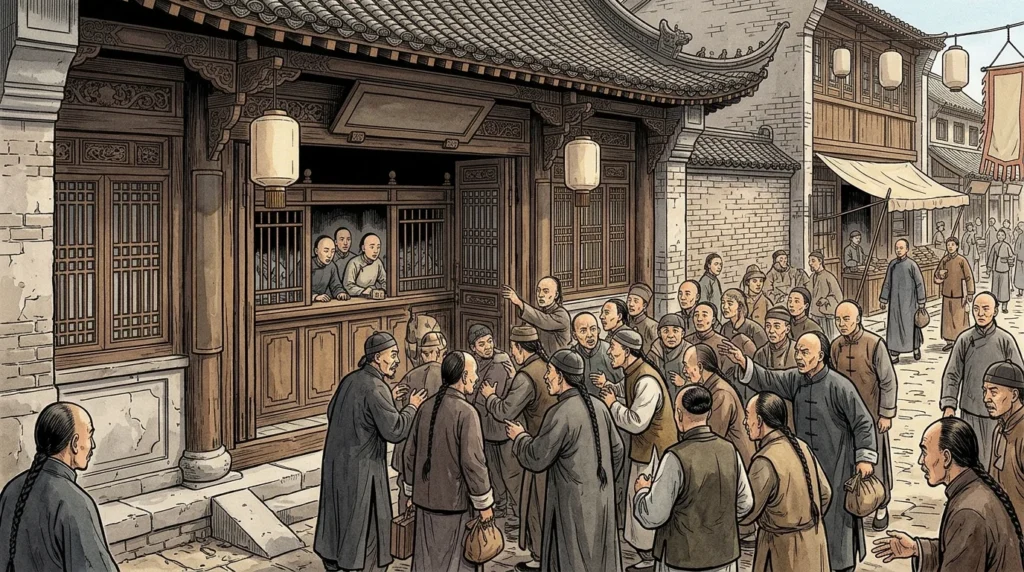
On the night of December 1, 1883, panic swept through the financial alleys of Shanghai and Hangzhou as depositors besieged the branches of the Fukang Qianzhuang (Fukang Bank), the flagship financial institution of China’s wealthiest “red-hatted merchant” (hongding shangren), Hu Guangyong—universally known as Hu Xueyan. For two decades, Hu had acted as the indispensable financier and arms procurer for Qing Imperial Commissioner Zuo Zongtang, raising millions of silver taels in foreign loans from the Hongkong and Shanghai Banking Corporation (HSBC) while capturing lucrative provincial tax deposits across southern China. When Hu’s audacious 20-million-tael speculative corner on the international raw silk market collapsed amid European recession and the looming Sino-French War, the failure of the Fukang banking network triggered a systemic run across Shanghai’s native money shops (qianzhuang) and strained the inter-provincial Shanxi draft banks (piaohao). The 1883 crash exposed the structural vulnerability of traditional Chinese banking and catalyzed the late-Qing campaign to create modern joint-stock and central banks—beginning with Sheng Xuanhuai’s Imperial Bank of China in May 1897 and the Ministry of Revenue’s Hubu Bank in 1905. [1]
The Architecture of Late-Imperial Finance: Shanxi Piaohao and Coastal Qianzhuang
Throughout the nineteenth century, prior to the introduction of Western corporate banking law, China’s vast bimetallic economy (operating on uncoined silver bullion measured in weight and purity by the liang or tael for wholesale trade, and cast copper cash for retail wages) relied on two complementary indigenous institutions: the nationwide Shanxi remittance banks (piaohao, also called piaozhuang) and the localized coastal money shops (qianzhuang).
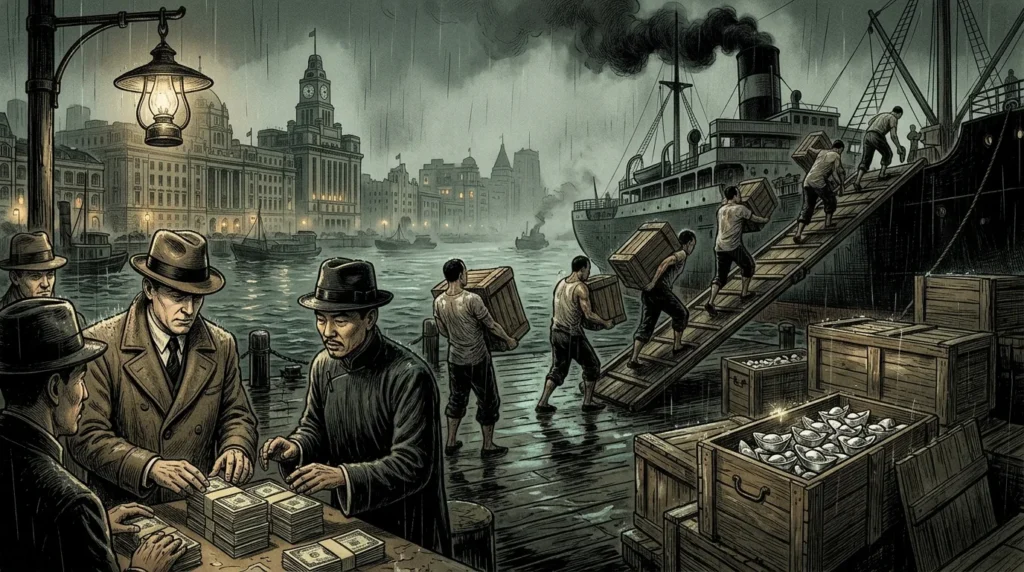
The piaohao system originated in circa 1823 in the walled city of Pingyao in Shanxi Province, when manager Lei Lütai reorganized the Xiyucheng pigment trading house—which possessed branches in Beijing, Tianjin, and Sichuan—into the Rishengchang (“Sunrise of Prosperity”) draft bank. Rather than shipping heavy wooden logs hollowed out to carry silver sycee ingots (biaoyin) under armed martial-arts escort across bandit-plagued mountain roads, Rishengchang issued encrypted, watermarked paper bills of exchange (huipiao) redeemable in silver at dozens of branch offices across the empire. Soon joined by rival networks in Pingyao, Qixian, and Taigu—collectively known as the Ping-Qi-Tai clusters, including Weitaihou, Rixinzhong, and Dadetong—around thirty major Shanxi draft banks came to dominate long-distance inter-provincial credit. [2]
The Shanxi banks’ golden era arrived during the Taiping Rebellion (1850–1864), when rebel armies severed the Grand Canal and Yangtze River routes that provinces used to ship physical silver tax revenues (Jingshi) to the Board of Revenue (Hubu) in Beijing. Beginning in 1862, the Qing court authorized provincial treasurers and customs superintendents to deposit imperial tax receipts, salt gabelle funds, and domestic transit duties (lijin) with the Shanxi piaohao, which remitted the credits by paper draft to the capital. Meanwhile, in booming treaty ports like Shanghai, Hankou, and Ningbo, local partnerships known as qianzhuang accepted commercial deposits, cleared interbank silver balances through guild houses, and issued short-term fiduciary promissory notes called zhuangpiao (native bank orders) that financed China’s tea and silk exports—often borrowing seasonal working capital in short-term call loans (chaokuan) from both Shanxi piaohao and foreign exchange banks. [3]
Hu Xueyan, the Xinjiang Campaign Loans, and the 1881–1883 Raw Silk Corner
Towering above this nexus of imperial fiscal deposits and treaty-port credit stood Hu Xueyan (1823–1885). Born into poverty in Anhui and trained as an apprentice in a Hangzhou money shop, Hu forged a lifelong alliance with Zhejiang Governor and later Viceroy Zuo Zongtang during the suppression of the Taiping and Nian rebellions. In the 1860s, Hu established the Fukang Qianzhuang in Hangzhou, rapidly expanding into a network of branches across Shanghai, Ningbo, Fuzhou, Hankou, and Beijing, alongside the celebrated Hu Qing Yu Tang traditional pharmaceutical house and extensive pawnshop and real-estate holdings. [4]
When the Qing court ordered Zuo Zongtang to reconquer Xinjiang from Yakub Beg between 1875 and 1881, inter-provincial military subsidies (xiexiang) lagged chronically behind campaign expenses. Operating from Shanghai, Hu Xueyan acted as Zuo’s financial quartermaster, contracting six major foreign loans—primarily with the British-controlled Hongkong and Shanghai Banking Corporation (HSBC)—totaling nearly 16 million silver taels. Secured against the Maritime Customs revenues of southern treaty ports and carrying interest rates of 8 to 15 percent per annum, these syndications earned Hu lucrative brokerage margins, the unprecedented honour of an official Red Coral Hat button of the First Rank, and the coveted Yellow Riding Jacket. [5]
Emboldened by his official patronage and millions of taels in public and private deposits held inside the Fukang bank network, Hu launched an ambitious gamble in 1881–1882 to break the pricing monopoly of European and American trading houses (yanghang) over Chinese raw silk exports. Using credits drawn from his Fukang branches and Shanghai qianzhuang, Hu purchased and warehoused approximately 14,000 to 20,000 bales of high-grade Jiangnan raw silk, tying up an estimated 15 million to 20 million silver taels in inventory in an effort to force foreign buyers to pay higher prices. [6]
The December 1883 Crash of Fukang Bank and the Shanghai Financial Panic
Instead of capitulating, foreign silk merchants in Shanghai united in a buyer’s boycott, refusing to purchase a single bale from Hu’s warehouses for over a year. Simultaneously, an abundant 1883 Italian and French silkworm harvest flooded the Lyon and London markets, driving international raw silk prices sharply downward just as diplomatic hostilities between Qing China and France over Tonkin (northern Vietnam) triggered a credit freeze across the China coast. [7]
By the autumn of 1883, Shanghai was already reeling from the collapse of a speculative bubble in the shares of modern Chinese joint-stock shipping and mining enterprises—such as the China Merchants’ Steam Navigation Company and the Kaiping Mines—which had crashed when nervous investors dumped equities and comprador Xu Run defaulted on more than 2 million taels in real-estate loans borrowed from twenty-two local qianzhuang. Facing an acute silver drain and due dates on an 800,000-tael HSBC loan, Hu Xueyan was forced to liquidate batches of his warehoused silk at catastrophic losses exceeding 8 million to 10 million taels. [8]
When Li Hongzhang’s political associate Sheng Xuanhuai delayed provincial customs transfers that Zuo Zongtang had earmarked to service Hu’s foreign obligations, rumors of insolvency exploded. In November and early December 1883, Hu’s Beijing branch (Fukang Jingshi) failed first, followed on December 1, 1883 by the shuttering of the Hangzhou and Shanghai headquarters of the Fukang Qianzhuang. High-ranking Beijing mandarins—including Prince Gong and Imperial Tutor Weng Tonghe—and provincial treasuries lost millions of taels in frozen deposits. By imperial edict, Empress Dowager Cixi stripped Hu Xueyan of his official rank and ordered the confiscation of his estates to satisfy state and foreign creditors; Hu died in poverty in November 1885. The domino effect across Shanghai was devastating: of the roughly 78 registered qianzhuang operating in Shanghai at the start of 1883, only 10 survived the winter credit crunch, while Shanxi piaohao and foreign banks (including the British Oriental Bank Corporation, which failed in May 1884) wrote off heavy treaty-port bad debts.
Sheng Xuanhuai’s 1897 Imperial Bank of China and the 1905 Da-Qing Bank
The 1883 financial panic—followed a decade later by China’s humiliating defeat in the First Sino-Japanese War (1894–1895) and the 230-million-tael Treaty of Shimonoseki indemnity—convinced Qing modernizers that fragmented partnership banks could neither mobilize industrial capital nor defend China’s monetary sovereignty against foreign treaty-port banks like HSBC, the Deutsch-Asiatische Bank, and the Yokohama Specie Bank.
In late 1896, Imperial Director-General of Railways Sheng Xuanhuai memorialized the throne to establish a modern Chinese commercial bank modeled directly on Western joint-stock statutes. Opened for business on the Shanghai Bund on May 27, 1897, the Imperial Bank of China (Zhongguo Tongshang Yinhang, later known in English as the Commercial Bank of China) was China’s first indigenous modern bank. Capitalized initially at 5 million Kuping silver taels (with 2.5 million taels paid up by Sheng’s China Merchants’ Steam Navigation Company, the Imperial Telegraph Administration, and high officials, plus a 1-million-tael deposit loan from the Board of Revenue), the bank adopted the internal rulebook of HSBC, hired former HSBC veteran A. W. Maitland as its foreign chief manager alongside Chinese managing director Chen Shengjiao, and received an imperial charter to mint silver coins and issue modern banknotes in taels and Mexican silver dollars.
Recognizing the need for a true state central bank to unify currency issuance and manage treasury accounts, the Qing court approved the creation of the Bank of the Board of Revenue (Hubu Yinhang) in Beijing in September 1905 under the New Policies (Xinzheng) reforms, capitalized jointly by the state and private subscribers at 4 million taels. In 1908, following the reorganization of the ministries, the institution was renamed the Da-Qing Bank (Great Qing Bank, Da-Qing Yinhang), doubled its capital to 10 million taels, and was granted the exclusive statutory privilege of issuing national paper currency and managing the imperial treasury.
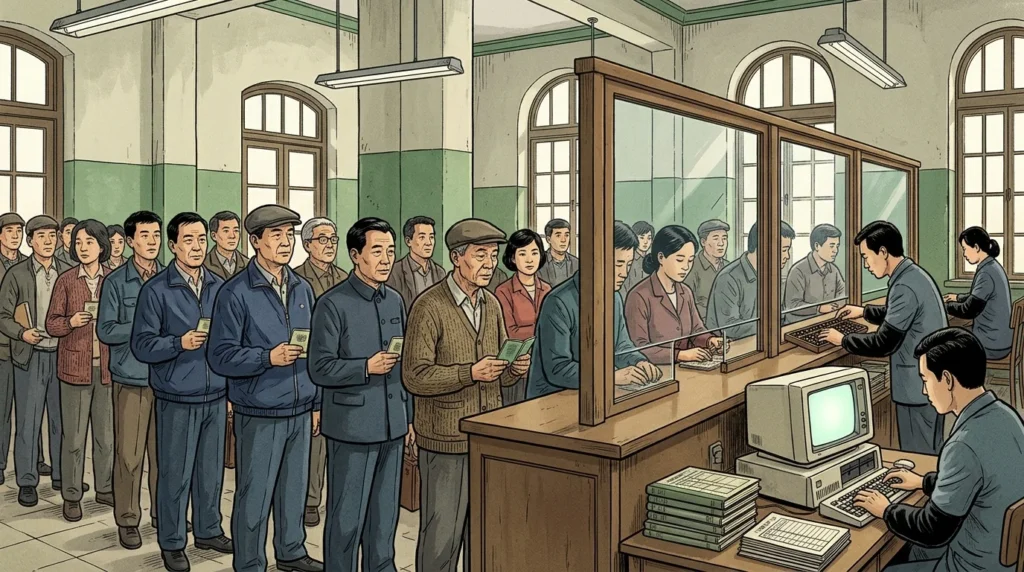
The rise of the Da-Qing Bank and the 1908 Bank of Communications (Jiaotong Yinhang) stripped the Shanxi piaohao of the government tax-remittance monopoly that had sustained them since the 1860s. When the conservative Shanxi banking families rejected proposals in 1908–1909 to merge their unlimited-liability partnerships into a modern joint-stock Shanxi commercial bank, their fate was sealed. The outbreak of the Xinhai Revolution in October 1911 triggered defaulted imperial loans, looted provincial branches, and massive deposit runs across northern and central China. While the Da-Qing Bank was reorganized in February 1912 by Sun Yat-sen’s Republican government into the modern Bank of China (Zhongguo Yinhang), virtually the entire century-old network of Shanxi piaohao—including Rishengchang itself in 1914—went into liquidation.
Theoretical & Balance-Sheet Transmission Mechanism
In the Kindleberger–Minsky taxonomy of financial instability (Kindleberger, 1978; Minsky, 1986) and Irving Fisher’s (1933) debt-deflation framework, speculative asset booms become systemic crises when credit expansion shifts balance sheets from hedge finance (cash flows covering principal and interest) to speculative and Ponzi finance (relying on rising asset prices and short-term margin roll-overs).
Once monetary tightening or an exogenous shock halts price appreciation, forced margin liquidations trigger Fisherian debt-deflation: fire-sale asset discounts erode bank collateral values, contracting credit supply across the real economy.
Sources and Further Reading
- Morck, Randall, and Yang, Fan, “The Shanxi Banks: Rise and Fall of China’s First Financial Empire,” University of Manchester Economics Discussion Paper Series, 2023. Peer-Reviewed / Academic Research
- Luo, Changxin, “Family Banking Firms: Shanxi Piaohao and the North Chinese Interior, 1820–1930,” Journal of Chinese History, Cambridge University Press, 2024. Peer-Reviewed / Academic Research
- Ma, Debin, “Money and Finance in China’s History,” National Bureau of Economic Research (NBER) Working Paper No. 15884, 2010. Peer-Reviewed / Academic Research
- Köll, Elisabeth, “ Controlling Modern Enterprise in Late Qing China: Sheng Xuanhuai, the 1883 Financial Crisis, and Joint-Stock Institutions,” NBER Conference Paper, Harvard Business School, 2003. Peer-Reviewed / Academic Research
- Mo, Yamin, “Sino-Foreign Business Networks: Foreign and Chinese Banks in the Chinese Banking Sector, 1890–1911,” Modern Asian Studies, Cambridge University Press, 2020. Peer-Reviewed / Academic Research
- Theobald, Ulrich, “Piaohao (Draft Banks) and Late Imperial Chinese Finance,” ChinaKnowledge.de (University of Tübingen), 2016. Historical & Financial Reference
- Irving Fisher — "The Debt-Deflation Theory of Great Depressions," Econometrica 1, no. 4 (FRASER Federal Reserve Archive, 1933): 337–357 Central Bank / Monetary Authority
- Charles P. Kindleberger & Robert Z. Aliber — Manias, Panics, and Crashes: A History of Financial Crises (Palgrave Macmillan) Peer-Reviewed / Academic Research
Cite This Historical Dossier (APA / Chicago)
APA (7th ed.): Ç., S. (Ed.). (2026). Shanxi Piaohao, the 1883 Collapse of Hu Xueyan's Fukang Bank, and Late-Qing Modern Banking. In Forgotten Fortunes Historical Monograph Series (Forgotten Fortunes Editorial Desk). https://forgottenfortunes.net/china-shanxi-piaohao-hu-xueyan/
MLA (9th ed.): Ç., Soner, ed. "Shanxi Piaohao, the 1883 Collapse of Hu Xueyan's Fukang Bank, and Late-Qing Modern Banking." Forgotten Fortunes: Financial & Monetary History Archive, 2026, https://forgottenfortunes.net/china-shanxi-piaohao-hu-xueyan/.
Chicago (17th ed.): Ç., Soner, ed. "Shanxi Piaohao, the 1883 Collapse of Hu Xueyan's Fukang Bank, and Late-Qing Modern Banking." Forgotten Fortunes Historical Monograph Series (Forgotten Fortunes Editorial Desk), September 20, 2026. https://forgottenfortunes.net/china-shanxi-piaohao-hu-xueyan/.
Have an idea for another financial history documentary or article? Request a story →