In This Article
On Sunday, November 3, 1935, Finance Minister H. H. Kung (Kong Xiangxi) of China’s Nationalist Government in Nanjing issued an emergency monetary decree that ended more than five centuries of silver-backed currency on the Chinese mainland. Effective Monday, November 4, 1935, all silver coins and bullion in public and private hands were nationalized, and banknotes issued by three state-controlled institutions—the Central Bank of China, the Bank of China, and the Bank of Communications—were declared sole legal tender, or fabi (法币). This decisive break with the silver standard was the culmination of a devastating two-year deflationary and banking crisis triggered abroad: when the United States Congress passed the Silver Purchase Act of June 19, 1934, artificial American treasury buying doubled global bullion prices, siphoned more than 250 million ounces of silver out of Shanghai, collapsed scores of native and commercial banks, and enabled Nanjing to seize majority control of China’s private banking sector. [1]

China’s Silver Standard and the Early Great Depression Buffer
During the initial years of the Great Depression between 1929 and 1931, China stood virtually alone among major trading nations in maintaining a metallic silver standard. Because the Chinese silver dollar (yuan) floated freely with the international commodity value of silver, the 51.6 percent plunge in global silver prices on the New York market—from an average of $0.585 per troy ounce in 1928 to $0.283 per ounce in 1932—acted as an automatic currency depreciation for China. While gold-standard economies suffered catastrophic price deflation and collapsing exports, China’s depreciating silver currency insulated domestic wholesale prices, stimulated urban manufacturing in Shanghai, and drew net inflows of silver bullion from abroad. [2]
That insulation abruptly reversed between late 1931 and 1933 as China’s major trading partners abandoned gold and devalued their currencies. Great Britain left the gold standard in September 1931, stripping the pound sterling of its parity; Japan followed in December 1931, allowing the yen to depreciate sharply; and in April 1933, President Franklin D. Roosevelt took the United States off the gold standard and began bidding up the dollar price of gold and silver. Suddenly, the Chinese silver dollar appreciated sharply against the pound, the yen, and the U.S. dollar. In March 1933, the Nationalist Government completed the long-planned “abolition of the tael and conversion to the dollar” (feiliang gaiyuan), replacing chaotic regional weight-based silver sycee ingots with a standardized silver dollar coin minted in Shanghai. Yet standardization could not protect China from an external shock engineered in Washington. [3]
The U.S. Silver Purchase Act of June 1934 and the Bullion Drain
Driven by a powerful coalition of senators from seven western silver-producing states—which accounted for less than one percent of U.S. employment but wielded fourteen Senate votes—and agrarian inflationists who favored bimetallism, the Roosevelt administration signed the Silver Purchase Act on June 19, 1934. The statute directed the U.S. Secretary of the Treasury to purchase silver at home and abroad until either the market price reached $1.29 per troy ounce or the monetary value of the Treasury’s silver stock reached one-fourth of its combined gold and silver reserves. [4]
As the U.S. Treasury entered the London and New York bullion markets on a massive scale, the world price of silver surged from $0.45 per ounce in mid-1934 to a peak of $0.81 per ounce in April 1935. For China, the consequences were immediate and catastrophic. Because the external melting and export value of Chinese silver coins now significantly exceeded their domestic purchasing power and face exchange value in Shanghai, arbitrageurs, foreign banks in the international concessions, and speculators shipped shiploads of silver bullion out of China. [5]
Having enjoyed net silver inflows until 1931, China experienced a net export of approximately 14 million yuan worth of silver in 1933, which exploded to more than 256 million yuan (roughly 200 million troy ounces of legal exports alone) in 1934—with nearly five-sixths of that total departing in the four months immediately following the passage of the U.S. Silver Purchase Act. When extensive clandestine smuggling through Japanese-controlled North China, Dalian, and Taiwan in 1934 and 1935 is included, well over 250 million ounces of silver drained out of the country. In Shanghai, the nation’s financial heart, silver stocks held by banks plunged by nearly half, while rural silver had already been sucked into the treaty ports to cover interior trade deficits. [6]
Deflation and the 1934–1935 Shanghai Banking Crisis
Because physical silver constituted the high-powered reserve base of the Chinese monetary system, the sudden hemorrhage of bullion produced a violent monetary contraction. Between 1931 and mid-1935, Shanghai wholesale prices fell by roughly 25 to 30 percent, agricultural commodity prices in the interior collapsed even more steeply, and Shanghai’s real estate market—which had served as the primary collateral for commercial and native bank lending during the 1929–1931 boom—froze completely. [7]
In late 1934 and early 1935, this deflationary vise triggered a severe banking crisis across Shanghai and the Yangtze delta. Traditional Chinese native banks (qianzhuang), which provided unsecured short-term working capital to merchants and small manufacturers based on personal credit networks, suffered first. The daily interbank native interest rate (yincha) spiked sharply as silver reserves vanished from vaults. Unable to roll over credits or liquidate frozen real estate deeds, more than half of Shanghai’s qianzhuang either failed outright or suspended operations between 1934 and 1935. [8]
The crisis quickly engulfed modern joint-stock commercial banks as well. Major private institutions such as the Minghua Commercial and Savings Bank, the American-Oriental Banking Corporation, the Ningpo Commercial and Savings Bank, and the Commercial Bank of China faced severe depositor runs or insolvencies. Over 1,000 commercial and industrial firms in Shanghai went bankrupt or reorganized in 1934 and 1935, while cotton mills and silk filatures shuttered across Jiangsu and Zhejiang.
Repeated diplomatic appeals by Finance Minister H. H. Kung to U.S. Treasury Secretary Henry Morgenthau Jr.—recorded in U.S. State Department cables in August and September 1934—warned that Washington’s silver purchases were ruining China’s economy. When Washington replied that it was bound by congressional mandate, Nanjing imposed a 10 percent silver export duty plus a variable “equalization charge” on October 15, 1934. Although the export tax severed the direct link between Shanghai exchange rates and London bullion prices, the wide price gap between domestic silver and world markets fueled rampant armed smuggling through North China and foreign-controlled concessions, accelerating domestic hoarding and bank runs.
The March 1935 Coup Against the Bank of China
For Finance Minister H. H. Kung and his brother-in-law T. V. Soong (Song Ziwen), the liquidity crisis among Shanghai’s commercial banks presented a long-sought political opportunity. Since the founding of the Nationalist regime in 1927, Shanghai’s premier modern banks—above all the Bank of China, led by general manager Zhang Jia’ao (Chang Kia-ngau), and the Bank of Communications—had fiercely defended their private shareholder autonomy and resisted pressure to finance Nanjing’s chronic military budget deficits through unrestrained bond purchases.
In March 1935, under the pretext of rescuing the banking system from the silver crunch and strengthening bank capital, H. H. Kung engineered a financial coup. The Ministry of Finance issued 100 million yuan in new “1935 Financial Bonds”—without putting up a single ounce of actual silver—and used these state bonds to forcibly subscribe to new shares in the Bank of China and the Bank of Communications. Overnight, the Nationalist government’s equity stake in the Bank of China jumped from 20 percent to 50 percent (increasing its capital from 20 million to 40 million yuan), and its stake in the Bank of Communications rose to 55 percent. Zhang Jia’ao was removed as general manager of the Bank of China and replaced as chairman by T. V. Soong. By mid-1935, Nanjing also took over several failed smaller banks (including the Commercial Bank of China, the Ningpo Commercial Bank, and the National Industrial Bank of China), cementing state command over what became known as the “Four Banks and Two Bureaus.”
The November 3, 1935 Fabi Decree and Its Legacy
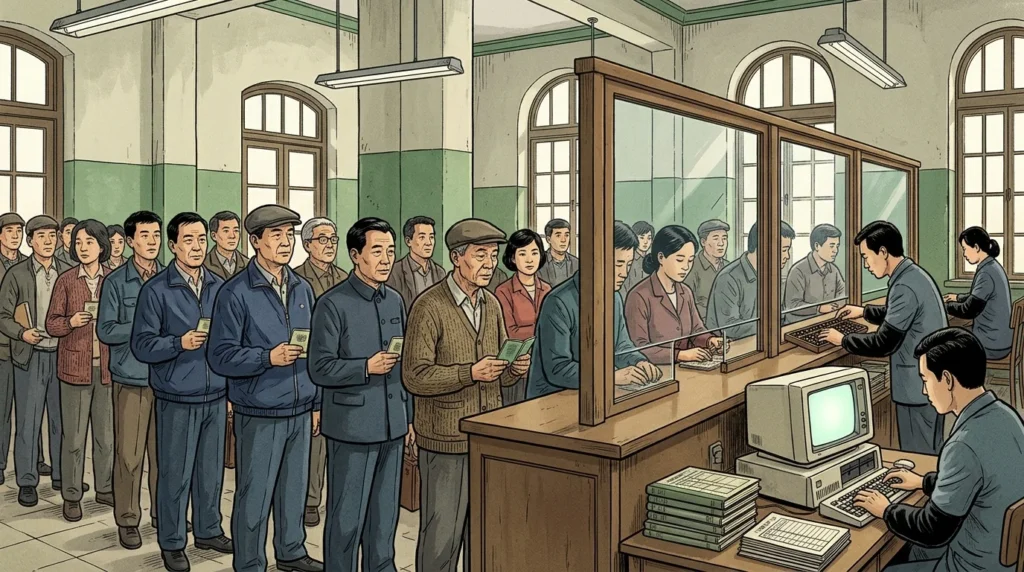
With the Bank of China and the Bank of Communications now firmly under state control, Nanjing possessed the institutional machinery to abandon the silver standard altogether. Advised by British Treasury envoy Sir Frederick Leith-Ross, H. H. Kung announced the historic currency reform decree on November 3, 1935, taking effect on November 4:
- Banknotes issued by the Central Bank of China, the Bank of China, and the Bank of Communications (joined in early 1936 by the Farmers Bank of China) were declared full legal tender (fabi) for all tax payments and public and private debts.
- The circulation of silver dollars or bullion as currency was strictly prohibited, and all banks, firms, and individuals were ordered to surrender their physical silver holdings to a Currency Reserve Board in exchange for fabi notes at face value, with hoarding punishable under treason laws.
- To stabilize the external value of the new fiat currency, the three government banks were instructed to buy and sell foreign exchange without limit, pegging the fabi yuan at approximately 1 shilling 2.5 pence sterling (roughly $0.295 to $0.30 U.S. dollars).
Remarkably, once China left the silver standard and flooded the world market with nationalized bullion—and after the U.S. Treasury belatedly agreed in May 1936 to purchase 75 million ounces of Chinese silver directly for dollars to provide foreign exchange reserves—the 1935 fabi reform succeeded in halting deflation and reviving Chinese industrial output and exports throughout 1936 and early 1937. Yet as historians and economists from Milton Friedman to Parks Coble have emphasized, the March 1935 nationalization of the Bank of China and the November 1935 replacement of physical silver with unbacked state paper also eliminated every institutional constraint on deficit monetization. When full-scale war with Japan erupted in July 1937, the Nationalist government turned the printing presses of the state banks into its primary fiscal engine, unleashing the hyperinflation of the 1940s that ultimately destroyed the regime.
Theoretical & Balance-Sheet Transmission Mechanism
In the Kindleberger–Minsky taxonomy of financial instability (Kindleberger, 1978; Minsky, 1986) and Irving Fisher’s (1933) debt-deflation framework, speculative asset booms become systemic crises when credit expansion shifts balance sheets from hedge finance (cash flows covering principal and interest) to speculative and Ponzi finance (relying on rising asset prices and short-term margin roll-overs).
Once monetary tightening or an exogenous shock halts price appreciation, forced margin liquidations trigger Fisherian debt-deflation: fire-sale asset discounts erode bank collateral values, contracting credit supply across the real economy.
Sources and Further Reading
- Office of the Historian, “ Foreign Relations of the United States, Diplomatic Papers, 1934, The Far East, Volume III, Document 335,” U.S. Department of State, 1934. Official / State Archive
- Office of the Historian, “ Foreign Relations of the United States, Diplomatic Papers, 1935, The Far East, Volume III, Document 613,” U.S. Department of State, 1935. Official / State Archive
- Bank of China, “ Effort Against Silver Outflow During the World Silver Market Fluctuation (1933 – 1935),” Bank of China History, 2008-09-26. Historical & Financial Reference
- Richard C. K. Burdekin, “ US Pressure on China’s Currency: Milton Friedman and the Silver Episode Revisited,” Claremont McKenna College / EconStor, 2006. Historical & Financial Reference
- Parks M. Coble, “ The Collapse of Nationalist China: How Chiang Kai-shek Lost China’s War, 1945–1949,” Cambridge University Press, 2023. Peer-Reviewed / Academic Research
- Carmen M. Reinhart and Kenneth S. Rogoff, “ This Time is Different: A Panoramic View of Eight Centuries of Financial Crises,” National Bureau of Economic Research (Working Paper No. 13882), 2008. Peer-Reviewed / Academic Research
- Irving Fisher — "The Debt-Deflation Theory of Great Depressions," Econometrica 1, no. 4 (FRASER Federal Reserve Archive, 1933): 337–357 Central Bank / Monetary Authority
- Charles P. Kindleberger & Robert Z. Aliber — Manias, Panics, and Crashes: A History of Financial Crises (Palgrave Macmillan) Peer-Reviewed / Academic Research
Cite This Historical Dossier (APA / Chicago)
APA (7th ed.): Ç., S. (Ed.). (2026). China's 1933–1935 Silver Crisis, the 1935 Fabi Reform, and the Bank of China. In Forgotten Fortunes Historical Monograph Series (Forgotten Fortunes Editorial Desk). https://forgottenfortunes.net/china-1935-fabi-currency-reform/
MLA (9th ed.): Ç., Soner, ed. "China's 1933–1935 Silver Crisis, the 1935 Fabi Reform, and the Bank of China." Forgotten Fortunes: Financial & Monetary History Archive, 2026, https://forgottenfortunes.net/china-1935-fabi-currency-reform/.
Chicago (17th ed.): Ç., Soner, ed. "China's 1933–1935 Silver Crisis, the 1935 Fabi Reform, and the Bank of China." Forgotten Fortunes Historical Monograph Series (Forgotten Fortunes Editorial Desk), September 11, 2026. https://forgottenfortunes.net/china-1935-fabi-currency-reform/.
Have an idea for another financial history documentary or article? Request a story →