In This Article
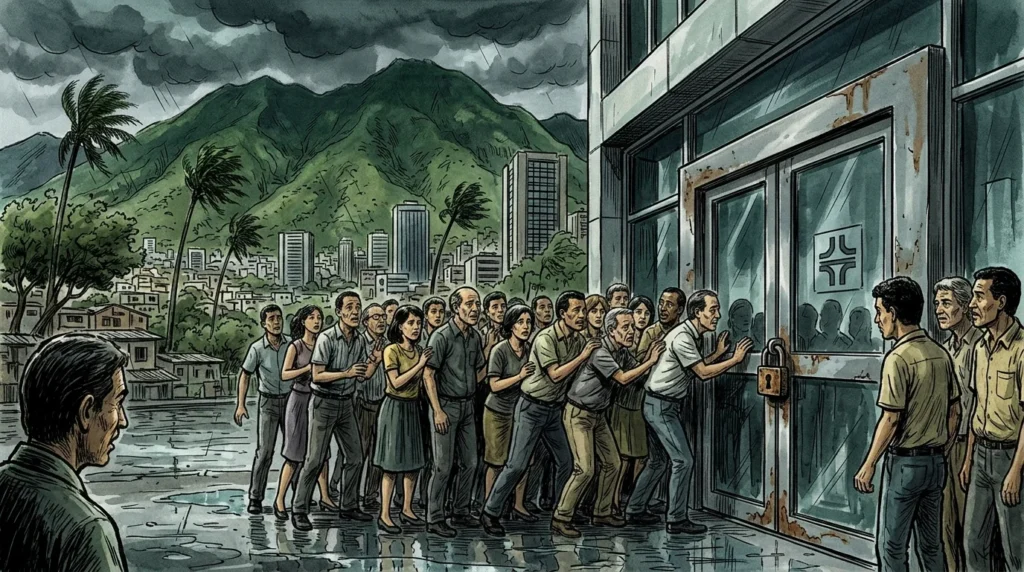
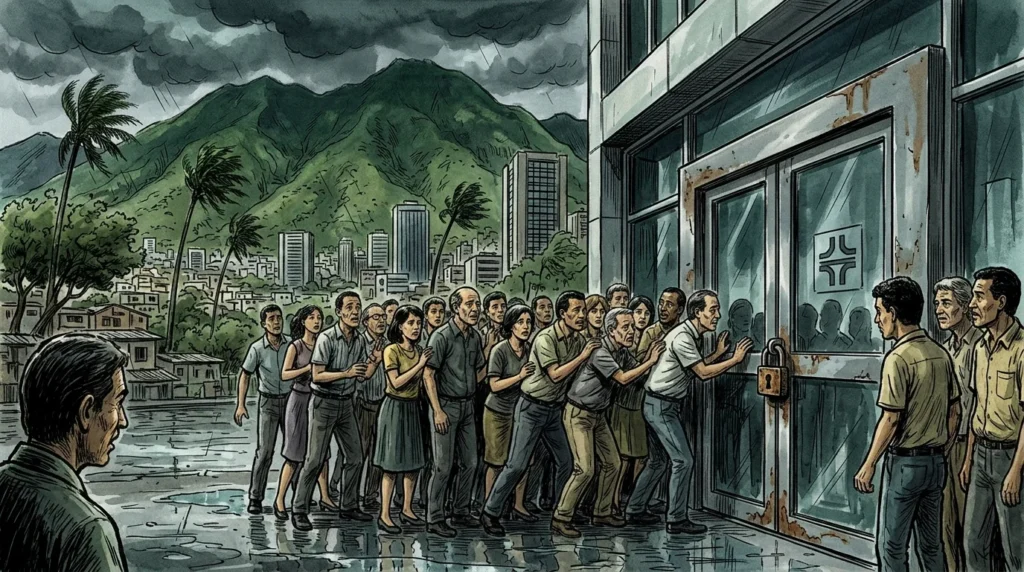
On Thursday, January 13, 1994, the Central Bank of Venezuela (Banco Central de Venezuela, or BCV) excluded Banco Latino—the nation’s second-largest commercial bank by deposit volume—from the national check-clearing system after it failed to cover its daily clearinghouse obligations. Three days later, the Superintendency of Banks and Other Financial Institutions (SUDEBAN) formally intervened in the bank, shuttering its doors and freezing the accounts of hundreds of thousands of retail depositors, pension funds, military welfare trusts, and state enterprises. What regulators initially treated as an isolated liquidity failure at a politically connected institution rapidly mutated into one of the most destructive systemic banking crises in late-twentieth-century Latin America. Within twelve months, cascading runs toppled more than eighteen financial institutions holding roughly half of Venezuela’s total banking deposits, exhausting the Deposit Guarantee and Bank Protection Fund (Fondo de Garantía de Depósitos y Protección Bancaria, or FOGADE) and costing the Venezuelan state over 1.3 trillion bolívares—equivalent to approximately 18 to 20 percent of national gross domestic product. [1]
Deregulation Without Supervision: The 1989 El Gran Viraje Reforms
The structural vulnerabilities that destroyed Banco Latino originated in the macroeconomic adjustment program launched by President Carlos Andrés Pérez in February 1989, known as El Gran Viraje (“The Great Turnaround”). After decades in which the Venezuelan state used oil rents to maintain fixed exchange rates, regulated interest ceilings, and directed credit allocations, a collapse in international petroleum prices and the exhaustion of foreign exchange reserves forced Caracas to turn to the International Monetary Fund. As part of the liberalization package, Venezuelan authorities dismantled administrative controls on commercial bank deposit and lending rates and opened the financial sector to rapid market competition. [2]
Financial liberalization proceeded without a corresponding modernization of bank supervision or capital adequacy enforcement. Until a new General Law of Banks and Other Financial Institutions finally took effect in January 1994—the very month the crisis erupted—SUDEBAN operated under an outdated legal framework with minimal budgetary autonomy, few trained examiners, and virtually no consolidated oversight of financial groups. Venezuelan commercial banks belonged to sprawling industrial-financial conglomerates that owned mortgage banks, investment banks (sociedades financieras), leasing companies, money-market funds, and offshore subsidiaries in Curaçao, Aruba, the Cayman Islands, and Miami. Because regulators inspected domestic commercial bank balance sheets in isolation rather than on a consolidated group basis, bank insiders routinely shifted non-performing loans, unrecorded liabilities, and speculative equity positions across domestic and offshore affiliates to fabricate capital ratios and conceal insolvency. [3]
| Documented Figure / Metric | Historical Significance & Archival Context |
|---|---|
| 50 percent | By the time the acute phase of the crisis subsided in 1995, the Venezuelan state had intervened in, nationalized, or liquidated 18 banking groups (encompassing more than 40 individual financial affiliates) that collectively controlled roughly 50 percent of the nation's total deposits and banking assets. |
| $3.5 billion | Much of the bailout liquidity flowed directly into the foreign exchange market, draining the Central Bank's international reserves by more than $3.5 billion during the first half of 1994 alone. |
| 1.3 trillion bolívares | In total, direct fiscal and quasi-fiscal outlays by FOGADE and the Central Bank exceeded 1.3 trillion bolívares in 1994–1995—calculated by the International Monetary Fund and academic researchers at roughly 18 to 20 percent of Venezuela's 1994 GDP, with broader multi-year resolution estimates reaching even higher. |
Banco Latino, Gustavo Gómez López, and the Mesas de Dinero
No institution exploited this regulatory vacuum more aggressively than Banco Latino. Founded in 1950 and long associated with financier Pedro Tinoco—who left the chairmanship of Banco Latino in February 1989 to become President of the Central Bank of Venezuela under Carlos Andrés Pérez—the bank became the flagship of the country’s newly liberalized financial elite. Following Tinoco’s departure and subsequent death in 1993, Banco Latino was led by President Gustavo Gómez López, under whose management the institution embarked on a relentless campaign to capture market share across retail, corporate, and public-sector deposits. [4]
To attract funds in an environment of high inflation and volatile interest rates, Banco Latino offered yields substantially above those of conservative rivals, often pushing nominal deposit rates above 60 to 70 percent per annum by 1993. Much of this funding was gathered outside conventional balance-sheet savings accounts through high-yield money-market desks known as mesas de dinero and through fiduciary trust accounts and offshore subsidiaries, notably Banco Latino International in Miami and Banco Latino N.V. in Curaçao. Retail and institutional clients were frequently steered into off-balance-sheet placements and commercial paper that lacked explicit FOGADE deposit insurance coverage, even though bank branches marketed them as seamlessly guaranteed bank deposits. [5]
On the asset side, Banco Latino deployed these expensive short-term liabilities into illiquid, long-term speculative ventures and extensive insider lending (autopréstamos). Bank directors and affiliated holding companies channeled billions of bolívares into luxury real estate developments, tourism complexes, agricultural estates, industrial acquisitions, and equity market speculation. When Venezuela suffered two military coup attempts in February and November 1992, followed by the impeachment of President Carlos Andrés Pérez in May 1993 and a sharp slide in world oil prices, capital flight accelerated and domestic real estate and stock values tumbled. To prevent the bolívar from collapsing, the Central Bank of Venezuela tightened monetary policy and issued high-yielding zero-coupon bonds, driving interbank and lending rates above 70 percent. Unable to collect on its non-performing insider loans, Banco Latino was forced to roll over compounding interest expenses by bidding ever more desperately for short-term deposits. [6]
January 13, 1994: Clearinghouse Exclusion and Contagion
By the final quarter of 1993, rumors of Banco Latino’s distress were circulating through Caracas financial circles, and clearinghouse overdrafts mounted rapidly. Between October and December 1993, the bank lost tens of billions of bolívares in deposits and relied heavily on emergency discount-window credit from the Central Bank, then headed by Ruth de Krivoy. When Banco Latino could no longer meet its clearing balances on January 13, 1994, the BCV halted its participation in the automated clearinghouse, and SUDEBAN appointed an intervention board on January 16. [7]
The closure of Banco Latino immediately paralyzed a critical artery of the Venezuelan economy. Not only did the bank hold roughly 10 percent of the nation’s total commercial deposits, but it also managed the payrolls and reserve funds of PDVSA affiliates, the armed forces pension institute, municipal governments, and diplomatic missions. Furthermore, auditors inspecting Banco Latino’s books discovered that massive volumes of customer funds held in the mesas de dinero and offshore affiliates had vanished into uncollectible insider loans and unrecorded losses. When Venezuelan courts later issued arrest warrants for 83 Banco Latino directors and executives—almost all of whom, including Gustavo Gómez López, fled the country—public confidence in the entire private banking system evaporated. [8]
Fearful that other banks shared Banco Latino’s opaque accounting practices, depositors launched indiscriminate runs across the banking sector. Rather than isolating insolvent institutions and imposing strict conditionality, the incoming administration of President Rafael Caldera—who took office on February 2, 1994—and the legislature sought to calm the public by raising the statutory FOGADE deposit insurance ceiling fourfold, from 250,000 bolívares to 1,000,000 bolívares per account, while reopening a nationalized Banco Latino in April 1994 with massive state capital injections.
The Bailout Spiral: FOGADE Liquidity Advances and the Second Wave
When the panic spread in February and March 1994 to eight additional banks associated with the Latino financial network and other weak groups—including Banco Maracaibo, Banco Construcción, Banco Barinas, Banco Metropolitano, Banco La Guaira, Fiveca, and Bancor—FOGADE lacked the liquid reserves to pay off depositors. Relying on credits printed by the Central Bank of Venezuela, FOGADE extended open-ended liquidity assistance (auxilios financieros) to keep the troubled banks open without removing their existing managers or shareholders.
This policy created severe moral hazard and perverse incentives. As documented by IMF economists and subsequent parliamentary investigations, owners of insolvent banks used the emergency bolívar advances provided by FOGADE and the BCV to pay off connected insiders, purchase U.S. dollars in the foreign exchange market, and transfer capital abroad before regulators finally stepped in. In June 1994, after absorbing hundreds of billions of bolívares in state liquidity without recovering solvency, all eight assisted institutions were formally intervened and closed, wiping out approximately 21 percent of national deposits alongside the earlier 10 percent held at Banco Latino.
Still the contagion did not stop. A third wave of insolvencies struck in the second half of 1994 and early 1995. In August 1994, the government was forced to nationalize Banco de Venezuela—the country’s oldest and third-largest commercial bank—and in September it seized Banco Consolidado, owned by financier José Álvarez Stelling. In December 1994, Grupo Latinoamericano Progreso, headed by Orlando Castro and centered on Banco Progreso and Banco República, collapsed after auditors uncovered losses exceeding $635 million that soon doubled upon closer inspection, followed in early 1995 by the state takeover of Banco Ítalo-Venezolano, Banco Profesional, and Banco Principal.
Macroeconomic Fallout, Exchange Controls, and Fiscal Legacy
By the time the acute phase of the crisis subsided in 1995, the Venezuelan state had intervened in, nationalized, or liquidated 18 banking groups (encompassing more than 40 individual financial affiliates) that collectively controlled roughly 50 percent of the nation’s total deposits and banking assets. Over 70 percent of the surviving banking sector ended up directly in state hands.
The macroeconomic consequences were devastating. To finance FOGADE’s rescue operations, the Central Bank of Venezuela injected vast quantities of base money into the economy while attempting to sterilize the excess liquidity through costly zero-coupon bond auctions. Much of the bailout liquidity flowed directly into the foreign exchange market, draining the Central Bank’s international reserves by more than $3.5 billion during the first half of 1994 alone. Faced with an unstoppable run on the bolívar, President Rafael Caldera took to national television on June 27, 1994, suspended constitutional economic guarantees, froze prices on basic goods, and imposed strict foreign exchange controls managed by a new agency, the Technical Office of Exchange Administration (OTAC), fixing the exchange rate at 170 bolívares per U.S. dollar.
In total, direct fiscal and quasi-fiscal outlays by FOGADE and the Central Bank exceeded 1.3 trillion bolívares in 1994–1995—calculated by the International Monetary Fund and academic researchers at roughly 18 to 20 percent of Venezuela’s 1994 GDP, with broader multi-year resolution estimates reaching even higher. Non-oil real GDP contracted by more than 3 percent in 1994, annual consumer price inflation surged to 70.8 percent in 1994 and nearly 100 percent by 1996, and the destruction of household savings and public finances permanently reshaped Venezuela’s political economy.
Theoretical & Balance-Sheet Transmission Mechanism
In the Kindleberger–Minsky taxonomy of financial instability (Kindleberger, 1978; Minsky, 1986) and Irving Fisher’s (1933) debt-deflation framework, speculative asset booms become systemic crises when credit expansion shifts balance sheets from hedge finance (cash flows covering principal and interest) to speculative and Ponzi finance (relying on rising asset prices and short-term margin roll-overs).
Once monetary tightening or an exogenous shock halts price appreciation, forced margin liquidations trigger Fisherian debt-deflation: fire-sale asset discounts erode bank collateral values, contracting credit supply across the real economy.
Sources and Further Reading
- Alicia García-Herrero, “ Monetary Impact of a Banking Crisis and the Conduct of Monetary Policy: The Case of Venezuela,” International Monetary Fund (IMF Working Paper WP/97/140), 1997. International Financial Institution
- Time Magazine, “ Banking: We’re All Going to Pay,” Time, 1994. Historical & Financial Reference
- Ludmila Vinogradoff, “ La crisis del Banco Latino hunde las finanzas de Venezuela,” El País, 1994-04-18. Historical & Financial Reference
- El Tiempo, “ Los banqueros venezolanos fugitivos abandonan Miami,” El Tiempo, 1994. Historical & Financial Reference
- Jorge Alvarez, Marco Arena, and Alain Brousseau, “ Regional Spillovers from the Venezuelan Crisis,” International Monetary Fund, 2022. International Financial Institution
- Gerdie Everaert and Lorenzo Pozzi, “ Financial development in the aftermath of banking crises,” Journal of International Money and Finance, 2025. Peer-Reviewed / Academic Research
- Irving Fisher — "The Debt-Deflation Theory of Great Depressions," Econometrica 1, no. 4 (FRASER Federal Reserve Archive, 1933): 337–357 Central Bank / Monetary Authority
- Charles P. Kindleberger & Robert Z. Aliber — Manias, Panics, and Crashes: A History of Financial Crises (Palgrave Macmillan) Peer-Reviewed / Academic Research
Cite This Historical Dossier (APA / Chicago)
APA (7th ed.): Ç., S. (Ed.). (2026). Venezuela's 1994 Banking Crisis and the Collapse of Banco Latino. In Forgotten Fortunes Historical Monograph Series (Forgotten Fortunes Editorial Desk). https://forgottenfortunes.net/venezuela-1994-banco-latino-crisis/
MLA (9th ed.): Ç., Soner, ed. "Venezuela's 1994 Banking Crisis and the Collapse of Banco Latino." Forgotten Fortunes: Financial & Monetary History Archive, 2026, https://forgottenfortunes.net/venezuela-1994-banco-latino-crisis/.
Chicago (17th ed.): Ç., Soner, ed. "Venezuela's 1994 Banking Crisis and the Collapse of Banco Latino." Forgotten Fortunes Historical Monograph Series (Forgotten Fortunes Editorial Desk), September 11, 2026. https://forgottenfortunes.net/venezuela-1994-banco-latino-crisis/.
Have an idea for another financial history documentary or article? Request a story →