In This Article
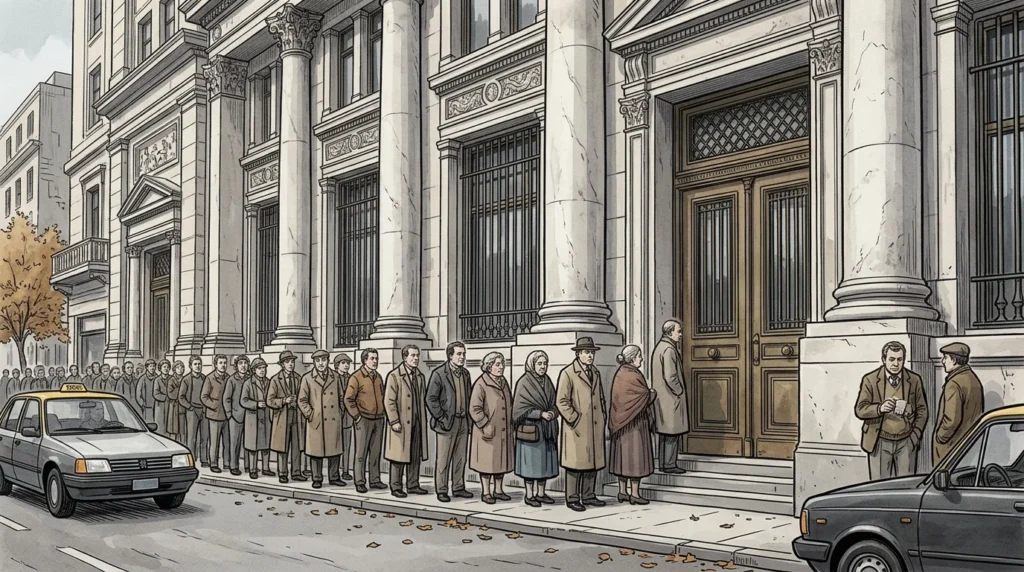
When Mexico abruptly devalued the peso on December 20, 1994, the shockwaves struck Argentina’s banking system with immediate and devastating force. Between December 1994 and May 1995, a systemic run known as the “Tequila Effect” drained approximately US$8 billion—roughly 18 percent of total deposits—from Argentine commercial banks. Unlike traditional central banks, the Central Bank of the Argentine Republic (BCRA) operated under the strict statutory constraints of the 1991 Convertibility Law, a currency-board arrangement that pegged the peso one-to-one to the U.S. dollar and prohibited unbacked money creation to rescue illiquid lenders. Confronted with a systemic liquidity squeeze that began with the failure of wholesale bond trader Banco Extrader, Economy Minister Domingo Cavallo and BCRA President Roque Fernández engineered an unprecedented regulatory overhaul: shrinking the fragmented banking system from 205 institutions to 127 through closures and mergers, establishing the privately funded SEDESA deposit insurance scheme, reforming bank resolution under Article 35 bis, and creating systemic liquidity buffers backed by international contingent repurchase lines. [1]
The 1991 Convertibility Regime and the Lender-of-Last-Resort Constraint
Enacted in March 1991 by Economy Minister Domingo Cavallo to halt decades of chronic hyperinflation, Argentina’s Convertibility Law anchored the domestic monetary base to hard foreign-exchange reserves at a fixed parity of one peso per U.S. dollar. Along with the 1992 revision of the BCRA Charter, the regime legally barred the central bank from extending unbacked credit to the fiscal treasury or to commercial banks, while abolishing explicit state deposit insurance in an effort to eradicate moral hazard. [2]
During the capital-inflow boom between 1991 and 1994, price stability returned rapidly and total deposits in the Argentine banking system more than tripled to roughly US$45 billion. Yet the system remained structurally fragmented across 205 financial institutions, including provincial state-owned banks burdened by political lending, small cooperative banks, and wholesale merchant banks that held leveraged portfolios of Latin American sovereign bonds funded by overnight interbank deposits. Under the currency-board rules, only the narrow portion of Central Bank international reserves exceeding 80 percent of the monetary base (or up to one-third backed by dollar-denominated Argentine sovereign bonds under the charter’s strict limits) could be mobilized to provide liquidity relief during a panic. [3]
December 1994: The Mexican Devaluation and the Collapse of Banco Extrader
The December 20, 1994 devaluation of the Mexican peso caused international institutional investors to reassess currency pegs and external deficits across Latin America. As yields on Argentine Brady bonds and domestic sovereign debt spiked, wholesale banks carrying unhedged bond inventories suffered immediate mark-to-market losses and margin calls. Within days of the Mexican shock, Banco Extrader—a specialized wholesale bank heavily exposed to Mexican and Argentine government securities—failed to meet its interbank clearing obligations and was suspended by the BCRA, becoming the first institutional casualty of the crisis. [4]
The failure of Banco Extrader and the subsequent suspension of several other wholesale lenders—including Banco Basel, Banco Finansur, and Banco Medefin—paralyzed the Buenos Aires interbank money market. Healthy major banks refused to lend overnight funds to second-tier cooperative and regional banks, fearing hidden bond losses. What began in late December 1994 as a wholesale funding freeze mutated by January and February 1995 into a nationwide retail bank run. [5]
The 18 Percent Deposit Drain and Improvised Liquidity Defenses
The retail panic unfolded in two distinct phases during the first five months of 1995. In January and February, depositors shifted funds out of small cooperative and provincial banks into large domestic and foreign-owned commercial banks—a classic “flight to quality”—while converting peso accounts into dollar-denominated deposits inside the domestic system. By late February and March 1995, however, fears of an outright devaluation or deposit freeze ahead of the May 1995 presidential election triggered an indiscriminate run out of both peso and dollar accounts across nearly all categories of banks. [6]
Between late December 1994 and mid-May 1995, total banking system deposits fell by approximately US$8 billion, or 18.4 percent of the pre-crisis deposit base, while BCRA international reserves dropped by more than US$5 billion. To prevent a complete payment-system breakdown without violating the Convertibility Law, Roque Fernández and the BCRA improvised emergency liquidity valves. First, the central bank slashed statutory reserve requirements on demand and time deposits from as high as 43 percent down to 30 percent on sight accounts and 1 percent on time deposits, freeing roughly US$3.3 billion in commercial bank reserves. Second, the authorities coordinated a private safety-net pool initially administered through state-owned Banco de la Nación Argentina, utilizing a 2 percent mandatory reserve contribution to purchase loan portfolios from illiquid banks. Third, in February 1995, the Argentine Congress amended the BCRA Charter to permit fuller utilization of excess backing reserves for temporary rediscounts and repurchase operations with illiquid but solvent institutions. [7]
International Rescue, Article 35 bis, and SEDESA Deposit Insurance
Recognizing that domestic reserve buffers were nearing exhaustion, Cavallo negotiated a multilateral financial support package in March 1995 totaling approximately US$5 billion from the International Monetary Fund (IMF), the World Bank, and the Inter-American Development Bank (IDB), supplemented by US$2 billion in “Patriotic Bonds” (*Bono Patriótico*) subscribed by domestic corporations and international banks. Following President Carlos Menem’s reelection on May 14, 1995, confidence stabilized and deposits began flowing back into the banking system. [8]
To resolve the dozens of insolvent banks exposed by the run without triggering court-ordered liquidation freezes that previously locked up depositors’ funds for years, Congress enacted Law 24,485 in April 1995. The statute introduced two critical pillars of modern Argentine bank resolution:
- Article 35 bis (Good-Bank / Bad-Bank Resolution): This amendment to the Financial Institutions Law empowered the BCRA to carve out performing assets and privileged deposit liabilities from a failing bank and transfer them cleanly to acquiring commercial banks, leaving only residual non-performing assets and subordinated claims in the judicial liquidation estate.
- SEDESA (Seguro de Depósitos S.A.): Reversing the 1992 abolition of deposit insurance, the government established a privately managed, risk-adjusted deposit guarantee fund administered by SEDESA. Funded entirely by mandatory monthly premiums from commercial banks rather than the central bank or fiscal budget, SEDESA insured retail sight and time deposits up to US$10,000 (and up to US$20,000 for deposits of 90 days or longer) and gained authority to inject capital or facilitate Article 35 bis acquisitions.
Supported by two World Bank- and IDB-backed fiduciary vehicles—the Fiduciary Fund for Bank Capitalization (FFCB) for private bank mergers and the Fiduciary Fund for Provincial Development (FFDP) for privatizing insolvent provincial state banks—the Argentine banking sector underwent dramatic consolidation. Between December 1994 and late 1996, closures, absorptions, and provincial privatizations reduced the total number of financial institutions in Argentina from 205 to 127.
The BASIC Regulatory Framework and Contingent Repo Lines
Determined never again to face a systemic run without external liquidity cushions, BCRA President Roque Fernández and his successor Pedro Pou constructed a widely studied currency-board regulatory architecture between 1995 and 1998. The BCRA replaced traditional unremunerated reserve requirements with “Systemic Liquidity Requirements” (*Requisitos Mínimos de Liquidez*) reaching 20 percent of deposits, which banks could hold in interest-bearing offshore accounts at top-rated international banks or in OECD sovereign securities.
In December 1996, the BCRA complemented these liquid reserves by signing a pioneering Contingent Repurchase Facility with a consortium of 13 international commercial banks led by Chase Manhattan. Under this contract, in exchange for an annual commitment fee, the BCRA secured the right to sell dollar-denominated Argentine sovereign bonds and domestic mortgage assets under repurchase agreements for up to US$6.1 billion (roughly 10 percent of the deposit base) in the event of a systemic run—effectively outsourcing the lender-of-last-resort function to international private balance sheets. Combined with the “BASIC” supervisory regime (Bonds, Auditing, Supervision, Information, and Credit Ratings), these reforms turned post-Tequila Argentina into an international benchmark for emerging-market bank supervision during the late 1990s, even though they ultimately could not insulate the banking system from sovereign default and currency mismatch when the Convertibility regime collapsed in 2001–2002.
Theoretical & Balance-Sheet Transmission Mechanism
In the Kindleberger–Minsky taxonomy of financial instability (Kindleberger, 1978; Minsky, 1986) and Irving Fisher’s (1933) debt-deflation framework, speculative asset booms become systemic crises when credit expansion shifts balance sheets from hedge finance (cash flows covering principal and interest) to speculative and Ponzi finance (relying on rising asset prices and short-term margin roll-overs).
Once monetary tightening or an exogenous shock halts price appreciation, forced margin liquidations trigger Fisherian debt-deflation: fire-sale asset discounts erode bank collateral values, contracting credit supply across the real economy.
Sources and Further Reading
- Martín Uribe, “ The Tequila Effect: Theory and Evidence from Argentina,” Board of Governors of the Federal Reserve System, International Finance Discussion Papers No. 552, 1996. Central Bank / Monetary Authority
- Pablo E. Guidotti, “ Central Banking, Crisis Management, and Financial Stability in Emerging Economies: The Argentine Experience,” Deutsche Bundesbank / Sveriges Riksbank Conference Paper, 2016. Central Bank / Monetary Authority
- John H. Welch, “ Swallowing the Tequila Worm: Mexico and Argentina in 1995,” Federal Reserve Bank of Dallas Southwest Economy, 1995. Central Bank / Monetary Authority
- Augusto de la Torre, “ Resolving Bank Failures in Argentina: Recent Developments and Issues,” World Bank Policy Research Working Paper No. 2295 (via RePEc), 2000. International Financial Institution
- World Bank, “ Argentina: Crisis and Poverty 2003 — Background on 1995 Financial Consolidation,” World Bank Group, 2003. International Financial Institution
- Charles W. Calomiris, “ Lessons from the Tequila Crisis for Successful Financial Liberalization,” American Enterprise Institute (AEI), 1999. Historical & Financial Reference
- Irving Fisher — "The Debt-Deflation Theory of Great Depressions," Econometrica 1, no. 4 (FRASER Federal Reserve Archive, 1933): 337–357 Central Bank / Monetary Authority
- Charles P. Kindleberger & Robert Z. Aliber — Manias, Panics, and Crashes: A History of Financial Crises (Palgrave Macmillan) Peer-Reviewed / Academic Research
Cite This Historical Dossier (APA / Chicago)
APA (7th ed.): Ç., S. (Ed.). (2026). The 1995 Argentine Tequila Banking Run and Currency-Board Supervision. In Forgotten Fortunes Historical Monograph Series (Forgotten Fortunes Editorial Desk). https://forgottenfortunes.net/argentina-1995-tequila-bank-crisis/
MLA (9th ed.): Ç., Soner, ed. "The 1995 Argentine Tequila Banking Run and Currency-Board Supervision." Forgotten Fortunes: Financial & Monetary History Archive, 2026, https://forgottenfortunes.net/argentina-1995-tequila-bank-crisis/.
Chicago (17th ed.): Ç., Soner, ed. "The 1995 Argentine Tequila Banking Run and Currency-Board Supervision." Forgotten Fortunes Historical Monograph Series (Forgotten Fortunes Editorial Desk), September 11, 2026. https://forgottenfortunes.net/argentina-1995-tequila-bank-crisis/.
Have an idea for another financial history documentary or article? Request a story →