In This Article
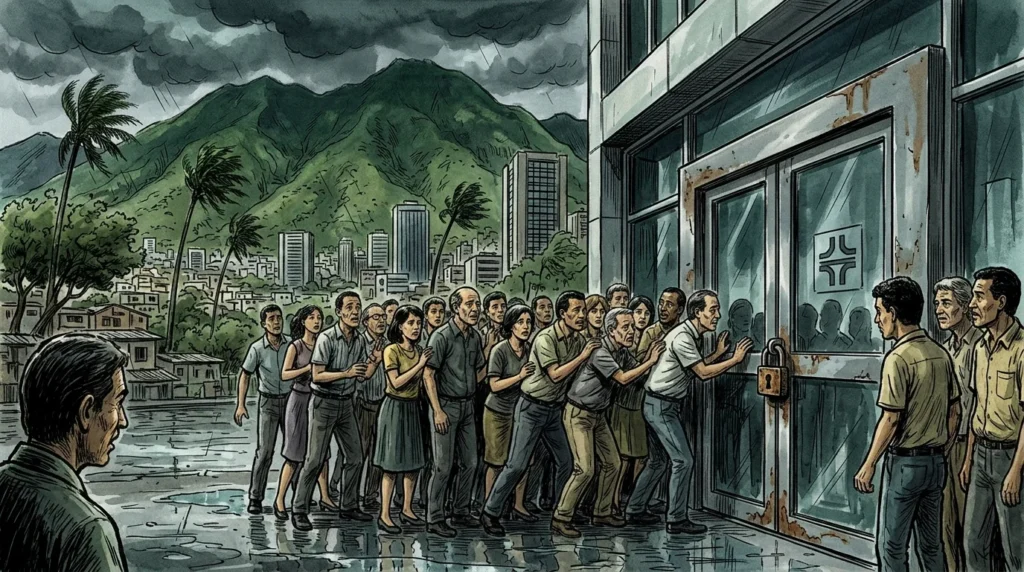
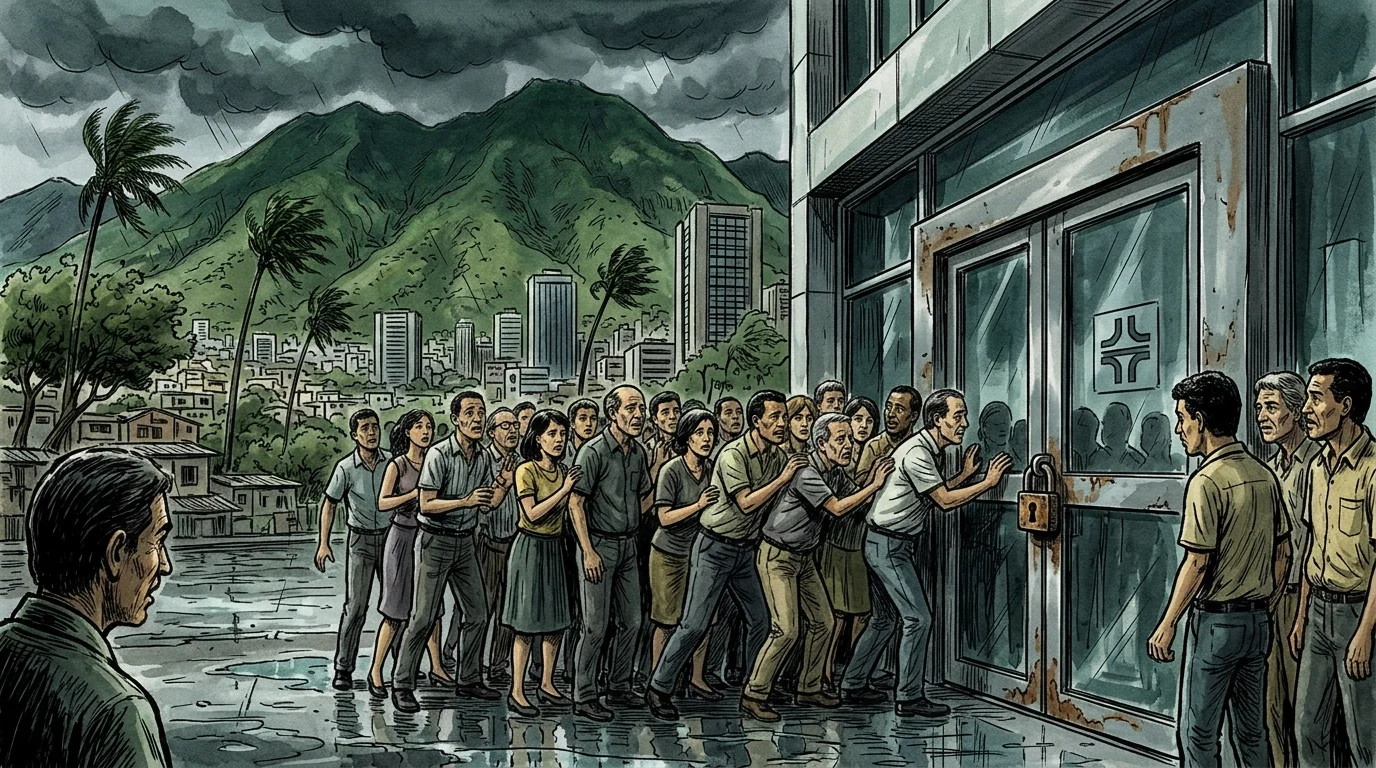
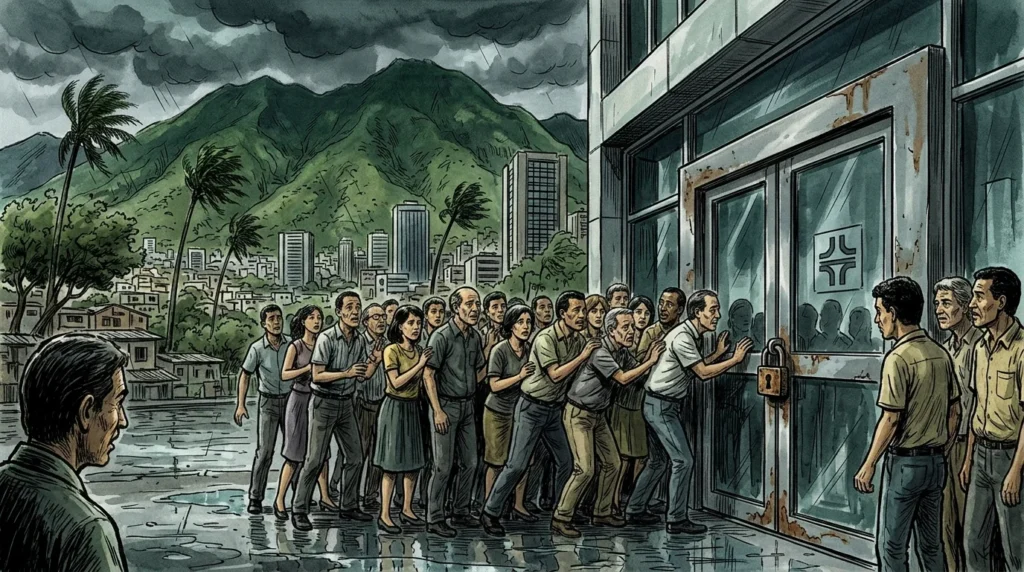
On November 29, 1982, the administration of Venezuelan President Luis Herrera Campíns and Central Bank of Venezuela (BCV) President Leopoldo Díaz Bruzual ordered the immediate state intervention of the Banco de los Trabajadores de Venezuela (BTV)—the country’s largest combined commercial and mortgage lender. Excluded from the BCV clearinghouse after failing to cover hundreds of millions of bolívares in daily check clearings, the union-controlled financial colossus collapsed under more than Bs. 11 billion in illiquid real-estate ventures and loans to its own shell subsidiaries. Less than three months later, on February 18, 1983—remembered in Venezuela as Viernes Negro (“Black Friday”)—relentless capital flight forced the government to abandon the historic 4.30 bolívares per US dollar exchange rate that had anchored the oil economy for two decades. [1]
While international accounts of Venezuelan financial history often begin with the systemic banking crash of 1994, the institutional fault lines of Venezuelan banking were forged across two earlier waves of crisis between 1961 and 1985. The first wave, triggered by capital flight and the collapse of the Caracas construction boom after the January 1958 overthrow of dictator Marcos Pérez Jiménez, forced the BCV to intervene in Banco Táchira and Banco Fomento Comercial de Venezuela in 1961–1962 and produced the General Banking Law of 1961. The second wave, fueled by the 1970s petrodollar windfall and the 1978–1982 failures of Banco Nacional de Descuento (BND) and BTV, exposed the absence of a formal depositor safety net and compelled President Jaime Lusinchi to establish the Deposit Guarantee and Bank Protection Fund (FOGADE) on March 20, 1985. [2]
The Post-Pérez Jiménez Capital Flight and the 1961–1962 Banking Interventions
Between 1945 and 1957, surging post-World War II petroleum royalties and the monumental public-works and urban construction projects of General Marcos Pérez Jiménez transformed Venezuela’s banking sector. Nineteen new private commercial banks opened across the country, while the state-owned Corporación Venezolana de Fomento (CVF, founded in 1947) and Banco Industrial de Venezuela sponsored six regional development banks (Bancos de Fomento Regional). Because Venezuela lacked specialized long-term mortgage lenders, commercial banks routinely used short-term sight and savings deposits to finance speculative Caracas land subdivisions, luxury apartment towers, and discounted promissory notes issued by government public-works contractors. [3]
When a civic-military uprising overthrew Pérez Jiménez on January 23, 1958, this fragile maturity transformation unraveled. The incoming democratic government of Rómulo Betancourt audited and froze dubious construction contracts from the dictatorship, bursting the Caracas real-estate bubble. At the same time, political instability, regional anxiety following the 1959 Cuban Revolution, and capital flight drained more than US$1 billion in gold and dollar reserves from the Central Bank of Venezuela between 1958 and late 1960, forcing Finance Minister José Antonio Mayobre to impose exchange controls in November 1960. [4]
For Venezuela’s commercial banks, the combination of capital flight and real-estate deflation was devastating. Between mid-1959 and 1961, total private deposits in commercial banks shrank by more than 20%, while construction developers defaulted across Caracas. Between 1961 and 1963, thirty banking offices closed nationwide and the commercial banking system recorded net aggregate losses for the first time in modern Venezuelan history. [5]
To prevent a domino-style collapse of the payments system, the BCV extended massive emergency rediscounts and liquidity advances (redescuentos y anticipos) to troubled institutions. Two prominent banks that had accumulated heavy concentrations of uncollectible insider and real-estate loans proved beyond rescue through ordinary liquidity lines: the Superintendency of Banks (Sudeban) and the BCV formally intervened in Banco Táchira in 1961 (suspending its operations and placing it into a protracted liquidation) and intervened to restructure Banco Fomento Comercial de Venezuela in 1961–1962. [6]
To address the structural cause of the 1961–1962 crisis—the funding of long-term real estate with short-term commercial deposits—Congress enacted the General Law of Banks and Other Credit Institutions (Ley General de Bancos y otros Institutos de Crédito) on February 13, 1961. The statute enforced strict functional specialization, confining commercial banks to short-term working-capital loans while creating dedicated Mortgage Banks (bancos hipotecarios funded by long-term mortgage bonds known as cédulas hipotecarias) and, alongside US Alliance for Progress technical assistance, the National Savings and Loan System (Sistema Nacional de Ahorro y Préstamo, overseen by BANAP from 1966). [7]
Petrodollar Euphoria, the 1978 BND Failure, and the Rise of the Workers’ Bank (BTV)
Ironically, the strict functional separation enacted after the 1961–1962 banking crisis was bypassed within seven years by a politically untouchable statutory exception: the Banco de los Trabajadores de Venezuela (BTV). Created by a special organic law in 1967 and opening its doors in 1968, BTV was conceived under the banner of social-democratic labor capitalism as a joint venture between Venezuela’s dominant trade union federation—the Confederación de Trabajadores de Venezuela (CTV), closely tied to the ruling Acción Democrática (AD) party—and the Venezuelan national government. [8]
Unlike private financial institutions governed by the 1961 Banking Law, BTV’s special charter exempted it from functional specialization, authorizing a single institution to operate simultaneously as a commercial bank, a mortgage bank, and an investment finance company (sociedad financiera). When the 1973–1974 OPEC oil price quadrupling flooded Venezuela with petrodollars during the first presidency of Carlos Andrés Pérez (1974–1979), commercial bank deposits doubled and total branches tripled nationwide.
Even at the height of the oil boom, lax supervision by Sudeban allowed sprawling financial-industrial conglomerates to use captive banks for insider self-lending (autopréstamos). The first major tremor struck on December 7, 1978, just days after the presidential election of opposition COPEI candidate Luis Herrera Campíns, when the outgoing administration had to intervene in the Banco Nacional de Descuento (BND)—then Venezuela’s largest private commercial bank, led by financier José Joaquín González Gorrondona—after BND suffered acute illiquidity from billions of bolívares lent to its own real-estate, industrial, and shipping affiliates. With no deposit insurance fund in existence, the BCV and the National Treasury had to pour over Bs. 7 billion into BND over the next several years before placing it into final liquidation in 1985.
While BND foundered, the union-controlled Banco de los Trabajadores de Venezuela expanded at breakneck speed under its powerful president Eleazar Pinto, a senior CTV and Acción Democrática labor leader. Favored by massive placements of public-sector agency deposits, union pension funds, and state-backed working-class housing mandates, BTV grew by 1981–1982 into the largest financial institution in Venezuela, commanding total assets exceeding Bs. 25 billion (roughly US$5.8 billion at the Bs. 4.30 per dollar exchange rate).
November 29, 1982: The Collapse and Intervention of BTV
Beneath BTV’s rapid asset growth lay a fatal maturity and governance trap. Taking advantage of its triple license as a commercial, mortgage, and investment bank, Eleazar Pinto and BTV’s board used short-term government deposits and high-interest retail time deposits to fund long-term real-estate projects and corporate acquisitions. By 1982, official audits revealed that approximately 41% of BTV’s entire loan and investment portfolio—more than Bs. 11 billion—was locked up in loans and equity stakes in over fifty affiliated construction, land-development, and shell companies (such as the Grupo IBSA).
Many of these affiliate companies generated no operating cash flow; instead, BTV repeatedly rolled over their delinquent obligations and booked unpaid interest as fresh income, while spending lavishly on publicity and political patronage. As BCV President Leopoldo Díaz Bruzual later disclosed, internal inspection reports showed that BTV’s balance sheet had been structurally impaired since the second half of 1978, but its immense political backing from the CTV labor confederation deterred regulators from acting.
The reckoning arrived in 1982 when global oil prices softened and Venezuelan savers—anticipating an inevitable devaluation of the bolívar—began converting local deposits into US dollars at a pace exceeding US$100 million per week. As public-sector entities and private depositors withdrew cash, BTV suffered chronic deficits in the BCV’s daily check clearinghouse (cámara de compensación). Over the course of 1982, the Central Bank injected more than Bs. 2 billion in emergency support into BTV—purchasing Bs. 1,240 million of BTV mortgage bonds, releasing Bs. 500 million in legal reserve requirements, and granting Bs. 190 million in direct rediscounts and advances.
By November 1982, with BTV executives and their relatives quietly redeeming their own fixed-term deposits ahead of maturity, BCV President Díaz Bruzual refused to continue monetizing BTV’s unbacked clearinghouse overdrafts. When BTV failed to cover its clearinghouse deficit of more than Bs. 300 million, the Central Bank excluded BTV from the national clearinghouse and President Luis Herrera Campíns ordered the formal intervention of the Banco de los Trabajadores de Venezuela on November 29, 1982.
Political Shockwaves, Viernes Negro, and the 1985 Creation of FOGADE
The fall of BTV triggered an immediate political and financial earthquake. While CTV union leaders denounced the COPEI government’s intervention as a partisan attack on organized labor, a December 1982 presidential report exposed the bank’s massive self-lending to delinquent subsidiaries, phantom scholarships abroad, indefinite paid leave for political operatives, and insider deposit withdrawals, leading criminal courts to issue arrest warrants for Eleazar Pinto and dozens of BTV directors and managers.
For thousands of ordinary workers, union cooperatives, and small savers whose accounts were frozen at BTV—and for the broader Venezuelan financial market—the collapse shattered confidence in domestic banking institutions. Combined with the state oil company PDVSA’s central bank reserve centralization and Petróleos debt fears, the BTV shock accelerated the flight from the bolívar that culminated eighty-one days later on February 18, 1983 (Viernes Negro), when Herrera Campíns and Díaz Bruzual suspended free foreign-exchange trading, ended the twenty-year Bs. 4.30 per dollar parity, and established the tiered RECADI exchange-control regime.
Most critically, the failures of BND (1978), the agricultural development bank Bandagro (1981), and BTV (1982)—soon followed by stress at regional development banks and the June 1985 collapse of Banco de Comercio—highlighted a glaring institutional vacuum: Venezuela had no deposit insurance corporation or statutory bank-resolution agency. Every time a bank failed, the National Treasury and the BCV had to improvise ad-hoc fiscal rescues and central bank advances while small retail depositors waited months or years in legislative limbo to recover their savings.
To close that institutional gap, newly elected President Jaime Lusinchi promulgated Presidential Decree No. 540 on March 20, 1985 (published in Official Gazette No. 33.190 on March 22, 1985), creating the Deposit Guarantee and Bank Protection Fund (Fondo de Garantía de Depósitos y Protección Bancaria, or FOGADE). Configured as an autonomous public institute financed by mandatory semi-annual assessments of 0.25% on commercial bank deposits alongside BCV credit lines, FOGADE was mandated to guarantee domestic savings and time deposits (initially up to Bs. 250,000 per depositor), provide open-bank financial assistance to distressed credit institutions, and serve as the statutory liquidator of insolvent banks. While FOGADE successfully managed the mid-1980s liquidations of BND and Banco de Comercio, the persistence of weak prudential supervision and insider banking groups meant that the fund created in the wake of the 1982 BTV collapse would face an even more catastrophic systemic test nine years later during the Venezuelan banking crisis of 1994.
Theoretical & Balance-Sheet Transmission Mechanism
In the Kindleberger–Minsky taxonomy of financial instability (Kindleberger, 1978; Minsky, 1986) and Irving Fisher’s (1933) debt-deflation framework, speculative asset booms become systemic crises when credit expansion shifts balance sheets from hedge finance (cash flows covering principal and interest) to speculative and Ponzi finance (relying on rising asset prices and short-term margin roll-overs).
Once monetary tightening or an exogenous shock halts price appreciation, forced margin liquidations trigger Fisherian debt-deflation: fire-sale asset discounts erode bank collateral values, contracting credit supply across the real economy.
Sources and Further Reading
- Nikita Harwich Vallenilla, “Bancos,” Diccionario de Historia de Venezuela, Fundación Empresas Polar, 2010. Historical & Financial Reference
- Banco Central de Venezuela (BCV), “Quiebras Bancarias y Crisis Financieras en Venezuela,” Banco Central de Venezuela, Official Monetary and Financial History Series. Historical & Financial Reference
- Fundación Empresas Polar, “1982: Intervención del Banco de los Trabajadores de Venezuela y Auxilios del BCV,” Cronología de Historia de Venezuela, Fundación Empresas Polar, 2010. Historical & Financial Reference
- Fundación Empresas Polar, “1982: Informe sobre las Irregularidades del Banco de los Trabajadores de Venezuela,” Cronología de Historia de Venezuela, Fundación Empresas Polar, 2010. Historical & Financial Reference
- Instituto de Investigaciones Económicas y Sociales (IIES), “Crisis Financiera, Intervenciones Bancarias y el Rol de FOGADE en Venezuela,” Revista Economía (Universidad de Los Andes, Mérida), No. 11, 1996. Historical & Financial Reference
- Fondo de Cultura Económica, “Banca Comercial, Fuga de Capitales y Política Monetaria en Venezuela,” El Trimestre Económico, Historical Archive. Historical & Financial Reference
- Irving Fisher — "The Debt-Deflation Theory of Great Depressions," Econometrica 1, no. 4 (FRASER Federal Reserve Archive, 1933): 337–357 Central Bank / Monetary Authority
- Charles P. Kindleberger & Robert Z. Aliber — Manias, Panics, and Crashes: A History of Financial Crises (Palgrave Macmillan) Peer-Reviewed / Academic Research
Cite This Historical Dossier (APA / Chicago)
APA (7th ed.): Ç., S. (Ed.). (2026). Venezuela's 1961 Bank Runs, the 1982 BTV Collapse, and the 1985 Birth of FOGADE. In Forgotten Fortunes Historical Monograph Series (Forgotten Fortunes Editorial Desk). https://forgottenfortunes.net/venezuela-1982-btv-bank-collapse/
MLA (9th ed.): Ç., Soner, ed. "Venezuela's 1961 Bank Runs, the 1982 BTV Collapse, and the 1985 Birth of FOGADE." Forgotten Fortunes: Financial & Monetary History Archive, 2026, https://forgottenfortunes.net/venezuela-1982-btv-bank-collapse/.
Chicago (17th ed.): Ç., Soner, ed. "Venezuela's 1961 Bank Runs, the 1982 BTV Collapse, and the 1985 Birth of FOGADE." Forgotten Fortunes Historical Monograph Series (Forgotten Fortunes Editorial Desk), September 13, 2026. https://forgottenfortunes.net/venezuela-1982-btv-bank-collapse/.
Have an idea for another financial history documentary or article? Request a story →