In This Article
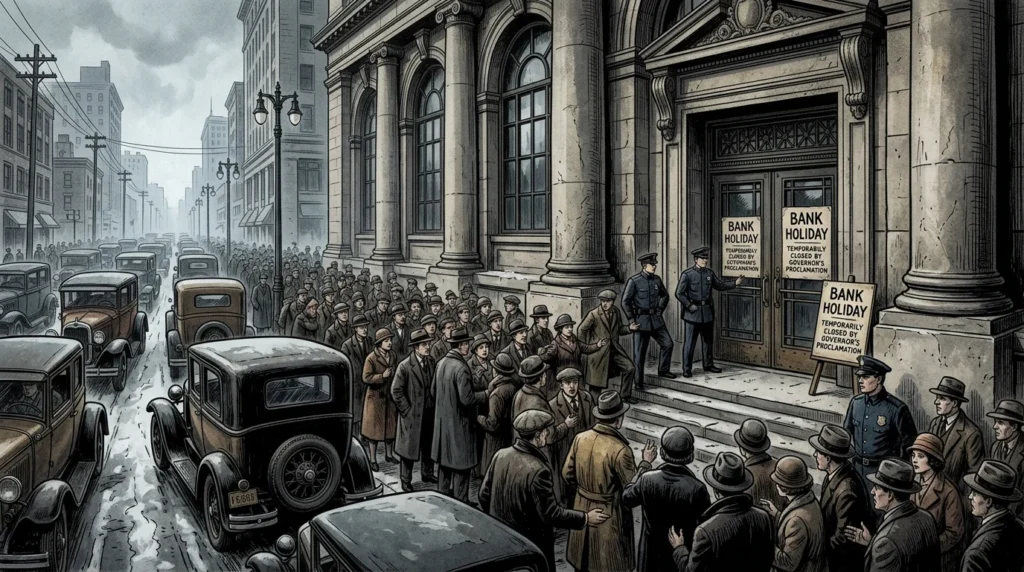
On May 10, 1837, banks in New York City stopped exchanging their paper money for gold and silver. It was a desperate attempt to protect their remaining reserves, but the decision exposed a much larger financial emergency. [1]

Across the United States, credit was disappearing, merchants were failing, and confidence in banks was collapsing. Land that had attracted enthusiastic investors became difficult to sell. Cotton, the country’s most important export, lost value just as borrowers needed money to repay their debts.
The Panic of 1837 became one of the most damaging financial crises in early American history. Its consequences would extend well beyond the initial bank runs. [2]
The central question was not simply why people suddenly lost confidence. It was how a rapidly expanding economy had built so much of its prosperity on credit that a shortage of reliable money could bring large parts of the system to a halt.
The Credit Boom Before the Panic of 1837
During the early 1830s, the United States appeared to be entering an era of extraordinary opportunity.
Settlement and commercial agriculture were expanding westward. New canals and railroads promised to connect distant communities with growing cities and ports. Cotton production was increasing, and American merchants were building extensive trading relationships with Britain.
Banks helped finance this expansion.
Unlike modern American currency, much of the paper money circulating in the 1830s consisted of notes issued by individual banks. A banknote represented a promise that its issuing bank would exchange it for a specified amount of gold or silver coin.
Those coins were known as specie.
Banks could issue notes and extend loans without holding an equal amount of coin for every dollar of their outstanding obligations. That was a normal feature of banking, but it also created vulnerability. If too many customers demanded payment in specie at once, even a bank with valuable loans and other assets might struggle to meet their demands.
During prosperous periods, the system could support rapid growth.
A bank might lend money to a merchant purchasing goods, a planter expanding cotton production, or an investor buying western land. Borrowers spent the funds, businesses received payments, and the resulting transactions supported further lending.
However, much of this apparent wealth depended on future prices remaining high and borrowers continuing to obtain credit. Land speculation became especially intense. Investors purchased property expecting to resell it at a profit. Federal land sales generated substantial government revenue, while rising land values encouraged further borrowing. Some of this expansion occurred on territories opened to white settlement through the forced removal and dispossession of Native American peoples.
The financial boom also depended on an expanding system of plantation slavery. Enslaved people produced much of the cotton that generated export earnings, while plantation land and enslaved human beings were themselves used as collateral for loans.
The economy was growing, but its financial foundations were increasingly dependent on borrowed money, rising asset prices, and international confidence.
Andrew Jackson and the Destruction of the National Bank
One of the most important political developments preceding the crisis was President Andrew Jackson’s confrontation with the Second Bank of the United States. Established under a federal charter in 1816, the institution served several functions. It held government deposits, handled federal financial transactions, issued its own banknotes, and operated as a major commercial bank. It also exerted some discipline over state-chartered banks. [3]
When the Second Bank received notes issued by other banks, it could present those notes for redemption in specie. Banks that issued excessive amounts of paper money therefore risked losing their gold and silver reserves.
The Second Bank was not a modern central bank, but it was an influential institution within the American monetary system.
Jackson believed it possessed excessive economic and political power.
He regarded its federal privileges as an advantage benefiting wealthy investors and financial interests. His opponents argued that the institution helped maintain confidence and stability in banking.
The disagreement became known as the Bank War.
In 1832, Jackson vetoed legislation that would have renewed the Bank’s federal charter. His administration subsequently redirected federal deposits away from the institution and toward selected state banks. The Second Bank’s federal charter expired in 1836. It continued operating under a Pennsylvania state charter, but it no longer occupied its former national position. The consequences were complicated. [4]
The disappearance of the institution’s national functions weakened one source of discipline over state-bank note issuance. Many state banks expanded their lending during the boom.
However, it would be misleading to suggest that every bank suddenly became uncontrolled or that Jackson’s veto alone caused the crisis.
State banking practices varied considerably. Some institutions maintained more conservative lending standards than others, while international capital flows also contributed to the expansion of American credit.
Jackson’s banking policies changed the financial system at a dangerous moment. They were important contributors to the conditions surrounding the panic, but they were not the entire explanation.
The Specie Circular and the Movement of Money
By 1836, land speculation had become a major political concern.
Jackson’s administration feared that investors were purchasing federal land with excessive quantities of bank credit, driving up prices and encouraging unsustainable speculation.
On July 11, 1836, Treasury Secretary Levi Woodbury issued an instruction that became known as the Specie Circular. [5]
The order generally required purchasers of federal public land to pay in gold or silver instead of ordinary bank paper, subject to limited temporary exceptions for qualifying settlers. The objective was to restrain speculative purchases and reduce dependence on questionable banknotes. But the order also changed where money was needed. Imagine a buyer who had obtained a bank loan and wanted to purchase government land in a western district.
Previously, the buyer might have used acceptable banknotes or banking instruments. Under the new requirements, the buyer generally needed actual gold or silver. Acquiring those coins could require drawing specie from banks in established financial centers. Money that had supported lending in places such as New York could therefore be redirected toward western land transactions. This was important because the banking system did not possess unlimited specie reserves.
The Specie Circular increased demand for the very form of money that banks needed to maintain confidence in their own notes.
Another government policy complicated matters. In June 1836, Congress approved legislation arranging for much of the federal government’s accumulated surplus to be deposited with the states. The transfers began in 1837. Moving government balances between banks and regions could place pressure on institutions losing deposits, especially if they had already lent much of their available funds. [6]
The precise importance of these policies remains debated.
Economic historian Peter Rousseau has argued that transfers of government deposits, combined with increased demand for specie in western states, played a particularly important role in weakening New York banks.
Other historians emphasize different combinations of domestic policy, international finance, and commercial failures.
The distinction matters. The federal surplus distribution and the Specie Circular were related to the broader monetary disruption, but they were not interchangeable policies, and their individual effects cannot be established simply by observing that the panic followed them.
How Britain and Cotton Transmitted the Crisis
The American banking system was vulnerable to developments far beyond Washington. Britain was a major source of credit for American merchants and an important market for American cotton. In the 1830s, cotton connected the financial interests of southern plantations, American merchants, British manufacturers, and London banking houses. The system relied on more than the physical movement of cotton.
It also relied on promises to pay.
A merchant handling cotton might obtain financing through a bill of exchange — a document requiring payment at a future date. Such instruments allowed goods to move through international trade before every participant had received the money ultimately owed.
British financial firms could discount these bills, providing immediate funds in exchange for the right to collect later. This helped American commerce expand, but it also created chains of financial dependency. A southern merchant might rely on credit from a commercial house, which in turn depended on the willingness of British institutions to finance its bills. When lenders became cautious, the consequences could spread across the Atlantic.
British Credit Tightens
During 1836, the Bank of England became concerned about pressure on its gold reserves and moved to restrict credit. British financial institutions became less willing to extend financing on the same terms as before. For American merchants dependent on short-term borrowing, tighter credit created an immediate problem. Debts still had to be paid, even when new loans became harder to obtain. [7]
The difficulties intensified when cotton prices fell in early 1837.
Cotton was particularly important because it represented a major source of American export earnings. Lower prices reduced the value of shipments and weakened the financial position of merchants and planters.
Loans supported by cotton became more difficult to repay.
Commercial houses that had expected profitable sales suddenly faced losses and urgent demands from creditors.
Some failed.
Those failures then damaged the financial institutions that had extended credit to them.
In this way, trouble in the cotton trade became trouble for banks and merchants operating far beyond the South.
A Crisis Without Modern Financial Borders
The financial links between London, Liverpool, New Orleans, and New York made it possible for pressure in one market to undermine confidence in another.
Trade, credit, and specie movements connected institutions that might appear geographically distant but were financially dependent on one another.
Historian Stephen W. Campbell has emphasized the wider international dimensions of the crisis, including flows of precious metals connecting the United States with Britain, Mexico, China, and other parts of the trading world.
Yet historians disagree about the relative importance of the international shock. Rousseau’s research suggests that domestic monetary disturbances had already left major New York banks dangerously exposed before the final phase of the panic. The international credit squeeze and the fall in cotton prices added pressure to an unstable banking system. The crisis was therefore not simply imported from Britain, nor was it entirely created by decisions in Washington.
American financial fragility and international credit contraction reinforced one another.
May 1837: When the Banking System Broke
By the spring of 1837, merchants were struggling to settle their obligations.
Commercial failures damaged confidence in the firms and banks that financed trade. Customers became increasingly concerned about whether their paper money and deposits could be converted into gold or silver.
This concern created a classic banking problem. Banks normally keep only part of their obligations in immediately available reserves. Much of their money is tied up in loans that cannot be collected overnight. When customers believe a bank might become unable to pay, withdrawing funds becomes a reasonable individual response. But when many customers attempt to withdraw at once, their actions can produce the very shortage they fear.
That is the mechanism of a bank run.
As demands for specie increased, banks faced difficult choices. They could attempt to call in loans, reduce lending, obtain additional coin, or suspend redemption. Calling in loans made conditions worse for borrowers. Selling assets quickly could mean accepting steep losses. Continuing to exchange notes and deposits for specie risked exhausting reserves.
On May 10, 1837, New York City banks suspended specie payments. Their notes and deposit obligations had not simply disappeared. Rather, the banks had stopped honoring demands to convert them into gold and silver on the usual terms. This distinction is essential. A suspension of specie payments was not the same thing as bankruptcy, and not every bank that suspended payments ultimately failed. [8]
Nevertheless, the suspension was a profound disruption.
It undermined public confidence in bank money and made financial transactions more difficult. Banks elsewhere also suspended payments, while the contraction in credit spread through commerce.
Businesses that depended on borrowing suddenly found it harder to obtain funds. Merchants struggled to pay suppliers. Banks struggled to collect loans. The declining availability of trustworthy credit made ordinary commercial activity increasingly uncertain. The crisis was not caused by a single nationwide bank run beginning on one morning. Financial failures and localized panics had already been developing in several commercial centers. But May 10 marked a decisive point at which distress became a general crisis of confidence in the American banking system. [9]
From Banking Panic to Economic Depression
A financial panic becomes an economic depression when failures within the banking system disrupt production, employment, trade, and household income. That process unfolded across the United States. Merchants who had relied on credit to purchase inventories reduced their orders. Businesses unable to refinance their obligations closed or contracted. Construction and internal improvement projects became more difficult to finance.
Workers faced unemployment, shorter working hours, and reduced earnings. Falling demand then placed additional pressure on prices. This created another damaging mechanism. Suppose a borrower owed $1,000 when prices and incomes were high. If the prices of the goods the borrower sold fell sharply, the debt would still be $1,000. [10]
The borrower would have to sell more goods to raise the same amount of money.
Economists call this problem debt deflation: falling prices can make existing debts more burdensome relative to the incomes and asset values available to repay them.
That burden encouraged further defaults and asset sales. The resulting losses damaged banks, which became even less willing to lend. Economic hardship was unevenly distributed.
Merchants with substantial debts were exposed to sudden financial ruin. Small businesses suffered when customers and lenders disappeared. Wage earners who depended on continuing employment faced immediate insecurity.
In the South, declining cotton prices disrupted plantation finance and exposed the risks of the credit system supporting slavery.
Enslaved people, who had no control over the loans and investment decisions built around their forced labor, remained vulnerable to being treated as financial property when owners and creditors confronted losses.
Contemporary political cartoons captured the visible consequences of the crisis.
Edward Williams Clay’s 1837 lithograph The Times, preserved by the Library of Congress, portrayed closed businesses, distressed workers, struggling families, and customers gathered outside a bank that had suspended specie payments. [11]
The image was political satire rather than a statistical record, but it reflected a contemporary understanding that the financial panic had become a social emergency.
There were also important regional differences.
Harvard Business School’s historical research identifies relatively conservative banking practices in parts of New England as one reason those institutions were better positioned than some more speculative banks.
The crisis did not destroy every institution equally. Its effects depended on lending practices, asset quality, regional economic conditions, and exposure to particular markets.
Why the Depression Continued After 1837
The first panic did not produce one uninterrupted collapse with a simple beginning and end. Some economic conditions improved during 1838, and banks in important financial centers gradually resumed specie payments. But the recovery was fragile. In 1839, another major financial contraction developed. [12]
This second crisis is essential to understanding why the broader depression became so prolonged. During the boom years, American state governments had borrowed extensively to finance canals, transportation networks, and other internal improvements. Such projects were supposed to support economic growth by making it cheaper and easier to move people and goods. But their financial success often depended on continued access to capital and expectations of future economic expansion.
When credit conditions deteriorated, many projects became difficult to complete or finance.
State governments faced rising debt burdens, weakening revenues, and reduced investor confidence.
Economic historian John Joseph Wallis argues that the crisis of 1839 had important domestic causes distinct from those of 1837, especially the expansion of state borrowing and the collapse of internal improvement investment.
The renewed downturn brought further bank suspensions and financial distress. Some states subsequently defaulted on their debts or repudiated particular obligations during the early 1840s. These events damaged confidence in American securities and reduced access to international capital. The longer depression involved several overlapping episodes: the original panic, an incomplete recovery, and a renewed contraction.
By the early 1840s, the combined effects had produced years of serious economic hardship.
The distinction between the 1837 and 1839 crises helps explain why it is too simple to attribute the entire downturn to a single presidential decision or monetary policy.
Martin Van Buren and the Political Consequences
Martin Van Buren became president on March 4, 1837, just as financial conditions were deteriorating. He inherited the consequences of the boom and the policies of the Jackson administration, but his own government had to respond to the immediate emergency. In September 1837, Van Buren addressed a special session of Congress. He acknowledged that widespread bank suspensions had disrupted the federal government’s arrangements for holding public money.
His principal institutional proposal was an Independent Treasury.
Under this system, federal funds would be held and managed separately from ordinary commercial banks. The objective was to reduce the government’s dependence on private banking institutions and protect public money from disruptions in the banking system. The proposal reflected Van Buren’s preference for limiting government involvement with commercial banking rather than creating a new national bank. Opponents argued that separating government funds from banks would do too little to restore lending and commercial activity.
The debate continued for years. Congress finally established an Independent Treasury system in 1840, but the legislation was repealed in 1841 following a political shift. A more durable version was enacted in 1846. The immediate economic benefits of Van Buren’s original proposal were limited.
Meanwhile, the depression seriously damaged his political standing. In the presidential election of 1840, Van Buren lost to William Henry Harrison. The financial crisis had therefore helped transform not only American banking but also the country’s political leadership and the debate over federal economic responsibilities.
Was Andrew Jackson Responsible for the Panic of 1837?
Jackson’s policies occupy a central place in the history of the crisis, but the question requires a distinction between contributing conditions and immediate triggers. His confrontation with the Second Bank changed the national banking structure. His administration’s Specie Circular increased demand for gold and silver in public land transactions. Federal deposit policies affected the movement of reserves between financial institutions.
These developments mattered.
Yet the crisis also reflected rapid private credit expansion, speculative asset purchases, excessive exposure to cotton, dependence on British financing, and the vulnerability of banks operating with limited immediately available reserves.
Even historians who agree on these facts differ over their relative importance. Some accounts emphasize the loss of discipline associated with the Second Bank’s decline. Others focus on the movement of government balances and coin between banks. Still others give particular weight to British credit restrictions, the collapse of commercial firms, and the fall in cotton prices.
These explanations need not be mutually exclusive. A banking system can become vulnerable for one set of reasons and collapse after pressure from another. That is particularly true when different financial institutions depend on one another.
The most defensible conclusion is that Jacksonian policy contributed to the conditions surrounding the panic, while private speculation and international financial disturbances helped transform those conditions into a systemic crisis.
Blaming one president alone obscures the structure of the economy that made the disaster possible.
What the Panic of 1837 Revealed About Financial Stability
The Panic of 1837 exposed a weakness that would reappear repeatedly in financial history. Economic expansion can create the appearance of abundant wealth while increasing dependence on continued borrowing. Banks finance investment. Asset prices rise. Borrowers become more confident, and lenders become more willing to extend credit. The system can appear healthy precisely because the expansion is still underway.
But rising asset prices do not guarantee that debts can be repaid, and valuable long-term investments do not necessarily provide the ready money needed during a panic. When confidence weakens, demands for immediate payment can overwhelm institutions whose assets are tied up in longer-term loans. The crisis also demonstrated the international nature of financial vulnerability.
American banks did not need to operate in London to be affected by British monetary conditions. Their borrowers and commercial partners were already connected to British credit markets through trade and finance.
The United States eventually developed new banking arrangements, although major financial panics continued throughout the nineteenth century.
The Federal Reserve System, established in 1913, emerged much later from continuing debates about banking instability and the need for a more flexible monetary system.
It would be inaccurate to describe the Panic of 1837 as the direct cause of the Federal Reserve’s creation. But the crisis formed part of the longer history that demonstrated the recurring dangers of fragmented banking and sudden credit contractions.
The fundamental lesson of 1837 was that financial prosperity and financial stability are not the same thing.
The United States had growing industries, expanding trade, valuable land, and enormous economic potential. What it lacked was a financial system capable of absorbing a severe loss of confidence without spreading distress throughout the economy. When credit contracted, the wealth created during the boom could not immediately be converted into the money needed to settle obligations. The resulting damage lasted years.
The Panic of 1837 was therefore more than a dispute over banking policy or a collapse in speculative land prices. It was an early demonstration of how domestic credit, international trade, public finance, and public confidence could become so interconnected that disruption in one part threatened the entire system.
Theoretical & Balance-Sheet Transmission Mechanism
In the Kindleberger–Minsky taxonomy of financial instability (Kindleberger, 1978; Minsky, 1986) and Irving Fisher’s (1933) debt-deflation framework, speculative asset booms become systemic crises when credit expansion shifts balance sheets from hedge finance (cash flows covering principal and interest) to speculative and Ponzi finance (relying on rising asset prices and short-term margin roll-overs).
Once monetary tightening or an exogenous shock halts price appreciation, forced margin liquidations trigger Fisherian debt-deflation: fire-sale asset discounts erode bank collateral values, contracting credit supply across the real economy.
Sources & Further Reading
- Federal Deposit Insurance Corporation (FDIC). 1800–1849: Historical Timeline, including the Panic of 1837. FDIC, historical banking chronology.
https://www.fdic.gov/history/1800-1849 Official / State Archive - David J. Erickson. Before the Fed: The Historical Precedents of the Federal Reserve System. Federal Reserve History. Covers the Second Bank of the United States, Jackson’s Bank War, and early American monetary institutions.
https://www.federalreservehistory.org/essays/before-the-fed Central Bank / Monetary Authority - Harvard Business School, Baker Library Historical Collections. 1837: The Hard Times. Historical research on speculation, banking practices, commercial failures, and the consequences of the panic.
https://www.library.hbs.edu/hc/crises/1837.html Peer-Reviewed / Academic Research - Peter L. Rousseau. Jacksonian Monetary Policy, Specie Flows, and the Panic of 1837. The Journal of Economic History, Vol. 62, No. 2, 2002, pp. 457–488. National Bureau of Economic Research Working Paper 7528, February 2000.
https://www.nber.org/papers/w7528 Peer-Reviewed / Academic Research - Stephen W. Campbell. The Transatlantic Financial Crisis of 1837. Oxford Research Encyclopedia of Latin American History, Oxford University Press, 2017.
https://doi.org/10.1093/acrefore/9780199366439.013.399 Peer-Reviewed / Academic Research - John Joseph Wallis. What Caused the Crisis of 1839? National Bureau of Economic Research, Historical Working Paper 0133, April 2001.
https://www.nber.org/papers/h0133 Peer-Reviewed / Academic Research - Sharon Ann Murphy. Banking on Slavery: Financing Southern Expansion in the Antebellum United States. University of Chicago Press, 2023. Research on southern banking, slavery, plantation finance, and the panics of 1837 and 1839.
https://doi.org/10.7208/chicago/9780226824604.001.0001 Peer-Reviewed / Academic Research - Levi Woodbury, U.S. Treasury Department. Circular from the Secretary of the Treasury to Receivers of Public Money and to the Deposit Banks. July 11, 1836. Primary document establishing the Specie Circular requirements. The American Presidency Project, University of California, Santa Barbara.
https://www.presidency.ucsb.edu/documents/circular-from-the-secretary-the-treasury-receivers-public-money-and-the-deposit-banks Peer-Reviewed / Academic Research - Martin Van Buren. Special Session Message to Congress. September 4, 1837. Primary presidential statement addressing the banking crisis and proposed Independent Treasury. Martin Van Buren National Historic Site, National Park Service.
https://www.nps.gov/mava/learn/historyculture/martin-van-buren-september-4-1837-special-session-message.htm Official / State Archive - U.S. Department of the Treasury. Levi Woodbury (1834–1841). Official historical biography discussing government deposits, federal surpluses, the Panic of 1837, and the Independent Treasury system.
https://home.treasury.gov/about/history/prior-secretaries/levi-woodbury-1834-1841 Official / State Archive - Irving Fisher — "The Debt-Deflation Theory of Great Depressions," Econometrica 1, no. 4 (FRASER Federal Reserve Archive, 1933): 337–357 Central Bank / Monetary Authority
- Charles P. Kindleberger & Robert Z. Aliber — Manias, Panics, and Crashes: A History of Financial Crises (Palgrave Macmillan) Peer-Reviewed / Academic Research
Cite This Historical Dossier (APA / Chicago)
APA (7th ed.): Ç., S. (Ed.). (2026). The Panic of 1837: How America's Credit Boom Became a Depression. In Forgotten Fortunes Historical Monograph Series (Forgotten Fortunes Editorial Desk). https://forgottenfortunes.net/panic-of-1837/
MLA (9th ed.): Ç., Soner, ed. "The Panic of 1837: How America's Credit Boom Became a Depression." Forgotten Fortunes: Financial & Monetary History Archive, 2026, https://forgottenfortunes.net/panic-of-1837/.
Chicago (17th ed.): Ç., Soner, ed. "The Panic of 1837: How America's Credit Boom Became a Depression." Forgotten Fortunes Historical Monograph Series (Forgotten Fortunes Editorial Desk), August 22, 2026. https://forgottenfortunes.net/panic-of-1837/.
Have an idea for another financial history documentary or article? Request a story →