In This Article
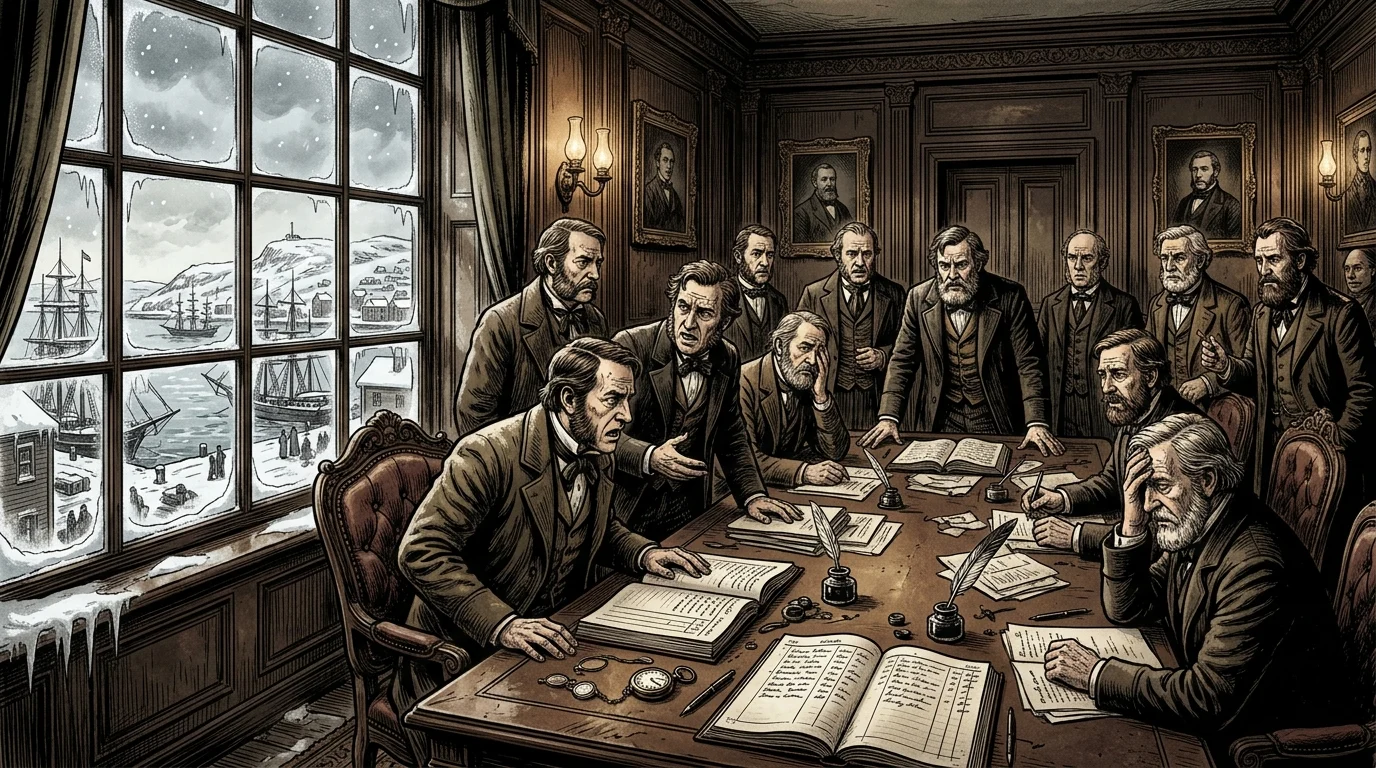
On December 10, 1894, Newfoundland experienced a financial catastrophe that left much of the colony without reliable money.
In the capital, St. John’s, the Commercial Bank of Newfoundland closed its doors. Within hours, the Union Bank of Newfoundland followed.
The two institutions had supplied much of the credit and paper currency used throughout the island. Their sudden failure threatened merchants, workers, ordinary depositors, and even the colonial government.
Businesses closed, unemployment spread, and banknotes that people had used as money abruptly lost much of their value.
Yet the disaster had been developing for years.
Newfoundland’s banks were closely controlled by the same merchants who borrowed enormous sums from them. When those merchants struggled to repay their loans, the banks turned to British lenders for support.
When that external credit disappeared, the entire arrangement collapsed.
The Newfoundland Bank Crash of 1894 reveals how concentrated economic power, conflicts of interest, and dependence on borrowed money can transform a commercial downturn into a monetary crisis.
An Economy Built Around Fish and Credit
During the nineteenth century, Newfoundland’s economy depended heavily on the Atlantic cod fishery. Fish exports connected the colony to markets in Europe, the Caribbean, and South America. But the industry operated through a financial arrangement that made merchants unusually important. Many fishing families lacked the money to purchase boats, equipment, food, and supplies before the season began.
Merchants provided those goods on credit, expecting repayment from the fishermen’s catches later in the year. The merchants then exported the fish and collected payment from overseas buyers. This system allowed the fishing economy to function, but it required substantial financing. A merchant might advance supplies in the spring and wait months before receiving payment.
During that period, the merchant needed money to maintain inventories, pay workers, and finance shipments. Banks provided much of this working capital. The Commercial Bank of Newfoundland and the Union Bank of Newfoundland became central institutions within this network. The Union Bank began operations in 1854, while the Commercial Bank was established in 1857.
A third institution, the government-operated Newfoundland Savings Bank, also served the colony. [1][6] By the 1890s, the two private banks had become deeply involved in supporting the fish trade. That dependence would prove dangerous.
| Documented Figure / Metric | Historical Significance & Archival Context |
|---|---|
| $1.75 million | At the same time, its directors owed the bank approximately $1.75 million. |
| $1.2 million | Approximately $1.2 million in notes issued by the Commercial and Union banks had been circulating at the time of the crash. |
| $10 | A person holding a $10 Union Bank note could receive an officially recognized value of $8. |
| $1 | These paper instruments were denominated in $1, $1.50, $2, and $5. |
When Bank Directors Became Their Own Borrowers
The most serious weakness was not simply that banks lent money to fish merchants. It was that many of the merchants receiving those loans also controlled the banks. Leading businessmen sat on the boards of both the Commercial and Union banks. They could influence lending decisions involving their own businesses and commercial associates.
Large overdrafts became common. An overdraft allowed a borrower to withdraw more money than was available in an account, effectively creating additional credit. Such arrangements can help businesses manage temporary cash shortages. But they become dangerous when borrowers continually extend their debts without generating enough income to repay them.
In Newfoundland, the problem was intensified by limited independent oversight. Bank directors approved substantial credit for merchants, including themselves, while relying on deposits from private citizens and the colonial government. The banks released financial statements, but meaningful external examination was limited. As the debt accumulated, the institutions became increasingly vulnerable to the fortunes of a relatively small group of businessmen. [2][6]
One particularly revealing example was Robert Stewart Munn.
Robert Stewart Munn and the Merchant-Banker Network
Robert Stewart Munn was a prominent merchant and politician associated with John Munn and Company, an important business operating in Newfoundland’s fishing and sealing industries. He was also a director of the Union Bank. Munn’s business depended on extensive commercial credit. His firm financed fishing operations, supplied merchants and fishermen, and participated in the export trade.
When fishing returns disappointed or customers failed to repay their debts, Munn borrowed additional money to cover the shortfalls.
The financial pressure gradually accumulated.
By 1894, Munn personally owed approximately $400,000 to the Union Bank, while the debts of John Munn and Company totaled approximately $875,000. [4]
These figures illustrate the extraordinary scale of borrowing concentrated around individual merchant interests. Munn was not the only merchant operating under such financial pressures. James Goodfellow, a leading figure at the Commercial Bank, had also expanded his business using bank credit. His indebtedness to the Commercial Bank grew from approximately $30,000 in December 1886 to more than $169,000 by 1894. [2]
The banks were exposed to a familiar financial danger. If one merchant failed to repay a large loan, the bank could suffer a significant loss. If several merchants failed simultaneously, the bank itself might become unable to meet its obligations. And because the same merchants exercised influence over bank management, there was little independent restraint on the accumulation of these risks.
How Newfoundland’s Banks Became Dependent on London
The financial situation worsened as Newfoundland experienced difficult commercial conditions during the late 1880s and early 1890s. Problems in the cod fishery reduced income for merchants and fishing communities. Weak demand, uncertain prices, and difficulties in other developing industries placed additional pressure on the economy. The government was also undertaking expensive railway construction, increasing the colony’s financial commitments. [1]
The banking system faced a growing imbalance. Merchants continued borrowing to finance their operations, but their businesses were not consistently producing enough money to repay existing debts. Banks therefore found themselves with large outstanding loans and increasingly limited available cash. To continue operating, they borrowed from other financial institutions, including banks in Britain.
This created a dangerous chain of financial dependence. Newfoundland merchants needed credit from local banks. Local banks needed continued support from British lenders. British lenders expected the Newfoundland banks to remain financially reliable.
The system could function as long as confidence survived. But if overseas lenders suddenly demanded repayment, Newfoundland’s banks would have to find cash quickly. That would require their merchant customers to repay outstanding loans. The problem was that much of the merchants’ wealth was tied up in fish inventories, shipments, and other business assets.
Those assets could not necessarily be converted into cash at short notice.
A temporary shortage of funds could therefore develop into a banking collapse.
December 10, 1894: Black Monday
In early December 1894, the Commercial Bank faced a critical loss of confidence in London.
British financial institutions had become increasingly unwilling to extend further credit.
According to historical accounts, a demand for payment associated with the estate of a prominent Newfoundland fish agent in England contributed directly to the bank’s immediate difficulties. [2]
On December 8, it became clear that the Commercial Bank could not meet important demands from its London creditors. The bank turned to its merchant customers for repayment. But many of those merchants were themselves heavily indebted and unable to produce cash quickly. Their assets were often tied up in unsold fish and other commercial commitments.
On Monday, December 10, 1894, the Commercial Bank suspended operations.
The date became known in Newfoundland’s history as Black Monday.
News spread rapidly through St. John’s. Depositors became concerned that other financial institutions might also be unable to repay their money. Customers rushed to withdraw funds from the Union Bank and Newfoundland Savings Bank. The Savings Bank managed to survive.
It held priority claims on funds at the Union Bank and quickly withdrew a substantial amount to meet demands from its own customers. But that withdrawal further weakened the Union Bank’s available reserves. Within hours of the Commercial Bank’s closure, the Union Bank also suspended operations. Neither institution reopened. [6]
Two of the colony’s three principal banks had disappeared in a single day.
The Commercial Bank’s $3.5 Million Financial Problem
The collapse exposed how deeply the banks’ finances had deteriorated.
A subsequent legislative investigation found serious problems with excessive lending and large overdrafts.
The Commercial Bank had approximately $3.5 million in liabilities when it failed.
At the same time, its directors owed the bank approximately $1.75 million. [2]
These figures describe different sides of the financial problem. The $3.5 million represented the bank’s obligations. The $1.75 million represented money owed to the bank by its own directors. In other words, a very large portion of the money the Commercial Bank expected to recover was tied to the people responsible for managing it.
Those loans were assets on the bank’s books, but their actual value depended on whether borrowers could repay them. When creditors demanded cash, the bank could not simply transform those outstanding loans into money. The institution faced both a shortage of liquidity and severe doubts about the value of its assets. This distinction is important.
A bank may appear to possess substantial assets because borrowers owe it money. But if those borrowers cannot pay, the apparent assets may provide little protection to depositors. Newfoundland’s banks had allowed their financial strength to become dangerously dependent on the businesses of their own directors.
When Banknotes Suddenly Lost Their Value
The consequences extended far beyond ordinary bank deposits. The Commercial and Union banks also issued paper banknotes that circulated as money throughout Newfoundland. These notes were used in everyday transactions. People accepted them when buying food, paying workers, purchasing supplies, and conducting business.
The notes depended on confidence that their issuing banks would honor their obligations. When both banks closed, that confidence collapsed. Shops became reluctant to accept the failed institutions’ paper money. Workers and merchants suddenly faced uncertainty about how they could make payments.
The colony was not literally without every form of currency. Coins and other instruments still existed.
But two major sources of its circulating paper money had failed, creating an acute shortage of reliable means of payment.
Approximately $1.2 million in notes issued by the Commercial and Union banks had been circulating at the time of the crash. [6]
For ordinary people, this created a financial shock. A banknote that had been accepted at its full face value could no longer be exchanged or spent with the same confidence. Even people who had never borrowed from a bank were affected. The crisis demonstrated that a bank failure could threaten not only savings and commercial loans, but also the money used in everyday life.
The 80% and 20% Emergency Guarantees
The Newfoundland government needed to restore confidence in the colony’s currency. During December 1894, the legislature investigated the failed banks and considered emergency measures. A joint select committee examined their financial condition. Its findings were deeply critical of the institutions’ lending practices.
The committee estimated that the Union Bank’s recoverable assets were worth approximately 80% of its liabilities, while the corresponding figure for the Commercial Bank was only about 20%. [2]
These were estimates of recoverable assets, not proof that every depositor ultimately received those percentages. The government also introduced legislation to restore some value to the failed banks’ circulating notes. Under the Bank Note Act, the colony guaranteed:
- 80% of face value for Union Bank notes.
- 20% of face value for Commercial Bank notes.
The difference was substantial. A person holding a $10 Union Bank note could receive an officially recognized value of $8. A person holding a $10 Commercial Bank note could receive only $2. The emergency guarantees helped create a more dependable currency system, but they imposed heavy losses on holders of the failed banks’ notes. [7]
Deposits and banknotes were separate claims. The percentages assigned to circulating notes should not be confused with final recoveries on individual savings accounts. Public anger was considerable. In January 1895, thousands of people protested in St. John’s, demanding that the government honor the failed notes at full value. The authorities did not agree to those demands.
The losses remained part of the financial consequences of the crash.
Robert Gillespie Reid’s Emergency Wage Notes
The banking collapse also created immediate difficulties for the colony’s railway construction program. Robert Gillespie Reid, the Scottish-born railway contractor developing Newfoundland’s transportation infrastructure, needed to keep workers employed and construction moving. But reliable cash was scarce, and commercial credit had become difficult to obtain. Reid responded by issuing his own wage notes.
These paper instruments were denominated in $1, $1.50, $2, and $5.
Workers could use them to purchase goods at supply facilities established for the railway project. The notes could also be redeemed for currency at the company’s office on Water Street in St. John’s. [3] This was a practical response to the collapse of the ordinary payment system. Reid’s wage notes were not a replacement for the entire colony’s banking system.
They were a form of private payment instrument designed to help a particular business continue operating during a shortage of dependable currency. Their existence illustrates how severe the monetary disruption had become. When ordinary money is difficult to obtain or use, businesses sometimes create alternative arrangements to keep transactions moving. Such solutions may provide temporary relief, but they depend on confidence in the person or company issuing the notes.
The Government Nearly Defaults on Its Debt
The collapse threatened Newfoundland’s public finances as well. The colonial government maintained funds at the Union Bank and suffered from the failure. It also faced substantial obligations connected with railway construction and other public expenditures. Interest on its overseas debt was due on January 1, 1895.
Officials feared that the government might be unable to make the payment. A missed payment would have created a sovereign debt crisis on top of the banking collapse. Newfoundland initially sought assistance from Britain, but the British authorities were unwilling to provide immediate unconditional financial support. The colony eventually avoided default by drawing upon funds connected with a Union Bank deposit at the National Bank of Commerce in New York. [7]
The government also worked to stabilize the economy through new banking arrangements and currency legislation. Canadian financial institutions, including the Bank of Montreal, Bank of Nova Scotia, and Merchants’ Bank of Halifax, expanded into Newfoundland. Their arrival provided alternative banking services and helped restore confidence. Canadian currency also became increasingly important in local circulation. [1][6]
The measures did not erase the losses suffered by depositors and merchants.
But they helped prevent a prolonged complete breakdown of commercial payments.
The Human and Political Aftermath
The economic effects of Black Monday were immediate. Merchant firms closed or reduced operations. Workers lost employment. Fishing communities that depended on merchant credit found themselves struggling to obtain supplies.
The disruption spread from St. John’s into coastal settlements whose economic activity depended on the fish trade. The political consequences were also severe. The colony experienced rapid changes in government leadership, while officials struggled to address unemployment, commercial failures, and public anger. The collapse prompted investigations into bank management.
Directors of the Commercial Bank were charged with financial misconduct, including allegations concerning misleading statements and conspiracy to defraud shareholders. Similar proceedings were brought against Union Bank directors. However, criminal responsibility proved difficult to establish. The Commercial Bank directors were ultimately acquitted of conspiracy, and proceedings against Union Bank directors were discontinued. [7]
The outcomes did not erase the documented weaknesses in bank management. They instead demonstrated the difference between identifying dangerous lending practices and proving criminal wrongdoing in court. For Robert Stewart Munn, the crisis marked the end of his commercial career. Already in poor health, he died of pleurisy on December 17, 1894, one week after the bank failures.
His estate was subsequently declared insolvent. John Munn and Company went bankrupt, and its sealing fleet was sold in the spring of 1895. [4] A commercial network that had operated for generations was disappearing.
Why Newfoundland Did Not Join Canada in 1895
The banking crash revived debate about whether Newfoundland should join the Canadian Confederation. Financially weakened and facing substantial public debt, the colony needed access to stable credit and investment. In 1895, Newfoundland representatives traveled to Ottawa to discuss possible terms of union. Reid also participated in the discussions.
But the negotiations failed. One major obstacle was the amount of Newfoundland’s public debt, much of it associated with railway construction. The Canadian government was unwilling to accept the proposed financial burden under the terms being discussed. [3] Newfoundland remained outside Confederation.
It would not join Canada until 1949, more than half a century after the banking disaster.
The 1894 crash was not the sole reason for Newfoundland’s eventual entry into Confederation.
But it remained an important episode in the colony’s longer history of financial dependence and political uncertainty.
What the Newfoundland Bank Crash Teaches Us
The Newfoundland Bank Crash of 1894 was not simply the result of one poor fishing season or one unsuccessful business. It developed from a fragile financial structure. The colony depended heavily on the fish trade. Merchants depended on credit to operate their businesses.
Banks depended on those merchants to repay large loans. And the banks themselves depended on continued support from overseas lenders. The same businessmen who borrowed heavily from the banks also exercised influence over lending decisions. This concentrated financial risk and weakened independent oversight.
When British creditors withdrew support, the Commercial Bank could not obtain enough cash. Its failure triggered a wider loss of confidence that brought down the Union Bank. Because the two banks issued much of Newfoundland’s paper currency, their collapse also damaged the colony’s monetary system. The government had to intervene, Canadian banks entered the market, and ordinary people absorbed substantial financial losses.
The crisis illustrates two fundamental principles of banking. First, lending institutions must manage conflicts of interest and ensure that borrowers are capable of repaying their debts. Second, a banking system must maintain enough reliable liquidity to withstand unexpected demands for payment.
Newfoundland’s financial disaster showed what can happen when a colony’s banks, principal industries, and circulating money all depend on the financial health of the same small group of merchants.
When that group could no longer repay its debts, the damage reached almost everyone.
Theoretical & Balance-Sheet Transmission Mechanism
In the Kindleberger–Minsky taxonomy of financial instability (Kindleberger, 1978; Minsky, 1986) and Irving Fisher’s (1933) debt-deflation framework, speculative asset booms become systemic crises when credit expansion shifts balance sheets from hedge finance (cash flows covering principal and interest) to speculative and Ponzi finance (relying on rising asset prices and short-term margin roll-overs).
Once monetary tightening or an exogenous shock halts price appreciation, forced margin liquidations trigger Fisherian debt-deflation: fire-sale asset discounts erode bank collateral values, contracting credit supply across the real economy.
Sources and Further Reading
- [1] Bank of Canada Museum, Welcoming Newfoundland to Canada. March 25, 2024. — https://www.bankofcanadamuseum.ca/2024/03/welcoming-newfoundland-to-canada Historical & Financial Reference
- [2] Melvin Baker, James Goodfellow. Dictionary of Canadian Biography, University of Toronto / Université Laval. — https://www.biographi.ca/en/bio/goodfellow_james_12E.html Historical & Financial Reference
- [3] Bank of Canada Museum, The “Streak of Rust” and the King of Newfoundland. May 2020. — https://www.bankofcanadamuseum.ca/2020/05/streak-of-rust-king-newfoundland Historical & Financial Reference
- [4] Robert H. Cuff and Paul F. Kenney, Robert Stewart Munn. Dictionary of Canadian Biography, University of Toronto / Université Laval. — https://www.biographi.ca/en/bio/6321 Historical & Financial Reference
- [5] Heritage Foundation of Newfoundland and Labrador, Bank of British North America Registered Heritage Structure. Historical & Financial Reference
- Irving Fisher — "The Debt-Deflation Theory of Great Depressions," Econometrica 1, no. 4 (FRASER Federal Reserve Archive, 1933): 337–357 Central Bank / Monetary Authority
- Charles P. Kindleberger & Robert Z. Aliber — Manias, Panics, and Crashes: A History of Financial Crises (Palgrave Macmillan) Peer-Reviewed / Academic Research
[6] Jenny Higgins, 1894 Bank Crash. Newfoundland and Labrador Heritage Website, 2008.
https://www.heritage.nf.ca/articles/economy/1894-bank-crash.php
[7] Jenny Higgins, Impacts of the 1894 Bank Crash. Newfoundland and Labrador Heritage Website, 2008.
https://www.heritage.nf.ca/articles/economy/bank-crash-impacts.php
Cite This Historical Dossier (APA / Chicago)
APA (7th ed.): Ç., S. (Ed.). (2026). The Merchant-Banker Network Behind the Newfoundland Bank Failures of 1894. In Forgotten Fortunes Historical Monograph Series (Forgotten Fortunes Editorial Desk). https://forgottenfortunes.net/newfoundland-bank-failures-of-1894-newfoundland-bank-failures-1894-merchant/
MLA (9th ed.): Ç., Soner, ed. "The Merchant-Banker Network Behind the Newfoundland Bank Failures of 1894." Forgotten Fortunes: Financial & Monetary History Archive, 2026, https://forgottenfortunes.net/newfoundland-bank-failures-of-1894-newfoundland-bank-failures-1894-merchant/.
Chicago (17th ed.): Ç., Soner, ed. "The Merchant-Banker Network Behind the Newfoundland Bank Failures of 1894." Forgotten Fortunes Historical Monograph Series (Forgotten Fortunes Editorial Desk), August 26, 2026. https://forgottenfortunes.net/newfoundland-bank-failures-of-1894-newfoundland-bank-failures-1894-merchant/.
Have an idea for another financial history documentary or article? Request a story →