
In This Article
More than a millennium before the kingdom of Lydia struck the Mediterranean world’s first electrum coins in the seventh century BCE, the city-states of Old Babylonian Mesopotamia and the Assyrian merchant colonies of central Anatolia operated a deeply monetized economy. Between roughly 2000 and 1750 BCE—spanning the Isin-Larsa period, the First Dynasty of Babylon, and the Old Assyrian Colony Period—scribes, palace administrators, and private merchant houses settled complex domestic and international transactions without minted coinage. Instead, they relied on a dual commodity standard that paired weighed silver bullion (kaspum) for high-value commerce and credit with measured barley (she’um) for wages, agrarian rents, and daily retail exchange. [1]

Metrological Precision: Talents, Minas, Shekels, and Haematite Duck Weights
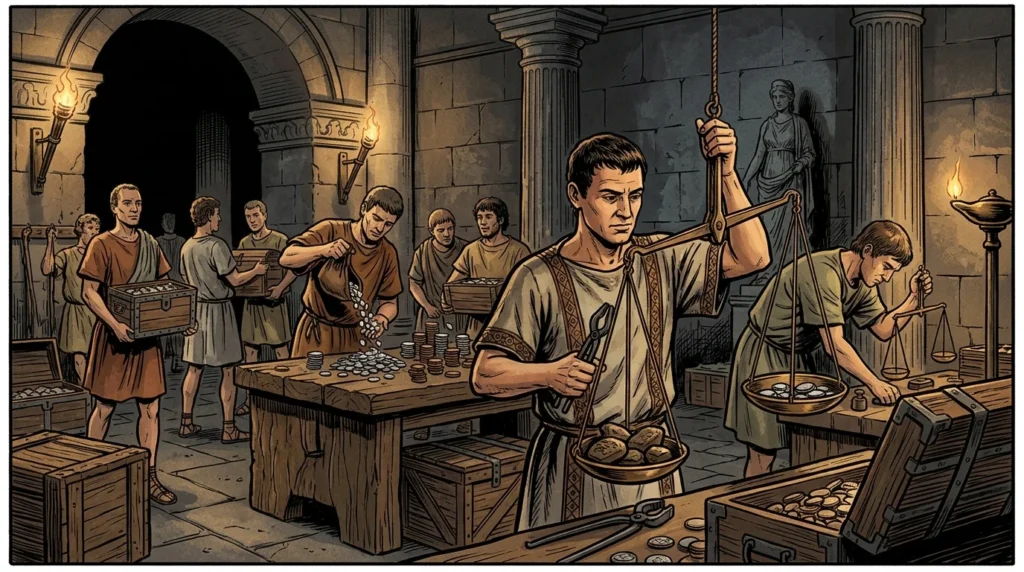
In the absence of state-stamped coins of uniform weight, every silver payment in Old Babylonian cities such as Ur, Larsa, Sippar, Eshnunna, and Babylon required a physical act of weighing (shaqalum—the Akkadian verb “to weigh,” which simultaneously meant “to pay” and gave rise to the noun shiqlum, or shekel). Mesopotamian metrology rested on the sexagesimal (base-60) mathematical system inherited from the third-millennium Sumerian and Akkadian empires. At the base of the weight hierarchy stood the individual barleycorn (uttetum, Sumerian she), weighs roughly 0.046 grams. One hundred and eighty barleycorns constituted one Mesopotamian shekel (shiqlum, Sumerian gin) of approximately 8.33 grams. [2]
Sixty shekels formed one mina (manum, Sumerian ma-na) weighing roughly 500 grams (half a kilogram), and sixty minas composed one talent (biltum, Sumerian gun, literally a “load” that a single porter or pack animal could carry) equal to 3,600 shekels, or approximately 30 kilograms. To prevent fraud at the scales, merchants and temple treasuries kept sets of finely polished stone balance weights carved from dense, dark haematite, diorite, or basalt. Because hard volcanic and iron-oxide stones resisted chipping and moisture absorption, a carved haematite weight shaped like a resting duck—with its bill tucked neatly over its back—retained its calibrated mass for generations. Royal and temple authorities enforced uniform metrological standards by inscribing official weights with the name of the reigning monarch or the patron deity of justice, such as the sun-god Shamash at Sippar. [3]
Physical silver (kaspum, written logographically as Sumerian ku-babbar, “shining metal”) circulated in several distinct forms tailored to transaction size. For large real-estate transfers, bridewealth settlements, or wholesale caravan purchases, silver moved in cast ingots, flat disks, or standardized spiral coils and penannular rings (harum or hullum) worn on the arm or strung on cords, from which segments could be snipped. For fractional payments worth a few barleycorns of silver, traders weighed out cut scraps of sheet metal, wire, broken jewelry, and chopped ingots—what modern archaeologists term Hacksilber. To avoid re-weighing and assaying silver at every stage of a recurring transaction, institutional treasuries and reputable merchants placed verified quantities of silver inside leather or linen pouches (kisum), tied the neck with cord, and impressed their personal cylinder seals onto a lump of wet clay over the knot, creating a sealed bullion instrument that circulated by trust in the guarantor’s seal.
The Gur of Barley and the Dual Monetary Standard
While weighed silver excelled as a portable store of value and settlement medium for wholesale merchants, palaces, and urban elites, even a single shekel of silver (~8.33 grams) represented roughly a full month’s wage for an unskilled laborer. Conducting everyday village or market purchases—such as buying bread, beer, onions, or reed mats—in silver required weighing out minuscule slivers of metal equivalent to two or three barleycorns, a process prone to scale error and metal loss. Old Babylonian Mesopotamia solved this denomination problem by operating a bi-metallic-style dual commodity standard that paired silver with measured barley (she’um). [4]
Unlike silver, which was measured by mass on balance pans, barley was measured by volume in standardized dry-capacity vessels. The foundational unit of capacity was the sila (Akkadian qum), equivalent to roughly one liter—approximating the daily grain ration of an adult worker. Ten sila made one ban (sutum, ~10 liters); six ban formed one parsiktum or pi (60 sila, ~60 liters); and five parsiktum constituted the royal gur (Akkadian kurrum), equal to 300 sila or approximately 300 liters of grain. Across southern and central Mesopotamia, the gur of barley and the shekel of silver served as interlocking units of account. [5]
Tariff Equivalencies and Interest Caps in the Laws of Eshnunna and Hammurabi
The legal and administrative bridge between the silver standard and the barley standard survives explicitly in Old Babylonian law collections, most notably the Laws of Eshnunna—discovered on two cuneiform tablets at Tell Harmal (ancient Shaduppum, an administrative center of the kingdom of Eshnunna in the Diyala Valley) and dated between c. 1930 and 1770 BCE—and the famous Laws of Hammurabi of Babylon (c. 1750 BCE). The very first statute (§1) of the Laws of Eshnunna opens with an official royal tariff fixing the baseline purchasing power of one shekel of silver across the kingdom’s staple commodities: [6]
- Barley: 1 gur (300 sila, ~300 liters) of barley = 1 shekel (~8.33g) of silver.
- Fine Oil: 3 sila (~3 liters) of fine oil = 1 shekel of silver.
- Sesame Oil: 1 ban and 2 sila (12 sila, ~12 liters) of sesame oil = 1 shekel of silver.
- Pork Lard: 1 ban and 5 sila (15 sila, ~15 liters) of lard = 1 shekel of silver.
- Wool: 6 minas (~3 kilograms) of wool = 1 shekel of silver.
- Salt and Copper: 2 gur (600 sila) of salt or 2 to 3 minas of refined copper = 1 shekel of silver.
Because one gur equaled 300 sila and one shekel of silver contained 180 barleycorns, the canonical 1-to-1 ratio between the gur and the shekel allowed palace scribes to translate effortlessly between grain accounts and silver accounts. Subsequent clauses of the Laws of Eshnunna (§§3–14) priced daily hire rates for wagons, oxen, boats, harvesters, and winnowers in either fractions of a silver shekel or sila of barley, demonstrating that both commodities functioned simultaneously as legal tender. [7]
However, because agricultural harvests arrived in a single spring surge (April–May), the market price of barley fluctuated seasonally—rising prior to harvest when granaries ran low and dropping immediately after threshing. Creditors frequently exploited these swings by lending barley to peasant households during the lean pre-harvest months and demanding repayment in silver, or vice versa. Both the Laws of Eshnunna (§§18A–21) and the Laws of Hammurabi (§§88–96, and in surviving fragments of the tablet breaks) regulated silver-to-grain conversions and imposed strict statutory interest caps reflecting the distinct economic dynamics of the two currencies. On loans of silver, the maximum legal interest rate was fixed at 20 percent per annum (one-sixth of a shekel per shekel, or 12 shekels per mina). On loans of barley, the maximum legal interest rate was capped at 33.33 percent per annum (100 sila of interest per 300-sila gur), compensating grain lenders for the post-harvest decline in barley’s relative value against silver. [8]
Assyrian Caravans and the Karum Kanesh Merchant Clearing System
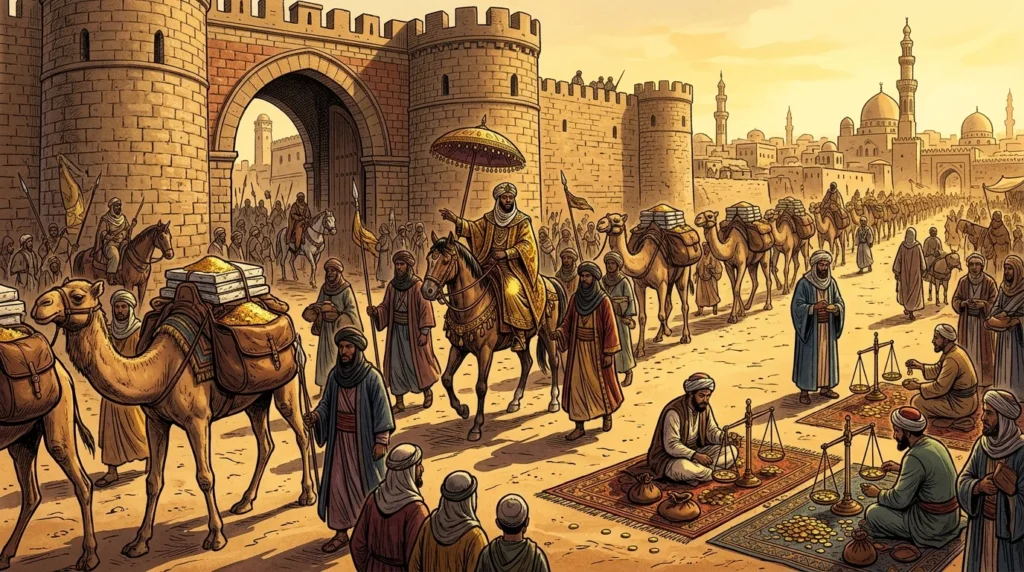
While southern Mesopotamian river cities relied on the dual silver-barley standard to coordinate irrigation agriculture and urban craft production, northern Mesopotamia developed an extraordinary long-distance commercial clearing system built around refined silver bullion. Between roughly 1950 and 1740 BCE (documented most densely in Level II of the merchant lower town, c. 1950–1836 BCE), private merchant families from the city-state of Assur on the Tigris River established a network of nearly forty commercial enclaves across central Anatolia. At the center of this network stood Karum Kanesh (modern Kültepe, near Kayseri in Turkey), where archaeologists have excavated more than 23,000 cuneiform clay tablets from roughly seventy private family archives.
The term karum—originally denoting a river “quay” or harbor embankment where cargo boats unloaded and settled customs—came to designate an autonomous, legally recognized merchant quarter and chamber of commerce attached to an Anatolian palace city. Governed by bilateral treaties sworn with local Anatolian rulers and accountable to the City Assembly (bit alim) back in Assur, the administrative office of the colony (the bit karim, or “House of the Quay”) served as a customs clearinghouse, commercial court, depository, and accounting office.
The economic engine of the Kanesh trade was pure arbitrage driven by regional resource endowments. Anatolia possessed rich deposits of native silver and copper (and some gold) but lacked tin—the indispensable alloying metal required to turn soft copper into durable bronze—and craved high-grade Mesopotamian textiles. Merchant entrepreneurs in Assur imported tin (annakum) originating from eastern mines in the Iranian plateau or Central Asia and purchased fine woolen textiles (kutannum) woven both in Babylonia and by Assyrian women in domestic workshops in Assur. Loaded onto caravans of black donkeys—each pack animal carrying roughly one talent (~65 kilograms) of tin and two dozen textiles—these shipments trekked some 1,200 kilometers across six weeks of rugged terrain from Assur to Kanesh.
Upon arriving at Karum Kanesh, caravan leaders presented their sealed manifests at the Anatolian palace for customs inspection, paying an import tithe (nishatum) of 5 percent on textiles and roughly 3 percent on tin, while granting the local king a preemptive right (shi’amatum) to purchase an additional 10 percent of the textiles at a discounted tariff. Once cleared, the Assyrian resident agents distributed the tin and textiles through regional Anatolian satellite stations (wabartum) either for cash silver or on interest-bearing credit contracts lasting from a few weeks to a full year, often executing multi-step swaps through thousands of minas of Anatolian copper before converting the proceeds into refined silver (kaspum sarrupum or litum) and gold.
Joint-Stock Naruqqum Ventures and Bearer Debt Notes
Because a single donkey caravan required heavy upfront capital and took months to turn over, the merchants of Assur and Karum Kanesh pioneered financial instruments that minimized the physical transport of metal and pooled investor risk. When silver proceeds were shipped back to Assur to buy fresh consignments of tin and Babylonian textiles, each packet of refined litum silver was weighed on the karum scales, sealed inside a bullae-marked leather wrapper impressed with the merchant’s cylinder seal, and listed in an accompanying cuneiform overland waybill. In Assur, the silver simultaneously paid an export tax and funded the next outbound caravan, often yielding gross markups of 100 percent on tin and up to 200 percent on fine textiles before transport and customs expenses.
Even more remarkably, the Kültepe tablets preserve dozens of transferable debt notes (tuppum harmum—clay tablets encased inside sealed clay envelopes bearing identical contract text) payable not merely to a named individual, but to the “bearer of this tablet” (tamkarum, literally “the merchant” who presents the document). Within the bit karim at Kanesh, member merchants settled overlapping debts through book-entry clearing accounts, offsetting credit balances without weighing out physical hacksilber at every step. To finance multi-year trading careers, senior investors in Assur formed long-term joint-stock partnerships known as a naruqqum (“leather money-sack”), in which a dozen shareholders contributed shares denominated in minas of gold and silver to capitalize a traveling merchant for eight to twelve years, dividing periodic dividends and final profits on a pro-rata basis.
Theoretical & Balance-Sheet Transmission Mechanism
In the Kindleberger–Minsky taxonomy of financial instability (Kindleberger, 1978; Minsky, 1986) and Irving Fisher’s (1933) debt-deflation framework, speculative asset booms become systemic crises when credit expansion shifts balance sheets from hedge finance (cash flows covering principal and interest) to speculative and Ponzi finance (relying on rising asset prices and short-term margin roll-overs).
Once monetary tightening or an exogenous shock halts price appreciation, forced margin liquidations trigger Fisherian debt-deflation: fire-sale asset discounts erode bank collateral values, contracting credit supply across the real economy.
Sources and Further Reading
- Albrecht Goetze, “The Laws of Eshnunna,” Annual of the American Schools of Oriental Research, Vol. 31, 1956. Historical & Financial Reference
- Hakan Erol, “Old Assyrian Metal Trade, its Volume and Interactions,” Belleten (Turkish Historical Society), Vol. 83, No. 298, December 2019. Official / State Archive
- Jona Lendering, “Kaneš (Kültepe),” Livius.org Ancient History Archive, 2020. Historical & Financial Reference
- University of Verona Department of Cultures and Civilizations, “The Old Assyrian Trade Network: Assur, Kanesh, Tin, Textiles, and Silver,” Academic Course Dossier, University of Verona. Historical & Financial Reference
- Academic and Business Research Institute (AABRI), “Ancient Assyrian Trade Networks and Commercial Institutions at Karum Kanesh,” AABRI Manuscripts, 2016. Historical & Financial Reference
- Biblical Archaeology Society, “Kültepe Excavations Reveal Remains Predating Karum Kanesh,” Bible History Daily, 2015. Historical & Financial Reference
- Irving Fisher — "The Debt-Deflation Theory of Great Depressions," Econometrica 1, no. 4 (FRASER Federal Reserve Archive, 1933): 337–357 Central Bank / Monetary Authority
- Charles P. Kindleberger & Robert Z. Aliber — Manias, Panics, and Crashes: A History of Financial Crises (Palgrave Macmillan) Peer-Reviewed / Academic Research
Cite This Historical Dossier (APA / Chicago)
APA (7th ed.): Ç., S. (Ed.). (2026). Weighed Silver, the Gur of Barley, and the Karum Kanesh Clearing System. In Forgotten Fortunes Historical Monograph Series (Forgotten Fortunes Editorial Desk). https://forgottenfortunes.net/old-babylonian-silver-barley-trade/
MLA (9th ed.): Ç., Soner, ed. "Weighed Silver, the Gur of Barley, and the Karum Kanesh Clearing System." Forgotten Fortunes: Financial & Monetary History Archive, 2026, https://forgottenfortunes.net/old-babylonian-silver-barley-trade/.
Chicago (17th ed.): Ç., Soner, ed. "Weighed Silver, the Gur of Barley, and the Karum Kanesh Clearing System." Forgotten Fortunes Historical Monograph Series (Forgotten Fortunes Editorial Desk), September 14, 2026. https://forgottenfortunes.net/old-babylonian-silver-barley-trade/.
Have an idea for another financial history documentary or article? Request a story →