
In This Article
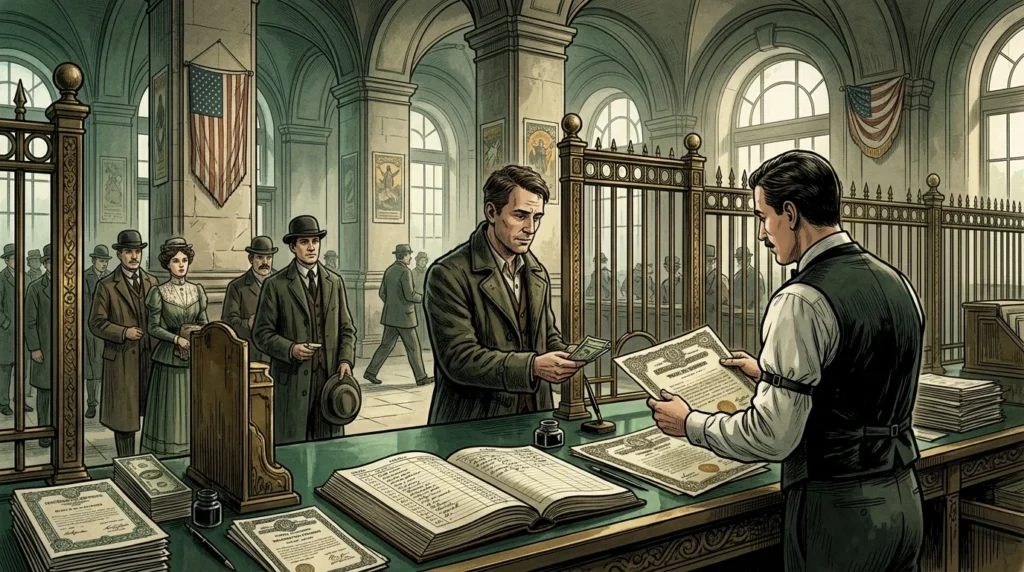
On February 25, 1862, with the Union Treasury nearly empty of gold coin and military expenditures exceeding $2 million a day, President Abraham Lincoln signed H.R. 240—the first Legal Tender Act—authorizing the issuance of $150 million in non-interest-bearing paper currency known officially as United States Notes and popularly as “greenbacks” [1][2]. Unlike every previous federal treasury note, the new paper bills were backed by neither a dedicated gold or silver reserve nor a promised redemption date, yet Congress declared them “lawful money and a legal tender in payment of all debts, public and private” within the United States, except for import duties and interest on the federal debt [1][2][5].
Intended by Treasury Secretary Salmon P. Chase and the 37th Congress as a temporary wartime expedient, the greenback experiment permanently transformed the monetary and constitutional architecture of the United States [1][2][7]. Across three statutes in 1862 and 1863, Congress authorized a total of $450 million in United States Notes, creating the nation’s first uniform legal-tender paper currency [1][5][6]. The experiment sparked daily gold-room speculation during the Civil War, produced a dramatic constitutional showdown at the U.S. Supreme Court in the Legal Tender Cases (1870–1871), ignited the agrarian Greenback Party movement after the Panic of 1873, and survived the return to the gold standard on January 1, 1879, leaving $346.68 million in red-seal notes circulating until 1971 [1][3][6][7].
The 1861 Specie Crisis, Demand Notes, and the Legal Tender Acts (1861–1863)
When the American Civil War began in April 1861, the United States had no central bank and no national paper currency [2][6]. Under the Independent Treasury System established in 1846, the federal government conducted its fiscal operations strictly in gold and silver coin (specie), while domestic commerce relied on thousands of heterogeneous paper notes issued by state-chartered private banks [2][3].
To meet initial mobilization costs in the summer of 1861, Congress authorized the Treasury to issue $50 million (later increased to $60 million) in non-interest-bearing Demand Notes in denominations of $5, $10, and $20 [1][3]. Printed with vivid green anti-photographic ink on their reverse side—which earned them the original nickname “greenbacks”—the Demand Notes were receivable for customs duties and redeemable in gold coin on demand at Sub-Treasury offices [1][3]. By late December 1861, however, Union military setbacks and heavy gold withdrawals forced New York banks and the U.S. Treasury to suspend specie payments, making it impossible to continue redeeming Demand Notes in gold [4][6].
Faced with an acute fiscal emergency in early 1862, Representative Elbridge G. Spaulding of New York introduced H.R. 240 to make irredeemable Treasury paper legal tender [2][5]. Despite fierce opposition from Wall Street bankers and constitutional conservatives who argued that the Constitution empowered Congress only to “coin Money,” Congress passed the first Legal Tender Act on February 25, 1862 [1][2][5]. The statute authorized $150 million in United States Notes in denominations of $5 to $1,000 (of which $60 million replaced the existing Demand Notes) [1]. Under the “First Obligation” printed on their reverse, these notes were legal tender for all public and private debts except customs duties and interest on the public debt—which continued to be paid in gold so the Union could service its bonds abroad—and were convertible at par into 6 percent, twenty-year federal gold bonds [1][2][5].
As war costs mounted, Congress passed a second Legal Tender Act on July 11, 1862, authorizing another $150 million in United States Notes, including up to $35 million in smaller $1 and $2 denominations to replace hoarded silver coins [1]. The first $1 Legal Tender Note, issued in August 1862 with a distinctive red Treasury seal and serial numbers, featured the portrait of Treasury Secretary Salmon P. Chase [3]. A third Legal Tender Act on March 3, 1863, authorized a final $150 million tranche—bringing total statutory greenback authorizations to $450 million—and eliminated the right to convert greenbacks at par into 6 percent gold bonds, turning the notes into pure fiat currency [1][5][6].
| Documented Figure / Metric | Historical Significance & Archival Context |
|---|---|
| $150 million | The statute authorized $150 million in United States Notes in denominations of $5 to $1,000 (of which $60 million replaced the existing Demand Notes). |
| $1 | The first $1 Legal Tender Note, issued in August 1862 with a distinctive red Treasury seal and serial numbers, featured the portrait of Treasury Secretary Salmon P. |
| $346,681,016 | The Act of May 31, 1878 halted all further destruction of retired greenbacks and permanently froze the outstanding stock of United States Notes at exactly $346,681,016, requiring the Treasury to reissue every redeemed note back into circulation. |
| $100 | In 1966 the Treasury restricted remaining greenback printings to $100 notes, made its final BEP delivery of United States Notes in 1971, and formally ended statutory reissue requirements under the Riegle Community Development and Regulatory Improvement Act of 1994. |
The Gold Room, Counterfeiting Deterrence, and Centralization at the BEP (1862–1869)
Because importers still needed gold coin to pay customs duties and foreign creditors required specie for international trade, a formal market emerged in New York—centered in the New York Stock Exchange’s “Gold Room”—where greenbacks were traded daily against gold dollars [4][5]. As economists Kristen L. Willard, Timothy W. Guinnane, and Harvey S. Rosen demonstrated using daily Civil War quotations, the gold price of the greenback served as a real-time financial barometer of Union military fortunes and fiscal expectations [4].
Whenever Confederate armies won major victories or Congress expanded paper authorizations, traders anticipated a longer, costlier war and a lower probability of post-war gold redemption, driving the greenback down [4][6]. After the Union defeats at Chickamauga and during Jubal Early’s raid toward Washington in July 1864, the greenback fell to its wartime nadir of roughly 35 cents on the gold dollar [6]. Conversely, Union triumphs at Gettysburg and Vicksburg in July 1863 and the capture of Atlanta in September 1864 sparked immediate greenback rallies, while on the Pacific Coast merchants bypassed greenback depreciation altogether by enforcing state “specific contract” laws requiring payment in gold coin [4][5].
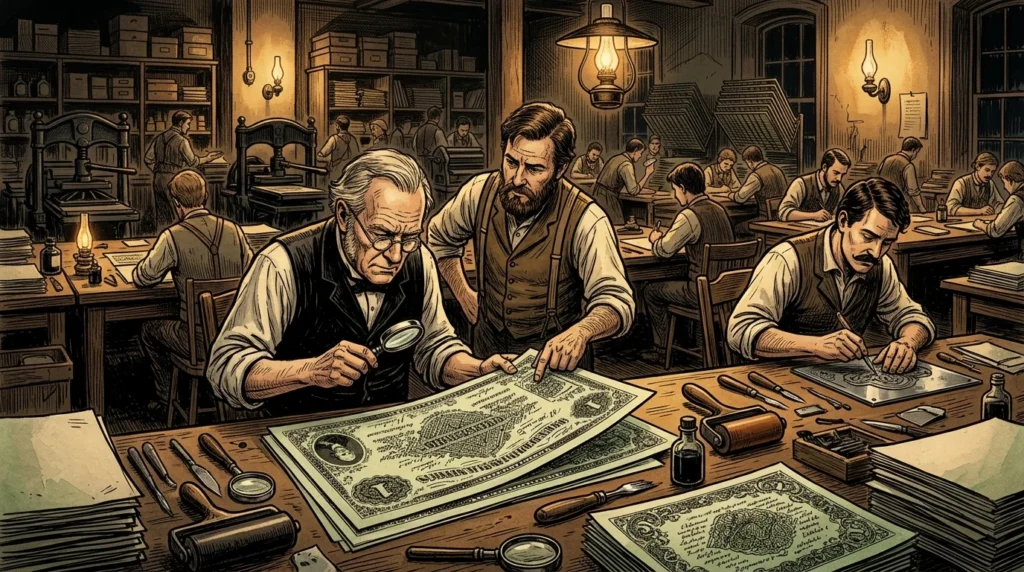
At the same time, the proliferation of unbacked federal paper required major advances in physical security to deter counterfeiters [3]. Beginning in 1862, the Treasury incorporated intricate geometric lathe-work patterns, fine-line intaglio engraving, engraved signatures, and official Treasury seals into its notes [3]. Initially, private bank-note companies in New York engraved and printed the primary note faces before shipping the sheets to Washington for sealing, trimming, and cutting [3]. In 1869, to eliminate security vulnerabilities and standardize production, the Treasury centralized the entire engraving and printing of note faces and seals inside the Bureau of Engraving and Printing (BEP) in Washington, introducing a redesigned 1869 $1 United States Note featuring George Washington [3].
The Legal Tender Cases: Hepburn v. Griswold and Knox v. Lee (1870–1871)
Once the Civil War ended in April 1865, the constitutional validity of forcing private creditors to accept depreciated paper dollars for contracts signed before February 1862 came before the U.S. Supreme Court [1][5][7]. In a remarkable historical irony, the Court was now led by Chief Justice Salmon P. Chase, whom Lincoln had appointed to the bench in late 1864 after Chase resigned from the Treasury [7].
Although Chase had reluctantly endorsed the Legal Tender Act as Treasury Secretary in 1862—writing in March 1864 that “when public exigencies require, Coin must become paper” and “when public exigencies allow, Paper must become coin”—by 1870 he was courting the Democratic presidential nomination and sought to restore a strict metallic standard [7]. On February 7, 1870, writing for a narrow 4–3 majority in Hepburn v. Griswold, Chief Justice Chase declared the Legal Tender Act unconstitutional as applied to pre-existing debts, ruling that forcing a creditor to accept depreciated paper impaired the spirit of the Contract Clause and deprived lenders of property without due process under the Fifth Amendment [5][7].
Because invalidating legal-tender payments threatened to throw post-war American debt contracts and railroad bonds into chaos, the decision triggered immediate political turmoil [7]. On the very day Chase read the Hepburn opinion, President Ulysses S. Grant nominated two new Supreme Court justices—William Strong and Joseph P. Bradley—to fill an expanded nine-seat bench and replace the retiring Justice Robert C. Grier [5][7]. Fifteen months later, on May 1, 1871, the reconstituted Court overturned Hepburn by a 5–4 vote in the Legal Tender Cases (Knox v. Lee and Parker v. Davis), holding that Congress possessed full constitutional authority under its war and sovereign fiscal powers to issue fiat paper currency as legal tender for both prior and subsequent debts [1][5][7].
The Panic of 1873, the Greenback Party, and Specie Resumption (1873–1971)
While the Supreme Court settled the constitutional question, the economic battle between eastern “Goldbugs” and agrarian and labor “Greenbackers” intensified [1][6]. Immediately after the war, Treasury Secretary Hugh McCulloch had begun retiring greenbacks to deflate prices and return the dollar to its pre-war gold parity [1][6]. When the Panic of 1873 plunged the United States into a severe six-year industrial and agricultural depression, indebted western and Midwestern farmers and industrial workers blamed the Treasury’s currency contraction for falling crop prices and crushing real mortgage burdens [1][6].
Beginning in Indiana in 1874, agrarian reformers, labor advocates, and local manufacturers organized the Greenback Party (formally the Independent National Party, and later the Greenback-Labor Party), which campaigned nationally between 1876 and 1884 for the permanent expansion of federal fiat currency and the abolition of private bank-note monopolies [1][6]. Although sound-money Republicans pushed through the Specie Payment Resumption Act of January 1875—pledging to redeem greenbacks in gold coin at par beginning on January 1, 1879—agrarian lawmakers won a major legislative compromise in May 1878 [1][4][6]. The Act of May 31, 1878 halted all further destruction of retired greenbacks and permanently froze the outstanding stock of United States Notes at exactly $346,681,016, requiring the Treasury to reissue every redeemed note back into circulation [1][6].
When specie resumption took effect on January 1, 1879, public confidence in the Treasury’s gold reserve was so complete that few holders bothered to redeem their notes, allowing greenbacks to circulate alongside gold coin at full parity [4][6]. Following the creation of the Federal Reserve System in 1913 and the standardization of small-size U.S. currency in 1928–1929 (which reduced note dimensions by roughly 30 percent to 6.14 by 2.61 inches), red-seal United States Notes became a minor, fixed component of a money supply dominated by elastic Federal Reserve Notes [1][3]. In 1966 the Treasury restricted remaining greenback printings to $100 notes, made its final BEP delivery of United States Notes in 1971, and formally ended statutory reissue requirements under the Riegle Community Development and Regulatory Improvement Act of 1994 [1][3].
Theoretical & Balance-Sheet Transmission Mechanism
In the Kindleberger–Minsky taxonomy of financial instability (Kindleberger, 1978; Minsky, 1986) and Irving Fisher’s (1933) debt-deflation framework, speculative asset booms become systemic crises when credit expansion shifts balance sheets from hedge finance (cash flows covering principal and interest) to speculative and Ponzi finance (relying on rising asset prices and short-term margin roll-overs).
Once monetary tightening or an exogenous shock halts price appreciation, forced margin liquidations trigger Fisherian debt-deflation: fire-sale asset discounts erode bank collateral values, contracting credit supply across the real economy.
Sources and Further Reading
- Historical Resource Center, “ United States Notes (Legal Tender Notes / Greenbacks) — Historical Fact Sheet,” Bureau of Engraving and Printing, U.S. Department of the Treasury, 2013. Official / State Archive
- National Archives and Records Administration, “ H.R. 240, Legal Tender Act, February 25, 1862 (Records of the U.S. House of Representatives),” U.S. Capitol Visitor Center, 2020. Official / State Archive
- U.S. Currency Education Program, “ The $1 Note and U.S. Currency History,” Board of Governors of the Federal Reserve System and Bureau of Engraving and Printing, 2023. Central Bank / Monetary Authority
- Kristen L. Willard, Timothy W. Guinnane, and Harvey S. Rosen, “ Turning Points in the Civil War: Views from the Greenback Market (NBER Working Paper No. 5381),” National Bureau of Economic Research, 1995-12. Peer-Reviewed / Academic Research
- Dictionary of American History, “ Legal Tender Act (1862) — Dictionary of American History,” Encyclopedia.com (Cengage / Gale), 2019. Historical & Financial Reference
- Elmer Ellis, “ Greenbacks — Dictionary of American History & Gale Encyclopedia of U.S. Economic History,” Encyclopedia.com (Cengage / Gale), 2019. Historical & Financial Reference
- Stanley I. Kutler, “ Legal Tender Cases — Encyclopedia of the American Constitution,” Encyclopedia.com (Cengage / Gale), 2019. Historical & Financial Reference
- Irving Fisher — "The Debt-Deflation Theory of Great Depressions," Econometrica 1, no. 4 (FRASER Federal Reserve Archive, 1933): 337–357 Central Bank / Monetary Authority
- Charles P. Kindleberger & Robert Z. Aliber — Manias, Panics, and Crashes: A History of Financial Crises (Palgrave Macmillan) Peer-Reviewed / Academic Research
Cite This Historical Dossier (APA / Chicago)
APA (7th ed.): Ç., S. (Ed.). (2026). Civil War Emergency and the US Treasury Greenback Experiment. In Forgotten Fortunes Historical Monograph Series (Forgotten Fortunes Editorial Desk). https://forgottenfortunes.net/us-treasury-greenback-experiment-civil-war/
MLA (9th ed.): Ç., Soner, ed. "Civil War Emergency and the US Treasury Greenback Experiment." Forgotten Fortunes: Financial & Monetary History Archive, 2026, https://forgottenfortunes.net/us-treasury-greenback-experiment-civil-war/.
Chicago (17th ed.): Ç., Soner, ed. "Civil War Emergency and the US Treasury Greenback Experiment." Forgotten Fortunes Historical Monograph Series (Forgotten Fortunes Editorial Desk), August 27, 2026. https://forgottenfortunes.net/us-treasury-greenback-experiment-civil-war/.
Have an idea for another financial history documentary or article? Request a story →