In This Article
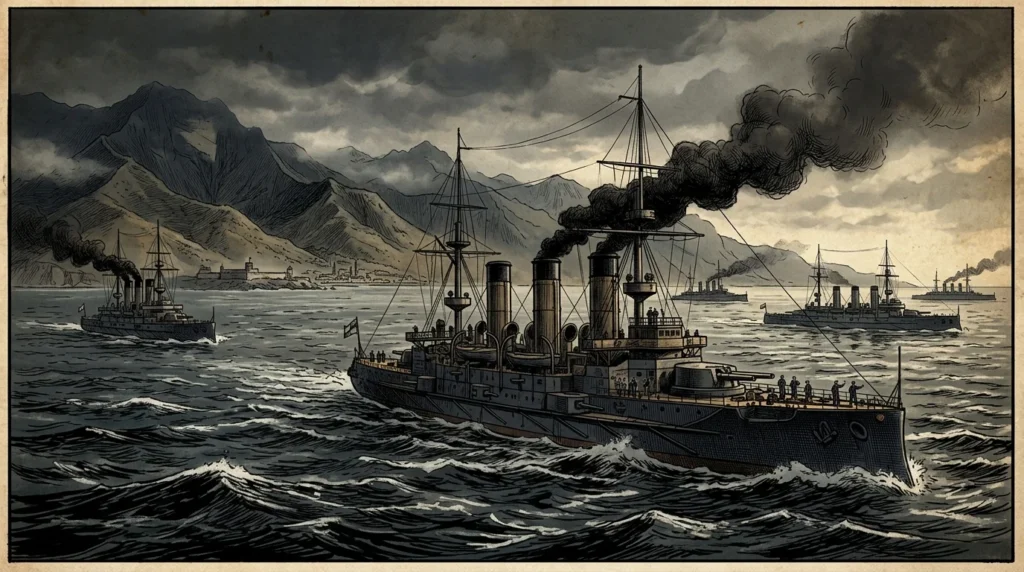
In December 1902, British and German warships seized Venezuela’s small navy, shelled its coastal forts and closed its main ports. Italy soon joined them. The stated grievance was money: unpaid claims by European merchants and companies, and years of missed payments to foreign bondholders. For a few weeks the Caribbean looked like the stage for an old-fashioned debt collection by cannon, and the episode ended up reshaping how creditors, debtors and the United States dealt with sovereign default in the Americas [2][5].
The blockade is often remembered as the high-water mark of “gunboat diplomacy.” Seen from London’s bond market, though, it was an exception. For three decades British investors had relied on a quieter weapon: an organised creditors’ body, the Corporation of Foreign Bondholders, and its power to shut defaulters out of the capital markets [1].
A Club for Unpaid Creditors
By the late 1860s London was lending heavily to foreign governments, and defaults were frequent. Individual bondholders had no practical way to sue a sovereign borrower, and thousands of scattered investors could rarely agree on a common position. The Corporation of Foreign Bondholders (CFB) was founded in 1868 to solve that coordination problem, and in 1873 it was incorporated under a licence from the Board of Trade [1]. Isidor Gerstenberg, a leading figure in its creation, chaired its council in its early years [1].
The CFB collected information on debtor countries, kept agents abroad, published detailed annual reports, and negotiated on behalf of bondholders who joined its committees [1]. Its early leadership was criticised for being too close to the banks that underwrote foreign loans and too quick to accept poor settlements. In response it was reconstituted in 1898 under a special Act of Parliament. From then on its 21-member Council comprised six members appointed by the British Bankers’ Association, six by the London Chamber of Commerce and nine co-opted by the Council itself [1].
The Market Lockout: How Creditors Applied Pressure
The CFB’s main sanction was exclusion. Following a practice dating from 1827, the London Stock Exchange refused to quote new bonds issued by governments that were in default and would not negotiate in good faith; in extreme cases existing loans could be struck off as well [1]. Because a listing in London was valuable, a defaulting government that wanted new money had a strong incentive to settle with its old creditors. The CFB also kept in touch with bondholder groups on the Continent, so that a defaulter turned away in London could not easily raise money in Amsterdam or Paris instead [1].
Military force was rarely part of the toolkit. The British government was generally reluctant to act on behalf of private investors, and Mauro and Yafeh describe gunboat diplomacy as having been used only in “extremely rare cases” [1]. Economists still disagree about how much the threat of force mattered. Mitchener and Weidenmier argue that such “supersanctions” were an important enforcement mechanism between 1870 and 1913, while other scholars find few cases where force was used purely to collect debts [1][2].
Venezuela’s Road to Default
Venezuela had a long history of borrowing in London and failing to pay. At the turn of the century its finances collapsed again. A revolution that began in 1898 lasted more than two years, foreign-owned property was destroyed, and the government stopped servicing its debt [2]. Cipriano Castro, who took power in 1899, defaulted on bonds held in Europe and refused to engage seriously with foreign claimants [5].
The complaints were mixed. Some came from bondholders, both British holders of older Venezuelan loans and German investors. Others came from merchants, shipowners and railway companies whose property had been seized or damaged during the civil wars [3][5]. Germany sounded out Washington first. Theodore Roosevelt, in a July 1901 reply to the German diplomat Hermann Speck von Sternberg, accepted that Germany could act to collect what it was owed, provided it did not annex territory [5]. Britain had its own reasons for taking a hard line, including an older dispute over the boundary between Venezuela and British Guiana [1].
Blockade, December 1902
When Castro ignored a final ultimatum, German, British and Italian forces seized several Venezuelan vessels, bombarded coastal forts and established a naval blockade in December 1902 [5]. The blockading powers closed the ports of La Guaira and Puerto Cabello and seized customhouses, the government’s main source of cash. Germany later bombarded the fort at San Carlos on its own [2].
The economic effect was immediate. Mitchener and Weidenmier estimate that Venezuela’s bilateral trade fell by roughly 30 percent as a result of the blockade [2]. By January 1903 the economy was badly damaged, and Castro asked Roosevelt to arrange a settlement. Roosevelt was increasingly uneasy about European warships in the Caribbean, and Britain was eager to get out [5].
The intervention also provoked a legal backlash in Latin America. Argentina’s foreign minister, Luis María Drago, argued that public debt could not justify armed intervention or the occupation of American territory by a European power. The principle became known as the Drago Doctrine [9].
The Washington Protocols: Customs Revenue as Collateral
The crisis ended in February 1903, when Venezuela agreed to set aside 30 percent of its customs duties until the claims were settled [5]. Britain’s protocol, signed in Washington on 13 February 1903, shows how the deal worked. Venezuela accepted the justice of the British claims and agreed to pay at once about £5,500 for the seizure and plundering of British vessels and the mistreatment of British subjects. Other claims, including those of the railway companies, went to a mixed commission. The 30 percent of customs receipts at La Guaira and Puerto Cabello was to be paid to representatives of the Bank of England in Caracas while the question of priority went to arbitration [3].
The bondholders had their own clause. Article VI committed Venezuela to “enter into a fresh arrangement respecting the external debt of Venezuela with a view of the satisfaction of the claims of the bondholders,” including “a definition of the sources from which the necessary payments are to be provided” [3]. A diplomatic treaty that ended a naval blockade thus contained an obligation to restructure privately held bonds.
A further question remained: should the three blockading powers be paid before other creditor nations, such as the United States and France, which had not used force? The matter went to the Permanent Court of Arbitration at The Hague. On 22 February 1904 its tribunal ruled that Germany, Britain and Italy were entitled to preferential treatment [4]. Critics saw the award as a reward for the use of force.
What the Bondholders Actually Got
For British investors the outcome was mixed. According to the CFB’s own reporting, summarised by Mauro and Yafeh, bondholder claims against Venezuela totalled about £10 million, but arbitrators awarded only about £1.84 million [1]. The CFB had also discussed a scheme, under the auspices of the Banque de Paris et des Pays-Bas, to unify all of Venezuela’s bonds [1]. On the other hand, the blockading powers were paid: by the end of 1906, the CFB reported, Venezuela had completed all payments to the three governments. By 1911 the CFB was describing Venezuela’s repayment record as “a record in the history of the smaller Spanish-American republics” [1].
Mitchener and Weidenmier conclude that the blockade did what creditors wanted, forcing Venezuela to negotiate a debt settlement in 1903 [2]. Mauro and Yafeh are more cautious. They treat the case as a successful use of force, but one partly driven by geopolitics rather than purely by bondholder interests [1].
Roosevelt’s Corollary and the End of Debt Collection by Warship
The more lasting consequence was American. Roosevelt worried that a future creditor crisis could lead to a European invasion of a Latin American country [6]. In his annual message to Congress in December 1904 he declared that “chronic wrongdoing” might require intervention, and that the Monroe Doctrine could force the United States, “however reluctantly, in flagrant cases of such wrongdoing or impotence, to the exercise of an international police power” [7]. The Roosevelt Corollary, expanded in his 1905 message, meant that Washington would make sure countries in the hemisphere met their obligations to foreign creditors, so that Europeans had no excuse to intervene [6][7]. In practice it was used to justify U.S. interventions in Cuba, Nicaragua, Haiti and the Dominican Republic [6].
International law moved too. At the Second Hague Peace Conference in 1907, the powers agreed not to use armed force to recover contract debts owed to their nationals, unless the debtor state refused arbitration, blocked agreement on its terms, or ignored the resulting award [8]. This was a diluted form of Drago’s principle.
Legacy
The Venezuelan blockade sits where two systems of creditor enforcement met. One was private and market-based: the CFB, the Stock Exchange quotation ban and the slow pressure of exclusion from credit. The other was state power, used occasionally when investors’ grievances coincided with a government’s strategic aims. In Venezuela the warships worked in the narrow sense, since claims were recognised, customs revenue was pledged and the blockading powers were paid. But their success alarmed Washington, angered Latin American jurists and helped produce new rules that made such episodes harder to repeat. For bondholders, the more durable protection remained the one the CFB had always relied on: a defaulter’s need, sooner or later, to borrow again [1][2].
Theoretical & Balance-Sheet Transmission Mechanism
In the Kindleberger–Minsky taxonomy of financial instability (Kindleberger, 1978; Minsky, 1986) and Irving Fisher’s (1933) debt-deflation framework, speculative asset booms become systemic crises when credit expansion shifts balance sheets from hedge finance (cash flows covering principal and interest) to speculative and Ponzi finance (relying on rising asset prices and short-term margin roll-overs).
Once monetary tightening or an exogenous shock halts price appreciation, forced margin liquidations trigger Fisherian debt-deflation: fire-sale asset discounts erode bank collateral values, contracting credit supply across the real economy.
Sources and Further Reading
- Paolo Mauro and Yishay Yafeh, “ The Corporation of Foreign Bondholders (IMF Working Paper WP/03/107),” International Monetary Fund, 2003. International Financial Institution
- Kris James Mitchener and Marc D. Weidenmier, “ Supersanctions and Sovereign Debt Repayment (NBER Working Paper 11472),” National Bureau of Economic Research, 2005. Peer-Reviewed / Academic Research
- United Nations, “ Mixed Claims Commission Great Britain–Venezuela (including the Protocol of 13 February 1903),” Reports of International Arbitral Awards, Vol. IX, pp. 349–533. International Financial Institution
- Permanent Court of Arbitration, “ Preferential Treatment of Claims of Blockading Powers against Venezuela (Germany, Great Britain, Italy v. Venezuela),” 1904. Historical & Financial Reference
- Theodore Roosevelt Center, “ Venezuela Debt Crisis,” Theodore Roosevelt Center, Dickinson State University. Historical & Financial Reference
- Office of the Historian, “ Roosevelt Corollary to the Monroe Doctrine, 1904,” U.S. Department of State. Official / State Archive
- National Archives, “ Theodore Roosevelt’s Corollary to the Monroe Doctrine (1905),” U.S. National Archives. Official / State Archive
- Avalon Project, “ Limitation of Employment of Force for Recovery of Contract Debts (Hague, II); October 18, 1907,” Lillian Goldman Law Library, Yale Law School, 1907-10-18. Peer-Reviewed / Academic Research
- Encyclopaedia Britannica, “ Luis María Drago,”. Historical & Financial Reference
- Irving Fisher — "The Debt-Deflation Theory of Great Depressions," Econometrica 1, no. 4 (FRASER Federal Reserve Archive, 1933): 337–357 Central Bank / Monetary Authority
- Charles P. Kindleberger & Robert Z. Aliber — Manias, Panics, and Crashes: A History of Financial Crises (Palgrave Macmillan) Peer-Reviewed / Academic Research
Cite This Historical Dossier (APA / Chicago)
APA (7th ed.): Ç., S. (Ed.). (2026). The Venezuelan Blockade of 1902–1903 and Britain's Foreign Bondholders. In Forgotten Fortunes Historical Monograph Series (Forgotten Fortunes Editorial Desk). https://forgottenfortunes.net/venezuelan-blockade-and-foreign-bondholders-venezuelan-blockade-foreign-bon/
MLA (9th ed.): Ç., Soner, ed. "The Venezuelan Blockade of 1902–1903 and Britain's Foreign Bondholders." Forgotten Fortunes: Financial & Monetary History Archive, 2026, https://forgottenfortunes.net/venezuelan-blockade-and-foreign-bondholders-venezuelan-blockade-foreign-bon/.
Chicago (17th ed.): Ç., Soner, ed. "The Venezuelan Blockade of 1902–1903 and Britain's Foreign Bondholders." Forgotten Fortunes Historical Monograph Series (Forgotten Fortunes Editorial Desk), August 27, 2026. https://forgottenfortunes.net/venezuelan-blockade-and-foreign-bondholders-venezuelan-blockade-foreign-bon/.
Have an idea for another financial history documentary or article? Request a story →