In This Article
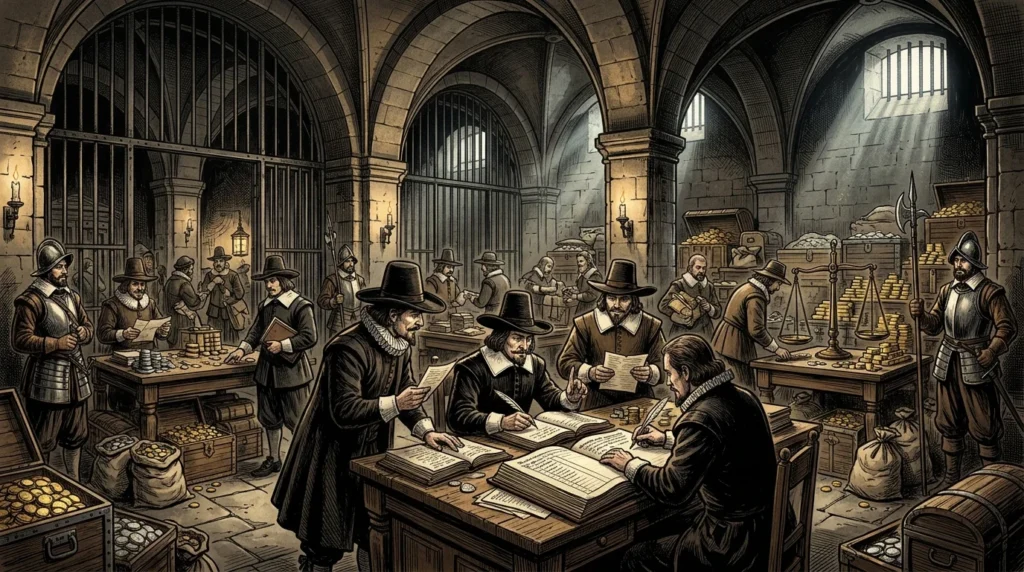
For decades, financial historians portrayed the interwar Netherlands as an island of calm that escaped the banking panics of the Great Depression—until archival disclosures at De Nederlandsche Bank (DNB) and the Dutch National Archives revealed why Dutch banks had been so conservative in 1931: they had already suffered a catastrophic systemic banking crisis a decade earlier. Between 1920 and 1924, the collapse of the post-World War I credit boom and a brutal deflationary contraction wiped out more than 40 Dutch provincial and commercial banks, destroyed over 300 million guilders in bank capital and reserves, and forced De Nederlandsche Bank under President Gerard Vissering to improvise massive lender-of-last-resort interventions. Beginning with the April 1922 liquidation of Rotterdam’s Marx & Co.’s Bank—which inflicted a nearly 27-million-guilder loss on DNB—the crisis reached its climax in the summer of 1924 when the Netherlands’ largest commercial lender, the Rotterdamsche Bankvereeniging (Robaver), nearly imploded under more than 100 million guilders in bad industrial loans to Wm. H. Müller & Co. and required a secret DNB and Treasury-guaranteed syndicate rescue, before Central European contagion felled Amsterdam’s Amstelbank in May 1931. [1]
Neutrality Profits, Universal Banking Ambitions, and the 1919–1920 Credit Boom
Until the early twentieth century, Dutch commercial banking was notoriously cautious. Unlike the German Großbanken that took long-term equity stakes and board seats in heavy industry, Dutch banks relied primarily on short-term self-liquidating trade bills and collateralized stock-exchange call loans known as the prolongatie market. When the outbreak of World War I in July 1914 forced the Amsterdam Stock Exchange to close for six months and froze the prolongatie market, Dutch banking underwent a rapid structural transformation. Starting with the 1911 merger that created the Rotterdamsche Bankvereeniging under its ambitious president-director Willem Westerman, a wave of concentration consolidated Dutch finance around five dominant clearing banks: Robaver, the Amsterdamsche Bank, the Twentsche Bank, the Incasso-Bank, and the Nederlandsche Handel-Maatschappij (NHM). [2]
Neutrality during World War I flooded the Netherlands with gold and foreign capital, expanding the money supply and encouraging Dutch banks to finance domestic import-substitution industries, shipping lines, colonial commodities, and mining ventures. After the November 1918 Armistice, Dutch bankers anticipated an immediate global reconstruction boom. Throughout 1919 and early 1920, commercial and provincial banks extended vast, unsecured current-account overdrafts (rekening-courantkredieten) to industrial and trading firms without demanding audited balance sheets or liquid collateral. Instead of issuing long-term corporate bonds or equities, Dutch shipbuilders, margarine producers, overseas trading houses, and coal-mining syndicates funded fixed capital expansion with rolling short-term bank credit—leaving the entire Dutch banking sector fatally exposed when global commodity prices and freight rates crashed in the second half of 1920. [3]
| Documented Figure / Metric | Historical Significance & Archival Context |
|---|---|
| 100 million guilders | By early 1924, Robaver had extended well over 100 million guilders in badly impaired loans to just a handful of connected industrial debtors, with exposures to Kröller's Müller & Co. and affiliated entities exceeding Robaver's entire equity capital. |
| 140 million guilders | First, the Dutch Treasury provided a secret state counter-guarantee to DNB covering massive emergency liquidity advances to Robaver (part of roughly 140 million guilders in total write-offs, liquidity lines, and restructuring facilities mobilized to keep the bank and its industrial debtors afloat). |
Deflationary Shock and the April 1922 Collapse of Marx & Co.’s Bank
Between mid-1920 and 1923, wholesale prices in the Netherlands plunged by more than 45 percent, shipping values collapsed by three-quarters, and German hyperinflation devastated Rotterdam’s transit trade with the Ruhr industrial basin. Simultaneously, De Nederlandsche Bank President Gerard Vissering and the Dutch Ministry of Finance pursued a strict deflationary policy to restore the Dutch guilder to its prewar gold parity of 1,653.44 guilders per kilogram of fine gold—a goal ultimately achieved jointly with Great Britain in April 1925. Caught between falling asset values and high real interest rates, dozens of smaller regional lenders failed or were absorbed in distress, including the Algemeene Centrale Bankvereeniging voor den Middenstand and scores of provincial commercial and agricultural banks. [4]
The first major systemic shock hit Rotterdam’s Marx & Co.’s Bank, a respected commercial bank founded in 1869 by Moses Ezechiëls and Salomon Marx that had expanded aggressively during the war, increasing its share capital to 12 million guilders. Under managing director Paul Joan van der Chijs and his colleagues, Marx & Co. concentrated enormous unsecured credits in speculative industrial and raw-material ventures—most notoriously advancing millions of guilders to the Nederlandsche Spitsbergen Compagnie (Nespico), an Arctic coal-mining enterprise on Svalbard whose mines proved commercially unviable once postwar coal prices tumbled. Rumors of insolvent industrial debtors triggered a severe deposit run in mid-1921 that drained more than half of Marx & Co.‘s deposits. Fearing a contagious panic across Rotterdam and Amsterdam, DNB President Vissering stepped in alongside Rotterdamsche Bankvereeniging and private bankers R. Mees & Zoonen to guarantee the bank’s creditors. When audits revealed that Marx & Co.‘s capital was completely wiped out, the bank entered formal liquidation in April 1922 with DNB acting as liquidator. Because DNB had rashly counter-guaranteed the private rescue syndicate against losses on discounted corporate promissory notes, the central bank ultimately had to absorb a staggering loss of nearly 27 million guilders—consuming virtually all of DNB’s accumulated reserve funds and forcing the central bank to slash its dividend. [5]
Willem Westerman, Anton Kröller, and the 1924 Rotterdamsche Bankvereeniging Crisis
Even as DNB nursed its wounds from Marx & Co., a far larger catastrophe was brewing inside the Netherlands’ biggest commercial bank: the Rotterdamsche Bankvereeniging (Robaver). Nicknamed “Westerman’s Bank,” Robaver had grown into a financial colossus with 75 million guilders in paid-in capital and 35 million guilders in published reserves, controlling an extensive provincial network through its subsidiary, the Nationale Bankvereeniging (Natobank). Yet governance inside Robaver was fatally compromised by interlocking directorates and personal empire-building. Willem Westerman sat on the boards of dozens of client companies while Rotterdam shipping, mining, and iron-ore magnate Anton Kröller—head of the sprawling conglomerate Wm. H. Müller & Co. and simultaneously a member of DNB’s supervisory council—served as chairman of Robaver‘s supervisory board. [6]
Exploiting his dual position and intimate alliance with Westerman, Kröller used Robaver as a private treasury to cover colossal post-1920 losses across Wm. H. Müller & Co. and the Hollandsche Vereeniging tot Exploitatie van Margarinefabrieken (Hovema). By early 1924, Robaver had extended well over 100 million guilders in badly impaired loans to just a handful of connected industrial debtors, with exposures to Kröller’s Müller & Co. and affiliated entities exceeding Robaver‘s entire equity capital. In the spring of 1924, as rumors of the hidden losses leaked onto the Amsterdam Bourse, Robaver shares began to slide and nervous depositors withdrew tens of millions of guilders. While his bank bled liquidity in May and June 1924, Westerman famously retreated to a health spa in Mariënbad, Czechoslovakia, sending reassuring telegrams that failed to stem the run. [7]
Hendrik Colijn and the Secret June–July 1924 State-Backed Rescue Syndicate
By June 1924, Robaver faced imminent illiquidity and insolvency. Unlike Marx & Co., Robaver was genuinely “too big to fail”: its collapse would have brought down the Nationale Bankvereeniging across the Dutch provinces, triggered runs on the other major clearing banks, and derailed the guilder’s return to the gold standard. Yet DNB President Gerard Vissering—traumatized by the 27-million-guilder loss on Marx & Co.—refused to extend further unguaranteed central bank credit on his own authority. Vissering turned urgently to Finance Minister Hendrik Colijn (leader of the Anti-Revolutionary Party and former head of Bataafsche Petroleum / Royal Dutch Shell). [8]
Acting in strict secrecy during June and July 1924 without prior parliamentary debate—fearing that public disclosure in the Tweede Kamer would ignite a nationwide bank run—Colijn and Vissering engineered a two-part rescue. First, the Dutch Treasury provided a secret state counter-guarantee to DNB covering massive emergency liquidity advances to Robaver (part of roughly 140 million guilders in total write-offs, liquidity lines, and restructuring facilities mobilized to keep the bank and its industrial debtors afloat). Second, an international banking consortium led by Amsterdam and foreign houses formed a support syndicate to purchase millions of guilders of Robaver shares on the stock exchange to halt the free-fall in its share price. In return, Colijn and Vissering forced Willem Westerman to resign in October 1924, installed former Finance Minister Karel Pieter van der Mandele to clean up the Rotterdam board, slashed Robaver‘s share capital from 75 million to 50 million guilders while wiping out 49 million guilders in reserves and bad loans, and detached its foreign banking affiliates. Only years later did the full scale of Colijn’s extraparliamentary guarantee become public knowledge. [9]
Central European Contagion and the May 1931 Collapse of the Amstelbank
The trauma of 1920–1924 fundamentally reshaped Dutch banking behavior. Throughout the late 1920s, the surviving major Dutch commercial banks shunned long-term industrial tie-ups and maintained high liquidity ratios. However, after Amsterdam emerged alongside London and New York as a premier international acceptance and capital-export center during the 1920s, specialized international institutions in Amsterdam accumulated heavy short-term credits in Germany, Austria, and Hungary. Prominent among them was the Amstelbank, founded in Amsterdam in 1921 as the Dutch affiliate and Western European funding conduit of Vienna’s largest universal bank, the Österreichische Creditanstalt für Handel und Gewerbe (led by Louis Rothschild and Baron C. W. von Noot).
When the Creditanstalt shocked the world on May 11, 1931, by disclosing catastrophic losses of 140 million Austrian schillings, panic immediately engulfed its Amsterdam subsidiary. Foreign and domestic creditors rushed to withdraw deposits from the Amstelbank, which had funneled virtually its entire balance sheet into Central European industrial and banking credits guaranteed by Vienna. Within days in mid-May 1931, the Amstelbank was forced to suspend payments and apply for a court-ordered moratorium (surseance van betaling), followed shorty thereafter by severe runs on the German-affiliated Hollandsche Crediet- en Effectenbank and the near-failure of the illustrious Amsterdam merchant bank Mendelssohn & Co. later in 1939. Because the core domestic clearing banks had already purged their balance sheets after the 1924 Robaver crisis, DNB successfully ring-fenced the May 1931 Amstelbank failure—preserving domestic banking stability even as the September 1931 British sterling devaluation inflicted a new round of exchange-reserve losses on De Nederlandsche Bank.
Theoretical & Balance-Sheet Transmission Mechanism
In the Kindleberger–Minsky taxonomy of financial instability (Kindleberger, 1978; Minsky, 1986) and Irving Fisher’s (1933) debt-deflation framework, speculative asset booms become systemic crises when credit expansion shifts balance sheets from hedge finance (cash flows covering principal and interest) to speculative and Ponzi finance (relying on rising asset prices and short-term margin roll-overs).
Once monetary tightening or an exogenous shock halts price appreciation, forced margin liquidations trigger Fisherian debt-deflation: fire-sale asset discounts erode bank collateral values, contracting credit supply across the real economy.
Sources and Further Reading
- Jan Luiten van Zanden and Roland Uittenbogaard (via Lodewijk Petram), “De vergeten bankencrisis van de jaren 1920,” Historical Financial Research / Uitgeverij Atlas Contact, 2016. Historical & Financial Reference
- Abe de Jong, Ailsa Röell, and Gerarda Westerhuis, “De bankencrisis van de jaren twintig,” Economisch Statistische Berichten (ESB), Vol. 96, No. 4614S, pp. 434–437, 2011. Historical & Financial Reference
- Colvin, C. L., de Jong, A., and Fliers, P. T., “Interlocking Directorates and Conflicts of Interest: The Rotterdamsche Bankvereeniging, Müller & Co. and the Dutch Financial Crisis of the 1920s,” Queen’s University Belfast / Business History, 2021. Peer-Reviewed / Academic Research
- Nationaal Archief (Dutch National Archives), “Inventaris van het archief van de Rotterdamsche Bank N.V. en voorgangers (2.25.77.28): Crisis van Marx & Co. (1922) en Reorganisatie Robaver (1924),” Nationaal Archief, The Hague, 2020. Official / State Archive
- Joods Erfgoed Rotterdam, “Marx & Co.’s Bank (1869–1922) en de liquidatie door De Nederlandsche Bank,” Stichting Joods Erfgoed Rotterdam, 2022. Historical & Financial Reference
- Jan-tjeerd de Vries, “Going Dutch: Monetary Policy in the Netherlands During the Interwar Gold Standard, 1925–1936,” Financial History Review, Cambridge University Press, 2021. Peer-Reviewed / Academic Research
- Historisch Nieuwsblad, “De eerste bankencrisis: Willem Westerman en de ondergang van de Rotterdamsche Bankvereeniging in 1924,” Historisch Nieuwsblad, 2016. Historical & Financial Reference
- Irving Fisher — "The Debt-Deflation Theory of Great Depressions," Econometrica 1, no. 4 (FRASER Federal Reserve Archive, 1933): 337–357 Central Bank / Monetary Authority
- Charles P. Kindleberger & Robert Z. Aliber — Manias, Panics, and Crashes: A History of Financial Crises (Palgrave Macmillan) Peer-Reviewed / Academic Research
Cite This Historical Dossier (APA / Chicago)
APA (7th ed.): Ç., S. (Ed.). (2026). The 1920–1924 Dutch Banking Crisis: Marx & Co., Robaver, and the 1931 Amstelbank Crash. In Forgotten Fortunes Historical Monograph Series (Forgotten Fortunes Editorial Desk). https://forgottenfortunes.net/1920s-dutch-banking-crisis/
MLA (9th ed.): Ç., Soner, ed. "The 1920–1924 Dutch Banking Crisis: Marx & Co., Robaver, and the 1931 Amstelbank Crash." Forgotten Fortunes: Financial & Monetary History Archive, 2026, https://forgottenfortunes.net/1920s-dutch-banking-crisis/.
Chicago (17th ed.): Ç., Soner, ed. "The 1920–1924 Dutch Banking Crisis: Marx & Co., Robaver, and the 1931 Amstelbank Crash." Forgotten Fortunes Historical Monograph Series (Forgotten Fortunes Editorial Desk), September 19, 2026. https://forgottenfortunes.net/1920s-dutch-banking-crisis/.
Have an idea for another financial history documentary or article? Request a story →