In This Article
For more than three centuries after the fragmentation of the Mauryan Empire, the Satavahana dynasty—known in the Puranic literature as the Andhras—governed the Deccan plateau, forging the first major indigenous empire to bridge northern and peninsular India [2][5]. Stretching across the fertile black-soil river valleys of the Godavari and the Krishna and commanding the rugged passes of the Western Ghats, the Satavahana realm sat astride the commercial crossroads of ancient South Asia [4][5]. Rather than relying on a hyper-centralized bureaucracy financed solely through direct agrarian taxation, the Satavahana state operated a layered political economy built on base-metal and silver coinage, merchant and artisan guilds (srenis), and tax-exempt land endowments to Buddhist monastic communities [1][2][4].
The financial mechanics of the Satavahana Deccan rested on the interaction of three distinct economic spheres: rural villages (gama) that produced grain, cotton, and oilseeds; inland market towns (nigama) and imperial cities (nagara) where corporate guilds accepted cash deposits and paid monthly interest; and coastal entrepôts such as Barygaza (modern Bharuch), Sopara, and Kalyan that linked the Deccan interior to the Roman Mediterranean [1][3][4]. When rival Western Kshatrapa rulers invaded the northern Deccan in the first and early second centuries CE—seizing mountain passes, coastal customs, and agrarian revenues—the Satavahana monarch Gautamiputra Satakarni responded with both military reconquest and a coordinated fiscal intervention, physically over-striking thousands of captured Kshatrapa silver coins and re-chartering monastic land immunities under royal authority [1][2][6].
Chronological Foundations and Early Deccan Statecraft
Reconstructing the rise of the Satavahana dynasty has long required historians to weigh conflicting Puranic king lists against dated inscriptions and coin strata [2][4]. Traditional accounts in the Matsya Purana assigned the dynasty a span of 460 years across twenty-nine or thirty monarchs, while the Vayu, Vishnu, and Bhagavata Puranas recorded thirty kings reigning for 456 years, with certain manuscript variants listing only nineteen rulers over roughly 448.5 years [2]. Early Indologists such as R. G. Bhandarkar, H. C. Raychaudhuri, and D. C. Sircar sought to reconcile these discrepancies by proposing that the Vayu Purana preserved only the main imperial lineage while the Matsya Purana aggregated collateral regional branches [2].
Modern archaeological and numismatic syntheses, including the work of historian Himanshu Prabha Ray, place the functional consolidation of Satavahana rule in the first century BCE [4][5]. In this framework, the dynastic founder Simuka established sovereign authority in the northern and central Deccan shortly before 100 BCE, followed by his brother Kanha (Krishna, c. 100–70 BCE), whose reign is attested by the earliest Satavahana cave inscription at Nashik [2][4]. Royal statecraft expanded markedly under Satakarni I (c. 70–60 BCE) and his queen, Nayanika (Naganika), whose sacrificial inscription in the rock-cut pass at Naneghat—linking the inland Junnar valley to the Konkan coastal ports—recorded lavish Vedic rituals accompanied by donations of tens of thousands of cows, horses, elephants, and silver karshapana coins [2][4]. Under Satakarni II (c. 50–25 BCE), the dynasty extended its jurisdiction across central India and the Deccan plateau, securing the overland corridors that carried peninsula resources toward northern and western markets [4].
Ahara Administration, Settlement Tiers, and Base-Metal Money
To govern an empire divided by basaltic plateaus and mountain ranges, the Satavahanas partitioned their core territories into provincial fiscal districts called aharas—such as Govardhana-ahara around Nashik, Soparaga-ahara on the coast, and Mamala-ahara near Karle [1][4]. Each ahara was placed under the supervision of a royal minister titled an amatya or amaca, who executed verbal orders from the king, maintained district land registries, and oversaw revenue collection [1][4].
Within each ahara, economic life moved across a three-tiered hierarchy of settlements documented in contemporary Brahmi inscriptions: gama (agrarian villages), nigama (market towns), and nagara (major urban and political centers) [4]. At the base of the pyramid, gama cultivators worked the moisture-retentive black regur soils of the Deccan trap to raise rice, wheat, millet, sesame, sugar cane, and raw cotton [4][5]. These primary surpluses traveled by ox-cart into nigama market hubs, where merchant assemblies (nigamasabha) and craft guilds processed textiles, pressed vegetable oils, forged iron implements, and registered commercial contracts [1][4].
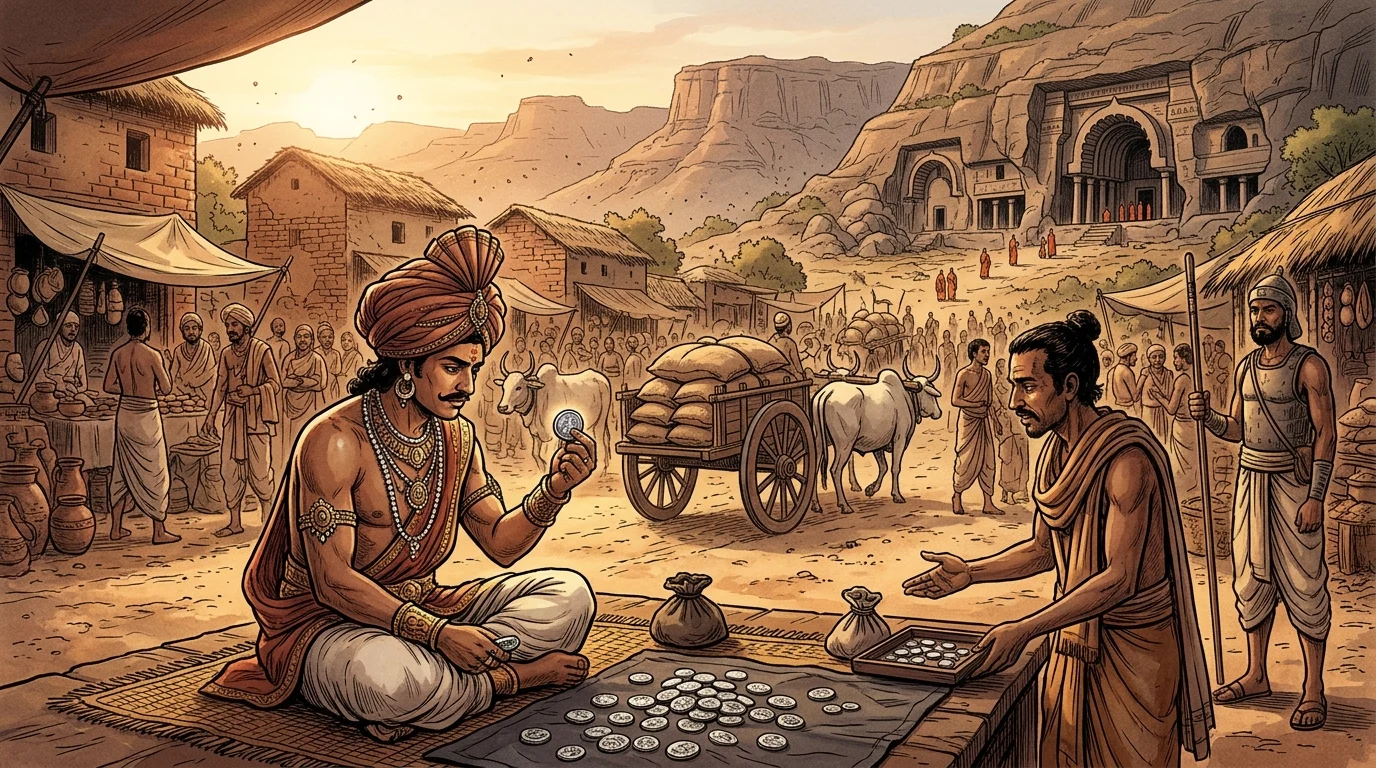
Unlike northern empires that reserved coinage largely for high-value silver and gold transactions, the Satavahanas monetized everyday village and market-town exchange by minting vast quantities of base-metal currency [2][4]. Drawing on regional mineral deposits, royal and local mints struck coins in lead, copper, and potin—an alloy of copper, tin, and lead [2][4]. While fractional base-metal coins lubricated daily retail trade in grain and cloth across the interior, silver karshapanas (Prakrit kahapanas) served as the standard unit of account for long-distance commerce, guild endowments, and large fiscal settlements [1][2]. Epigraphic records from Nashik preserve the exact precious-metal exchange ratio prevailing in the western Deccan during the early second century CE: thirty-five silver karshapanas exchanged for one gold suvarna [1].
Indo-Roman Commerce and the Western Ghats Trade Corridors
The monetization of the Deccan economy accelerated sharply during the first century CE as seasonal monsoon navigation across the Arabian Sea connected western India to the Roman Empire [3][4]. The process is described in detail in the Periplus of the Erythraean Sea, an anonymous first-century Greek merchant handbook written around 60–70 CE [3]. Referring to the Satavahana realm as Dachinabades—explicitly derived from the Prakrit Dakshinapatha, meaning the “Southern Country”—the author of the Periplus identified two inland commercial metropolises of paramount importance [3].
The first was Paithan (Pathana, ancient Pratishthana on the upper Godavari River), the Satavahana imperial capital located twenty days’ journey south of the port of Barygaza; the second was Tagara (modern Ter), described as a “very great city” lying ten days’ journey further east [3]. From Paithan, merchant caravans hauled large quantities of carnelian and onyx northward, while Tagara supplied bulk shipments of common cotton cloth, fine muslins, and molochinon (mallow-dyed fabrics), along with goods gathered from the eastern seaboard [3]. Because the interior lacked paved highways across the rugged Western Ghats, these cargoes moved in heavy ox-drawn wagons through difficult, roadless terrain down to the coast [3][4].
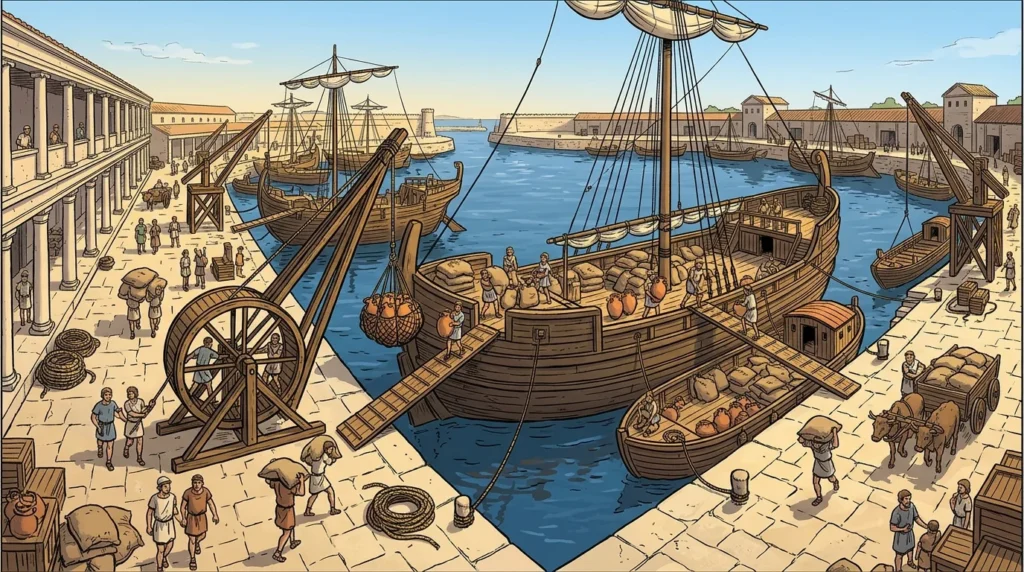
At Barygaza and the Konkan ports, Deccan cottons, spices, ivory, spikenard, and semi-precious stones were exchanged for Mediterranean imports: Italian, Laodicean, and Arabian wines; raw copper, tin, and lead needed by Deccan mints and bronze-workers; coral, flint glass, and storax; and shipments of Roman gold aurei and silver denarii [3]. As the Periplus observed, foreign merchants imported Roman gold and silver coin into Barygaza because “there is a profit when exchanged for the money of the country,” underscoring the sophisticated bullion arbitrage operating between Mediterranean specie and indigenous silver karshapanas [3].
Guild Banking and Buddhist Monastic Endowments
Where the ox-wagon trails climbed through the narrow passes of the Western Ghats—at Naneghat, Junnar, Karle, Kanheri, Bhaja, and Nashik—rock-cut Buddhist monastic complexes (lenas and viharas) rose directly alongside the commercial arteries [1][4]. As Himanshu Prabha Ray demonstrated, these monasteries were not isolated retreats; they functioned as institutional anchors along the trade routes, offering secure lodging, storage, and medical care to passing caravans while receiving patronage from royals, merchants (sethi), caravan leaders (sarthavaha), and artisan guilds [4].
The inscriptions carved into the walls of the Pandavleni Caves on Mount Trirashmi (Tiranhu) outside Nashik—adjacent to the district capital of Govardhana—reveal a sophisticated financial system in which corporate craft guilds operated as deposit banks [1][4]. In Cave No. 10 (Nasik Inscription No. 12), dated to the month of Vesakha in the year 42 (commonly equated with 120 CE in the Saka Era), Ushavadata (Rishabhadatta)—son of Dinika and son-in-law of the Western Kshatrapa ruler Nahapana—dedicated a rock-cut cave to the Buddhist Samgha of the four quarters and established a “perpetual endowment” (akshayanivi) of 3,000 silver kahapanas to clothe and support the twenty monks keeping the monsoon retreat (vassa) inside the sanctuary [1].
Rather than handing the coins directly to the monks for one-time expenditure, Ushavadata invested the 3,000 kahapanas as permanent capital with two corporate weavers’ guilds (kolikanikaya srenis) based at Govardhana [1]:
- First Weavers’ Guild Deposit: 2,000 kahapanas were invested at a monthly interest rate of one pratika (padika) per hundred—equivalent to 1 percent per month, or 12 percent per annum. This generated 240 kahapanas in annual interest, providing exactly 12 kahapanas per year as cloth money (chivarika) to each of the twenty resident monks [1].
- Second Weavers’ Guild Deposit: The remaining 1,000 kahapanas were placed with a second weavers’ guild at a monthly interest rate of three-quarters of a pratika per hundred—0.75 percent per month, or 9 percent per annum—yielding 90 kahapanas annually to cover the monks’ minor living expenses (kusana) [1].
The charter explicitly stipulated that the principal sum of 3,000 kahapanas was never to be repaid, with only the recurring interest enjoyed by the monastery, and recorded that the entire financial contract—alongside a separate gift of 8,000 coconut palm trees at Chikhalapadra village in the Kapura district—had been publicly proclaimed before the town assembly (nigamasabha) and inscribed on permanent record tablets (phalakavara) at the municipal registry [1]. An accompanying addendum noted that Ushavadata had also donated 70,000 silver karshapanas—converted at the rate of thirty-five per gold coin into 2,000 gold suvarnas—to gods and Brahmanas [1].
Kshatrapa Invasion, Maritime Blockades, and the Jogalthambi Over-Strikes
Ushavadata’s prominence at Nashik reflected a severe geopolitical and fiscal crisis for the Satavahana dynasty [1][2]. During the first and early second centuries CE, the Kshaharata branch of the Western Kshatrapas (Sakas), led by Nahapana, pushed southward from Gujarat and Malwa into the northern Deccan, seizing the Nashik-Pune heartland and the Konkan ports [2][5][6]. The Periplus of the Erythraean Sea captured the commercial disruption along the coast: the port of Kalyan (Calliena), which had flourished as a “lawful market-town” under the earlier Satavahana ruler Saraganus (Satakarni), had fallen under the control of a ruler named Sandares, who obstructed the harbor and forcibly escorted arriving Greek merchant vessels under guard northward to Barygaza so the Kshatrapa treasury could monopolize customs duties [3][4].
This territorial loss deprived the Satavahana crown of both maritime customs and inland agrarian taxes until Gautamiputra Satakarni launched a decisive military campaign to reconquer the northern Deccan and eradicate Nahapana’s Kshaharata lineage [2][6]. Because Nahapana’s last dated inscription falls in the year 46 (124 CE) and Gautamiputra issued his victory charter at Nashik in his eighteenth regnal year, numismatists including E. J. Rapson anchored Gautamiputra’s triumph over Nahapana to approximately 124 CE (placing Gautamiputra’s reign at c. 106–130 CE, though some scholars favor an earlier first-century date) [2][6].
To erase Kshatrapa monetary sovereignty without disrupting regional trade liquidity, Gautamiputra Satakarni executed one of antiquity’s most striking currency interventions [2]. In 1906, workers at Jogalthambi (Jogalthembi), a village near Nashik, unearthed a massive hoard of more than 13,250 silver drachms (karshapanas) originally minted by Nahapana and cataloged by the Reverend H. R. Scott and E. J. Rapson [2]. Because the Satavahanas had previously relied on base-metal coinage in the interior and lacked an established silver minting infrastructure in the newly recovered provinces, Gautamiputra’s mint-masters did not melt the captured Kshatrapa treasury down into bullion [2]. Instead, they physically over-struck roughly two-thirds of the coins in the hoard, stamping the Satavahana arched chaitya (Buddhist hill-shrine) and the Brahmi legend Rano Gotamiputasa Siri-Satakanisa directly over Nahapana’s portrait bust and the Ujjain symbol—a cross with four terminal circles—over Nahapana’s arrow-and-thunderbolt emblem [2]. The re-struck coins immediately recirculated as legitimate Satavahana specie while advertising the regime transfer in every market transaction [2].
Sovereign Land Grants, Fiscal Immunities, and Structural Consequences
Alongside currency re-monetization, Gautamiputra Satakarni moved immediately to bring religious endowments at Nashik under Satavahana legal authority [1]. In Nasik Inscription No. 4, issued in his eighteenth regnal year directly from the “camp of victory of the Vejayanti army,” the king commanded Vinhupalita, his district minister (amaca) at Govardhana, to transfer the 200-nivartana Ajakalakiya field in the village of Western Kakhadi—”previously enjoyed by Usabhadata (Ushavadata)”—to the Trirashmi Buddhist ascetics [1].
Crucially, this charter provides one of the earliest surviving Indian epigraphic records of comprehensive royal tax and administrative immunities (parihara) attached to a land grant [1][4]. The king decreed that the monastic property was:
“not to be entered (by royal officers), not to be touched (by any of them), not to be dug for salt, not to be interfered with by the district police, and (in short) to enjoy all kinds of immunities; with those immunities invest it; and this field and these immunities take care to have registered here.” [1]
By surrendering the state’s lucrative monopoly over subterranean salt and mineral extraction alongside ordinary land taxes and judicial entry rights, the crown created self-governing fiscal enclaves [1][4]. Yet a follow-up charter carved just six years later exposes the practical fragility of agrarian land grants when divorced from peasant labor [1]. In Nasik Inscription No. 5, dated to Gautamiputra’s twenty-fourth regnal year and issued jointly by the king and his mother, Queen Gotami Balasiri (Gautami Balashri), to the new Govardhana minister Samaka (Syamaka), the royal court acknowledged that the Kakhadi field had failed as a revenue asset: “this field is not tilled, nor is the village inhabited” [1]. Because an uncultivated, depopulated village generated no grain rent for the monks, the crown replaced the defunct grant with 100 nivartanas of prime royal domain land (rajakam khetam) situated directly on the boundary of Govardhana town, conferring the same full tax and salt-monopoly immunities [1].
Under Gautamiputra’s son and successor, Vasishthiputra Pulumavi (reigned c. 130–159 CE), royal patronage at Nashik culminated in the completion of Cave No. 3 [1][2]. In Pulumavi’s nineteenth regnal year, Queen Mother Gotami Balasiri composed the famous Nasik Prashasti (Inscription No. 2), eulogizing her late son Gautamiputra as the “lord of Dakshinapatha” who had uprooted the Sakas, Yavanas, and Pahlavas and destroyed the Kshaharata lineage, while Pulumavi granted the village of Pisajipadaka on the southwest side of Mount Trirashmi—relinquishing all royal revenues (savajatabhoganirathi)—to the Bhadrayaniya monastic order to maintain the cave [1][6].
Although the rival Kardamaka Western Kshatrapa ruler Rudradaman I later recorded in his Junagadh rock inscription of Saka Year 72 (150 CE) that he had twice defeated “Satakarni, the lord of Dakshinapatha,” sparing him only because of close dynastic marriage ties, the institutional architecture forged during the Satavahana zenith endured [2]. By combining regional ahara administration, base-metal retail coinage, guild deposit banking, and tax-immune monastic land charters, the Satavahana state demonstrated how agrarian grain surpluses and long-distance metal and textile trade could be integrated into a resilient fiscal order—while simultaneously establishing the legal template of tax-exempt land grants that would reshape South Asian political economy for centuries [1][2][4].
Theoretical & Balance-Sheet Transmission Mechanism
In the Kindleberger–Minsky taxonomy of financial instability (Kindleberger, 1978; Minsky, 1986) and Irving Fisher’s (1933) debt-deflation framework, speculative asset booms become systemic crises when credit expansion shifts balance sheets from hedge finance (cash flows covering principal and interest) to speculative and Ponzi finance (relying on rising asset prices and short-term margin roll-overs).
Once monetary tightening or an exogenous shock halts price appreciation, forced margin liquidations trigger Fisherian debt-deflation: fire-sale asset discounts erode bank collateral values, contracting credit supply across the real economy.
Sources and Further Reading
- Émile Senart, “ The Inscriptions in the Caves at Nasik (Epigraphia Indica, Vol. VIII, pp. 59–96),” Archaeological Survey of India, 1905–1906. Historical & Financial Reference
- E. J. Rapson, “ Catalogue of the Coins of the Andhra Dynasty, the Western Kṣatrapas, the Traikūṭaka Dynasty, and the ‘Bodhi’ Dynasty,” British Museum, 1908. Historical & Financial Reference
- Wilfred H. Schoff (trans.), “ The Periplus of the Erythraean Sea: Travel and Trade in the Indian Ocean by a Merchant of the First Century,” Longmans, Green, and Co. / University of Washington Silk Road Seattle, 1912. Peer-Reviewed / Academic Research
- Himanshu Prabha Ray, “ Monastery and Guild: Commerce under the Sātavāhanas,” Oxford University Press, 1986. Peer-Reviewed / Academic Research
- Encyclopædia Britannica, “ Satavahana dynasty,” Encyclopædia Britannica. Historical & Financial Reference
- Encyclopædia Britannica, “ Gautamiputra Satakarni,” Encyclopædia Britannica. Historical & Financial Reference
- Irving Fisher — "The Debt-Deflation Theory of Great Depressions," Econometrica 1, no. 4 (FRASER Federal Reserve Archive, 1933): 337–357 Central Bank / Monetary Authority
- Charles P. Kindleberger & Robert Z. Aliber — Manias, Panics, and Crashes: A History of Financial Crises (Palgrave Macmillan) Peer-Reviewed / Academic Research
Cite This Historical Dossier (APA / Chicago)
APA (7th ed.): Ç., S. (Ed.). (2026). Satavahana Deccan Economy: Grain, Metals, and Monastic Finance (c. 100 BCE–150 CE). In Forgotten Fortunes Historical Monograph Series (Forgotten Fortunes Editorial Desk). https://forgottenfortunes.net/satavahana-deccan-economy-grain-metals/
MLA (9th ed.): Ç., Soner, ed. "Satavahana Deccan Economy: Grain, Metals, and Monastic Finance (c. 100 BCE–150 CE)." Forgotten Fortunes: Financial & Monetary History Archive, 2026, https://forgottenfortunes.net/satavahana-deccan-economy-grain-metals/.
Chicago (17th ed.): Ç., Soner, ed. "Satavahana Deccan Economy: Grain, Metals, and Monastic Finance (c. 100 BCE–150 CE)." Forgotten Fortunes Historical Monograph Series (Forgotten Fortunes Editorial Desk), August 29, 2026. https://forgottenfortunes.net/satavahana-deccan-economy-grain-metals/.
Have an idea for another financial history documentary or article? Request a story →