In This Article
During the Principate and Pax Romana (27 BCE–180 CE), Imperial Rome achieved a demographic scale unmatched by any other Western city until nineteenth-century London: an urban population of roughly one million inhabitants. Because the surrounding Italian countryside could neither grow nor haul by oxcart the food and fuel required to keep a million residents alive, the Roman state constructed an intercontinental commodity and bullion extraction system spanning the entire Mediterranean and Atlantic periphery. Three monumental components anchored this imperial metabolism: the state-supervised grain fleets (Classis Alexandrina and Classis Africana) that delivered 30 to 60 million modii of wheat each sailing season to Puteoli and the artificial harbors of Claudius and Trajan at Portus; the fiscal olive-oil trade from southern Spain (Hispania Baetica) and North Africa that created the 35-meter-high artificial mountain of 53 million broken amphorae at Monte Testaccio; and the hydraulic gold and silver mines of Las Médulas and Rio Tinto in Iberia, where Roman military engineers used Pliny the Elder’s ruina montium (“wrecking of mountains”) to extract 20,000 Roman pounds of gold a year for the imperial mints. [1]
The Alexandrian Grain Fleet, the Annona, and the Hexagonal Basin of Portus
After Octavian (Augustus) annexed Ptolemaic Egypt in 30 BCE, he treated the Nile Valley as an imperial crown estate whose richest surplus—winter wheat harvested from flood-irrigated silt—was reserved first and foremost for the Roman plebs and legions. Administered from 8 CE onward by an equestrian Prefect of the Grain Supply (Praefectus Annonae), the cura annonae provided free monthly rations of 5 modii (roughly 33 kilograms) of unmilled wheat to approximately 200,000 adult male Roman citizens registered on the civic dole (frumentatio), while supplying the broader urban market that fed the remaining 800,000 inhabitants. [2]
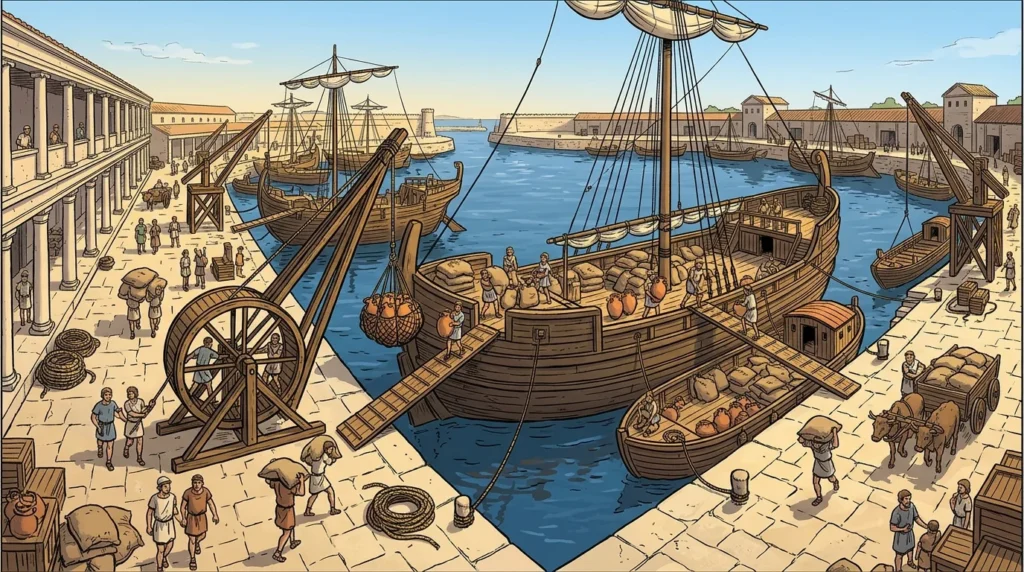
Ancient literary sources state that Egypt alone shipped 20 million modii (roughly 135,000 metric tons) of fiscal wheat per year under Augustus, while North Africa (modern Tunisia, eastern Algeria, and Tripolitania) and Sicily supplied another 20 to 40 million modii, bringing Rome’s total annual grain intake to between 30 and 60 million modii (200,000 to 400,000 metric tons). Moving this bulk cargo across the open Mediterranean between May and September required the largest wooden merchant vessels of antiquity. While ordinary Roman coastal freighters carried 70 to 150 tons, the flagship grain carriers of the Classis Alexandrina displaced 350 to 1,200 metric tons. When the second-century CE satirist Lucian inspected an Alexandrian grain ship named the Isis that had been blown off course into Piraeus, he recorded that the vessel measured 180 Roman feet (55 meters) in length, over 45 feet (14 meters) in beam, and 44 feet (13.4 meters) from deck to bilge—carrying enough Egyptian wheat in a single hold, Lucian wrote, to feed every person in Attica for a full year. [3]
During the early Principate, these deep-draft Alexandrian freighters could not enter the shallow, silting mouth of the Tiber River at Ostia; instead, they docked 190 kilometers to the south at the deep volcanic Bay of Puteoli (Pozzuoli), where grain was transshipped onto smaller coastal vessels. To eliminate this bottleneck, Emperor Claudius began excavating a 200-hectare artificial harbor 3 kilometers north of Ostia in 42 CE, protected by two curving moles and a towering lighthouse modeled on the Pharos of Alexandria. After a storm in 62 CE sank 200 grain ships inside Claudius’s outer basin, Emperor Trajan (between 103 and 113 CE) excavated a landlocked, 32-hectare inner hexagonal basin at Portus (measuring 357.77 meters along each of its six stone-quay sides and 715.54 meters across). Surrounded by vast multi-story granaries (horrea) and linked directly to the Tiber by an artificial canal (Fossa Traiana), Portus allowed ocean-going grain and oil freighters to offload directly onto flat-bottomed river barges (naves caudicariae), which oxen and tow-gangs hauled 30 kilometers upstream to the Emporium river port at the foot of Rome’s Aventine Hill. [4]
Monte Testaccio: 53 Million Baetican Olive-Oil Amphorae and Fiscal Tituli Picti
Second only to wheat in the Roman diet and household economy was olive oil—consumed not only as the primary source of dietary fat and cooking oil, but also as fuel for millions of terracotta oil lamps and as the base for cleansing soaps and unguents in the imperial baths. Rising directly behind the Emporium river wharves and the sprawling Horrea Galbana warehouses in southwestern Rome stands Monte Testaccio (Monte dei Cocci, the “Mountain of Shards”), a 35-meter-high artificial hill covering 20,000 square meters with a circumference of nearly one kilometer. [5]
Excavated by Heinrich Dressel in the late nineteenth century and systematically studied since 1989 by Spanish archaeological teams led by José María Blázquez and José Remesal Rodríguez, Monte Testaccio is not a random rubbish heap but an engineered, terraced imperial landfill composed almost entirely of broken, single-use olive-oil amphorae deposited between the reign of Augustus and the mid-third century CE. Approximately 80 to 85 percent of the mound consists of globular, thick-walled Dressel 20 amphorae produced along the banks of the Guadalquivir River (ancient Baetis) and its tributary the Genil in the southern Spanish province of Hispania Baetica, with the remainder comprising lighter cylindrical amphorae from Tripolitania and Byzacena in North Africa. Modern volumetric calculations estimate that Monte Testaccio contains the shattered remains of roughly 53 million amphorae, each of which originally held an average of 70 liters (about 216 Roman pounds, or 65–70 kilograms) of olive oil—representing more than 3.7 billion liters (over 3.4 million metric tons) of imported oil. [6]
Why were these expensive ceramic jars never reused? Unlike wine amphorae, which were lined inside with pine pitch or resin, porous unglazed terracotta absorbed residual olive oil that rapidly oxidized and turned rancid on contact with air, spoiling any fresh oil poured into it. Consequently, when Baetican Dressel 20 jars arrived at the Tiber Emporium, stevedores decanted the oil into bulk storage vats (dolia), smashed the empty amphorae into compact curved sherds (testae), stacked them into stepped retaining walls, and sprinkled them with quicklime (calcium oxide) to neutralize the stench of rancid oil. [7]
For financial historians, Monte Testaccio is the single largest archive of Roman customs and fiscal receipts in existence. Before leaving the river ports of Hispalis (Seville), Corduba (Córdoba), and Astigi (Écija), each Dressel 20 amphora had its potter’s kiln stamp impressed into the handle and four standardized lines of black or red ink inscriptions—tituli picti—painted onto its belly: [8]
- Alpha (α): The empty tare weight of the clay amphora in Roman pounds (typically 85 to 95 librae, ~28–31 kg), painted on the neck.
- Beta (β): The registered name of the private maritime merchant or shipper (negotiator or mercator, later organized into the state-chartered corpus oleariorum) taking responsibility for the sea voyage.
- Gamma (γ): The net weight of the olive oil inside in Roman pounds (typically 210 to 220 librae, ~68–72 kg).
- Delta (δ): Written diagonally near the handle, the official customs control visa recording the export district port in Baetica (Hispalis, Corduba, or Astigi), the verified weight, the name of the producing estate owner, the signature of the imperial customs clerk, and the consular date.
Ruina Montium at Las Médulas: 20,000 Pounds of Spanish Gold a Year
While Egypt, North Africa, and southern Baetica fed Rome’s stomach, the Iberian Peninsula also supplied the precious metal bullion required to strike the gold aureus (weighing roughly 7.3 to 8.0 grams of pure gold) and the silver denarius (~3.4 to 3.9 grams) that paid the legions, financed provincial administration, and settled Rome’s maritime trade balances. Following Augustus’s completion of the Cantabrian Wars (29–19 BCE), the Roman state asserted direct imperial ownership over the rich alluvial and primary gold deposits of northwestern Spain—centered on Las Médulas in the Bierzo basin of León (ancient Asturia)—as well as the colossal polymetallic silver-copper-iron pyritic belt of Rio Tinto in southwestern Baetica.
In Book 33.21 (§§66–78) of his Natural History, Pliny the Elder—who personally served in Spain as imperial procurator of Hispania Tarraconensis under Emperor Vespasian around 73 CE—left an eyewitness technical account of the awesome hydraulic engineering technique he called ruina montium (“the wrecking or collapse of mountains”), describing it as a feat that “far surpasses the work of the Giants.” At Las Médulas, where fine gold particles were disseminated throughout massive Miocene red conglomerate cliffs, Roman military surveyors from the Legio VII Gemina and tens of thousands of indigenous Asturian workers cut a network of at least seven to eight high-altitude aqueducts (corrugi) contoured into the sheer rock faces of the Montes Aquilianos and Sierra de Teleno over distances exceeding 100 kilometers (over 600 kilometers of total channels across the region).
These aqueducts fed enormous rectangular water-storage reservoirs (piscinae or stagna) perched atop the brow of the gold-bearing mountain. Miners then drove a labyrinth of narrow underground galleries, vertical shafts, and vaulted chambers deep into the dry conglomerate cliff face, leaving only slender earthen pillars to prop up the overhanging mountain. When the underground chambers were ready, engineers knocked away the wooden and stone supports and simultaneously opened the reservoir sluice gates above. Tens of thousands of cubic meters of water plunged violently down the shafts, trapping and compressing air inside the galleries until hydraulic pressure literally exploded the mountain from within. As millions of tons of shattered red conglomerate collapsed into the valley below, continuous streams of reservoir water washed the debris through stepped stone sluice-channels (agogae) carpeted with prickly gorse bushes (ulex). The dense gold particles caught in the thorny gorse, which workers then burned in pits so the pure gold dust could be washed from the ashes. According to Pliny the Elder (Natural History 33.78), the northwestern Spanish provinces of Asturia, Callaecia, and Lusitania yielded 20,000 Roman pounds (approximately 6.5 metric tons) of gold every single year by this method—producing an estimated 1.5 million Roman pounds (~490 metric tons) of gold across two centuries while carving the jagged red pinnacles of Las Médulas that remain visible today.
Subterranean Water Wheels at Rio Tinto and Imperial Silver Bullion
Further south at Rio Tinto (ancient Urium in Huelva) and neighboring Iberian mines such as Aljustrel (Vipasca), where silver and copper ores lay trapped beneath the water table in toxic jarosite and sulfide veins, Roman engineers deployed the opposite hydraulic marvel: deep underground mechanical drainage. In the late nineteenth and twentieth centuries, modern mining companies breaking into ancient Roman galleries at Rio Tinto uncovered batteries of eight pairs of timber reverse-overshot water wheels (tympana) measuring 4.5 meters (15 Roman feet) in diameter, arranged in stepped subterranean cascades that lifted mine water 30 meters vertically through bronze and lead pipes so enslaved miners could extract an estimated 200 metric tons of refined silver per year across the empire. Recorded forever in the Greenland ice sheet—where atmospheric lead pollution from Roman silver cupellation peaked sharply during the first and second centuries CE and was not surpassed until the Industrial Revolution—the mines of Las Médulas and Rio Tinto, the oil fleets of Monte Testaccio, and the grain ships of Portus stood as the physical pillars of Rome’s imperial economy.
Theoretical & Balance-Sheet Transmission Mechanism
In the Kindleberger–Minsky taxonomy of financial instability (Kindleberger, 1978; Minsky, 1986) and Irving Fisher’s (1933) debt-deflation framework, speculative asset booms become systemic crises when credit expansion shifts balance sheets from hedge finance (cash flows covering principal and interest) to speculative and Ponzi finance (relying on rising asset prices and short-term margin roll-overs).
Once monetary tightening or an exogenous shock halts price appreciation, forced margin liquidations trigger Fisherian debt-deflation: fire-sale asset discounts erode bank collateral values, contracting credit supply across the real economy.
Sources and Further Reading
- Ancient Rome Live / American Institute for Roman Culture, “ Monte Testaccio: Rome’s Artificial Mountain of 53 Million Olive Oil Amphorae,” Ancient Rome Live, 2021. Historical & Financial Reference
- Jason Urbanus, “ Portus: The Rise of Empire and Rome’s Maritime Gateway,” Archaeology Magazine / Archaeological Institute of America, 2015. Historical & Financial Reference
- Ostia and Portus Harbour Study, “ The Development and Characteristics of Ancient Harbours—Applying the PADM Chart to the Case Studies of Ostia and Portus,” PLOS ONE / PubMed Central, 2016. Official / State Archive
- University of Southampton / Portus Project, “ Archaeological Study of Portus Reveals Changes in Mediterranean Grain and Olive Oil Supply to Imperial Rome,” University of Southampton, 2019. Peer-Reviewed / Academic Research
- Bryn Mawr Classical Review, “ Review of E. Papi and M. Bonifay (eds.), Supplying Rome and the Empire (Journal of Roman Archaeology Supplement 69),” Bryn Mawr College, 2008. Peer-Reviewed / Academic Research
- Pliny the Elder, “ Natural History (Book 33.21 / §§66–78 on Ruina Montium Hydraulic Gold Mining and 20,000 Pounds of Spanish Gold per Year),” ToposText / Aikaterini Laskaridis Foundation. Historical & Financial Reference
- Irving Fisher — "The Debt-Deflation Theory of Great Depressions," Econometrica 1, no. 4 (FRASER Federal Reserve Archive, 1933): 337–357 Central Bank / Monetary Authority
- Charles P. Kindleberger & Robert Z. Aliber — Manias, Panics, and Crashes: A History of Financial Crises (Palgrave Macmillan) Peer-Reviewed / Academic Research
Cite This Historical Dossier (APA / Chicago)
APA (7th ed.): Ç., S. (Ed.). (2026). Feeding Imperial Rome: Alexandrian Grain Fleets, Monte Testaccio, and Las Médulas. In Forgotten Fortunes Historical Monograph Series (Forgotten Fortunes Editorial Desk). https://forgottenfortunes.net/roman-empire-commodities-grain-gold/
MLA (9th ed.): Ç., Soner, ed. "Feeding Imperial Rome: Alexandrian Grain Fleets, Monte Testaccio, and Las Médulas." Forgotten Fortunes: Financial & Monetary History Archive, 2026, https://forgottenfortunes.net/roman-empire-commodities-grain-gold/.
Chicago (17th ed.): Ç., Soner, ed. "Feeding Imperial Rome: Alexandrian Grain Fleets, Monte Testaccio, and Las Médulas." Forgotten Fortunes Historical Monograph Series (Forgotten Fortunes Editorial Desk), September 16, 2026. https://forgottenfortunes.net/roman-empire-commodities-grain-gold/.
Have an idea for another financial history documentary or article? Request a story →