
In This Article
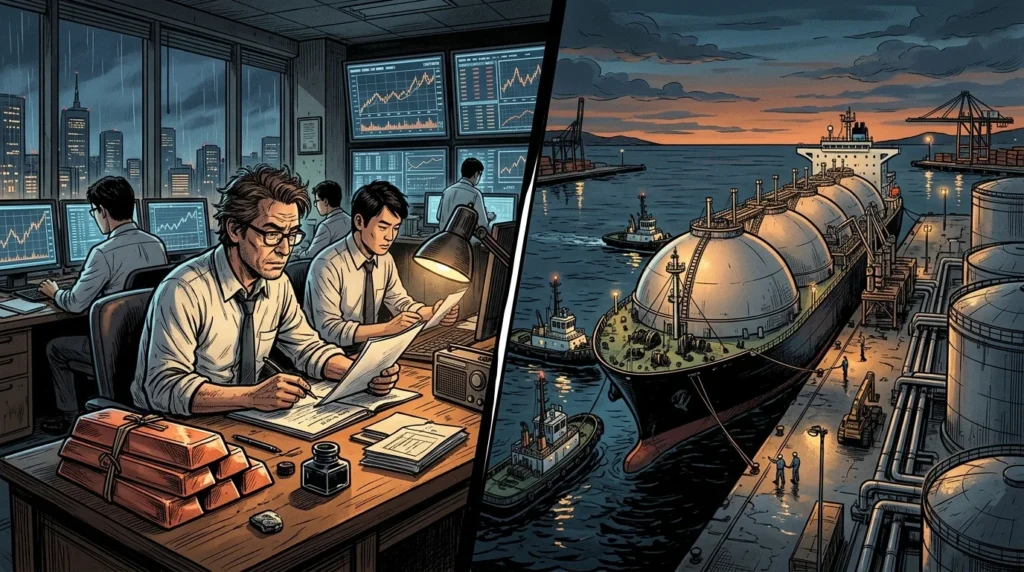
Across the four decades following World War II, Japan’s industrial rise was defined by three dramatic transformations in its physical commodity and energy base. In December 1946, with industrial output languishing at barely 30 percent of prewar levels, University of Tokyo economist Hiromi Arisawa and Prime Minister Shigeru Yoshida launched the Priority Production System (Keisha Seisan Hoshiki), using Reconstruction Finance Bank (Fukko Kinyu Kinko) credits to funnel every drop of Allied-approved imported fuel oil into steel mills and every ton of newly rolled steel into coal mines to hit a national target of 30 million metric tons of coal. A decade later, Japan abandoned expensive domestic coal for cheap Middle Eastern crude oil—a structural “energy revolution” ratified in blood and tear gas during the 1959–1960 Mitsui Miike coal mine strike in Kyushu, which left Japan 77.4 percent dependent on imported oil by 1973. When the October 1973 OAPEC oil embargo quadrupled crude prices overnight, rumor-driven supermarket runs on toilet paper and synthetic detergent in Osaka and 23 percent “crazy prices” (kyoran bukka) inflation jolted Tokyo into its third pivot: MITI’s July 1974 Sunshine Project, aggressive industrial energy conservation, and rapid diversification into liquefied natural gas (LNG) and nuclear power. [1]
December 1946: Hiromi Arisawa and the Priority Production System (Keisha Seisan Hoshiki)
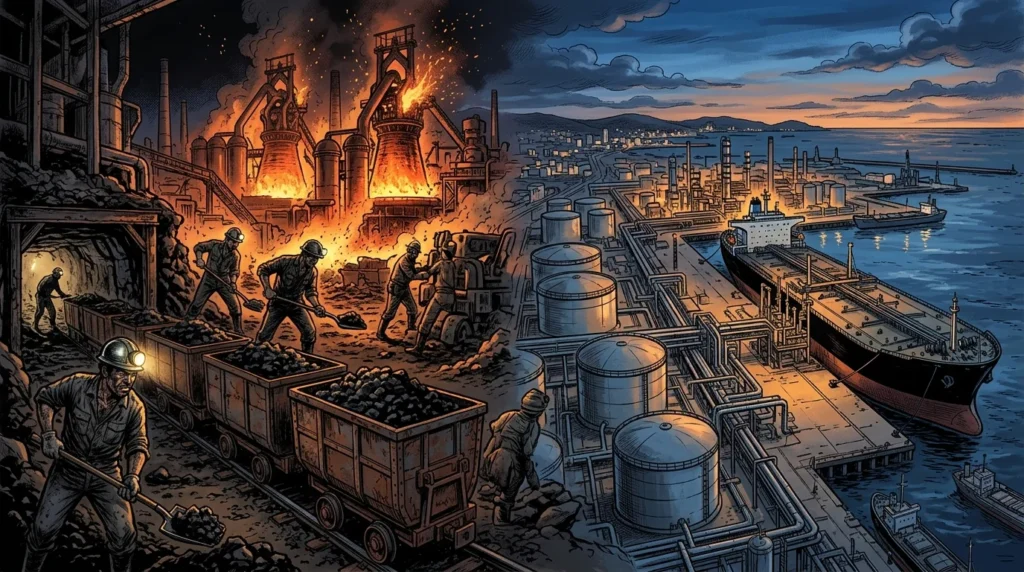
In the autumn of 1946, fourteen months after Japan’s surrender, the domestic economy stood on the verge of physical exhaustion. Allied strategic bombing and naval blockades had destroyed one-quarter of Japan’s industrial plant, severed access to Manchurian coking coal and Chinese iron ore, and repatriated over six million soldiers and civilians to the resource-poor home islands. Worse still, Japanese industry was trapped in a classic input-output deadlock: steel blast furnaces sat cold because coal mines could not supply enough fuel, while flooded and dilapidated coal mines could not repair their underground haulage rails, ventilation fans, or pit props because steel mills could not supply rolled steel. [2]
In 1946, annual domestic coal output fell to just 20.3 million metric tons—barely one-third of the 56.5 million tons mined in 1941—and after Allied Occupation railway requisitions and heating needs were deducted, almost no coal remained for basic manufacturing. Economist Hiromi Arisawa, a professor at the University of Tokyo who chaired Prime Minister Shigeru Yoshida’s informal “Coal Committee” of advisers, argued that across-the-board market allocation would fail in a starved economy. Instead, Arisawa proposed deliberately tilting (keisha) all scarce physical resources into two foundational sectors—coal and steel—to create an upward spiral of mutual reinforcement. [3]
Once General Douglas MacArthur’s Supreme Commander for the Allied Powers (SCAP) authorized the emergency import of heavy residual fuel oil (Grade B/C bunker oil) and coking coal in December 1946, the Yoshida Cabinet adopted the Priority Production System on December 27, 1946 with a national goal of producing 30 million metric tons of coal in fiscal year 1947. Under the loop, all imported fuel oil was allocated exclusively to open-hearth steel furnaces; the resulting steel output was directed preferentially to coal mines in Hokkaido and Kyushu; the incremental coal extracted was fed back into steel mills; and only once coal output crossed the 30-million-ton threshold did surplus coal and steel spill over into chemical fertilizers (ammonium sulfate to prevent famine), electric power, and railways. [4]
| Documented Figure / Metric | Historical Significance & Archival Context |
|---|---|
| US$1.80 | As world crude oil prices fell below US$1.80 per barrel and supertankers slashed ocean freight rates, MITI and Japan's heavy industrial conglomerates (keiretsu) pivoted from a "coal-first, oil-second" policy toward Pacific Coast petrochemical complexes and oil-fired thermal power plants. |
| ¥2 billion | For 282 days, the dispute was fought as "Total Capital versus Total Labor": Japan's major banks and employers' federations extended emergency credit to sustain Mitsui Mining, while Sohyo mobilized hundreds of thousands of picketers and ¥2 billion in union strike funds. |
| 37.0 percent | By February 1974, Japan's wholesale price index jumped 37.0 percent year-over-year and consumer price inflation hit 23.2 percent in 1974—an era Finance Minister Takeo Fukuda immortalized as "crazy prices" (kyoran bukka). |
The Reconstruction Finance Bank (Fukko Kinyu Kinko) and RFB Inflation
Physical rationing required an equally aggressive financial engine. Because commercial banks were paralyzed by wartime corporate bad debts and the cancellation of government wartime indemnities, private lenders refused to extend credit to money-losing coal and steel enterprises whose official output prices were capped far below production costs. To bridge the gap, the government opened the state-owned Reconstruction Finance Bank (Fukko Kinyu Kinko, or RFB) in January 1947, reinforced by direct budget price-differential subsidies (kakaku chousei補給金). [5]
Between January 1947 and March 1949, the Reconstruction Finance Bank became the dominant supplier of industrial capital in Japan, with its outstanding loan balance surging to ¥131.9 billion—accounting for nearly one-third of all corporate bank lending in the country and over 70 percent of fixed-capital investment in the coal, iron and steel, fertilizer, and electric power sectors. Coal mining alone received ¥47.5 billion (36 percent) of all RFB loans. Driven by priority rations, extra food allowances for underground miners, and RFB financing, Japanese coal production reached 29.3 million metric tons in fiscal 1947 and exceeded 34.7 million tons in fiscal 1948, while crude steel output more than tripled from 557,000 tons in 1946 to 1.71 million tons in 1948. [6]
Yet the monetary cost was severe—a phenomenon contemporaries dubbed “RFB Inflation” (Fukkin Infure). Because nearly 75 percent of the Reconstruction Finance Bank’s debentures were underwritten directly by the Bank of Japan printing fresh banknotes, retail prices tripled between 1947 and early 1949. Only with the arrival of Detroit banker Joseph Dodge in February 1949 and the implementation of the “Dodge Line”—which suspended new RFB lending, eliminated price subsidies, balanced the consolidated budget, and fixed the exchange rate at ¥360 to the U.S. dollar—was postwar inflation finally extinguished. [7]
The 1959–1960 Mitsui Miike Coal Strike and the Pivot to Middle East Oil
Having served as the hero of Japan’s 1947 industrial resurrection, domestic coal became an economic liability within a single decade. Located in deep, geologically faulted seams in Kyushu and Hokkaido, Japanese coal was expensive to extract compared with the vast, low-cost petroleum reserves discovered in Saudi Arabia, Kuwait, Iran, and the Neutral Zone during the 1950s—where Japan’s Arabian Oil Company struck the offshore Khafji field in January 1960. As world crude oil prices fell below US$1.80 per barrel and supertankers slashed ocean freight rates, MITI and Japan’s heavy industrial conglomerates (keiretsu) pivoted from a “coal-first, oil-second” policy toward Pacific Coast petrochemical complexes and oil-fired thermal power plants. [8]
To compete with cheap imported oil, Japanese coal companies launched ruthless “rationalization” plans to shed tens of thousands of unionized miners. The decisive confrontation erupted at Mitsui Mining’s historic Miike colliery in Omuta, Fukuoka Prefecture—Japan’s largest and most productive coal mine, whose militant union (Miike Tanko Rodo Kumiai, or Sankoro) had pioneered workplace production control and formed the backbone of the left-wing Sohyo labor federation alongside the 1960 anti-U.S.-Japan Security Treaty (Anpo) protests.
In August and December 1959, Mitsui Mining issued dismissal notices to over 1,200 designated Miike workers, deliberately targeting 300 shop-floor union activists. When management locked out the mine on January 25, 1960, the Miike union declared an indefinite strike. For 282 days, the dispute was fought as “Total Capital versus Total Labor”: Japan’s major banks and employers’ federations extended emergency credit to sustain Mitsui Mining, while Sohyo mobilized hundreds of thousands of picketers and ¥2 billion in union strike funds. In March 1960, Mitsui sponsored a compliant “second union” to resume coal production, leading to violent clashes with 15,000 police officers, naval picket battles in Ariake Bay, and the fatal stabbing of striking miner Kiyoshi Kubo by a right-wing gangster on March 29, 1960. In November 1960, exhausted and isolated after Prime Minister Hayato Ikeda took office promising his “Income Doubling Plan,” the Miike union accepted Central Labor Relations Commission mediation that upheld the firing of the 1,200 miners. Domestic coal’s share of Japan’s primary energy supply collapsed from 50.2 percent in 1955 to just 15.5 percent by 1973, while imported petroleum—nearly 80 percent of it from the Middle East—soared from 20.2 percent in 1955 to 77.4 percent in fiscal 1973.
October 1973: The Oil Shock, Osaka’s “Toilet Paper Panic,” and “Crazy Prices”
That 77.4 percent oil dependency left Japan more exposed than any other major industrial democracy when the Fourth Arab–Israeli War broke out on October 6, 1973. On October 16–17, 1973, Gulf OPEC members raised the posted price of Arabian Light crude by 70 percent to US$5.12 per barrel—and then doubled it again in December to US$11.65 per barrel, a fourfold increase in ninety days—while the Organization of Arab Petroleum Exporting Countries (OAPEC) announced progressive production cuts against nations not classified as “friendly” to the Arab cause.
In Japan, the supply shock collided with an economy already overheating from Prime Minister Kakuei Tanaka’s “Plan for Remodeling the Japanese Archipelago” and loose monetary policy. In late October 1973, MITI officials publicly urged paper manufacturers and households to conserve paper, while television broadcasts reported potential fuel-rationing shortages. On the morning of November 1, 1973, at the千里Daimaru (Senri New Town) cooperative supermarket in Toyonaka, Osaka Prefecture, roughly two hundred housewives lined up before opening to buy half-price packs of toilet paper after rumors spread that paper—perceived as dependent on imported pulp and fuel oil—was about to disappear from shelves.
National television cameras broadcast footage of shoppers grappling for paper rolls in the aisles, and within forty-eight hours the “Toilet Paper Panic” (Toiretto Pepa Sodo) swept from Kansai to Tokyo and across the country, quickly spreading to laundry detergent, sugar, soy sauce, and kerosene. Although domestic toilet paper production had actually increased in 1973, wholesale distributors hoarded inventories to profit from soaring prices. By February 1974, Japan’s wholesale price index jumped 37.0 percent year-over-year and consumer price inflation hit 23.2 percent in 1974—an era Finance Minister Takeo Fukuda immortalized as “crazy prices” (kyoran bukka). In December 1973, the Diet enacted two emergency wartime-style statutes—the Petroleum Supply and Demand Optimization Law and the Emergency Measures Law for the Stabilization of National Life—dispatching price inspectors to seize hoarded toilet paper and kerosene while dimming neon lights in Ginza and cutting late-night television broadcasts. In 1974, Japan’s real GDP contracted by 1.2 percent, recording its first annual decline since the end of World War II and permanently ending the era of 10 percent high-speed growth.
MITI’s 1974 Sunshine Project and the Post-1973 Energy Restructuring
Shaken by the realization that an external resource cutoff could paralyze Japanese society within weeks, Tokyo overhauled both its foreign diplomacy and its industrial structure. While Deputy Prime Minister Takeo Miki flew to Middle Eastern capitals in December 1973 to secure “friendly nation” status from OAPEC, MITI’s Agency of Industrial Science and Technology launched the Sunshine Project (Sanshain Keikaku) in July 1974—the world’s first comprehensive, multi-decade national R&D program dedicated to non-petroleum renewable and alternative energy technologies.
Backed by sustained public funding through the creation of the New Energy Development Organization (NEDO) in October 1980 after the Second Oil Crisis, the Sunshine Project targeted four core pillars through the year 2000: solar photovoltaics and thermal systems, geothermal power, coal gasification and liquefaction, and hydrogen energy—followed in 1978 by the complementary Moonlight Project (Munraito Keikaku) for industrial energy efficiency and waste-heat recovery. Paired with the 1974 “Three Power Source Development Laws” (which used electricity taxes to subsidize municipalities hosting nuclear and LNG power plants) and a 90-day strategic petroleum reserve mandate, Japan slashed its industrial energy intensity by more than 30 percent between 1973 and 1989, shifting its industrial center of gravity from energy-guzzling aluminum smelting, steel, and shipbuilding toward semiconductors, precision electronics, and fuel-efficient automobiles.
Theoretical & Balance-Sheet Transmission Mechanism
In the Kindleberger–Minsky taxonomy of financial instability (Kindleberger, 1978; Minsky, 1986) and Irving Fisher’s (1933) debt-deflation framework, speculative asset booms become systemic crises when credit expansion shifts balance sheets from hedge finance (cash flows covering principal and interest) to speculative and Ponzi finance (relying on rising asset prices and short-term margin roll-overs).
Once monetary tightening or an exogenous shock halts price appreciation, forced margin liquidations trigger Fisherian debt-deflation: fire-sale asset discounts erode bank collateral values, contracting credit supply across the real economy.
Sources and Further Reading
- Tetsuji Okazaki, “ Postwar Economic Reconstruction and the Priority Production System in Japan,” CIRJE Discussion Paper CF-340, University of Tokyo, 2005. Historical & Financial Reference
- Institute of Developing Economies (IDE-JETRO), “ Coal Mining Rationalization, the Energy Revolution, and the 1960 Miike Dispute,” IDE-JETRO Japanese Experience Series, 2008. Historical & Financial Reference
- Benjamin C. Uchiyama, “ The 1960 Miike Coal Mine Strike and the Transformation of Postwar Japanese Labor and Energy Policy,” Portland State University PDXScholar, 2019. Peer-Reviewed / Academic Research
- Japan Bank for International Cooperation, “ Fifty Years Since the 1973 First Oil Crisis: Japan’s Resource Diplomacy and Energy Diversification,” JBIC Today, 2023. Historical & Financial Reference
- Agency of Industrial Science and Technology (MITI), “ Japan’s Sunshine Project: Summary of Comprehensive Research on New Energy Technology,” U.S. Department of Energy OSTI / MITI Japan, 1993. Official / State Archive
- New Energy and Industrial Technology Development Organization, “ History of the Sunshine Project, Moonlight Project, and NEDO Energy Innovation,” NEDO, 2023. Historical & Financial Reference
- Irving Fisher — "The Debt-Deflation Theory of Great Depressions," Econometrica 1, no. 4 (FRASER Federal Reserve Archive, 1933): 337–357 Central Bank / Monetary Authority
- Charles P. Kindleberger & Robert Z. Aliber — Manias, Panics, and Crashes: A History of Financial Crises (Palgrave Macmillan) Peer-Reviewed / Academic Research
Cite This Historical Dossier (APA / Chicago)
APA (7th ed.): Ç., S. (Ed.). (2026). Priority Production, the Miike Coal Strike, and Japan's 1973 Toilet Paper Panic. In Forgotten Fortunes Historical Monograph Series (Forgotten Fortunes Editorial Desk). https://forgottenfortunes.net/japan-priority-production-oil-shocks/
MLA (9th ed.): Ç., Soner, ed. "Priority Production, the Miike Coal Strike, and Japan's 1973 Toilet Paper Panic." Forgotten Fortunes: Financial & Monetary History Archive, 2026, https://forgottenfortunes.net/japan-priority-production-oil-shocks/.
Chicago (17th ed.): Ç., Soner, ed. "Priority Production, the Miike Coal Strike, and Japan's 1973 Toilet Paper Panic." Forgotten Fortunes Historical Monograph Series (Forgotten Fortunes Editorial Desk), September 15, 2026. https://forgottenfortunes.net/japan-priority-production-oil-shocks/.
Have an idea for another financial history documentary or article? Request a story →