In This Article
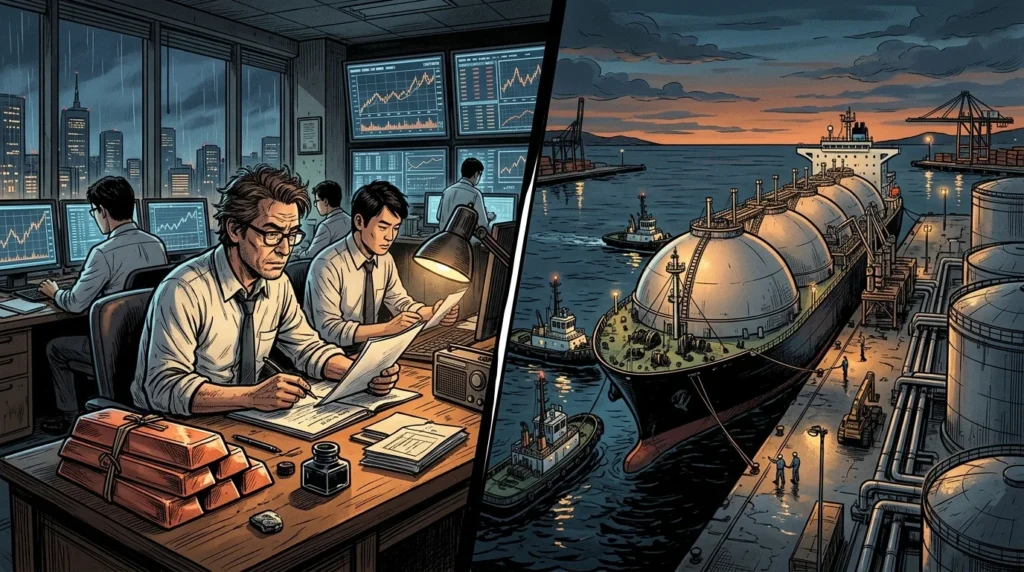
For most of the early 1990s, the most feared name in the world copper market belonged to a soft-spoken salaryman in Tokyo. Yasuo Hamanaka, head of copper trading at Sumitomo Corporation, was nicknamed “Mr. Five Percent” because traders believed he controlled about 5% of the world’s copper supplies [6]. When Sumitomo revealed in June 1996 that he had been trading without authorization for a decade, the hole he left behind was first put at US$1.8 billion and later at US$2.6 billion, at the time one of the largest trading losses ever disclosed [2][5].

The Sumitomo affair was not just a story of one rogue trader. It exposed how a single firm could build dominant positions on the London Metal Exchange (LME), how warnings about faked paperwork were passed around and dropped, and how banks and brokers that financed the trading later paid to settle claims that they should have known better.
A Trader Trying to Win Back Old Losses
Hamanaka was a career Sumitomo man and the firm’s best-known trader, working for one of Japan’s giant trading houses with assets of about US$50 billion [2][6]. According to Sumitomo’s own account, his increasingly desperate trading was meant to recoup or hide losses dating from the mid-1980s [6]. Instead of disclosing those losses, he kept trading in secret, betting on copper through accounts that his superiors did not know about, or so the company later maintained [2][5].
The scale grew steadily. In September 1996 Sumitomo’s president, Kenji Miyahara, said that Hamanaka had carried out as many as 2,000 unauthorized deals in a single year and had created false documents to hide them [5]. The company later told investigators that the names of three other executives that appeared in the paperwork had all been forged by Hamanaka [6].
| Documented Figure / Metric | Historical Significance & Archival Context |
|---|---|
| £16 million | In 1999 Merrill Lynch paid fines totalling nearly £16 million to the CFTC and the LME, the LME's £6.5 million share being a record for the exchange; Merrill neither admitted nor denied the allegations that it had aided and abetted the attempt to corner the market. |
| US$125 million | Morgan Chase agreed to pay US$125 million to settle, without admitting wrongdoing. |
Warnings That Went Nowhere: 1991 to 1993
The first public sign of trouble came in 1991. On November 22 that year, the American copper trader David Threlkeld faxed David King, chief executive of the LME, to say that Hamanaka had asked him the previous month to confirm trades that had never taken place. According to Threlkeld, Hamanaka admitted the trades did not exist but said the confirmations were needed for tax purposes [4].
King later said he had alerted LME members, raised the matter with Britain’s Securities and Investments Board (SIB), and attended a meeting at the SIB with Hamanaka, other Sumitomo representatives and regulators. A Sumitomo director then stated that the tax authorities were satisfied, and the matter was dropped [4]. King also said he warned Sumitomo in 1991 and again in 1993 about the size of its activity in the market [4]. Allegations that Hamanaka had tried to fake trading records were therefore on file five years before the collapse, but Sumitomo took no action against him until June 1996 [6].
A structural gap made this easier. Sumitomo was not an LME member. As King put it after the scandal broke, the exchange had no jurisdiction over “an employee of a nonmember firm on the other side of the world” [4].
How the Squeeze Worked
Copper on the LME trades both as futures contracts and as warrants, documents that give title to physical metal stored in exchange-approved warehouses. A trader who holds most of the available warrants while also holding a large long futures position can squeeze those who have sold copper for future delivery. If the sellers cannot find metal to deliver, they must buy back their contracts, and the dominant holder sets the price.
That, according to the U.S. Commodity Futures Trading Commission (CFTC), is what happened in 1995 and 1996. In its 1998 order, the CFTC found that Sumitomo, acting through its agent or agents and “in conjunction with an entity operating in the United States,” built large and dominant copper futures positions on the LME. In the autumn of 1995 it took delivery on a significant share of its maturing contracts, gaining a dominant cash and futures position that pushed copper prices, including U.S. prices, to artificially high levels and created an artificial premium of nearby prices over later-dated futures. Sumitomo then profited by liquidating futures and warrants at those inflated prices [1]. Sumitomo settled without admitting or denying the findings [1].
Others helped finance the position. The LME later alleged that between October and December 1995 a U.S. copper merchant used Merrill Lynch financing to build a huge copper position, falsely claiming it was needed for Sumitomo’s physical requirements. Among the clues the exchange said Merrill should have noticed was that no significant amount of copper left LME warehouses after the deals it financed [8].
The LME’s own concern rose in the same period. King said that in October and November 1995 he became worried about “the structure of the market” and asked members for detailed information on their own and their clients’ positions and warrant holdings [4].
Collapse: June 1996
On June 13, 1996, Sumitomo announced in New York, after the close of commodities trading, that it had found “significant unreported losses,” estimated at US$1.8 billion, from ten years of unauthorized trading by its former head of copper trading. The company said it had first found evidence on June 5, had notified regulators in the United States, Britain and Japan, and could absorb the loss [2]. Hamanaka was dismissed [3].
The market reaction was immediate. Dealers feared that Sumitomo, the largest player in copper, would have to sell large holdings, and many traders, including hedge funds, sold first. On June 14, July copper futures on New York’s Comex fell 10.30 cents to 93.85 cents a pound, a two-year low and about 25% below the near-term price a month earlier. In London, the LME cash bid dropped to 97 cents a pound from US$1.05 the day before [3]. Shares of copper producers such as Phelps Dodge were hit as well [3].
As Sumitomo unwound the positions, the bill rose. On September 19, 1996, it raised its loss estimate to US$2.6 billion and said it would post the first annual loss in its 77-year history. Miyahara insisted the trading had been “done completely by one person,” though analysts questioned whether one man could have hidden such activity for ten years [5].
Prosecution and Penalties
Tokyo prosecutors arrested Hamanaka on forgery charges in October 1996, the day after Sumitomo filed a formal complaint against him [6]. He pleaded guilty to fraud and forgery in 1997, and in March 1998 the Tokyo District Court sentenced him to eight years in prison [7][10]. Sumitomo also brought a civil suit against Hamanaka and his former boss to recover part of its losses [7].
Regulators followed. In May 1998 Sumitomo agreed to pay the CFTC a total of US$150 million: a US$125 million civil penalty, then the largest in the agency’s history, and US$25 million placed in escrow for up to four years to compensate people harmed by the manipulation [1][7]. It also agreed to pay about US$8 million (reported as £5 million) to Britain’s Financial Services Authority, the SIB’s successor [7][8]. The CFTC noted that it made no finding on Sumitomo’s claim that Hamanaka’s trading was unauthorized and hidden from other officials [7].
The brokers were next. In 1999 Merrill Lynch paid fines totalling nearly £16 million to the CFTC and the LME, the LME’s £6.5 million share being a record for the exchange; Merrill neither admitted nor denied the allegations that it had aided and abetted the attempt to corner the market [8].
Sumitomo Turns on the Banks
Having paid regulators, Sumitomo went after the institutions that had dealt with Hamanaka. In 1999 it sued J.P. Morgan in the United States, alleging that the bank had extended what were in effect loans dressed up as derivatives deals, even though it should have known Hamanaka lacked authority to take them on. In April 2002 J.P. Morgan Chase agreed to pay US$125 million to settle, without admitting wrongdoing [9].
The last major case was a US$1.1 billion claim (US$695 million plus interest) in London’s High Court against the LME broker Credit Lyonnais Rouse (CLR), filed in 1999. Sumitomo argued that CLR knew or turned a blind eye to the fact that Hamanaka was a rogue trader; CLR replied that Sumitomo was the author of its own misfortune because it had failed to supervise him. The case centred on a June 1993 copper deal involving 2.53 million tonnes of copper. The parties settled in October 2004, weeks into the trial, on confidential terms, with Sumitomo withdrawing all allegations of dishonesty [10].
What the Affair Revealed
The Sumitomo case showed how many ways a corner could stay hidden. Inside the firm, a star trader faked documents and forged colleagues’ names. On the exchange, the regulator had no direct power over a non-member client. Among lenders and brokers, large and profitable business discouraged hard questions. British regulators announced a review of metals-trading rules within days of the disclosure [4], and the LME’s chief executive conceded that the exchange’s ability to scrutinise overseas non-members was a weak point [4].
The people harmed were spread widely: copper consumers who paid artificially high prices in 1995 and 1996, traders caught on the wrong side of the squeeze, and producers whose shares fell when prices collapsed [1][3]. Sumitomo itself absorbed a US$2.6 billion loss [5]. The affair remains a lesson in how quickly a market built on trust in physical warrants and long-standing relationships can be bent by a single determined participant with enough borrowed money.
Theoretical & Balance-Sheet Transmission Mechanism
In the Kindleberger–Minsky taxonomy of financial instability (Kindleberger, 1978; Minsky, 1986) and Irving Fisher’s (1933) debt-deflation framework, speculative asset booms become systemic crises when credit expansion shifts balance sheets from hedge finance (cash flows covering principal and interest) to speculative and Ponzi finance (relying on rising asset prices and short-term margin roll-overs).
Once monetary tightening or an exogenous shock halts price appreciation, forced margin liquidations trigger Fisherian debt-deflation: fire-sale asset discounts erode bank collateral values, contracting credit supply across the real economy.
Sources and Further Reading
- Commodity Futures Trading Commission, “ CFTC Files and Settles Action Against Sumitomo Corporation for Manipulating the Copper Market in 1995-96 (Release #4144-98),” U.S. Commodity Futures Trading Commission, 1998-05-11. Official / State Archive
- “ Sumitomo Corp. Hit by Huge Trading Loss,” Los Angeles Times, 1996-06-14. Historical & Financial Reference
- “ Copper Takes a Beating: Markets, Industry Hit by News of Sumitomo Losses,” Los Angeles Times, 1996-06-15. Historical & Financial Reference
- “ Metal Exchange Admits Oversight Problem,” Los Angeles Times, 1996-06-20. Historical & Financial Reference
- “ Trading Losses Are Increased by Sumitomo to $2.6 Billion,” Los Angeles Times, 1996-09-20. Historical & Financial Reference
- “ Ex-Sumitomo Copper Trader Arrested,” Los Angeles Times, 1996-10-23. Historical & Financial Reference
- “ Firm to Pay $158 Million in Copper Case,” Los Angeles Times, 1998-05-12. Historical & Financial Reference
- “ Merrill fined £16m for role in copper scandal,” The Guardian, 1999-07-01. Historical & Financial Reference
- “ Sumitomo, U.S. firm settle over copper trading lawsuit,” The Japan Times, 2002-04-02. Historical & Financial Reference
- “ Settlement reached on Sumitomo copper suit,” The Guardian, 2004-10-26. Historical & Financial Reference
- Irving Fisher — "The Debt-Deflation Theory of Great Depressions," Econometrica 1, no. 4 (FRASER Federal Reserve Archive, 1933): 337–357 Central Bank / Monetary Authority
- Charles P. Kindleberger & Robert Z. Aliber — Manias, Panics, and Crashes: A History of Financial Crises (Palgrave Macmillan) Peer-Reviewed / Academic Research
Cite This Historical Dossier (APA / Chicago)
APA (7th ed.): Ç., S. (Ed.). (2026). Mr. Five Percent: How Sumitomo's Hidden Copper Trades Cost $2.6 Billion. In Forgotten Fortunes Historical Monograph Series (Forgotten Fortunes Editorial Desk). https://forgottenfortunes.net/sumitomo-copper-trading-losses/
MLA (9th ed.): Ç., Soner, ed. "Mr. Five Percent: How Sumitomo's Hidden Copper Trades Cost $2.6 Billion." Forgotten Fortunes: Financial & Monetary History Archive, 2026, https://forgottenfortunes.net/sumitomo-copper-trading-losses/.
Chicago (17th ed.): Ç., Soner, ed. "Mr. Five Percent: How Sumitomo's Hidden Copper Trades Cost $2.6 Billion." Forgotten Fortunes Historical Monograph Series (Forgotten Fortunes Editorial Desk), August 26, 2026. https://forgottenfortunes.net/sumitomo-copper-trading-losses/.
Have an idea for another financial history documentary or article? Request a story →