In This Article
On Thursday, March 27, 1980—a date remembered in financial history as “Silver Thursday”—the global silver market collapsed as Texas oil billionaires Nelson Bunker Hunt and William Herbert Hunt failed to meet massive margin calls on their leveraged bullion and futures holdings [1][2][5]. Over the preceding decade, the sons of legendary Texas wildcatter H. L. Hunt had amassed more than 100 million troy ounces of physical silver alongside towering futures positions on New York’s Commodity Exchange (COMEX) and the Chicago Board of Trade, controlling between one-third and one-half of the world’s deliverable silver supply [2][3][5]. Their buying spree propelled silver from less than $9 per ounce in September 1979 to an unprecedented peak of $50 per ounce in mid-January 1980 [2][3][4]. When commodity exchanges imposed strict position limits and Federal Reserve Chairman Paul Volcker curtailed bank lending for speculative commodity hoarding, silver plunged back below $11 per ounce in late March 1980—threatening to topple major Wall Street brokerage Bache Halsey Stuart Shields, forcing a Fed-supervised bank rescue that locked up the Hunts’ personal empire, and triggering a decade of federal manipulation charges, a $130 million racketeering judgment, and Chapter 11 bankruptcy [1][2][3][4].

East Texas Oil Roots and the 1973 Libyan Expropriation
The capital that financed the silver corner originated in the American and international petroleum industry [5][7]. H. L. Hunt had built one of the largest private fortunes in the United States in the East Texas oilfields during the 1920s and 1930s, passing down extensive energy enterprises and trusts to his children, including sons Nelson Bunker Hunt, William Herbert Hunt, and Lamar Hunt (founder of the Kansas City Chiefs football franchise) [3][5][7].
Seeking to expand beyond domestic basins, Nelson Bunker Hunt partnered with his brothers Lamar and William Herbert to establish Hunt International Petroleum [5]. After unsuccessful exploration ventures in Pakistan and Saudi Arabia, Hunt International Petroleum struck a massive discovery in Libya in 1961: the Sarir oilfield, the largest petroleum deposit in North Africa [5]. For more than a decade, low-cost Libyan crude production generated immense cash flows that elevated Nelson Bunker Hunt into contention for the title of the world’s wealthiest private individual [5].
That geopolitical arrangement ended abruptly in 1973, when Libyan ruler Muammar Gaddafi nationalized the Sarir oilfield and expropriated the Hunts’ North African operations [5]. Deeply distrustful of paper currencies amid the inflationary oil shocks of the 1970s—and barred as U.S. citizens from holding private gold bullion prior to the end of 1974—Nelson Bunker and William Herbert Hunt began accumulating silver futures and physical bullion, initially as an inflation hedge and increasingly as a vehicle to corner global supply [1][5].
| Documented Figure / Metric | Historical Significance & Archival Context |
|---|---|
| $1.1 billion | To prevent a disorderly default across the banking system, however, a Texas banker approached Volcker with a plan for a consortium of commercial banks to consolidate the Hunts' scattered obligations into a single $1.1 billion emergency restructuring loan through the family's Placid Oil Company. |
| 1980 bank | The 1980 bank consolidation bought time, but collapsing oil prices in the mid-1980s and mounting legal and tax claims dismantled the Hunt brothers' financial empire. |
| $1.5 billion | In 1986, after crude oil prices skidded, the Hunts defaulted on $1.5 billion in bank loans and sued their creditor banks in Dallas federal court alleging fraud; when the banks counter-demanded full repayment, the brothers placed Placid Oil Company and Penrod Drilling Company into Chapter 11 bankruptcy reorganization. |
| $130 million | Because the jury also convicted Nelson Bunker and William Herbert Hunt under federal racketeering (RICO) statutes, damages were trebled to more than $130 million. |
The Leveraged Silver Squeeze and Foreign Syndicates (1973–January 1980)
In ordinary commodity futures trading, institutional participants buy or sell standardized contracts for future delivery and close out their positions for cash before the delivery date arrives [2][4]. The Hunt brothers upended this convention by systematically demanding physical delivery of silver bullion when their long futures contracts matured, shipping the metal to private vaults in the United States and Switzerland, and removing deliverable supply from exchange warehouses [2][4][5].
As detailed in the U.S. Commodity Futures Trading Commission’s (CFTC) subsequent enforcement complaint and federal court findings, the Hunts amplified their purchasing power during 1979 through an international network of leveraged accounts and offshore partners [2][3][4]:
- Offshore Alliances and Family Accounts: Nelson Bunker and William Herbert Hunt formed International Metals Investment Co., a Bermuda-registered corporation co-owned with two wealthy Saudi investors, alongside parallel buying by Saudi royal brother-in-law Mahmoud Fustok, Brazilian-based trader Naji Robert Nahas, and Geneva investment advisory firm Advicorp [2][3]. To sidestep exchange scrutiny, Nelson Bunker Hunt also transferred hundreds of millions of dollars to his children’s accounts—characterizing the transfers as loans rather than taxable gifts—to finance additional silver purchases [2][4].
- Self-Reinforcing Margin Borrowing: Between September 1979 and January 1980, the Hunt group accumulated more than 100 million ounces of physical silver bullion while holding long futures contracts equivalent to 130 percent of total 1979 U.S. industrial silver consumption and half of annual global mine production [2][4]. As their concentrated buying drove spot and futures prices upward from roughly $9–$11 per ounce in September 1979, the brothers used the rising paper value of their bullion hoard as collateral to borrow vast sums from commercial banks and Wall Street brokerages—most notably Bache Halsey Stuart Shields (Bache & Co.)—to buy even more silver [1][2][4].
- The $50 Peak: By mid-January 1980, the squeeze had driven silver prices to a record $50 per troy ounce [2][4][5]. At the peak, the Hunts and their allies controlled an estimated one-third to one-half of the world’s deliverable silver—valued between $4.5 billion and $7 billion—while ordinary citizens lined up at coin shops to melt down family heirlooms and silverware [2][5][7].
Exchange Intervention, Silver Thursday, and the Bache Crisis (January–May 1980)
Alarmed that the Hunt syndicate’s concentration threatened the solvency of short-side commercial hedgers—such as industrial refiner Engelhard Minerals and Chemical Corporation and Peru’s state mineral marketing firm, Minpeco S.A.—regulators and exchange governors intervened [1][2][3]. In January 1980, under pressure from the CFTC, New York’s COMEX imposed strict position limits and emergency margin rules restricting new speculative long purchases to liquidation-only trading [2][4]. When the Hunts attempted to open new accounts in the names of other individuals and corporate entities to keep buying, fresh supplies of melted scrap silver flooded the market just as the Federal Reserve Board under Chairman Paul Volcker issued stern warnings instructing commercial banks not to extend credit for speculative commodity hoarding [1][2][4].
Starved of fresh leveraged buying while short-term interest rates surged under Volcker’s anti-inflation tightening, silver prices began to slide in February and March 1980 [1][4][5]. Because the Hunts had pledged their silver holdings as collateral for more than $200 million in loans from Bache & Co. and additional credit lines from institutions such as Merrill Lynch and the First National Bank of Chicago, every dollar drop in the price of silver triggered massive cash margin calls [1][2].
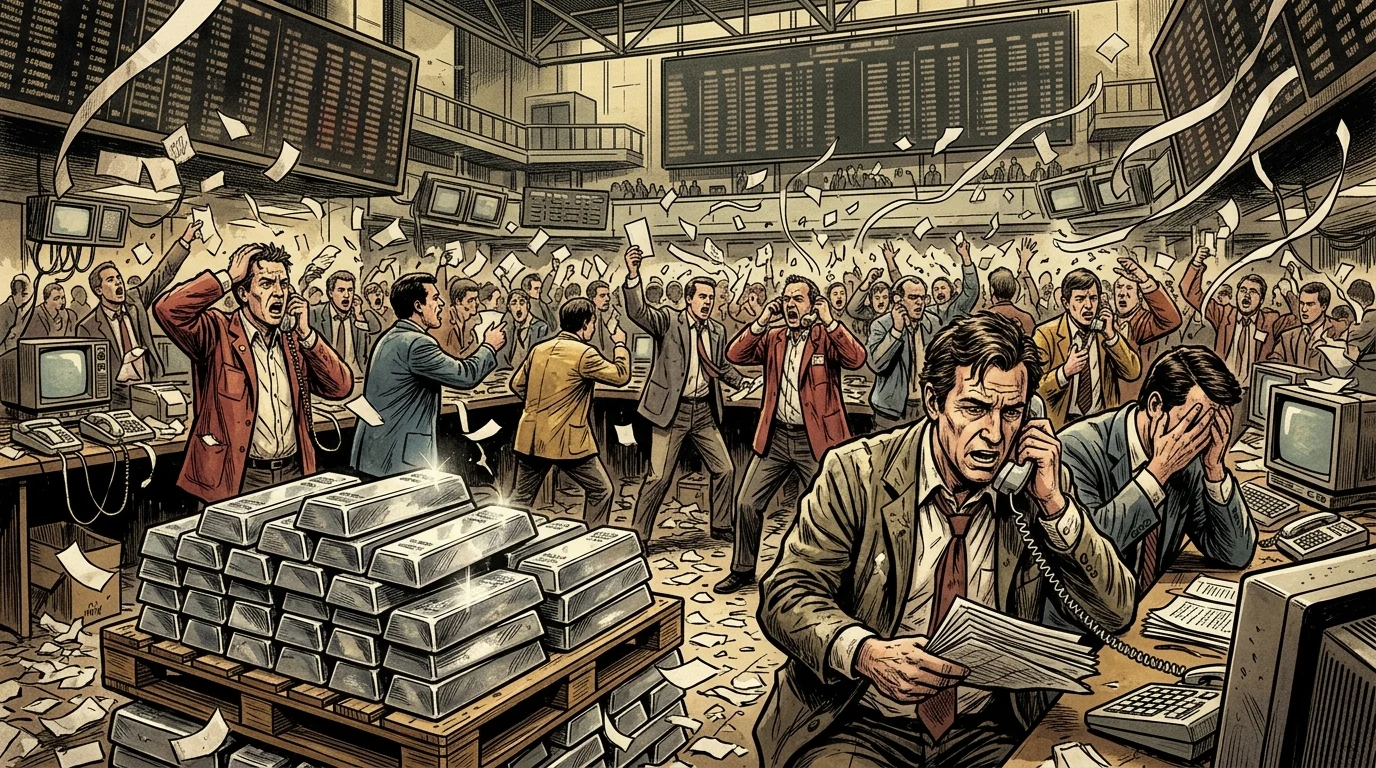
On Thursday, March 27, 1980 (“Silver Thursday”), the Hunts failed to meet their margin calls, forcing Bache and other brokers to dump silver collateral onto the open market [1][2][5]. Silver prices plunged below $11 per ounce—an 80 percent collapse from their January peak—converting the Hunts’ multi-billion-dollar paper fortune into roughly $1 billion to $1.7 billion in net losses and debt [2][3][5][7].
In his official Federal Reserve oral history, Chairman Paul Volcker recalled being interrupted during a Federal Reserve Board meeting by an urgent phone call warning that the Fed had to shut down the silver market immediately because Bache—then the nation’s second-largest brokerage house—was about to go bankrupt if silver fell any further [1]. After consulting with the Treasury Department and CFTC Chairman James Stone, Volcker and the Treasury declined to close the market, and a brief price stabilization the following day allowed Bache to liquidate enough positions to survive [1].
To prevent a disorderly default across the banking system, however, a Texas banker approached Volcker with a plan for a consortium of commercial banks to consolidate the Hunts’ scattered obligations into a single $1.1 billion emergency restructuring loan through the family’s Placid Oil Company [1][2][7]. Despite the Fed’s prior directive against speculative silver loans, Volcker and the Federal Reserve Board blessed the consolidated bank facility on one strict condition: under the supervision of Federal Reserve banking officer William Taylor, every available asset belonging to Nelson Bunker Hunt—including his oil interests and his prized stable of Thoroughbred racehorses—had to be locked up as collateral in a Delaware bank trust until the banks were repaid [1]. Weeks later, at a Reserve City Bankers meeting in Boca Raton, Volcker was called out of bed in his pajama top to mediate another overnight creditor standoff for silver dealer Engelhard, which avoided bankruptcy by transferring Beaufort Sea oil development leases (later written off for $500 million) to settle its silver obligations [1].
Minpeco RICO Verdict, CFTC Ban, and the Keeneland Dispersal (1985–2012)
The 1980 bank consolidation bought time, but collapsing oil prices in the mid-1980s and mounting legal and tax claims dismantled the Hunt brothers’ financial empire [2][3][4]. On February 28, 1985, following a five-year investigation across New York, London, and Zurich, the CFTC filed a formal administrative complaint charging Nelson Bunker Hunt, William Herbert Hunt, International Metals Investment Co., Naji Nahas, former ContiCommodity vice president Norton Waltuch, and Advicorp with illegally manipulating silver prices in 1979 and 1980 [2]. Concurrently, the Internal Revenue Service (IRS) demanded $238 million in back taxes over Bunker Hunt’s 1980 silver-trading transfers to his children, while the brothers’ sugar-refining and drilling subsidiary, Hunt International Resources Corp., defaulted on $295 million in debt [2].
In 1986, after crude oil prices skidded, the Hunts defaulted on $1.5 billion in bank loans and sued their creditor banks in Dallas federal court alleging fraud; when the banks counter-demanded full repayment, the brothers placed Placid Oil Company and Penrod Drilling Company into Chapter 11 bankruptcy reorganization [3]. To raise cash for creditors in January 1988, Nelson Bunker Hunt liquidated his entire Thoroughbred breeding and racing operation in a historic two-day dispersal sale at Keeneland Sales in Kentucky, selling 580 horses—including two-time Horse of the Year Dahlia—for a world-record $46,912,800 [3][6].
The decisive legal blow fell on August 20, 1988, when a federal jury in New York found Nelson Bunker, William Herbert, and Lamar Hunt liable for civil fraud, antitrust, and commodity law violations in a lawsuit brought by Peruvian state mineral marketer Minpeco S.A., which had lost $63 million on short futures positions during the 1979–1980 squeeze [3]. Because the jury also convicted Nelson Bunker and William Herbert Hunt under federal racketeering (RICO) statutes, damages were trebled to more than $130 million [3]. Unable to post bond, the brothers filed for personal Chapter 11 bankruptcy protection in September 1988 [4][5].
In December 1989, Nelson Bunker Hunt settled the CFTC’s manipulation case by agreeing—without admitting or denying guilt—to a permanent ban from trading on any U.S. commodity exchange and a then-record $10 million civil fine, subordinated to IRS claims that consumed 80 percent of his bankruptcy estate [4]. He emerged from bankruptcy with roughly $10 million in remaining assets and died in 2014 at age 88 [5]. William Herbert Hunt, who went through bankruptcy proceedings in 1990, later rebuilt a multi-billion-dollar fortune through his retained energy company, Petro-Hunt, culminating in a $1.45 billion sale of Williston Basin oil assets in 2012 before his death in 2024 at age 95 [7].
Theoretical & Balance-Sheet Transmission Mechanism
In the Kindleberger–Minsky taxonomy of financial instability (Kindleberger, 1978; Minsky, 1986) and Irving Fisher’s (1933) debt-deflation framework, speculative asset booms become systemic crises when credit expansion shifts balance sheets from hedge finance (cash flows covering principal and interest) to speculative and Ponzi finance (relying on rising asset prices and short-term margin roll-overs).
Once monetary tightening or an exogenous shock halts price appreciation, forced margin liquidations trigger Fisherian debt-deflation: fire-sale asset discounts erode bank collateral values, contracting credit supply across the real economy.
Sources and Further Reading
- Board of Governors of the Federal Reserve System, “ Oral History Interview: Paul A. Volcker (The Hunt Brothers and the Silver Crisis, pp. 154–157),” Federal Reserve Board Oral History Project, 2008-07-28. Central Bank / Monetary Authority
- Robert L. Jackson, “ Hunt Brothers Accused of Manipulating Silver Futures in ’79 and ’80,” Los Angeles Times, 1985-03-01. Historical & Financial Reference
- Associated Press, “ Hunts Guilty of Scheme to Corner Silver: Texans Ordered to Pay $130 Million to Firm in Fraud Convictions,” Los Angeles Times, 1988-08-21. Historical & Financial Reference
- Robert Rosenblatt, “ $10-Million Fine Levied on Nelson Bunker Hunt: Commodities,” Los Angeles Times, 1989-12-21. Historical & Financial Reference
- Rupert Cornwell, “ Nelson Bunker Hunt dead: Former world’s richest man dies in ‘modest circumstances’ in US after losing his fortune,” The Independent, 2014-10-23. Historical & Financial Reference
- Keeneland Association, “ Collections: Historic Bloodstock Dispersals at Keeneland,” Keeneland Magazine, Winter 2019, pp. 84–90. Historical & Financial Reference
- From Staff and Wire Reports, “ Oil magnate Herbert Hunt—famous Texas wildcatter and developer—dies at 95,” The Dallas Morning News, 2024-04-14. Historical & Financial Reference
- Irving Fisher — "The Debt-Deflation Theory of Great Depressions," Econometrica 1, no. 4 (FRASER Federal Reserve Archive, 1933): 337–357 Central Bank / Monetary Authority
- Charles P. Kindleberger & Robert Z. Aliber — Manias, Panics, and Crashes: A History of Financial Crises (Palgrave Macmillan) Peer-Reviewed / Academic Research
Cite This Historical Dossier (APA / Chicago)
APA (7th ed.): Ç., S. (Ed.). (2026). How the Hunt Brothers Cornered the Silver Market and Triggered Silver Thursday (1980). In Forgotten Fortunes Historical Monograph Series (Forgotten Fortunes Editorial Desk). https://forgottenfortunes.net/silver-thursday-hunt-brothers-market-collapse/
MLA (9th ed.): Ç., Soner, ed. "How the Hunt Brothers Cornered the Silver Market and Triggered Silver Thursday (1980)." Forgotten Fortunes: Financial & Monetary History Archive, 2026, https://forgottenfortunes.net/silver-thursday-hunt-brothers-market-collapse/.
Chicago (17th ed.): Ç., Soner, ed. "How the Hunt Brothers Cornered the Silver Market and Triggered Silver Thursday (1980)." Forgotten Fortunes Historical Monograph Series (Forgotten Fortunes Editorial Desk), August 27, 2026. https://forgottenfortunes.net/silver-thursday-hunt-brothers-market-collapse/.
Have an idea for another financial history documentary or article? Request a story →