
In This Article
For more than half a century, cheap pipeline natural gas from the Soviet Union and the Russian Federation formed a foundational pillar of Germany’s export-oriented industrial model. Guided by the doctrine of Wandel durch Handel (change through trade), successive German governments expanded overland and Baltic Sea pipeline links until Russian deliveries accounted for roughly 55% of German natural gas imports at the start of 2022. That interdependence collapsed within months of Russia’s February 2022 invasion of Ukraine. As state-controlled exporter Gazprom progressively throttled and then halted flows through the Nord Stream 1 pipeline—followed by the September 26, 2022 subsea pipeline explosions—European benchmark Dutch Title Transfer Facility (TTF) gas prices surged past €300 per megawatt-hour (MWh). Caught between missing Russian contract volumes and fixed-price obligations to municipal utilities and chemical manufacturers, Germany’s largest gas importer, Uniper SE, accumulated more than €19 billion in spot-market replacement losses. To avert a systemic domino failure across its municipal utility and industrial base, the German federal government activated a €200 billion Economic Stabilization Fund (Wirtschaftsstabilisierungsfonds, or WSF), fast-tracked floating liquefied natural gas (LNG) terminals, and nationalized Uniper in one of the largest corporate rescues in European history. [1]
From Ostpolitik to Nord Stream: Building the 55% Russian Gas Dependence
Germany’s structural reliance on Russian hydrocarbons began on February 1, 1970, in Essen, when West German Economics Minister Karl Schiller and Soviet Foreign Trade Minister Nikolai Patolichev signed the historic “pipes for gas” (Röhren-Erdgas-Geschäft) barter agreement. Under that structure, Mannesmann supplied large-diameter steel pipes financed by a consortium led by Deutsche Bank, while Soviet state exporter Sojuzgasexport repaid the loans with Siberian natural gas delivered to Ruhrgas in Bavaria starting in October 1973. [2]
Even during the height of the Cold War, gas flowed uninterrupted across Eastern Europe, reinforcing a conviction among German industrialists and policymakers that energy trade insulated bilateral relations from geopolitical friction. Following German reunification and the 1990s commissioning of the Yamal-Europe pipeline across Belarus and Poland, Berlin deepened its direct bilateral exposure to Russia’s Gazprom even as it committed to phasing out both domestic coal and nuclear power under the Energiewende (energy transition).
In 2011 and 2012, the twin strings of the Nord Stream 1 subsea pipeline entered operation across the Baltic Sea from Vyborg to Lubmin in Mecklenburg-Vorpommern, providing 55 billion cubic meters (bcm) of annual capacity that bypassed Ukrainian and Polish transit networks. In 2015—one year after Russia’s annexation of Crimea—German utility Wintershall (a subsidiary of chemical giant BASF) completed an asset swap that handed Gazprom full ownership of German gas trading firm Wingas and strategic underground gas storage facilities, including the massive Rehden cavern in Lower Saxony (representing roughly a fifth of Germany’s storage capacity). Simultaneously, a consortium backed by Gazprom, Uniper, Wintershall, OMV, Engie, and Shell began building the parallel 55 bcm Nord Stream 2 pipeline. Because Germany relied entirely on cheap pipeline imports from Russia, Norway, and the Netherlands, it entered 2022 without a single domestic liquefied natural gas (LNG) import terminal. [3]
The 2022 Nord Stream Curtailments, TTF Price Spike, and Baltic Explosions
Signs of market manipulation emerged even before the outbreak of war. Throughout the summer and autumn of 2021, Gazprom declined to book spot transit capacity through Ukraine and Poland and left its German-owned underground storage caverns at Rehden nearly empty, entering the 2021–2022 winter below 10% fill capacity. [4]
On February 22, 2022, two days before Russian forces invaded Ukraine, Chancellor Olaf Scholz halted the regulatory certification of the completed Nord Stream 2 pipeline. In April 2022, after Gazprom attempted to transfer ownership of its German subsidiary Gazprom Germania to an obscure Russian entity to trigger liquidation, Economy Minister Robert Habeck placed Gazprom Germania (subsequently renamed Securing Energy for Europe, or SEFE) under the trusteeship of the Federal Network Agency (Bundesnetzagentur) and passed minimum statutory storage mandates requiring German caverns to reach 85% capacity by October and 95% by November. [5]
Moscow retaliated by weaponizing pipeline flows. In mid-June 2022, Gazprom cut deliveries through Nord Stream 1 to 40% of capacity, blaming Canadian sanctions for delaying the return of a Siemens Energy compressor turbine serviced in Montreal. Following a ten-day annual maintenance shutdown in July 2022, Gazprom reduced Nord Stream 1 flows to just 20% of capacity on July 27, and on August 31, 2022, halted Nord Stream 1 flows indefinitely. The physical squeeze triggered an unprecedented price panic on European wholesale energy markets: benchmark Dutch TTF month-ahead natural gas prices—which had averaged €15 to €20/MWh during the 2010s—spiked above €300/MWh in late August 2022 (peaking near €340/MWh intraday on August 26). On September 26, 2022, a series of underwater explosions near the Danish island of Bornholm ruptured both strings of Nord Stream 1 and one of the two strings of Nord Stream 2, physically severing the Baltic pipeline corridor. [6]
Uniper’s €19 Billion Replacement Squeeze and Systemic Contagion Risk
The abrupt termination of Russian pipeline deliveries struck Düsseldorf-based Uniper SE with existential force. Created in 2016 when German utility E.ON spun off its fossil-fuel generation and global commodities trading businesses—and majority-owned by Finnish state-controlled utility Fortum—Uniper was Germany’s largest importer of Russian natural gas. Prior to the crisis, Uniper procured roughly 200 terawatt-hours (TWh) per year of gas from Gazprom under long-term contracts, supplying more than 500 municipal utilities (Stadtwerke) and major industrial customers across Germany. [7]
When Gazprom curtailed and then halted deliveries in the summer of 2022, Uniper remained legally bound to deliver contracted volumes to its municipal and industrial customers at pre-crisis fixed prices averaging €20 to €30/MWh. To honor those supply commitments without triggering cascading insolvencies across German municipal utilities, Uniper was forced to purchase missing gas volumes on the European spot market at prices between €150 and €300/MWh. At the height of the August 2022 price spike, Uniper burned through more than €100 million in cash every single day on gas replacement procurements alone, while margin calls on futures hedges drained billions in additional liquidity through state development bank KfW credit lines. [8]
The €200 Billion WSF Shield, Emergency FSRUs, and Uniper Nationalization
An initial €15 billion rescue package agreed between Berlin, Uniper, and Fortum on July 22, 2022—which envisioned passing 90% of replacement costs onto consumers via a controversial gas levy (Gasumlage) of 2.419 cents per kilowatt-hour—collapsed within weeks as Nord Stream 1 shut down completely and economists warned that the levy would fuel inflation and penalize households indiscriminately.
On September 21, 2022, the German federal government abandoned the gas levy and announced the full nationalization of Uniper under Section 29 of the revised Energy Security Act (Energiesicherungsgesetz). To finance both the corporate rescues of Uniper and SEFE and nationwide household and industrial energy price caps (Gaspreisbremse and Strompreisbremse), Chancellor Scholz unveiled a €200 billion Economic Stabilization Fund (Wirtschaftsstabilisierungsfonds, or WSF “defensive shield”) on September 29, 2022, backed by emergency federal borrowing authorizations approved by the Bundestag in October 2022.
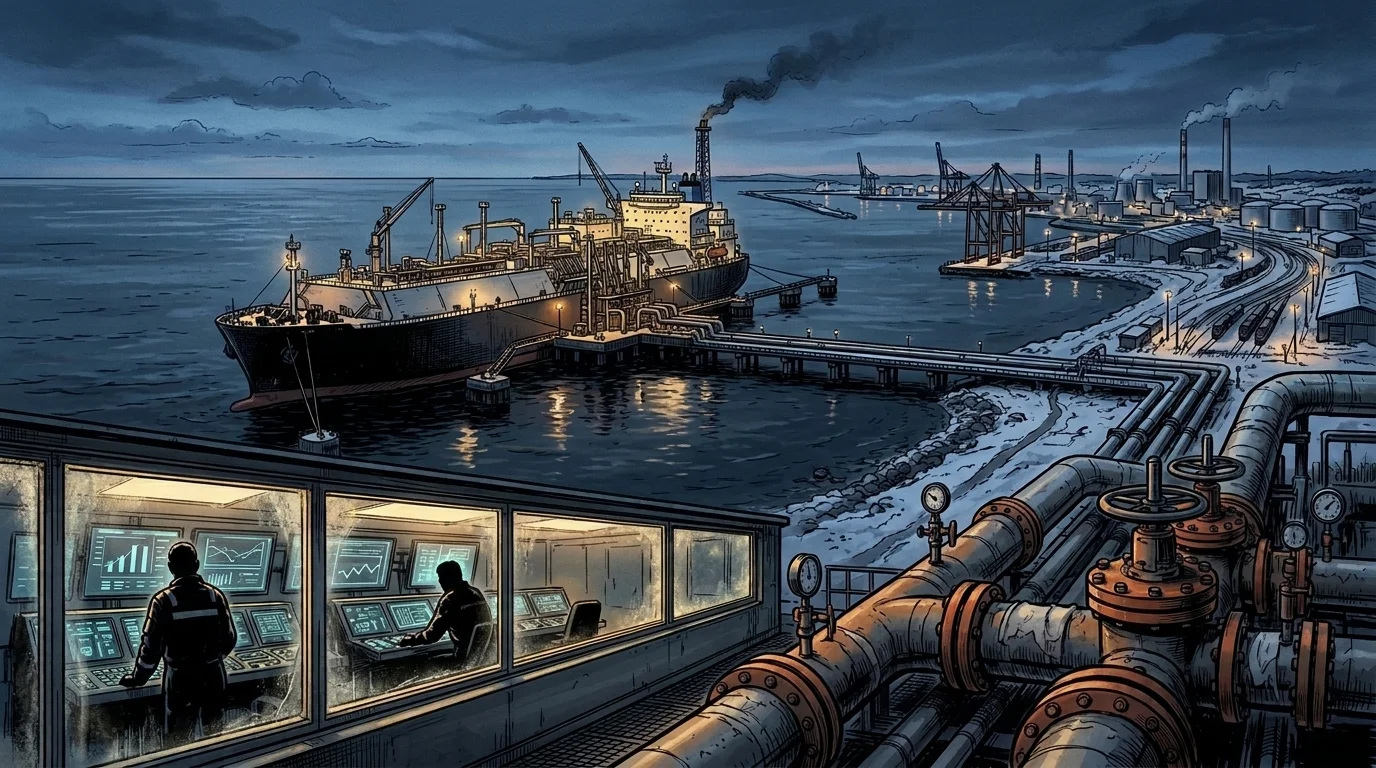
Following European Commission state-aid approval and shareholder ratification in December 2022, the federal government bought out Fortum’s shares for €0.5 billion, converted KfW bridge loans, and authorized up to €25 billion in equity capital alongside €18 billion in credit lines (with €13.5 billion in direct federal equity actually drawn across three tranches in December 2022 amidst a total stabilization framework initially valued at €29–33 billion), giving the German state a 99.12% ownership stake in Uniper after the utility recorded roughly €19.1 billion in full-year 2022 net losses. Simultaneously, under the May 2022 LNG Acceleration Act, Germany chartered five floating storage and regasification units (FSRUs), commissioning its first floating LNG import terminal at Wilhelmshaven in December 2022 after just 200 days of construction, while surging Norwegian, Dutch, and Belgian pipeline inflows allowed Germany to survive the 2022–2023 winter without physical gas rationing.
Theoretical & Balance-Sheet Transmission Mechanism
In the Kindleberger–Minsky taxonomy of financial instability (Kindleberger, 1978; Minsky, 1986) and Irving Fisher’s (1933) debt-deflation framework, speculative asset booms become systemic crises when credit expansion shifts balance sheets from hedge finance (cash flows covering principal and interest) to speculative and Ponzi finance (relying on rising asset prices and short-term margin roll-overs).
Once monetary tightening or an exogenous shock halts price appreciation, forced margin liquidations trigger Fisherian debt-deflation: fire-sale asset discounts erode bank collateral values, contracting credit supply across the real economy.
Sources and Further Reading
- Tim Krieger, “ Ordnungspolitik: Uniper-Rettung überzeugt nicht,” Wirtschaftsdienst, 2022. Peer-Reviewed / Academic Research
- Ting Lan and Galen Sher, “ The Economic Impacts on Germany of a Potential Russian Gas Shutoff,” International Monetary Fund, 2022. International Financial Institution
- Michael Bradshaw, “ Nord Stream leaks: where will Europe get its gas from now?,” The Conversation, 2022. Peer-Reviewed / Academic Research
- Philip Oltermann and Jasper Jolly, “ Germany in talks to nationalise gas importer Uniper,” The Guardian, 2022-09-14. Historical & Financial Reference
- Frank W. Geels, Florian Kern, and Gerhard Fuchs, “ The enactment of socio-technical transition pathways: A reformulated typology and a comparative multi-level analysis of the German and UK low-carbon electricity transitions,” Research Policy, 2016. Peer-Reviewed / Academic Research
- International Monetary Fund, “ Germany: 2020 Article IV Consultation,” IMF Staff Country Reports, 2021. International Financial Institution
- Irving Fisher — "The Debt-Deflation Theory of Great Depressions," Econometrica 1, no. 4 (FRASER Federal Reserve Archive, 1933): 337–357 Central Bank / Monetary Authority
- Charles P. Kindleberger & Robert Z. Aliber — Manias, Panics, and Crashes: A History of Financial Crises (Palgrave Macmillan) Peer-Reviewed / Academic Research
Cite This Historical Dossier (APA / Chicago)
APA (7th ed.): Ç., S. (Ed.). (2026). Germany's 2022 Nord Stream Gas Cutoff and the Uniper Nationalization. In Forgotten Fortunes Historical Monograph Series (Forgotten Fortunes Editorial Desk). https://forgottenfortunes.net/germany-2022-uniper-gas-crisis/
MLA (9th ed.): Ç., Soner, ed. "Germany's 2022 Nord Stream Gas Cutoff and the Uniper Nationalization." Forgotten Fortunes: Financial & Monetary History Archive, 2026, https://forgottenfortunes.net/germany-2022-uniper-gas-crisis/.
Chicago (17th ed.): Ç., Soner, ed. "Germany's 2022 Nord Stream Gas Cutoff and the Uniper Nationalization." Forgotten Fortunes Historical Monograph Series (Forgotten Fortunes Editorial Desk), September 9, 2026. https://forgottenfortunes.net/germany-2022-uniper-gas-crisis/.
Have an idea for another financial history documentary or article? Request a story →
