In This Article

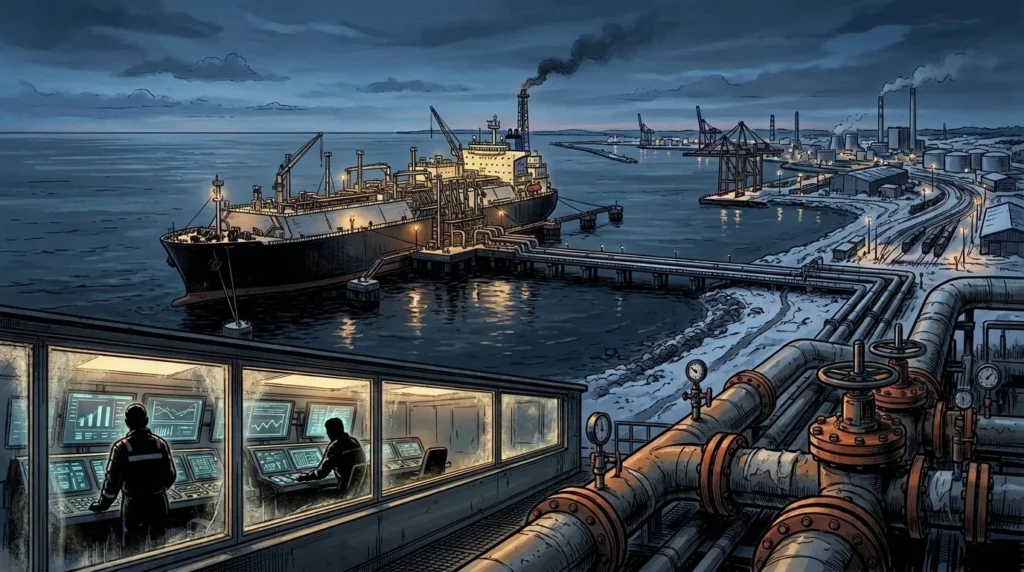
For the first decade after the Second World War, hard coal mined from the seams of the Ruhr Valley served as the indispensable fuel of the West German Wirtschaftswunder. Until 1957, coal shortages rather than surpluses preoccupied policy planners in Bonn and the High Authority of the European Coal and Steel Community. Within sixteen years, however, the Federal Republic of Germany experienced a dramatic structural transformation in its primary commodity markets. Beginning with the sudden Ruhr coal glut (Kohlenkrise) of February 1958, accelerating through the historic DM 1.2 billion German-Soviet pipes-for-gas barter agreement (Röhren-Erdgas-Geschäft) signed in Essen on February 1, 1970, and culminating in the October 1973 Arab oil embargo, West Germany pivoted from domestic coal autarky to hydrocarbon import dependence—and then scrambled to insulate its industrial base through state-backed energy diplomacy, Sunday driving bans, and the 1974 Kohlepfennig electricity surcharge. [1]
The 1958 Ruhr Kohlenkrise and the Pithead Stockpile Glut
Through 1956 and 1957, roughly 140 collieries operating across the Ruhr district produced more than 123 million metric tons of hard coal annually, employing nearly 607,000 miners. Expecting industrial energy consumption to rise indefinitely, West German officials lifted import restrictions on foreign fuels and signed long-term supply contracts with American coal exporters during the 1956 Suez Crisis. Once the Suez Canal reopened in 1957 and Atlantic maritime freight rates plunged, however, bulk shipments of strip-mined United States coal arrived at North Sea ports at prices significantly below the extraction cost of deep-shaft Ruhr seams. [2]
At the same time, multinational petroleum companies aggressively expanded refining capacity along the Rhine and lowered prices on light heating oil and heavy industrial fuel oil. Because Economics Minister Ludwig Erhard maintained low tariffs on crude oil and refined products to keep German manufacturing costs competitive, industrial boilers, municipal utilities, and household heating systems switched rapidly from solid fuel to liquid petroleum. Combined with an unusually mild winter in 1957–1958, demand for domestic hard coal collapsed. [3]
Unsold coal accumulated in massive black pyramids—known as Kohlenhalden—outside pitheads from Duisburg to Dortmund. On February 22, 1958, the Rosenblumendelle colliery in Mülheim an der Ruhr cancelled its regular shift for lack of buyers, introducing the first post-war Feierschicht (unpaid or partially compensated idle shift). By the end of 1958, West German pithead stockpiles exceeded 13 million metric tons of coal and coke, surpassing 15 million tons in 1959—more than the entire annual consumption of the federal railway system. Between 1958 and 1968, over 80 Ruhr mines closed permanently, and more than 300,000 mining jobs disappeared as petroleum overtook coal as West Germany’s primary energy source. [4]
The 1968 Coal Adaptation Act and the Creation of Ruhrkohle AG
Throughout the early 1960s, independent mining corporations—many owned by vertical steel conglomerates such as Thyssen, Krupp, Hoesch, and Rheinstahl—struggled with heavy fixed costs and deteriorating balance sheets. Individual closures triggered fierce protests across North Rhine-Westphalia, where the industrial union IG Bergbau und Energie warned that chaotic bankruptcies would devastate entire municipalities and radicalize the workforce during the 1966–1967 recession. [5]
When the Grand Coalition government entered office in late 1966, Social Democratic Economics Minister Karl Schiller engineered a comprehensive corporatist rescue. Under the Coal Adaptation Act (Kohleanpassungsgesetz) enacted in May 1968, the federal government and the state of North Rhine-Westphalia pressured 26 separate mining companies—representing roughly 85 percent of the Ruhr basin’s hard coal output—to transfer their colliery assets into a single consolidated enterprise: Ruhrkohle AG (RAG), formally founded in Essen on November 27, 1968. [6]
To induce the steel and industrial parent firms to surrender their mines, the federal and state governments guaranteed DM 2.1 billion in compensation claims (Einbringungsforderungen) paid out over twenty years at 6 percent interest, provided the former owners reinvested those proceeds into non-coal industrial projects within the mining regions. In parallel, long-term supply agreements (Hüttenverträge) bound German steelmakers to purchase domestic coking coal from Ruhrkohle AG, while the public treasury subsidized the price gap between German and world-market coal. [7]
The February 1, 1970 Mannesmann-Soviet Pipes-for-Gas Barter Deal
Even as Bonn consolidated domestic coal mining, West German industry sought cleaner, cheaper alternatives to Middle Eastern oil. In the late 1960s, the Soviet Union discovered vast natural gas reserves in Western Siberia but lacked both the high-pressure, large-diameter steel pipes needed to transport gas across permafrost and the hard currency to purchase Western equipment. An earlier effort by German steelmakers to supply pipeline tubes to Moscow in 1962–1963 had been blocked when the Adenauer government complied with a NATO embargo on strategic pipe exports. [8]
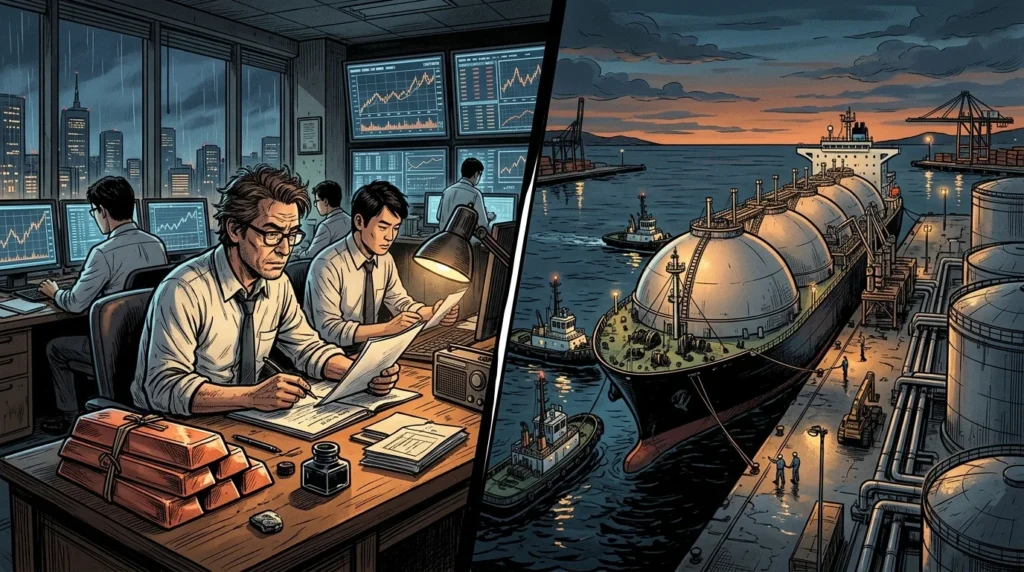
By 1969, however, the geopolitical and commercial calculus had changed. Following negotiations initiated at the Hanover Trade Fair in April 1969 between Soviet Foreign Trade Minister Nikolai Patolichev and West German Economics Minister Karl Schiller, three distinct corporate interests converged into a triangular countertrade structure (Dreiecksgeschäft). On February 1, 1970—six months before Chancellor Willy Brandt signed the Treaty of Moscow—representatives of West Germany and the Soviet Union gathered at the Hotel Kaiserhof in Essen to sign the first historic Röhren-Erdgas-Geschäft (pipes-for-gas deal).
The contract rested on three interlocking pillars:
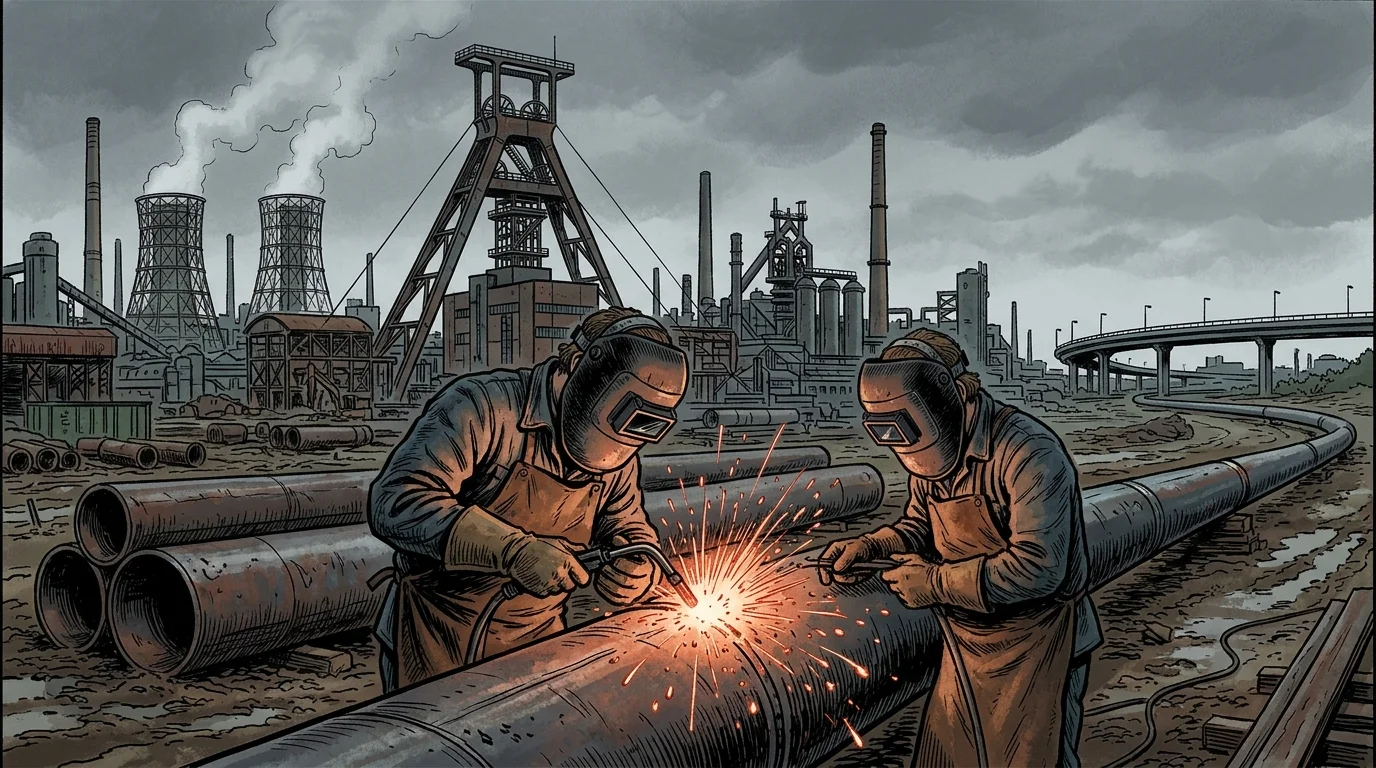
- Industrial Pipe Supply: Mannesmann AG, in partnership with Thyssen Röhrenwerke, agreed to manufacture and deliver 1.2 million metric tons of large-diameter (1,420-millimeter / 56-inch) cold-resistant steel pipes to the Soviet export agency Promsyrioimport to build a 2,000-kilometer trunk pipeline from Siberia to Western Europe.
- Long-Term Gas Deliveries: The Soviet state exporter Sojuznefteexport contracted with Essen-based utility Ruhrgas AG (led by Herbert Schelberger and Klaus Liesen) to deliver 52 billion cubic meters of natural gas over twenty years—roughly 3 billion cubic meters annually—beginning in October 1973 at the Czechoslovak-Bavarian border crossing at Waidhaus.
- Syndicated Bank Credit: A consortium of seventeen West German banks led by Deutsche Bank board member Friedrich Wilhelm Christians extended a DM 1.2 billion credit line to the Soviet Bank for Foreign Trade (Vneshtorgbank) over twelve years at a concessional 6.25 percent interest rate—well below prevailing West German market rates—to pay Mannesmann up front, with the loan amortized directly out of Ruhrgas’s subsequent payments for Soviet gas.
Subsequent supplementary agreements signed in 1972 and 1974 expanded the barter framework to additional pipe deliveries and raised Soviet gas commitments to over 10 billion cubic meters per year, establishing an energy bridge that persisted across the Cold War.
The October 1973 OAPEC Embargo and West Germany’s Car-Free Sundays
On October 1, 1973, Soviet natural gas began flowing through the Waidhaus metering station into the Bavarian grid right on schedule. Just sixteen days later, on October 17, 1973, the Organization of Arab Petroleum Exporting Countries (OAPEC) responded to the Yom Kippur War by announcing monthly 5 percent production cuts and embargoing oil shipments to nations supporting Israel, while OPEC unilaterally quadrupled the posted price of Arabian Light crude from roughly US$3.00 per barrel in October 1973 to US$11.65 per barrel by January 1974.
By 1973, petroleum accounted for 55.2 percent of West Germany’s primary energy consumption, up from just 21 percent in 1960. Within weeks, spot prices for heating oil and gasoline surged, and Bonn feared that Rotterdam port restrictions would disrupt barge deliveries along the Rhine. On November 9, 1973, the Bundestag passed the Energy Security Act (Energiesicherungsgesetz) in a single day, empowering Chancellor Willy Brandt’s cabinet to restrict energy consumption by decree.
On November 19, 1973, the federal government prohibited private motor vehicle traffic across West Germany on four consecutive Sundays: November 25, December 2, December 9, and December 16, 1973, accompanied by temporary six-month speed limits of 100 km/h on the Autobahnen and 80 km/h on rural highways. On the first autofreier Sonntag of November 25, hundreds of thousands of pedestrians, cyclists, and roller-skaters filled deserted motorways such as the Duisburg-Kaiserberg interchange. Although the four Sunday bans saved an estimated 130,000 to 160,000 tons of motor fuel—a modest fraction of total demand—they delivered an unmistakable psychological shock. West Germany’s annual crude oil import bill leaped by 153 percent, from roughly DM 9 billion in 1973 to nearly DM 23 billion in 1974, pushing real GDP growth from 5.3 percent in 1973 down to near zero in 1974 and into a 1.8 percent contraction in 1975.
The 1974 Kohlepfennig Surcharge and Constitutional Abolition
To prevent electric utilities from substituting imported oil or foreign coal for domestic Ruhr coal after the 1973 shock, Helmut Schmidt’s government enacted the Third Electricity Generation Act (Drittes Verstromungsgesetz) on December 13, 1974. The law required West German power plants to burn a mandated annual quota of approximately 33 million metric tons of domestic hard coal—a commitment later formalized through the 1980 Jahrhundertvertrag (Contract of the Century) between coal producers and electric utilities.
Rather than funding this mandate solely out of the federal budget, the 1974 statute created a special off-budget equalization fund (Ausgleichsfonds zur Sicherung des Steinkohleneinsatzes) financed by a direct percentage levy on every household and industrial electricity bill: the Ausgleichsabgabe, universally known as the Kohlepfennig (“coal penny”). Initially set at 3.24 percent of electricity tariffs in 1975 and peaking at 8.5 percent in the late 1980s and early 1990s, the surcharge funneled more than DM 5 billion per year by the early 1990s—and roughly DM 60 billion in cumulative transfers over twenty years—to compensate utilities for the price difference between expensive Ruhr hard coal and cheap imported steam coal or heavy fuel oil.
This cross-subsidization mechanism endured until October 11, 1994, when the Federal Constitutional Court (Bundesverfassungsgericht, BVerfGE 91, 186) ruled the Kohlepfennig unconstitutional. The court held that financing a general public policy objective—securing national energy supply and preserving mining employment—through an off-budget special levy (Sonderabgabe) on electricity consumers violated the constitutional principles of fiscal transparency and general taxation, because electricity consumers bore no special group responsibility for the structural plight of the coal mines. Forced to abolish the Kohlepfennig at the end of 1995, the federal government shifted coal subsidies onto the regular federal budget, setting in motion the phased elimination of German hard coal subsidies that concluded when the last Ruhr colliery, Prosper-Haniel in Bottrop, closed in December 2018.
Theoretical & Balance-Sheet Transmission Mechanism
In the Kindleberger–Minsky taxonomy of financial instability (Kindleberger, 1978; Minsky, 1986) and Irving Fisher’s (1933) debt-deflation framework, speculative asset booms become systemic crises when credit expansion shifts balance sheets from hedge finance (cash flows covering principal and interest) to speculative and Ponzi finance (relying on rising asset prices and short-term margin roll-overs).
Once monetary tightening or an exogenous shock halts price appreciation, forced margin liquidations trigger Fisherian debt-deflation: fire-sale asset discounts erode bank collateral values, contracting credit supply across the real economy.
Sources and Further Reading
- Dietmar Bleidick, “Der Ruhrbergbau. Von der Industrialisierung bis zur Kohlenkrise,” Bundeszentrale für politische Bildung (APuZ), 2019. Historical & Financial Reference
- Frank Bösch, “Energy Diplomacy: West Germany, the Soviet Union and the Oil Crises of the 1970s,” Historical Social Research / ZZF Potsdam, 2014. Historical & Financial Reference
- Ost-Ausschuss der Deutschen Wirtschaft, “Special: 50 Jahre Röhren gegen Gas,” Ost-Ausschuss der Deutschen Wirtschaft, 2020. Historical & Financial Reference
- Bundeszentrale für politische Bildung, “Vor 40 Jahren: Erster autofreier Sonntag in Deutschland,” Bundeszentrale für politische Bildung, 2013-11-22. Historical & Financial Reference
- Bundesverfassungsgericht, “BVerfGE 91, 186 – Kohlepfennig (Beschluss vom 11. Oktober 1994),” Deutschsprachiges Fallrecht (DFR) / Universität Bern, 1994-10-11. Historical & Financial Reference
- Evelyn Kroker (1992) — Zur Entwicklung des Ruhrkohlenbergbaus zwischen 1945 und 1980. Der Anschnitt, 44 (5–6), p. 192.
https://www.bergbaumuseum.de/fileadmin/forschung/zeitschriften/der-anschnitt/1992/1992-05-06/anschnitt-5-6-1992-evelyn-kroker-zur-entwicklung-des-ruhrkohlenbergbaus.pdf Historical & Financial Reference - Irving Fisher — "The Debt-Deflation Theory of Great Depressions," Econometrica 1, no. 4 (FRASER Federal Reserve Archive, 1933): 337–357 Central Bank / Monetary Authority
- Charles P. Kindleberger & Robert Z. Aliber — Manias, Panics, and Crashes: A History of Financial Crises (Palgrave Macmillan) Peer-Reviewed / Academic Research
Cite This Historical Dossier (APA / Chicago)
APA (7th ed.): Ç., S. (Ed.). (2026). The 1958 Ruhr Coal Crisis, the 1970 Soviet Pipes-for-Gas Deal, and the 1973 Oil Shock. In Forgotten Fortunes Historical Monograph Series (Forgotten Fortunes Editorial Desk). https://forgottenfortunes.net/ruhr-coal-crisis-soviet-gas-deal/
MLA (9th ed.): Ç., Soner, ed. "The 1958 Ruhr Coal Crisis, the 1970 Soviet Pipes-for-Gas Deal, and the 1973 Oil Shock." Forgotten Fortunes: Financial & Monetary History Archive, 2026, https://forgottenfortunes.net/ruhr-coal-crisis-soviet-gas-deal/.
Chicago (17th ed.): Ç., Soner, ed. "The 1958 Ruhr Coal Crisis, the 1970 Soviet Pipes-for-Gas Deal, and the 1973 Oil Shock." Forgotten Fortunes Historical Monograph Series (Forgotten Fortunes Editorial Desk), September 19, 2026. https://forgottenfortunes.net/ruhr-coal-crisis-soviet-gas-deal/.
Have an idea for another financial history documentary or article? Request a story →