In This Article
At 9:00 p.m. Moscow time on January 22, 1991—shortly after provincial banks had closed for the day—Soviet television news program Vremya broadcast a decree signed by President Mikhail Gorbachev and newly appointed Prime Minister Valentin Pavlov. Effective at midnight, all 50-ruble and 100-ruble banknotes of the 1961 issue ceased to be legal tender. Soviet citizens were given just three days, from January 23 to January 25, 1991, to exchange their large-denomination notes for smaller bills or new 1991-series notes, up to a strict cap of 1,000 rubles per worker. Far from restoring monetary stability, the “Pavlov Reform” shattered public trust in the ruble and inaugurated a seven-year monetary upheaval. Following the dissolution of the USSR in December 1991, Deputy Prime Minister Yegor Gaidar’s January 2, 1992 price liberalization collided with a fatal institutional flaw: fifteen newly independent republics continued sharing the Soviet ruble and independently creating non-cash ruble credit, while Central Bank of Russia chairman Viktor Gerashchenko flooded state enterprises with bailout loans. Consumer price inflation in Russia reached 2,509 percent in 1992 before the July 1993 demonetization of pre-1993 Soviet banknotes forcibly broke up the Ruble Zone, paving the way for the January 1, 1998 thousand-to-one redenomination. [1]
Perestroika Deficits and the January 1991 Pavlov Banknote Confiscation
By late 1990, Mikhail Gorbachev’s economic reforms had dismantled traditional Soviet command discipline without introducing market price signals. The Law on State Enterprises of 1987 allowed enterprise directors to raise wages rapidly, while the Law on Cooperatives of 1988 enabled semi-private cooperatives to convert non-cash enterprise balances (beznalichnye) into physical cash (nalichnye). Meanwhile, state retail prices remained artificially frozen and heavily subsidized. As the Soviet budget deficit swelled past 8.5 percent of gross domestic product in 1989 and exceeded 15 percent to 20 percent by 1991, Gosbank financed the shortfall by printing money. Store shelves emptied across the USSR while households accumulated an estimated 130 billion to 160 billion rubles in forced, unspendable cash and savings balances. [2]
Just days before taking office as Prime Minister in January 1991, former Finance Minister Valentin Pavlov publicly denied rumors of an imminent currency confiscation. Yet on the evening of January 22, 1991, the Kremlin struck. Claiming that criminal syndicates and foreign speculators were hoarding billions of large-denomination notes abroad, the decree withdrew all 1961-series 50- and 100-ruble banknotes—which accounted for roughly 48 billion rubles, or more than one-third of the entire 136 billion rubles of cash in circulation. Working citizens could exchange at most 1,000 rubles (or one month’s average wage) at their workplaces within 72 hours; pensioners could exchange only 200 rubles without appearing before special district commissions to prove the lawful origin of their money. Simultaneously, individual withdrawals from State Savings Bank (Sberbank) accounts were frozen at 500 rubles per month. [3]
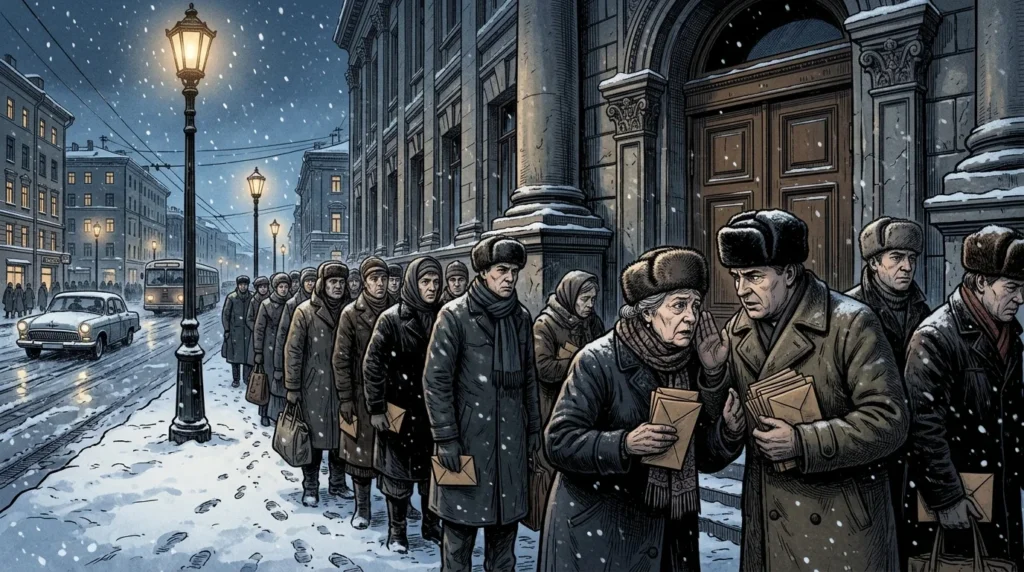
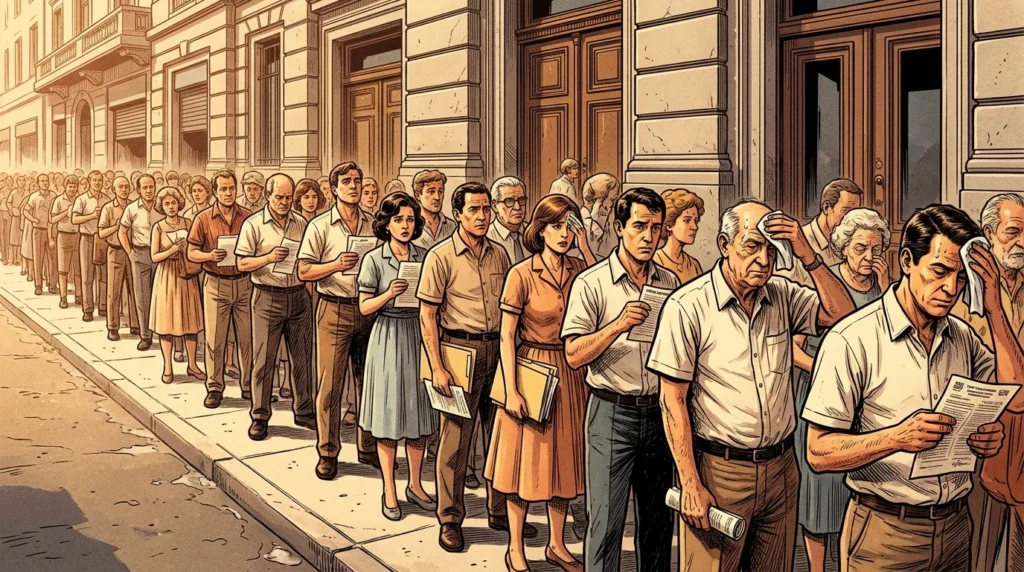
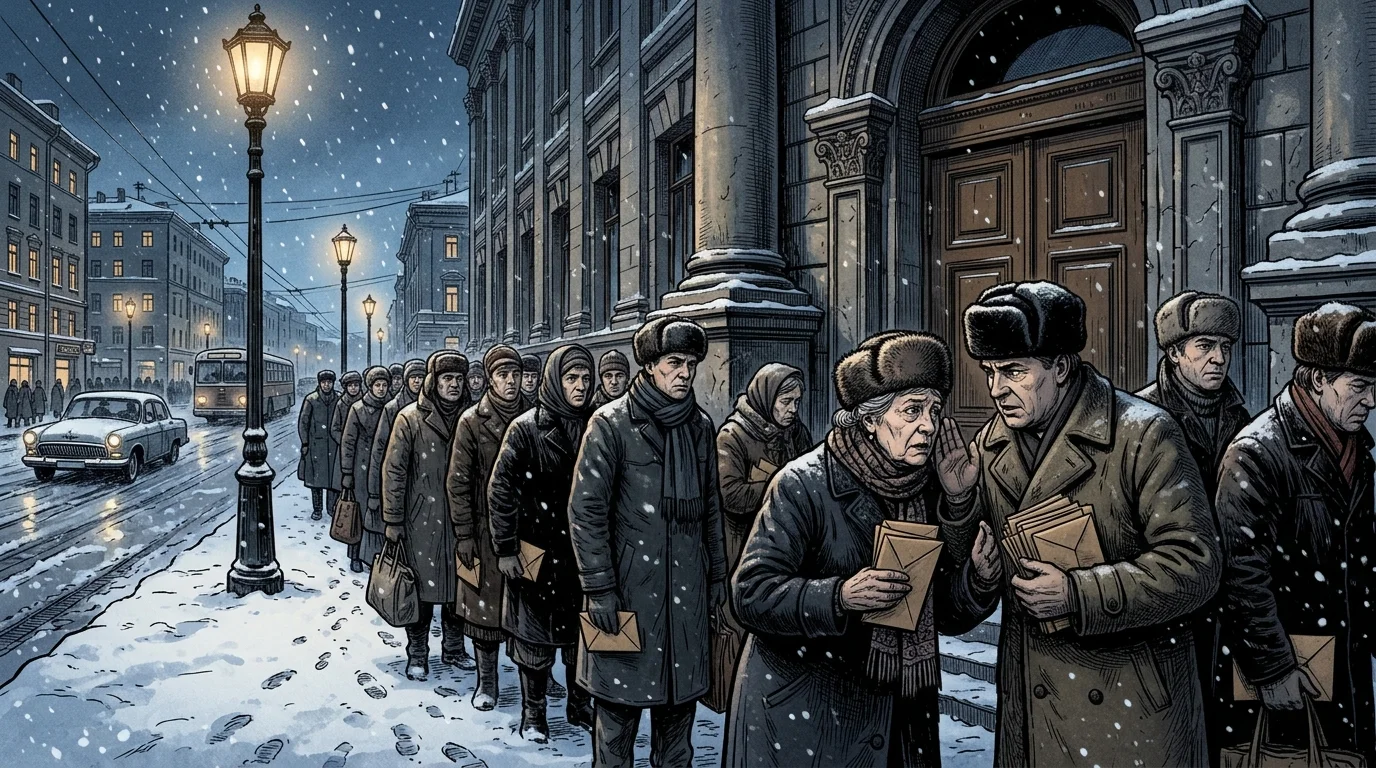
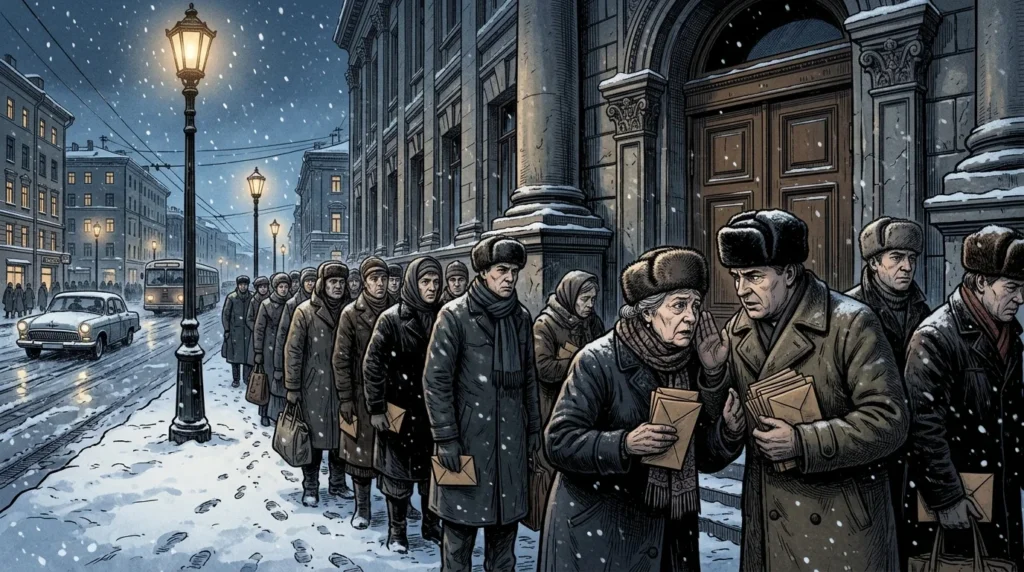
Panic ensued across the eleven time zones of the Soviet Union. Millions of elderly savers who kept funeral money in 50- and 100-ruble notes under their mattresses stood in freezing January queues outside savings banks, while taxi drivers, railway ticket clerks, and black-market exchangers traded small-denomination bills at steep discounts. Ultimately, the confiscation withdrew only about 14 billion rubles—roughly 10 percent of the cash supply—before the Pavlov government enacted massive administrative retail price hikes of 60 percent to 200 percent on April 2, 1991, wiping out the purchasing power of the population’s remaining savings. [4]
| Documented Figure / Metric | Historical Significance & Archival Context |
|---|---|
| 14 billion rubles | Ultimately, the confiscation withdrew only about 14 billion rubles—roughly 10 percent of the cash supply—before the Pavlov government enacted massive administrative retail price hikes of 60 percent to 200 percent on April 2, 1991, wiping out the purchasing power of the population's remaining savings. |
| 80 percent | On January 2, 1992, Gaidar's government liberalized approximately 80 percent of wholesale prices and 90 percent of retail consumer prices by presidential decree. |
| 245 percent | Because the decades-long monetary overhang had never been absorbed, prices jumped by 245 percent in the month of January 1992 alone, immediately refilling store shelves with goods that were now beyond the reach of ordinary salaries and pensions. |
| 1993 Ruble | As economists John Odling-Smee, Gonzalo Pastor, and Stanley Fischer later documented, the 1992–1993 Ruble Zone became a textbook "tragedy of the commons" in monetary economics. |
Yegor Gaidar’s January 2, 1992 Price Liberalization
Following the failed August 1991 hardliner coup and the December 1991 Belovezha Accords that dissolved the USSR, Russian President Boris Yeltsin appointed a team of young reformist economists led by Yegor Gaidar to rescue an economy on the brink of urban famine. Grain reserves had fallen to critically low levels, farmers refused to deliver food for worthless paper rubles, and the Soviet fiscal system had disintegrated. On January 2, 1992, Gaidar’s government liberalized approximately 80 percent of wholesale prices and 90 percent of retail consumer prices by presidential decree. [5]
Because the decades-long monetary overhang had never been absorbed, prices jumped by 245 percent in the month of January 1992 alone, immediately refilling store shelves with goods that were now beyond the reach of ordinary salaries and pensions. In a standard sovereign economy with a unified central bank, a one-time price jump eliminates the real value of excess money balances, after which tight monetary and fiscal policy can stabilize inflation. In post-Soviet Russia, however, two powerful engines of money creation immediately turned the initial price jump into sustained near-hyperinflation. [6]
The Tragedy of the Commons in the 15-Republic Ruble Zone
When the Soviet Union broke apart in December 1991, all fifteen successor states continued using the Soviet ruble as their common currency. Although only the Central Bank of Russia (CBR) physically controlled the Goznak banknote printing presses on Russian territory, the regional branches of the former Soviet Gosbank in Ukraine, Belarus, Kazakhstan, Uzbekistan, and the ten other republics were instantly transformed into fifteen independent national central banks. [7]
Every one of those fifteen central banks retained the technical authority to create non-cash ruble credit (beznalichnye) simply by extending central bank loans to its domestic commercial banks and state enterprises. Those newly created non-cash rubles could then be wired across republican borders to purchase Russian oil, timber, and manufactured goods. As economists John Odling-Smee, Gonzalo Pastor, and Stanley Fischer later documented, the 1992–1993 Ruble Zone became a textbook “tragedy of the commons” in monetary economics. Any individual republic that expanded ruble credit captured 100 percent of the local fiscal and industrial benefit while exporting the resulting inflation across all fifteen states. Conversely, any republic that practiced monetary restraint suffered imported inflation without gaining the seigniorage. [8]
Beginning in mid-1992, the Central Bank of Russia attempted to stem the flood of unbacked non-cash rubles from Ukraine and other republics by requiring all cross-border payments to clear through bilateral correspondent accounts at the CBR, financed by capped Russian “technical credits.” As non-Russian central banks exhausted their quotas, their non-cash rubles began trading at deep discounts of 20 percent to 60 percent against the Russian non-cash ruble, fracturing the supposedly unified currency union into fifteen distinct non-cash currencies even while identical physical Soviet banknotes circulated across the region.
Viktor Gerashchenko, Enterprise Arrears, and 2,509% Inflation
Inside Russia itself, Gaidar’s initial monetary tightening in the first quarter of 1992 met fierce resistance from state industrial directors. Rather than cut output, lay off workers, or lower prices when cash ran short, giant Soviet-era state enterprises simply continued shipping goods to one another on credit without paying. Between January and June 1992, inter-enterprise payment arrears exploded from less than 40 billion rubles to 3.2 trillion rubles—equivalent to roughly 40 percent of Russian GDP.
Facing an industrial revolt in the Supreme Soviet parliament, Yeltsin appointed Viktor Gerashchenko—the last chairman of the Soviet Gosbank—as head of the Central Bank of Russia in July 1992. Convinced that monetarist austerity would destroy Russia’s industrial base, Gerashchenko immediately organized a nationwide multilateral netting of inter-enterprise arrears backed by massive CBR credit creation, while extending trillons of rubles in subsidized loans to agriculture, the military-industrial complex, the Far North, and neighboring Ruble Zone republics (which received Russian financing worth roughly 8 percent to 10 percent of Russian GDP in 1992). Broad money grew by more than 600 percent over the year, and Russian consumer price inflation hit 2,509 percent for 1992, followed by 840 percent in 1993.
The July 1993 Cash Demonetization and the 1998 Redenomination
By mid-1993, countries leaving the Ruble Zone (such as the Baltic states, Ukraine, and Kyrgyzstan) were dumping their stocks of old 1961–1992 Soviet banknotes into Russia, threatening a fresh inflationary wave. On Saturday, July 24, 1993—while reformist Finance Minister Boris Fedorov was in the United States and President Yeltsin was on vacation—Gerashchenko’s Central Bank of Russia launched another surprise monetary confiscation. Effective July 26, 1993, all Soviet and Russian banknotes printed between 1961 and 1992 were demonetized inside Russia, replaced exclusively by new 1993-series Russian Federation notes.
Although Yeltsin intervened to extend the exchange deadline into August 1993 and raise the conversion cap to 100,000 rubles per citizen, the July 1993 cash reform achieved one decisive geopolitical result: it slammed the door on the Ruble Zone. Suddenly flooded with demonetized pre-1993 Soviet banknotes dumped across their borders and denied unconditional access to new 1993 Russian cash unless they surrendered monetary sovereignty to Moscow, Kazakhstan, Uzbekistan, Turkmenistan, Armenia, and Moldova introduced their own national currencies by November 1993. Only after the Ruble Zone’s breakup and the banning of direct Central Bank deficit financing in 1995 did Russian inflation subside enough to permit President Yeltsin’s decree on January 1, 1998, which redenominated the Russian ruble at a ratio of 1,000 old rubles (RUB) to 1 new ruble (RUR), erasing three zeros left behind by the post-Soviet hyperinflation.
Theoretical & Balance-Sheet Transmission Mechanism
In the Kindleberger–Minsky taxonomy of financial instability (Kindleberger, 1978; Minsky, 1986) and Irving Fisher’s (1933) debt-deflation framework, speculative asset booms become systemic crises when credit expansion shifts balance sheets from hedge finance (cash flows covering principal and interest) to speculative and Ponzi finance (relying on rising asset prices and short-term margin roll-overs).
Once monetary tightening or an exogenous shock halts price appreciation, forced margin liquidations trigger Fisherian debt-deflation: fire-sale asset discounts erode bank collateral values, contracting credit supply across the real economy.
Sources and Further Reading
- John Odling-Smee and Gonzalo Pastor, “ The IMF and the Ruble Area, 1991-1993,” IMF Working Papers, 2001. International Financial Institution
- Vincent Koen and Steven Phillips, “ Price Liberalization in Russia: The Early Record,” IMF Working Papers, 1992. International Financial Institution
- Stanley Fischer, Ratna Sahay, and Carlos A. Végh, “ Modern Hyper- and High Inflations,” National Bureau of Economic Research Working Paper 8930, 2002. Peer-Reviewed / Academic Research
- David Lipton, Jeffrey D. Sachs, and Vladimir Mau, “ Prospects for Russia’s Economic Reforms,” Brookings Papers on Economic Activity, 1992. Peer-Reviewed / Academic Research
- Valerii Stepanov, “ Prime Minister V.S. Pavlov and the Monetary Reform of 1991: Assessments and Judgments,” Theoretical Economics, 2022. Peer-Reviewed / Academic Research
- International Monetary Fund, World Bank, OECD, and EBRD, “ Chapter IV.1 Price Reform, in A Study of the Soviet Economy,” International Monetary Fund, 1991. International Financial Institution
- Irving Fisher — "The Debt-Deflation Theory of Great Depressions," Econometrica 1, no. 4 (FRASER Federal Reserve Archive, 1933): 337–357 Central Bank / Monetary Authority
- Charles P. Kindleberger & Robert Z. Aliber — Manias, Panics, and Crashes: A History of Financial Crises (Palgrave Macmillan) Peer-Reviewed / Academic Research
Cite This Historical Dossier (APA / Chicago)
APA (7th ed.): Ç., S. (Ed.). (2026). The 1991 Pavlov Confiscation, the Ruble Zone Collapse, and Russia's 2,500% Inflation. In Forgotten Fortunes Historical Monograph Series (Forgotten Fortunes Editorial Desk). https://forgottenfortunes.net/1991-pavlov-ruble-reform/
MLA (9th ed.): Ç., Soner, ed. "The 1991 Pavlov Confiscation, the Ruble Zone Collapse, and Russia's 2,500% Inflation." Forgotten Fortunes: Financial & Monetary History Archive, 2026, https://forgottenfortunes.net/1991-pavlov-ruble-reform/.
Chicago (17th ed.): Ç., Soner, ed. "The 1991 Pavlov Confiscation, the Ruble Zone Collapse, and Russia's 2,500% Inflation." Forgotten Fortunes Historical Monograph Series (Forgotten Fortunes Editorial Desk), September 10, 2026. https://forgottenfortunes.net/1991-pavlov-ruble-reform/.
Have an idea for another financial history documentary or article? Request a story →