In This Article
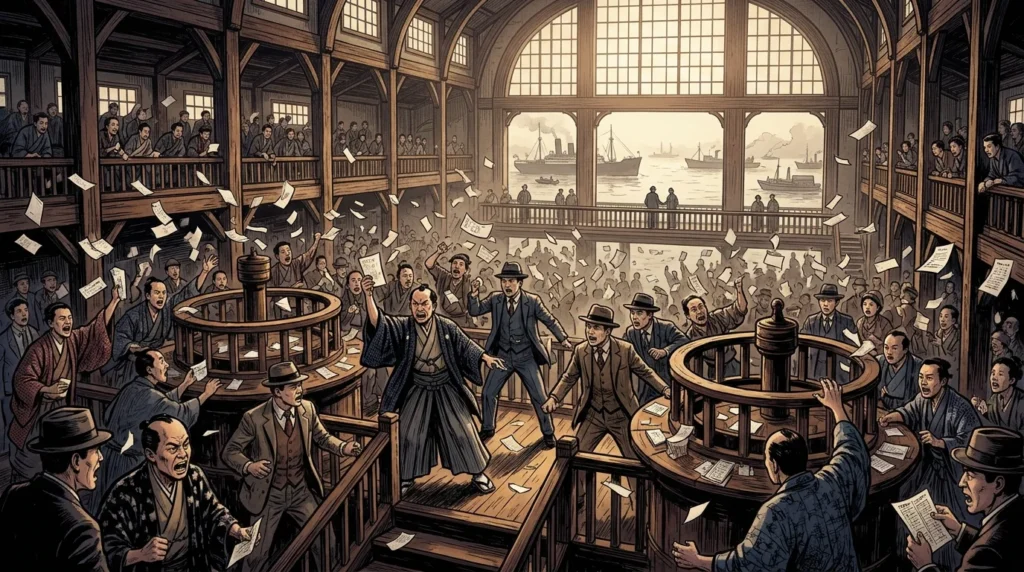
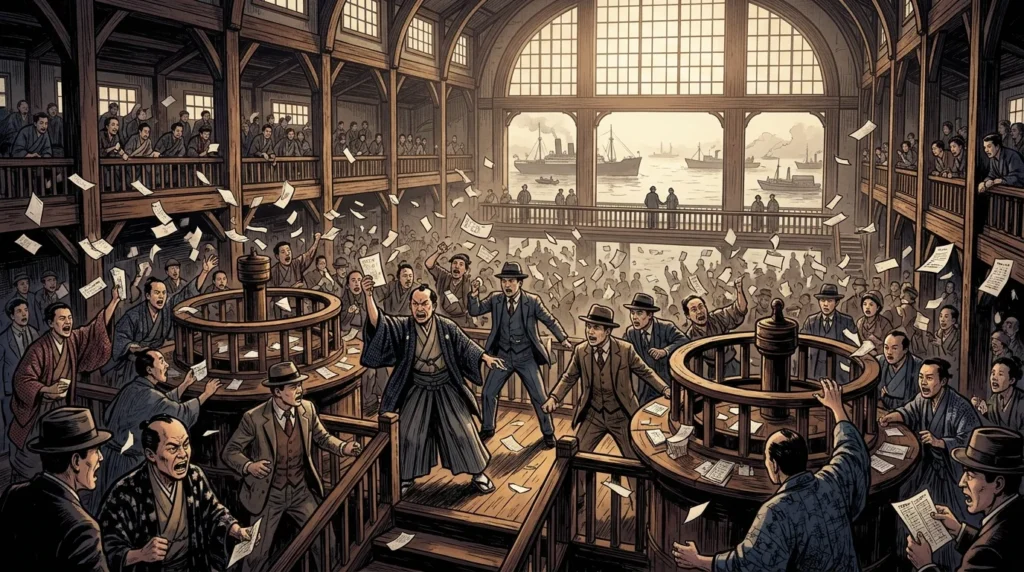
Late on the night of May 28, 1965, Japanese Finance Minister Kakuei Tanaka stepped before reporters in Tokyo to announce an extraordinary monetary intervention not seen since the financial panics of 1927. To halt a nationwide run on Yamaichi Securities Co., Ltd.—one of Japan’s “Big Four” brokerage houses—the government invoked Article 25 of the Bank of Japan Law, authorizing the central bank to extend emergency, effectively unsecured loans of “unlimited” scope to keep the insolvent brokerage afloat. The crisis, known in Japanese economic history as the 1965 Shōwa Securities Crisis (Shōwa 40-nen Shōken Fukyō, or “Securities Depression”), was the culmination of a speculative retail boom in stock investment trusts (tōshin) and short-term dealer bond collateralization (un’yō azukari) that unraveled after the Tokyo stock market peaked in July 1961. Neither two industry-wide stock-buying cartels—the Japan Joint Securities Co. and the Japan Securities Holding Association—nor a Ministry of Finance press blackout had succeeded in stemming the collapse. By rescuing Yamaichi with ¥28.2 billion (and Oi Securities with ¥5.3 billion) while amending the Securities and Exchange Law to replace simple broker registration with strict government licensing, Japanese authorities averted a systemic depression and forged the postwar “convoy system” of financial supervision. [1]
The Investment Trust Boom and “The Whale in the Pond” (1956–1961)
During Japan’s postwar “Jinmu” and “Iwato” high-growth economic expansions (1955–1961), rising household incomes and surging corporate capital investment fueled an unprecedented retail stock market mania. Reintroduced under the Securities Investment Trust Act of 1951, stock investment trusts (kabushiki tōshi shintaku)—managed by affiliates of Japan’s “Big Four” securities houses (Nomura, Nikko, Daiwa, and Yamaichi)—became the primary vehicle channeling middle-class household savings into equities. Promoted under the popular catchphrase “Goodbye to banks; Hello to securities firms,” investment trusts expanded tenfold in just five years: outstanding stock investment trust principal jumped from ¥59.5 billion at the end of 1955 to ¥604.2 billion in 1960 and topped ¥1.026 trillion in 1961, complemented by another ¥156.0 billion in newly launched bond investment trusts. [2]
Because the trusts grew far faster than the depth of the Tokyo Stock Exchange (TSE), market observers dubbed investment trusts “the whale in the pond”. Alongside the trust boom, Japanese brokerages relied heavily on a high-risk short-term funding mechanism known as “investable custody” (un’yō azukari, or “investment deposits”). Under this arrangement, securities firms borrowed discount bank debentures from hundreds of thousands of retail customers in exchange for a small fixed custody fee, pledged those customer debentures as collateral to borrow call money or loans from small financial institutions, and poured the proceeds into proprietary stock inventories to underwrite corporate share offerings. Between September 1958 and September 1964, total securities held by Japanese brokerages under investable custody nearly quadrupled from ¥62.7 billion to ¥249.1 billion, of which ¥195.9 billion were discount bank debentures. [3]
| Documented Figure / Metric | Historical Significance & Archival Context |
|---|---|
| ¥500 billion | Together with emergency lending, total BOJ credit extended to support the securities sector through these vehicles eventually reached approximately ¥500 billion. |
| ¥26.4 billion | By September 30, 1964, Japan's securities industry had accumulated combined losses of ¥26.4 billion. |
| ¥24 billion | Crucially, although internal estimates pegged the initial facility at ¥24 billion, Tanaka instructed officials to announce to the press at 11:30 p.m. that the Bank of Japan would lend Yamaichi funds "without collateral and without limit". |
Tight Money, Market Reversal, and the Two Stock-Buying Cartels (1961–1965)
The speculative cycle broke in July 1961 when a deteriorating balance of payments prompted the Bank of Japan (BOJ) to hike the official discount rate and tighten domestic credit. Cash-strapped industrial corporations immediately began liquidating their cross-held shares and redeeming bond investment trusts to raise working capital, just as companies were issuing massive waves of new equity to fund factory expansion. As the Tokyo Stock Exchange’s Modified Stock Price Average (the Nikkei index) reversed from its July 1961 peak of 1,829 yen—ultimately falling roughly 44 percent toward the 1,020 yen level by mid-1965—the virtuous cycle of the late 1950s turned into a vicious downward spiral. Falling equity prices eroded the net asset value of stock investment trusts, triggering a wave of retail cancellations that forced the trusts to dump shares into an illiquid market, driving stock prices even lower. Meanwhile, brokerages that had used short-term un’yō azukari custody deposits to finance proprietary stock inventories saw the value of their holdings plunge below their short-term liabilities. [4]
To put a floor under the sliding stock market and prevent the forced liquidation of investment trust portfolios, the Ministry of Finance (MOF), the Bank of Japan, and major commercial banks organized two unprecedented institutional price-keeping cartels. First, in January 1964, commercial banks and securities houses jointly capitalized the Japan Joint Securities Co., Ltd. (Nihon Kyōdō Shōken) to buy up surplus shares directly on the open market using BOJ-backed bank loans. When stock prices continued to slide following the November 1963 ”Kennedy Shock” (the US Interest Equalization Tax and the assassination of President John F. Kennedy) and a string of major industrial bankruptcies in late 1964 and early 1965 (including Sun Wave Industrial, Nihon Special Steel, and Sanyo Special Steel), brokerages formed a second vehicle in January 1965: the Japan Securities Holding Association (Nihon Shōken Hoyū Kumiai). Financed by Bank of Japan credits, the Holding Association absorbed overhanging equities directly from distressed investment trusts and brokerage inventories. Together with emergency lending, total BOJ credit extended to support the securities sector through these vehicles eventually reached approximately ¥500 billion. [5]
The May 1965 Run on Yamaichi Securities and Tanaka’s Article 25 Bailout
Price-keeping operations could not disguise the insolvency of individual brokerage firms. By September 30, 1964, Japan’s securities industry had accumulated combined losses of ¥26.4 billion. Worst hit of the Big Four was Yamaichi Securities Co., Ltd. (capitalized at ¥8 billion under President Teru Hidaka), which had aggressively expanded its proprietary stock inventory and underwritten burgeoning Second Section over-the-counter growth companies using retail custody certificates. By the end of fiscal 1964 (March 31, 1965), an internal audit revealed that Yamaichi’s true cumulative deficit had reached a staggering ¥28.2 billion—3.5 times its entire paid-in capital. [6]
Fearing that Yamaichi’s collapse would ignite a nationwide run on the ¥249 billion in retail un’yō azukari custody accounts—which functioned like uninsured demand deposits—the Ministry of Finance convened secret restructuring talks in late 1964 and early 1965 with Yamaichi’s three main banks (Industrial Bank of Japan, Fuji Bank, and Mitsubishi Bank). To buy time while the three banks argued over loss-sharing, the MOF persuaded Tokyo’s major national newspapers to observe a voluntary press blackout and asked the opposition Japan Socialist Party not to raise Yamaichi’s insolvency in the National Diet until a restructuring plan was ready. [7]
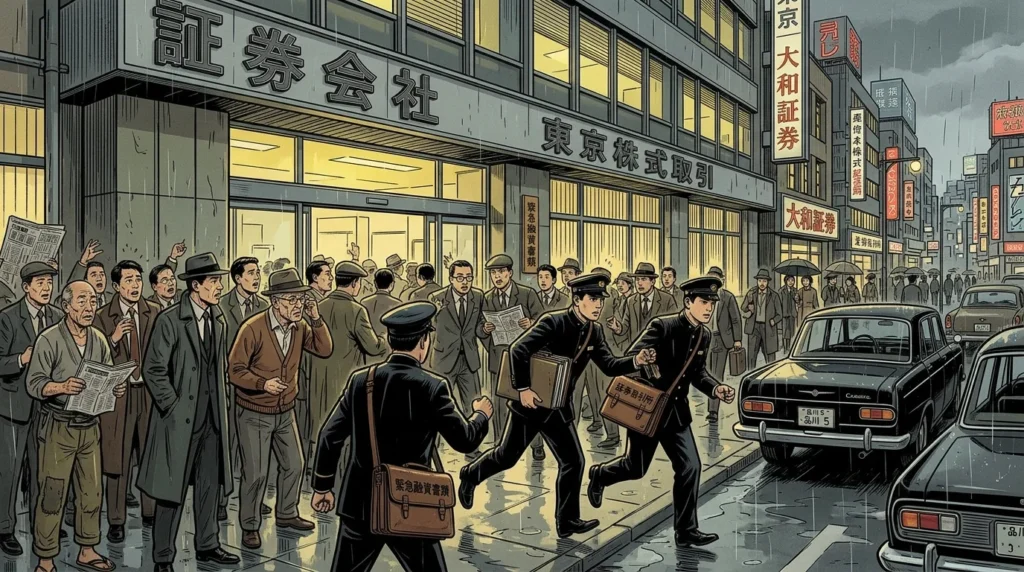
On May 21, 1965—three days before the scheduled end of the press embargo—the regional newspaper Nishinippon Shimbun, which was not party to the Tokyo press club agreement, broke the story that Yamaichi Securities was on the brink of failure and required an emergency bank rescue. The next morning, Saturday, May 22 (and continuing through Sunday at open regional branches), panicked retail investors stormed some 90 Yamaichi branch offices across Japan demanding the immediate return of their un’yō azukari custody debentures and the cancellation of their investment trusts. Over the following week, daily customer visits to Yamaichi branches topped 10,000 and exceeded 20,000 on May 28–29; police had to control crowds in Hiroshima, angry customers shattered branch windows in Kobe, and depositors withdrew ¥17.7 billion in a single week. By the early afternoon of Friday, May 28, Yamaichi’s accounting director telephoned the Ministry of Finance to report that not a single bank or credit association would lend the firm even ¥1 million. [8]
That evening, May 28, 1965, Finance Minister Kakuei Tanaka summoned top MOF officials, Bank of Japan Vice Governor Tadashi Sasaki, and the presidents of Fuji, Mitsubishi, and Industrial Bank of Japan to an urgent meeting at the BOJ’s Hikawa annex in Akasaka, Tokyo. When BOJ officials objected that rescuing a private securities firm had no modern precedent and would create severe moral hazard, Tanaka overruled their hesitation. Invoking Article 25 of the 1942 Bank of Japan Law—which empowered the central bank, with the Finance Minister’s authorization, to “undertake such businesses as are necessary for the maintenance and fostering of the credit system”—Tanaka ordered the BOJ to provide special uncollateralized emergency loans to Yamaichi through its main banks. Crucially, although internal estimates pegged the initial facility at ¥24 billion, Tanaka instructed officials to announce to the press at 11:30 p.m. that the Bank of Japan would lend Yamaichi funds “without collateral and without limit”. The psychological shock of an unlimited central bank guarantee broke the retail panic immediately. In total, the BOJ advanced ¥28.2 billion in Article 25 special loans to Yamaichi Securities and, in July 1965, an additional ¥5.3 billion to Osaka-based Oi Securities (later Wako Securities), which had suffered a parallel run, bringing direct Article 25 lending to ¥33.5 billion.
Licensing Reform, Deficit Bonds, and the Postwar Convoy System
The May 1965 panic permanently reshaped Japanese financial regulation, corporate governance, and fiscal policy. First, in May 1965 the National Diet amended the Securities and Exchange Law (effective October 1965, with full transition completed in April 1968), abolishing the US-style postwar registration system under which anyone meeting minimal capital rules could open a brokerage. In its place, the amended law instituted a strict Ministry of Finance licensing regime requiring separate licenses for dealing, brokerage, underwriting, and distribution, alongside higher net-asset standards and the phase-out of risky un’yō azukari custody borrowing. From a peak of 601 registered brokerages in 1962 (and 593 at the end of 1963), liquidations, mergers, and license withdrawals pared the industry down to 275–277 licensed securities companies by April 1968, placing securities firms under the same protective “convoy system” (gosō sendan hōshiki) that governed commercial banks.
Second, to pull the real economy out of the 1965 recession, incoming Finance Minister Takeo Fukuda abandoned the strict balanced-budget dogma enforced since the 1949 Dodge Line and announced in July 1965 that Japan would issue postwar deficit-covering government bonds for the first time. Propelled by fiscal stimulus and the ensuing “Izanagi Boom” (1965–1970), the Tokyo stock market rallied strongly, enabling both Yamaichi and Oi Securities to repay their Bank of Japan Article 25 loans in full by 1969. Meanwhile, the shares accumulated by the Japan Joint Securities Co. and the Japan Securities Holding Association were gradually resold to friendly industrial corporations and banks to insulate Japanese firms from foreign takeovers ahead of OECD capital liberalization—cementing the postwar keiretsu cross-shareholding structure. Ironically, the 1965 bailout also planted the seeds of future moral hazard: thirty-two years later, in November 1997, Yamaichi Securities collapsed for good under ¥260 billion in hidden off-balance-sheet losses (tobashi), forcing the Bank of Japan once again to invoke Article 25 (Article 38 of the revised law) solely to wind down the bankrupt firm.
Theoretical & Balance-Sheet Transmission Mechanism
In the Kindleberger–Minsky taxonomy of financial instability (Kindleberger, 1978; Minsky, 1986) and Irving Fisher’s (1933) debt-deflation framework, speculative asset booms become systemic crises when credit expansion shifts balance sheets from hedge finance (cash flows covering principal and interest) to speculative and Ponzi finance (relying on rising asset prices and short-term margin roll-overs).
Once monetary tightening or an exogenous shock halts price appreciation, forced margin liquidations trigger Fisherian debt-deflation: fire-sale asset discounts erode bank collateral values, contracting credit supply across the real economy.
Sources and Further Reading
- Japan Securities Research Institute, “ Chapter II: The History of the Japanese Securities Market (Securities Market in Japan 2024),” Japan Securities Research Institute (JSRI), 2024. Historical & Financial Reference
- Institute of Fiscal and Monetary Policy, Ministry of Finance, “ Fiscal and Monetary Policies of Japan: Reconstruction and High-Growth Period (1965 Securities Crisis),” Ministry of Finance of Japan (National Diet Library Digital Collections), 2000. Historical & Financial Reference
- Faculty of Economics, The University of Tokyo, “ Contemporary Economic History of Japan: Lecture 10 – The 1965 Securities Depression and Yamaichi Bailout,” The University of Tokyo OpenCourseWare, 2005. Historical & Financial Reference
- Masaru Hayami, “ Statement by the Governor concerning the Yamaichi Securities Co.,” Bank of Japan, 1999-06-02. Central Bank / Monetary Authority
- Kazuo Ueda, “ The Structure of Japan’s Financial Regulation and Supervision and the Role Played by the Bank of Japan,” Center for Advanced Research in Finance (CARF Working Paper F-209), The University of Tokyo, 2010-02. Central Bank / Monetary Authority
- David E. Weinstein, “ Foreign Direct Investment and Keiretsu: Rethinking U.S. and Japanese Policy,” National Bureau of Economic Research (in The Effects of U.S. Trade Protection and Promotion Policies, University of Chicago Press), 1997. Peer-Reviewed / Academic Research
- Irving Fisher — "The Debt-Deflation Theory of Great Depressions," Econometrica 1, no. 4 (FRASER Federal Reserve Archive, 1933): 337–357 Central Bank / Monetary Authority
- Charles P. Kindleberger & Robert Z. Aliber — Manias, Panics, and Crashes: A History of Financial Crises (Palgrave Macmillan) Peer-Reviewed / Academic Research
Cite This Historical Dossier (APA / Chicago)
APA (7th ed.): Ç., S. (Ed.). (2026). Japan's 1965 Shōwa Securities Crisis and the Bank of Japan Bailout of Yamaichi Securities. In Forgotten Fortunes Historical Monograph Series (Forgotten Fortunes Editorial Desk). https://forgottenfortunes.net/japan-1965-yamaichi-rescue/
MLA (9th ed.): Ç., Soner, ed. "Japan's 1965 Shōwa Securities Crisis and the Bank of Japan Bailout of Yamaichi Securities." Forgotten Fortunes: Financial & Monetary History Archive, 2026, https://forgottenfortunes.net/japan-1965-yamaichi-rescue/.
Chicago (17th ed.): Ç., Soner, ed. "Japan's 1965 Shōwa Securities Crisis and the Bank of Japan Bailout of Yamaichi Securities." Forgotten Fortunes Historical Monograph Series (Forgotten Fortunes Editorial Desk), September 11, 2026. https://forgottenfortunes.net/japan-1965-yamaichi-rescue/.
Have an idea for another financial history documentary or article? Request a story →