
In This Article
Between July 2004 and August 2009, Nigeria experienced one of the most dramatic boom-and-bust cycles in emerging-market financial history—a five-year arc in which an ambitious regulatory reform unintentionally engineered a colossal speculative stock market bubble. In July 2004, newly appointed Central Bank of Nigeria (CBN) Governor Charles Chukwuma Soludo ordered all Nigerian commercial banks to increase their minimum paid-up capital 12.5-fold, from ₦2 billion to ₦25 billion ($190 million), within 18 months. Forced to raise vast sums or perish, Nigeria’s 89 banks flooded the Nigerian Stock Exchange (NSE) with initial public offerings and secondary share placements, merging into 25 larger institutions by December 31, 2005. Flushed with fresh equity and soaring oil revenues, Nigerian banks deployed over ₦1 trillion in margin loans to retail speculators, stockbrokers, and insider shell companies to buy their own bank shares. The NSE All-Share Index (ASI) more than tripled to an all-time peak of 66,371.20 points on March 5, 2008, before the global oil crash punctured the bubble, wiping out nearly 70 percent of market value and forcing Soludo’s successor, Lamido Sanusi, to dismiss eight bank chief executives in 2009 and create the Asset Management Corporation of Nigeria (AMCON) to absorb ₦5.4 trillion in toxic debt. [1]

Soludo’s July 2004 ₦25 Billion Recapitalization Mandate
When economics professor Charles Soludo assumed office as Governor of the Central Bank of Nigeria in May 2004 under President Olusegun Obasanjo, the Nigerian banking system was chronically fragmented and structurally fragile. Following the poorly supervised banking deregulation of the late 1980s and early 1990s, 89 commercial banks operated across the country, yet their combined capital base was smaller than that of the fourth-largest bank in South Africa. Most Nigerian banks avoided lending to the real manufacturing or agricultural economy; instead, they survived as rent-seeking conduits that arbitraged foreign-exchange allocations from the central bank, traded high-yield government treasury bills, and courted short-term deposits from federal, state, and local government ministries. [2]
On July 6, 2004, addressing the Bankers’ Committee in Abuja, Soludo unveiled a sweeping 13-point reform agenda anchored by a radical capital mandate: every commercial bank operating in Nigeria had until December 31, 2005, to raise its minimum shareholders’ funds from ₦2 billion to ₦25 billion, purely through paid-up share capital and unimpaired reserves. Banks that failed to reach the ₦25 billion threshold through public share issuances or mergers would have their banking licenses revoked at midnight on the deadline. [3]
The announcement triggered an 18-month frenzy of corporate restructuring and capital raising. Because domestic bond markets were nascent and foreign strategic investors remained cautious, Nigerian banks turned en masse to the domestic equity market. Throughout late 2004 and 2005, television networks, billboards, and church halls across Lagos, Abuja, and Port Harcourt were saturated with advertisements urging civil servants, market traders, and pensioners to buy newly issued bank shares. When the consolidation window closed on December 31, 2005, 75 out of the 89 existing banks had successfully merged or recapitalized into 25 consolidated banking groups—led by giants such as First Bank, Union Bank, Zenith Bank, United Bank for Africa (UBA), Intercontinental Bank, and Oceanic Bank—while 14 weak banks that failed to meet the requirement had their licenses revoked on January 16, 2006. [4]
| Documented Figure / Metric | Historical Significance & Archival Context |
|---|---|
| 1 percent | Desperate to halt the freefall, NSE regulators imposed a temporary 1 percent daily downward price-movement cap in mid-2008, which merely froze market liquidity as buyers vanished completely. |
| $140 | Behind the scenes, the stock market crash combined with defaults by domestic petroleum product importers (who had borrowed heavily at $140 oil only to see fuel shipment values collapse) left nearly half of Nigeria's commercial banks technically insolvent. |
| 40.81 percent | The audit revealed that the five banks held ₦1.143 trillion in non-performing loans—representing 40.81 percent of their total loan books—including ₦456.28 billion in toxic margin loans and ₦487.02 billion in defaulted oil-marketing credits, wiping out their entire shareholders' equity. |
The 2006–2008 Nigerian Stock Exchange Margin-Loan Frenzy
Having raised more than ₦406 billion in fresh equity during the 2004–2005 consolidation exercise, Nigeria’s 25 surviving bank chief executives suddenly found themselves under intense pressure to deliver high returns on equity on vastly expanded capital bases. Simultaneously, soaring global crude oil prices—which rose from $35 per barrel in 2004 to $147 per barrel in July 2008—flooded the Nigerian financial system with petrodollar liquidity and lifted foreign-exchange reserves past $60 billion. Rather than building long-term industrial credit underwriting capabilities, banks returned to the Nigerian Stock Exchange for a second and third wave of “mega-offers” between 2006 and early 2008, raising hundreds of billions of naira more until banking stocks accounted for nearly two-thirds of the entire market capitalization of the Lagos bourse. [5]
To ensure that these massive secondary public offerings were oversubscribed—and to drive their own stock prices continuously upward—bank managements engineered an aggressive, largely unregulated margin-lending machine. Commercial banks extended credit facilities at unprecedented scale to stockbroking firms, high-net-worth speculators, and middle-class retail investors for the sole purpose of purchasing equities on the NSE, accepting the purchased shares themselves as collateral. Worse still, subsequent forensic audits revealed that several prominent bank CEOs established networks of hundreds of offshore and domestic Special Purpose Vehicles (SPVs) and shell companies that borrowed hundreds of billions of naira from their own banks to secretly buy up the bank’s own shares on the open market, artificially inflating share prices and booking fictitious capital gains.
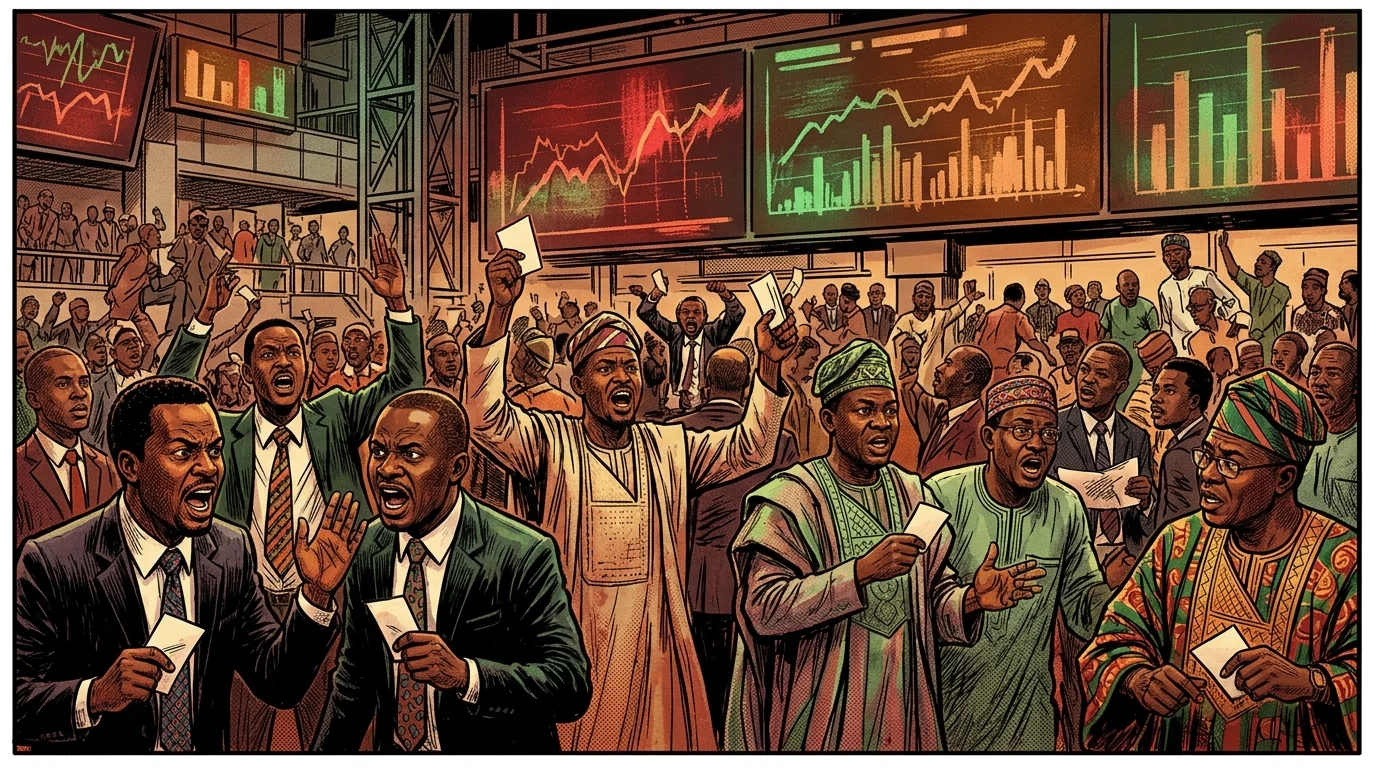
Caught in the euphoria, millions of ordinary Nigerians borrowed against their salaries and homes to speculate on stocks. Between December 2005 and March 2008, the NSE All-Share Index surged by more than 175 percent, rising from 24,085.76 points at the end of 2005 to 57,990.22 at the close of 2007, before reaching an all-time historic peak of 66,371.20 points on March 5, 2008. At that zenith, total equity market capitalization on the Nigerian Stock Exchange stood at ₦12.64 trillion (approximately $108 billion), while total capital market capitalization including debt securities topped ₦15.6 trillion. [6]
The 2008–2009 70% Market Crash and the Margin-Debt Spiral
The structural fragility of Nigeria’s equity boom was exposed within days of the March 2008 peak. Alarmed by rumors that the CBN and the Securities and Exchange Commission (SEC) were preparing to restrict bank lending to stockbrokers, institutional investors began taking profits. In the second half of 2008, the onset of the global financial crisis triggered two simultaneous external shocks that devastated Lagos: foreign hedge funds and portfolio managers liquidated their Nigerian equity and treasury positions to cover redemptions in London and New York, and Bonny Light crude oil prices collapsed by more than 70 percent, plunging from $147 per barrel in July 2008 to below $40 per barrel by December 2008. [7]
As the naira came under severe depreciation pressure and liquidity dried up, the margin-loan pyramid went into reverse. When share prices fell below the collateral coverage thresholds of margin loans, banks attempted to dump pledged shares onto the NSE, driving stock prices down even faster in a self-reinforcing liquidation spiral. Desperate to halt the freefall, NSE regulators imposed a temporary 1 percent daily downward price-movement cap in mid-2008, which merely froze market liquidity as buyers vanished completely. Once the cap was lifted, the rout resumed: from its March 5, 2008 peak of 66,371.20 points, the NSE All-Share Index plunged by 69.2 percent to hit a trough of roughly 20,400 points in early 2009, erasing nearly ₦9 trillion ($60 billion) in paper wealth. [8]
Behind the scenes, the stock market crash combined with defaults by domestic petroleum product importers (who had borrowed heavily at $140 oil only to see fuel shipment values collapse) left nearly half of Nigeria’s commercial banks technically insolvent. Unable to roll over interbank funding, distressed banks survived through late 2008 and early 2009 only by borrowing hundreds of billions of naira daily from the CBN’s Expanded Discount Window (EDW) while rolling over and concealing their non-performing margin loans.
Sanusi’s August 2009 Bank Purge and the Creation of AMCON
The reckoning arrived in June 2009, when President Umaru Musa Yar’Adua appointed Mallam Sanusi Lamido Sanusi—formerly Chief Risk Officer and Managing Director of First Bank of Nigeria—to succeed Soludo as CBN Governor. Immediately upon taking office, Sanusi commissioned joint teams of examiners from the CBN and the Nigeria Deposit Insurance Corporation (NDIC) to conduct a forensic special audit of all 24 operating commercial banks, focusing on their hidden exposures to capital-market margin loans and oil-and-gas marketers.
On August 14, 2009, Sanusi stunned the nation by releasing the findings of the first 10 bank audits and invoking Sections 33 and 35 of the Banks and Other Financial Institutions Act (BOFIA) to summarily dismiss the Chief Executive Officers and executive boards of five major commercial banks: Cecilia Ibru of Oceanic Bank, Erastus Akingbola of Intercontinental Bank, Bartholomew Ebong of Union Bank, Okey Nwosu of FinBank, and Sebastian Adigwe of Afribank. The audit revealed that the five banks held ₦1.143 trillion in non-performing loans—representing 40.81 percent of their total loan books—including ₦456.28 billion in toxic margin loans and ₦487.02 billion in defaulted oil-marketing credits, wiping out their entire shareholders’ equity. On October 2, 2009, following the audit of the remaining 14 banks, Sanusi dismissed three more CEOs (Francis Atuche of Bank PHB, Charles Otti of Spring Bank, and Ike Oraekwuotu of Equitorial Trust Bank) and injected a combined ₦620 billion ($4.1 billion) in Tier-2 subordinated convertible loans across the rescued institutions to prevent a systemic bank run and protect depositors.
High-profile criminal prosecutions by the Economic and Financial Crimes Commission (EFCC) soon followed. In October 2010, former Oceanic Bank CEO Cecilia Ibru pleaded guilty to three counts of bank fraud and reckless lending before the Federal High Court, receiving a six-month prison sentence and forfeiting ₦191 billion ($1.2 billion) in cash, international real estate across the United States and Dubai, and blue-chip shares in one of the largest individual asset forfeitures in banking history. To permanently remove the mountain of bad debt paralyzing Nigerian balance sheets, the National Assembly enacted the Asset Management Corporation of Nigeria (AMCON) Act in July 2010. Operating as a state-backed “bad bank” funded by CBN guarantees and a sinking-fund levy on commercial bank assets, AMCON issued more than ₦4 trillion in zero-coupon bonds to purchase over 12,000 non-performing margin and corporate loans with a face value of ₦5.4 trillion, restoring solvency to Nigeria’s banking system while leaving a multi-decade fiscal recovery legacy.
Theoretical & Balance-Sheet Transmission Mechanism
In the Kindleberger–Minsky taxonomy of financial instability (Kindleberger, 1978; Minsky, 1986) and Irving Fisher’s (1933) debt-deflation framework, speculative asset booms become systemic crises when credit expansion shifts balance sheets from hedge finance (cash flows covering principal and interest) to speculative and Ponzi finance (relying on rising asset prices and short-term margin roll-overs).
Once monetary tightening or an exogenous shock halts price appreciation, forced margin liquidations trigger Fisherian debt-deflation: fire-sale asset discounts erode bank collateral values, contracting credit supply across the real economy.
Sources and Further Reading
- Charles Chukwuma Soludo, “ The Outcome of the Banking Sector Recapitalization and the Way Forward for the Undercapitalized Banks,” Central Bank of Nigeria Official Address, January 16, 2006. Central Bank / Monetary Authority
- Euromoney, “ Nigeria Benefits from Banking Mergers and Recapitalizations,” Euromoney, 2006. Historical & Financial Reference
- Central Bank of Nigeria Journal of Applied Statistics, “ Stock Market Crisis and Macroeconomic Indicators in Nigeria,” CBN Journal of Applied Statistics, Vol. 1, No. 1, 2010. Central Bank / Monetary Authority
- Vanguard Nigeria, “ CBN Sacks 5 Banks’ Directors,” Vanguard Media, August 14, 2009. Historical & Financial Reference
- Sanusi Lamido Sanusi, “ Address by the Governor of the Central Bank of Nigeria on Developments in the Banking System in Nigeria,” Central Bank of Nigeria / The Nigerian Voice Archive, August 14, 2009. Central Bank / Monetary Authority
- Gamji Public Policy Archive, “ Post-Consolidation Challenges in the Nigerian Banking Sector,” Gamji Economic Review, 2006. Peer-Reviewed / Academic Research
- Irving Fisher — "The Debt-Deflation Theory of Great Depressions," Econometrica 1, no. 4 (FRASER Federal Reserve Archive, 1933): 337–357 Central Bank / Monetary Authority
- Charles P. Kindleberger & Robert Z. Aliber — Manias, Panics, and Crashes: A History of Financial Crises (Palgrave Macmillan) Peer-Reviewed / Academic Research
Cite This Historical Dossier (APA / Chicago)
APA (7th ed.): Ç., S. (Ed.). (2026). Nigeria's 2008 Margin-Loan Bubble: From Soludo's Bank Mergers to Sanusi's Bailout. In Forgotten Fortunes Historical Monograph Series (Forgotten Fortunes Editorial Desk). https://forgottenfortunes.net/nigeria-stock-market-crash-2008/
MLA (9th ed.): Ç., Soner, ed. "Nigeria's 2008 Margin-Loan Bubble: From Soludo's Bank Mergers to Sanusi's Bailout." Forgotten Fortunes: Financial & Monetary History Archive, 2026, https://forgottenfortunes.net/nigeria-stock-market-crash-2008/.
Chicago (17th ed.): Ç., Soner, ed. "Nigeria's 2008 Margin-Loan Bubble: From Soludo's Bank Mergers to Sanusi's Bailout." Forgotten Fortunes Historical Monograph Series (Forgotten Fortunes Editorial Desk), September 15, 2026. https://forgottenfortunes.net/nigeria-stock-market-crash-2008/.
Have an idea for another financial history documentary or article? Request a story →


