
In This Article
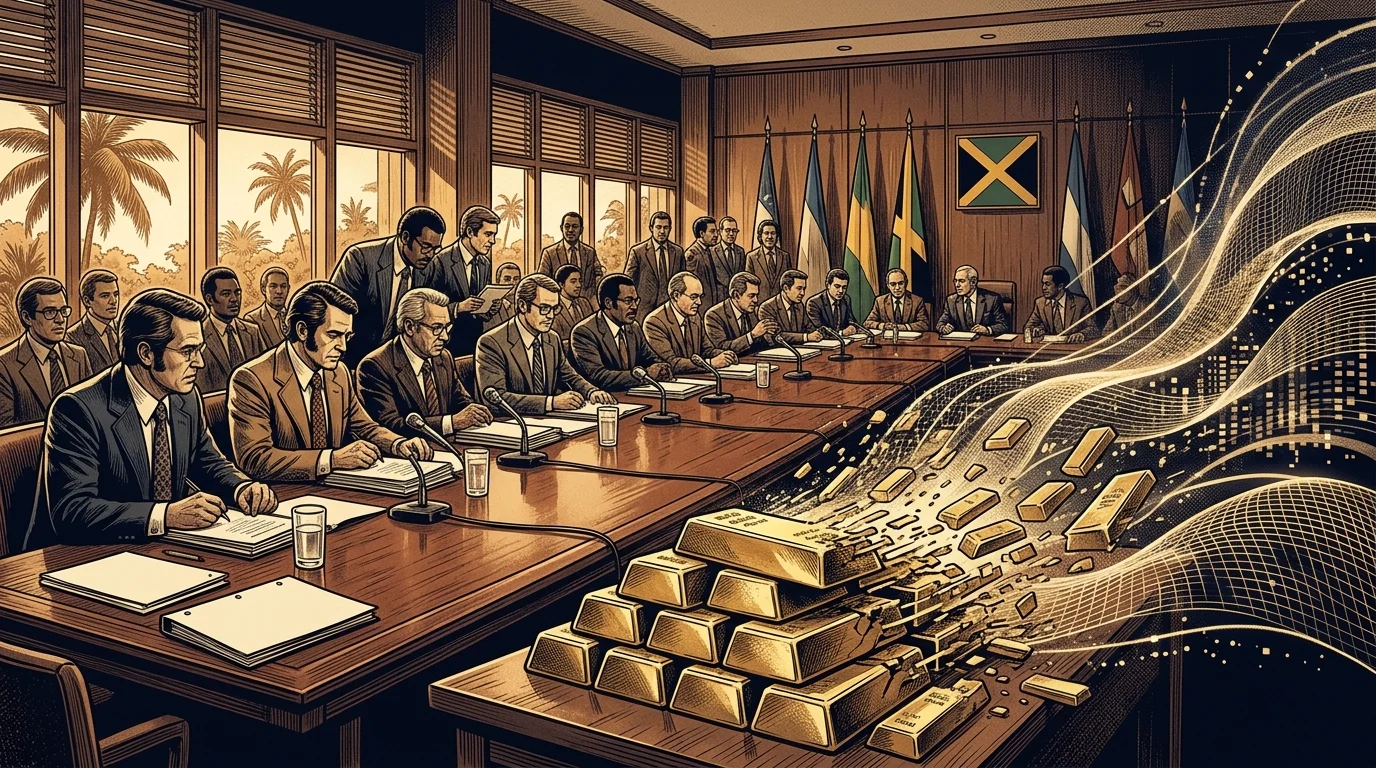
On January 7–8, 1976, finance ministers and central bank governors of the International Monetary Fund (IMF) Interim Committee gathered in Kingston, Jamaica, to negotiate the first comprehensive overhaul of the international monetary charter since the 1944 Bretton Woods Conference [4]. For nearly five years after President Richard Nixon suspended the convertibility of the U.S. dollar into gold in August 1971, major world currencies had floated outside the legal boundaries of the IMF’s original Articles of Agreement [1][3][4]. The resulting Jamaica Agreement—which formed the core of the Second Amendment to the IMF Articles of Agreement—resolved a prolonged diplomatic standoff between the United States and France, legalized flexible exchange rate arrangements under a rewritten Article IV, abolished the official price of gold, and created new financing mechanisms to support developing economies through balance-of-payments shocks [2][4][5].
From Bretton Woods to the 1971 Breakdown of Par Values
Established by delegates from forty-four nations at Bretton Woods, New Hampshire, in July 1944, the postwar international monetary order rested on fixed—though adjustable—exchange rate parities [1]. Once European currency convertibility was restored in 1958, member states settled international payment imbalances largely in U.S. dollars, while the United States committed to converting foreign official dollar holdings into gold at a fixed official parity of US$35 per troy ounce [1].
During the immediate postwar reconstruction of Europe and Japan, strong global demand for American exports and massive U.S. bullion holdings—roughly three-quarters of the world’s official monetary gold stock—kept the fixed-rate system stable [1]. Over the 1960s, however, recovering European and Japanese industries narrowed the U.S. trade surplus even as overseas military expenditures and foreign aid expanded the volume of dollars held abroad [1]. Because global gold production grew only marginally, foreign official dollar liabilities eventually exceeded U.S. gold reserves, exposing the Treasury to a classic convertibility run [1].
Faced with rising domestic inflation and mounting gold redemptions, President Nixon announced on August 15, 1971, that the United States would suspend the convertibility of the dollar into gold [1]. By early 1973, attempts to patch the fixed-parity grid together had collapsed, and the major industrial economies allowed their currencies to float against one another [4][5]. Formally, however, the par-value obligations of Article IV of the IMF charter remained on the books—merely suspended in practice—leaving the global currency regime in a state of legal limbo [2][3].
The U.S.–French Standoff and the Road to Kingston (1975)
Rewriting the IMF charter required bridging a deep doctrinal divide between the United States and France [2][5]. French policymakers traditionally favored a return to a generalized system of stable par values and sought to allow national central banks to transact in gold at market prices [3][5]. By contrast, the U.S. Treasury—led by Secretary William E. Simon and Under Secretary for Monetary Affairs Edwin H. Yeo III—insisted on preserving the freedom of the United States to float the dollar and sought to put gold on a “one-way track” out of the international monetary system so Washington would never again be forced to defend a metallic parity [2][4].
According to U.S. Treasury and State Department records, the bilateral dispute grew so sharp in the summer of 1975 that American officials believed they were on the verge of an exchange-rate confrontation with Paris [2]. A breakthrough arrived in November 1975 at the Rambouillet Summit in France, where Under Secretary Yeo and French Treasury Director Jacques de Larosière negotiated compromise texts on both exchange rate obligations and official gold transactions [2][3][4].
As documented in December 1975 meetings of the U.S. International Monetary Group and a Federal Reserve Board staff memorandum by economist Edwin M. Truman, the bilateral compromise rested on carefully balanced legal language [2][3]:
- Symmetric exchange-rate obligations (Proposed Article IV): To satisfy France, Section 1 required each member to collaborate with the Fund to assure orderly exchange arrangements and promote a “stable system of exchange rates” [2]. To satisfy the United States, that stability was grounded in underlying domestic economic policies rather than mandatory currency pegs, accompanied by an explicit pledge not to manipulate exchange rates to gain an unfair competitive advantage [2].
- Recognition of floating and the 85 percent supermajority: Section 2 allowed each member country to choose its own exchange arrangements, while Section 3 tasked the IMF with exercising “firm surveillance” over members’ exchange rate policies [2]. Although Section 4 permitted the IMF to re-establish a generalized system of adjustable par values in the future, doing so required an 85 percent majority of total voting power—giving the United States an effective veto—and even then no individual country could be forced to adopt a par value against its will [2][5].
- Interim gold compromise: Pending formal ratification of the charter amendments, the U.S. and France agreed that the IMF would simply “note” that certain countries reserved the right to acquire gold transferred via the new Trust Fund at market prices under Article VII replenishment clauses, avoiding any formal IMF endorsement of inter-central-bank gold trading above the old official price [3].
The Kingston Accords: Quotas and Credit Expansion (January 1976)
Armed with the U.S.–French compromise, the IMF Interim Committee convened in Kingston on January 7–8, 1976, and finalized the comprehensive reform package known as the Jamaica Agreement [4]. In his January 13, 1976 memorandum reporting the results to President Gerald Ford, Treasury Secretary Simon emphasized that the accord combined long-term constitutional revisions with immediate liquidity expansions to cushion the global economy following the 1973–1975 oil shock and recession [4].
First, the ministers confirmed a one-third overall increase in IMF member quotas—the capital subscriptions that determine each member state’s financial commitment, borrowing rights, and voting weight [4]. Under this Sixth General Review of Quotas, the United States quota was set to increase from approximately US$8 billion to about US$10 billion, while parallel adjustments to IMF voting majorities ensured that the United States retained blocking power over major institutional decisions [4].
Second, because formal legislative ratification of the new quotas and charter amendments would take time, the Interim Committee approved an immediate, temporary 45 percent expansion in member access limits across the IMF’s regular credit tranches [4]. Although championed primarily by developing countries facing acute current-account deficits, the enlarged 45 percent drawing limits were made available to all IMF members [4]. To ensure the Fund possessed sufficient usable cash to honor these drawings, every member nation agreed to make its domestic currency usable in IMF lending operations within six months—ending a longstanding loophole under which certain surplus countries had restricted the Fund from lending out their currencies [4].
Third, the Kingston agreement enacted a major liberalization of the IMF’s Compensatory Financing Facility, an initiative linked to Secretary of State Henry Kissinger’s Development Security Facility proposal [4][5]. This expanded facility provided primary commodity-exporting developing nations with greater short-term financing to offset sharp cyclical swings in export earnings [4][5].
Phasing Out Gold and Capitalizing the IMF Trust Fund
Alongside exchange rate reform, the Jamaica Agreement dismantled the monetary role of gold within the IMF [4]. The accords abolished the official price of gold, eliminated obligatory gold payments between member states and the Fund, and required the IMF to dispose of one-third (50 million ounces) of its existing bullion stockpile [4].
That 50-million-ounce reduction was divided into two equal channels of one-sixth (25 million ounces) each [4]:
- The IMF Trust Fund (25 million ounces): One-sixth of the Fund’s gold was slated for sale at market prices, with the net capital profits above the old official valuation channeled into a newly created Trust Fund providing concessionary balance-of-payments assistance to the world’s poorest developing countries [4].
- Direct gold restitution (25 million ounces): As a political quid pro quo for accepting public gold sales, another one-sixth of the IMF’s gold was returned (“restituted”) directly to all member countries in proportion to their existing quota shares, at the former official price [4]. Less-developed countries received approximately 28 percent of this direct gold distribution [4].
Simultaneously, the Group of Ten (G-10) industrial nations adopted transitional two-year guidelines pledging not to peg the market price of gold and capping the total volume of their combined official gold holdings, discouraging any move to resurrect a gold-based settlement regime [4][5].
Geopolitical Legacy: The Dollar, the SDR, and Surveillance
In a confidential January 15, 1976 briefing memorandum to Secretary of State Kissinger titled The Jamaica Monetary Accord and Beyond, Assistant Secretary of State Thomas O. Enders offered a candid strategic assessment of what Kingston had achieved [5]. Enders observed that while the agreement delivered substantial near-term balance-of-payments financing to developing nations, its constitutional provisions actually left the long-term evolution of the monetary system to market forces—an outcome that strongly favored the United States [5].
Although the amended Articles elevated the Special Drawing Right (SDR)—an international reserve asset originally created by the IMF in the late 1960s—as the formal “common denominator” of the Fund’s accounting system, Enders noted that the SDR remained “a very long way indeed from replacing the dollar as the principal reserve asset” [5]. With floating exchange rates now legally entrenched, the U.S. Treasury quietly backed away from earlier proposals for a “substitution account” that would have converted foreign official dollar balances into SDRs [5].
Following approval by the IMF Board of Governors and ratification by member legislatures, the Second Amendment to the Articles of Agreement entered into force in April 1978 [2][4]. By replacing rigid metallic parities with member-chosen exchange regimes and IMF Article IV surveillance, the 1976 Jamaica Agreement provided the durable legal foundation for the modern era of floating fiat currencies and dollar-centered global reserves [2][4][5].
Theoretical & Balance-Sheet Transmission Mechanism
In the Kindleberger–Minsky taxonomy of financial instability (Kindleberger, 1978; Minsky, 1986) and Irving Fisher’s (1933) debt-deflation framework, speculative asset booms become systemic crises when credit expansion shifts balance sheets from hedge finance (cash flows covering principal and interest) to speculative and Ponzi finance (relying on rising asset prices and short-term margin roll-overs).
Once monetary tightening or an exogenous shock halts price appreciation, forced margin liquidations trigger Fisherian debt-deflation: fire-sale asset discounts erode bank collateral values, contracting credit supply across the real economy.
Sources and Further Reading
- Federal Reserve History, “ Nixon Ends Convertibility of U.S. Dollars to Gold and Announces Wage/Price Controls,” Federal Reserve History, 2013-11-22. Central Bank / Monetary Authority
- U.S. Department of State, “ Notes on an International Monetary Group Meeting (FRUS 1969–1976, Vol. XXXI, Document 126),” Office of the Historian, U.S. Department of State, 1975-12-05. Official / State Archive
- Edwin M. Truman, “ Memorandum to the Chairman of the Federal Reserve System Board of Governors: French/U.S. Agreement on the Issue of Gold Purchases (FRUS 1969–1976, Vol. XXXI, Document 127),” Office of the Historian, U.S. Department of State, 1975-12-08. Central Bank / Monetary Authority
- William E. Simon, “ Memorandum From Secretary of the Treasury Simon to President Ford: Jamaica Meetings of Interim and Development Committees (FRUS 1969–1976, Vol. XXXI, Document 128),” Office of the Historian, U.S. Department of State, 1976-01-13. Official / State Archive
- Thomas O. Enders, “ Briefing Memorandum to Secretary of State Kissinger: The Jamaica Monetary Accord and Beyond (FRUS 1969–1976, Vol. XXXI, Document 129),” Office of the Historian, U.S. Department of State, 1976-01-15. Official / State Archive
- Irving Fisher — "The Debt-Deflation Theory of Great Depressions," Econometrica 1, no. 4 (FRASER Federal Reserve Archive, 1933): 337–357 Central Bank / Monetary Authority
- Charles P. Kindleberger & Robert Z. Aliber — Manias, Panics, and Crashes: A History of Financial Crises (Palgrave Macmillan) Peer-Reviewed / Academic Research
Cite This Historical Dossier (APA / Chicago)
APA (7th ed.): Ç., S. (Ed.). (2026). The 1976 Jamaica Agreement and the Post-Bretton Woods IMF System. In Forgotten Fortunes Historical Monograph Series (Forgotten Fortunes Editorial Desk). https://forgottenfortunes.net/jamaica-agreement-imf-monetary-system/
MLA (9th ed.): Ç., Soner, ed. "The 1976 Jamaica Agreement and the Post-Bretton Woods IMF System." Forgotten Fortunes: Financial & Monetary History Archive, 2026, https://forgottenfortunes.net/jamaica-agreement-imf-monetary-system/.
Chicago (17th ed.): Ç., Soner, ed. "The 1976 Jamaica Agreement and the Post-Bretton Woods IMF System." Forgotten Fortunes Historical Monograph Series (Forgotten Fortunes Editorial Desk), August 29, 2026. https://forgottenfortunes.net/jamaica-agreement-imf-monetary-system/.
Have an idea for another financial history documentary or article? Request a story →


