In This Article
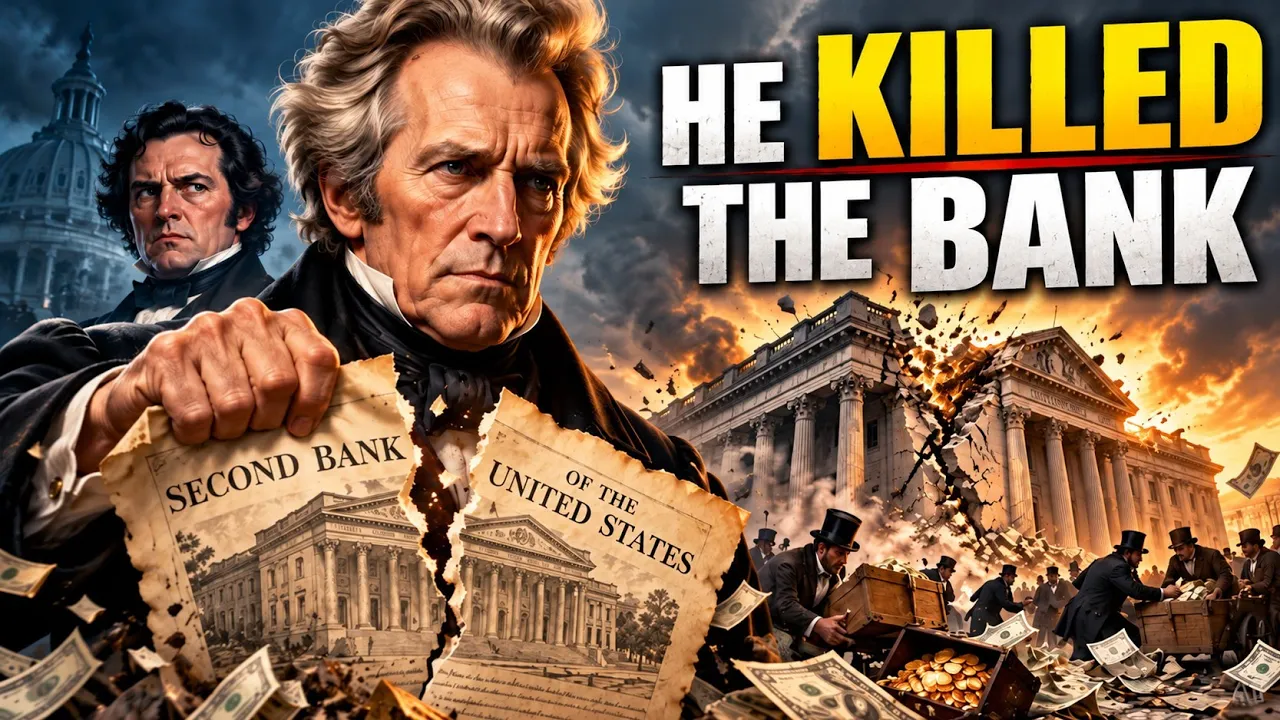
In 1832, President Andrew Jackson vetoed a bill that would have extended the life of one of America’s most powerful financial institutions: the Second Bank of the United States. [1]

The decision was more than a dispute over one bank’s charter. It challenged who should control the nation’s money, whether a federally chartered institution could be trusted with extraordinary financial power, and how much authority the president should exercise over the economy.
By 1836, the Bank had lost its federal charter. In May 1837, American banks faced a financial panic that spread across the country. [2]
The timing invited a simple conclusion: Jackson had destroyed the national bank and caused the crisis.
But the actual history is more complicated. The Bank War changed America’s financial system, while international lending, cotton markets, government deposits, and the movement of gold and silver all shaped what happened next.
Why America Created a Second National Bank
The United States had already experimented with a national bank before Jackson entered politics.
The First Bank of the United States, established in 1791, helped manage federal finances and support the young country’s financial system. Its twenty-year charter expired in 1811 when Congress declined to renew it. [3]
The consequences of operating without a national banking institution became more apparent during the War of 1812. [4]
British naval pressure disrupted American trade, reducing the customs revenue on which the federal government heavily depended. Financing the war became difficult, while the paper notes issued by different state banks varied in reliability.
In some areas, banks suspended the exchange of their paper notes for gold or silver. The country lacked a dependable nationwide mechanism for moving government funds, coordinating payments, and restraining unstable banking practices. President James Madison, who had once questioned the constitutionality of a national bank, eventually supported the creation of a new institution.
On April 10, 1816, he signed legislation establishing the Second Bank of the United States.
The Bank opened in Philadelphia in January 1817 with a twenty-year federal charter and an authorized capital of $35 million. [5]
It was not simply a government department. It was a corporation with private shareholders, government involvement, and unusually extensive financial privileges.
Its responsibilities included holding federal deposits, helping the Treasury make payments, issuing its own banknotes, extending commercial credit, and transferring money across different parts of the country.
Over time, it developed a network of twenty-five branches.
That network gave the Bank a reach that ordinary state-chartered institutions struggled to match.
How the Second Bank Influenced American Money
To understand the Bank War, it is essential to understand what the Second Bank actually controlled. In the early nineteenth century, Americans used gold and silver coins alongside paper money issued by individual banks. The paper notes were promises. A bank issuing a ten-dollar note was generally promising to exchange that note for ten dollars in gold or silver when demanded.
Gold and silver coin were known collectively as specie.
The problem was that banks typically issued more paper promises than the quantity of coins they physically held. This arrangement could support commerce and economic growth, but it depended on public confidence and careful management. If too many customers demanded coins simultaneously, a bank could run out of readily available reserves. The Second Bank helped restrain that risk.
When it received paper notes issued by state banks, it could return those notes to the issuing institutions and demand payment in specie.
Imagine a state bank that had issued large quantities of paper money to finance speculative land purchases.
If the Second Bank accumulated those notes and demanded repayment in gold or silver, the state bank would lose reserves. To protect itself, it might reduce lending or limit the number of new notes it issued.
This gave the Second Bank substantial influence over the expansion of credit. It could also ease financial conditions by allowing state-bank notes to remain outstanding rather than immediately demanding redemption. The result was a powerful institution capable of influencing the amount of money and credit circulating through the American economy. Yet it would be misleading to describe the Second Bank as a modern central bank.
It did not operate with the Federal Reserve’s contemporary monetary-policy tools. Nor did it systematically serve as a lender of last resort, supplying emergency liquidity to banks during financial panics.
It was simultaneously a commercial bank and a national financial institution performing some central-banking functions. That combination made it useful, influential, and politically controversial. Its own record was not spotless. Excessive credit expansion and subsequent contraction during its early years helped intensify the Panic of 1819. Farmers, merchants, and borrowers suffered during the resulting downturn. [6]
Although the Bank became more effectively managed under Nicholas Biddle in the 1820s, memories of its earlier conduct remained powerful. For many Americans, the institution represented financial discipline. For others, it represented concentrated financial power.
Why Andrew Jackson’s Bank War Became Political
Andrew Jackson entered the presidency in 1829 with a deep suspicion of banks and paper money. His distrust had personal roots. Earlier financial dealings involving unreliable paper promises had reinforced his preference for gold and silver. But the conflict went far beyond personal experience. Jackson believed the Second Bank concentrated excessive economic power within an institution that ordinary voters could not adequately control. [7]
Its federal charter granted advantages unavailable to competitors. Its shareholders included wealthy American and foreign investors. Its management could influence credit conditions across the country.
To Jackson, these privileges raised a fundamental political question: why should the federal government help sustain a powerful corporation that might use its influence against the public interest?
The Bank’s defenders saw the problem differently. They argued that a nationwide financial institution was necessary to maintain a more dependable currency, facilitate government payments, and discourage reckless banking practices. They feared that destroying the Bank would weaken the restraints on state banks and encourage unstable credit expansion. There was also a constitutional disagreement.
In 1819, the Supreme Court had upheld Congress’s authority to establish a national bank in McCulloch v. Maryland. [8]
Jackson nevertheless maintained that the specific privileges of the Second Bank were objectionable and that the president had an independent responsibility to judge legislation against the Constitution.
The debate therefore involved several overlapping questions: economic stability, concentrated wealth, constitutional authority, federalism, and democratic accountability. Neither side was arguing solely about banking efficiency. Both were arguing about power.
The Veto of 1832
The decisive confrontation began before the Bank’s charter was due to expire. Nicholas Biddle and political allies, including Senator Henry Clay, supported an early renewal of the charter in 1832. The existing authorization would otherwise continue until 1836. Bringing the issue forward created a political test for Jackson during his reelection campaign. [9]
Congress approved a bill extending the Bank’s charter.
On July 10, 1832, Jackson vetoed it.
His message attacked the special advantages enjoyed by the corporation, questioned the proposed charter’s constitutional foundations, and argued that government should not confer extraordinary privileges on wealthy private interests.
Jackson did not deny that a national banking institution could provide useful services. His objection was that the existing arrangement combined those services with powers and privileges he regarded as unacceptable. The veto shifted the controversy directly into the presidential election. Clay defended the Bank. Jackson presented his opposition as a stand against concentrated financial privilege.
Jackson won reelection decisively in November 1832. The result strengthened his political position, although an election victory did not settle the economic arguments surrounding the Bank. Congressional supporters failed to override his veto. The Second Bank would now have to confront the expiration of its federal charter. [10]
But Jackson was unwilling to allow the institution to retain its existing influence until 1836.
His next move was more immediately disruptive.
The Removal of Federal Deposits
Federal deposits were one of the Second Bank’s most important advantages. Holding government funds provided financial resources and reinforced the Bank’s central role in federal operations. Jackson decided to transfer the government’s banking business elsewhere. The decision created a constitutional and administrative confrontation because responsibility for managing federal deposits rested with the Treasury.
Treasury Secretary William J. Duane refused to carry out Jackson’s instructions. On September 23, 1833, Jackson dismissed him and appointed Roger B. Taney to lead the Treasury on a temporary basis. Taney implemented the policy. New federal deposits were redirected to selected state-chartered banks, while existing balances at the Second Bank were drawn down. [11]
These institutions became commonly known as pet banks, a politically charged description suggesting that government favor influenced their selection.
The change was not simply a transfer of government money from one set of vaults to another.
It altered the structure of American banking.
The Second Bank lost an important source of funding and some of its ability to coordinate credit across the country. Selected state banks gained public deposits and the advantages associated with handling federal funds.
Biddle responded by restricting credit and calling in loans.
Part of this contraction reflected the Bank’s reduced financial resources. But the Bank’s leadership also hoped that worsening credit conditions would generate opposition to Jackson and strengthen demands for renewed federal support.
Instead, the strategy created political difficulties for Biddle.
Businesses and borrowers experienced financial pressure, while Jackson could portray the Bank’s actions as evidence that a powerful corporation was willing to use credit as a political weapon.
The confrontation became so bitter that the Senate censured Jackson on March 28, 1834, over his exercise of authority in the deposit dispute. The censure was expunged from the Senate record in January 1837. By then, the outcome of the struggle was effectively settled.
What Happened When the Bank Lost Its Charter?
In 1836, the Second Bank’s federal charter expired without renewal. This did not mean that the institution immediately disappeared. It continued operating under a Pennsylvania state charter, but it no longer possessed its former nationwide federal status. The distinction matters.
Jackson had ended the federal banking arrangement that made the Second Bank an exceptional national institution. He had not eliminated commercial banking, government involvement with banks, or the broader financial system’s dependence on paper credit.
State banks continued accepting deposits, making loans, and issuing notes. Without the Second Bank’s previous influence, the country increasingly depended on a more decentralized banking structure. That arrangement offered opportunities for regional institutions and borrowers. It also made nationwide financial coordination more difficult.
The American economy was expanding rapidly during the mid-1830s.
Land speculation increased. Cotton production and trade attracted substantial financing. Foreign capital entered American markets, and banks supplied credit to businesses, merchants, and land purchasers.
The boom was not caused by Jackson’s banking policies alone. International investment, economic expansion, commodity demand, and expectations of future profits were all important. But the disappearance of the Second Bank’s national role changed the environment in which that expansion occurred.
The Specie Circular and the Problem of Gold
By 1836, speculation in western public lands had become a serious concern for Jackson’s administration. Buyers could obtain bank credit, purchase public land, and hope to resell it at higher prices. Paper money and bank lending helped finance this activity. Jackson feared that excessive credit and unreliable banknotes were supporting an unsustainable land boom.
On July 11, 1836, the Treasury issued instructions, at Jackson’s direction, that became known as the Specie Circular.
The policy generally required purchases of federal public land to be paid for in gold or silver, with limited transitional exceptions. The purpose was to discourage speculative purchases financed with questionable paper money. But the requirement had consequences for the banking system. Gold and silver reserves were unevenly distributed across the country.
A purchaser seeking western land might need coins that were held in eastern financial centers. Obtaining those coins could drain reserves from banks elsewhere. This mattered because bank reserves supported the ability to redeem notes and meet demands for payment. If reserves declined, banks became more vulnerable to withdrawals and less willing to extend credit. At the same time, another federal policy was changing the location of government funds.
The Deposit Act of June 23, 1836, provided for distributing much of the federal government’s accumulated surplus among the states through deposits that were legally repayable to the Treasury.
Approximately $37.5 million was designated for distribution in 1837, although only three of the planned four installments were made. The transfers required funds to move between banking institutions and regions. In an era without modern electronic payments, these movements could disrupt local reserves and liquidity. Taken together, the land-payment rules and shifting federal balances placed additional pressure on an already changing banking system.
However, historians disagree over exactly how important each policy was in producing the coming crisis.
The Panic of 1837: A Crisis With International Roots
The United States did not operate in financial isolation. American cotton exports were deeply connected to British manufacturers, merchants, banks, and creditors. Financing often depended on credit arrangements involving institutions on both sides of the Atlantic. During the mid-1830s, international lending had helped sustain American commercial expansion.
But financial conditions in Britain began tightening. The Bank of England, concerned about its own gold reserves, restricted credit during 1836. British lenders became less willing to extend or renew some forms of credit connected with American trade. This created difficulties for American merchants who depended on continued access to financing.
Cotton prices also weakened, undermining the financial position of businesses whose loans and commercial obligations depended on the commodity. The effects spread through the credit system. A cotton merchant unable to obtain financing might fail to meet a payment. A creditor expecting that payment could then struggle to meet its own obligations. Businesses that appeared profitable while credit was plentiful suddenly faced a shortage of usable cash.
Financial distress developed in several commercial centers, including New Orleans and New York, before the crisis reached its decisive stage.
On May 10, 1837, banks in New York City suspended specie payments.
In practical terms, they stopped routinely exchanging their paper notes and deposit claims for gold or silver on demand. The suspensions spread to banks elsewhere. Credit contracted, business failures multiplied, and the wider economy entered a severe downturn. Martin Van Buren had become president in March 1837, only weeks before the nationwide banking crisis.
He inherited the consequences of a financial system reshaped under Jackson, together with powerful economic pressures originating outside the United States. And the trouble did not end in 1837. After an uneven recovery, another financial crisis developed in 1839. Economic weakness and deflation continued into the early 1840s.
Did Andrew Jackson Cause the Panic of 1837?
This remains one of the most important questions in the history of American banking. It is tempting to draw a straight line from Jackson’s veto in 1832 to the collapse of confidence in 1837. The connection is real, but it is not that simple. Jackson’s policies altered the institutions responsible for managing government funds and influencing the banking system.
The destruction of the Second Bank’s federal role removed an institution that had exercised significant restraint over state-bank credit. The transfer of government deposits, the Specie Circular, and changing reserve requirements created additional pressures. Yet Britain was simultaneously experiencing monetary tightening, while American cotton markets and internationally financed businesses were becoming increasingly vulnerable. Economic historians have assigned different weights to these factors.
Peter Temin’s influential interpretation emphasized international monetary developments and challenged accounts that primarily blamed Jackson’s domestic policies. Economic historian Peter L. Rousseau, drawing on government records and contemporary financial evidence, offered a different explanation. His research emphasized transfers of federal balances between banks and increased demand for specie in western states. Rousseau argued that these developments seriously depleted reserves at major New York banks, making the system exceptionally vulnerable to panic.
His findings also challenged the idea that either the formal surplus distribution alone or a sudden international shock fully explained the crisis. Other historical research has stressed the importance of interconnected commercial failures, uncertainty, and the spread of collapsing confidence across New Orleans, New York, and London. These interpretations do not produce a single universally accepted explanation. Instead, they reveal how financial crises emerge when institutional weaknesses interact with changing economic conditions.
Jackson’s policies were important.
But the Panic of 1837 cannot be adequately explained as the automatic consequence of a single presidential veto.
The crisis reflected a combination of domestic policy, credit expansion, reserve movements, international financial tightening, and declining confidence.
The Long Aftermath of the Bank War
The Bank War outlasted Jackson’s presidency. The institution that had once held federal deposits and influenced credit across the country survived for several years as a Pennsylvania-chartered bank before finally failing in 1841. The federal government also faced the unresolved problem of where to keep and how to manage its money. Under Van Buren, Congress established an Independent Treasury system in 1840, intended to separate the handling of government funds from ordinary commercial banking.
The arrangement was largely repealed in 1841. A more lasting Independent Treasury system was established in 1846. Meanwhile, American banking continued developing through state-chartered institutions and, later, a new national banking framework during the Civil War. The country experienced substantial economic growth without the Second Bank, but its financial history was repeatedly interrupted by banking panics.
Following the severe Panic of 1907, reformers again focused on the need for national mechanisms to support monetary and banking stability. Congress established the Federal Reserve System in 1913. The Federal Reserve was not simply the Second Bank recreated. It emerged in a different economic and political environment, with a distinct institutional structure and responsibilities. Nevertheless, both institutions reflected a recurring American challenge: how to create financial stability without placing excessive power beyond public accountability.
What the Bank War Really Changed
Andrew Jackson won his immediate political struggle. He blocked the Second Bank’s recharter, redirected federal deposits, and helped end a banking institution that he believed possessed dangerous economic privileges. His supporters regarded the victory as a defense of democratic government against concentrated financial influence. His critics feared that eliminating the Bank’s national role would weaken financial discipline and encourage instability.
The subsequent history provided evidence for more than one interpretation. The Bank had supplied useful financial coordination, but its considerable privileges and political activities raised legitimate questions about accountability. The banking system that followed offered opportunities for competing institutions, but also faced serious problems of confidence, reserves, and coordination. And the Panic of 1837 demonstrated that even a domestic banking dispute could not be understood without examining international money and trade.
The lasting lesson is not that every national bank guarantees stability, or that every restriction on banking power produces disaster.
It is that financial power cannot simply be abolished by dismantling one institution.
It moves into other banks, other markets, and other relationships. The real question is whether the system that replaces the old institution can manage the risks that remain. For nineteenth-century America, that question was answered only through decades of further crises, political disputes, and institutional experimentation.
Theoretical & Balance-Sheet Transmission Mechanism
In the Kindleberger–Minsky taxonomy of financial instability (Kindleberger, 1978; Minsky, 1986) and Irving Fisher’s (1933) debt-deflation framework, speculative asset booms become systemic crises when credit expansion shifts balance sheets from hedge finance (cash flows covering principal and interest) to speculative and Ponzi finance (relying on rising asset prices and short-term margin roll-overs).
Once monetary tightening or an exogenous shock halts price appreciation, forced margin liquidations trigger Fisherian debt-deflation: fire-sale asset discounts erode bank collateral values, contracting credit supply across the real economy.
Sources & Further Reading
- Andrew Jackson. “Bank Veto,” July 10, 1832. Presidential speech transcript, Miller Center, University of Virginia. Primary historical document.
https://millercenter.org/the-presidency/presidential-speeches/july-10-1832-bank-veto Historical & Financial Reference - Andrew T. Hill. “The Second Bank of the United States.” Federal Reserve History, Federal Reserve System, 2015. Historical study of the Bank’s operations, political conflict, and dissolution.
https://www.federalreservehistory.org/essays/second-bank-of-the-us Central Bank / Monetary Authority - National Archives and Records Administration. “Conflict with the Executive: The Bank War.” Treasures of Congress. Official archival account of the charter dispute and Jackson’s political confrontation with Congress.
https://www.archives.gov/exhibits/treasures_of_congress/text/page9_text.html Official / State Archive - United States Senate Historical Office. “Senate Censures President.” Official history of the March 28, 1834, censure and the federal deposit controversy.
https://www.senate.gov/about/parties-leadership/censure-president-jackson.htm Official / State Archive - United States Department of the Treasury. “Circular from the Secretary of the Treasury to Receivers of Public Money and to the Deposit Banks,” July 11, 1836. Primary document reproduced by The American Presidency Project, University of California, Santa Barbara.
https://www.presidency.ucsb.edu/documents/circular-from-the-secretary-the-treasury-receivers-public-money-and-the-deposit-banks Peer-Reviewed / Academic Research - United States Department of the Treasury. Report on the Finances, September and December 1837. Historical Treasury reports preserved by FRASER, Federal Reserve Bank of St. Louis. Primary evidence concerning government deposits, fiscal conditions, and the 1837 crisis.
https://fraser.stlouisfed.org/title/annual-report-secretary-treasury-state-finances-194/report-finances-september-1837-report-finances-december-1837-5482/fulltext Central Bank / Monetary Authority - Federal Deposit Insurance Corporation. “1800–1849.” FDIC Banking History. Institutional historical overview of the Second Bank, banking expansion, the Specie Circular, and the Panic of 1837.
https://www.fdic.gov/history/1800-1849 Official / State Archive - Peter L. Rousseau. “Jacksonian Monetary Policy, Specie Flows, and the Panic of 1837.” The Journal of Economic History, Volume 62, Issue 2, 2002, pp. 457–488. Cambridge University Press.
https://doi.org/10.1017/S0022050702000566 Peer-Reviewed / Academic Research - Jessica Lepler. “‘The News Flew Like Lightning’: Spreading Panic in 1837.” Journal of Cultural Economy, Volume 5, Issue 2, 2012, pp. 179–195. Research on commercial failures, communication, and the spread of financial panic.
https://doi.org/10.1080/17530350.2012.660784 Peer-Reviewed / Academic Research - John Joseph Wallis. “What Caused the Crisis of 1839?” National Bureau of Economic Research, Historical Working Paper 0133, 2001. Research on the later crisis, state borrowing, and the prolonged economic downturn.
https://www.nber.org/papers/h0133 Peer-Reviewed / Academic Research - United States Department of the Treasury. “Levi Woodbury (1834–1841).” History of Prior Secretaries of the Treasury. Institutional account of the Independent Treasury system and federal financial administration during the banking crisis.
https://home.treasury.gov/about/history/prior-secretaries/levi-woodbury-1834-1841 Official / State Archive
Cite This Historical Dossier (APA / Chicago)
APA (7th ed.): Ç., S. (Ed.). (2026). Andrew Jackson's Bank War: How a President Challenged America's National Bank. In Forgotten Fortunes Historical Monograph Series (Forgotten Fortunes Editorial Desk). https://forgottenfortunes.net/andrew-jackson-bank-war/
MLA (9th ed.): Ç., Soner, ed. "Andrew Jackson's Bank War: How a President Challenged America's National Bank." Forgotten Fortunes: Financial & Monetary History Archive, 2026, https://forgottenfortunes.net/andrew-jackson-bank-war/.
Chicago (17th ed.): Ç., Soner, ed. "Andrew Jackson's Bank War: How a President Challenged America's National Bank." Forgotten Fortunes Historical Monograph Series (Forgotten Fortunes Editorial Desk), August 21, 2026. https://forgottenfortunes.net/andrew-jackson-bank-war/.
Have an idea for another financial history documentary or article? Request a story →