In This Article
On December 23, 2001, standing before a joint session of the Argentine National Congress in Buenos Aires after days of street protests and the resignation of President Fernando de la Rúa, Interim President Adolfo Rodríguez Saá announced that the Republic of Argentina would suspend payments on its external public debt. As legislators rose to their feet in applause, Argentina halted service on roughly US$81.8 billion in sovereign bond principal—exceeding US$93 billion to US$100 billion with accrued interest across 152 distinct bond series issued in seven currencies and governed by eight national jurisdictions. Until Greece’s restructuring a decade later, it was the largest sovereign default in world financial history. [1]

What followed over the next fifteen years reshaped the architecture of international sovereign finance. Under Presidents Néstor Kirchner and Cristina Fernández de Kirchner, Argentina executed two unilateral debt exchanges in 2005 and 2010 that persuaded 92.4% of bondholders to accept net-present-value haircuts of roughly 70%. Yet a determined cohort of holdout creditors led by NML Capital—a Cayman Islands subsidiary of Paul Singer’s Elliott Management—refused the swap. Deploying aggressive global litigation, NML briefly detained the Argentine Navy tall ship ARA Libertad in Ghana in 2012 and persuaded US District Judge Thomas P. Griesa to weaponize a boilerplate pari passu (“equal step”) clause, blocking payments to the 92.4% majority of restructured bondholders in 2014 until President Mauricio Macri’s administration paid US$9.3 billion in cash in April 2016 to end the fifteen-year war. [2]
Convertibility’s Debt Trap and the December 2001 Collapse
The roots of the 2001 default lay in the rigid monetary architecture erected a decade earlier to extinguish Argentina’s 1989–1990 hyperinflation. Under the Convertibility Law of April 1, 1991, designed by Economy Minister Domingo Cavallo during the presidency of Carlos Menem, Argentina fixed the new Peso Convertible at an irrevocable one-to-one parity with the US dollar and required the central bank to back the monetary base with foreign exchange reserves. While Convertibility eliminated inflation and spurred booming growth in the early 1990s, it stripped Argentina of independent monetary and exchange-rate policy. [3]
Because the state could no longer print money to cover federal and provincial budget deficits, it financed persistent fiscal shortfalls by issuing foreign-currency sovereign bonds on the New York, London, Frankfurt, Tokyo, and Milan markets. By the late 1990s, Argentina accounted for roughly one-quarter of all emerging-market bond issuance tracked by J.P. Morgan’s EMBI+ index. A sequence of external shocks—the 1997 Asian financial crisis, the August 1998 Russian default, the strong appreciation of the US dollar, tumbling global grain prices, and Brazil’s devaluation of the real in January 1999—left the dollar-pegged Argentine economy severely uncompetitive, plunging the country into a grinding three-year deflationary recession. [4]
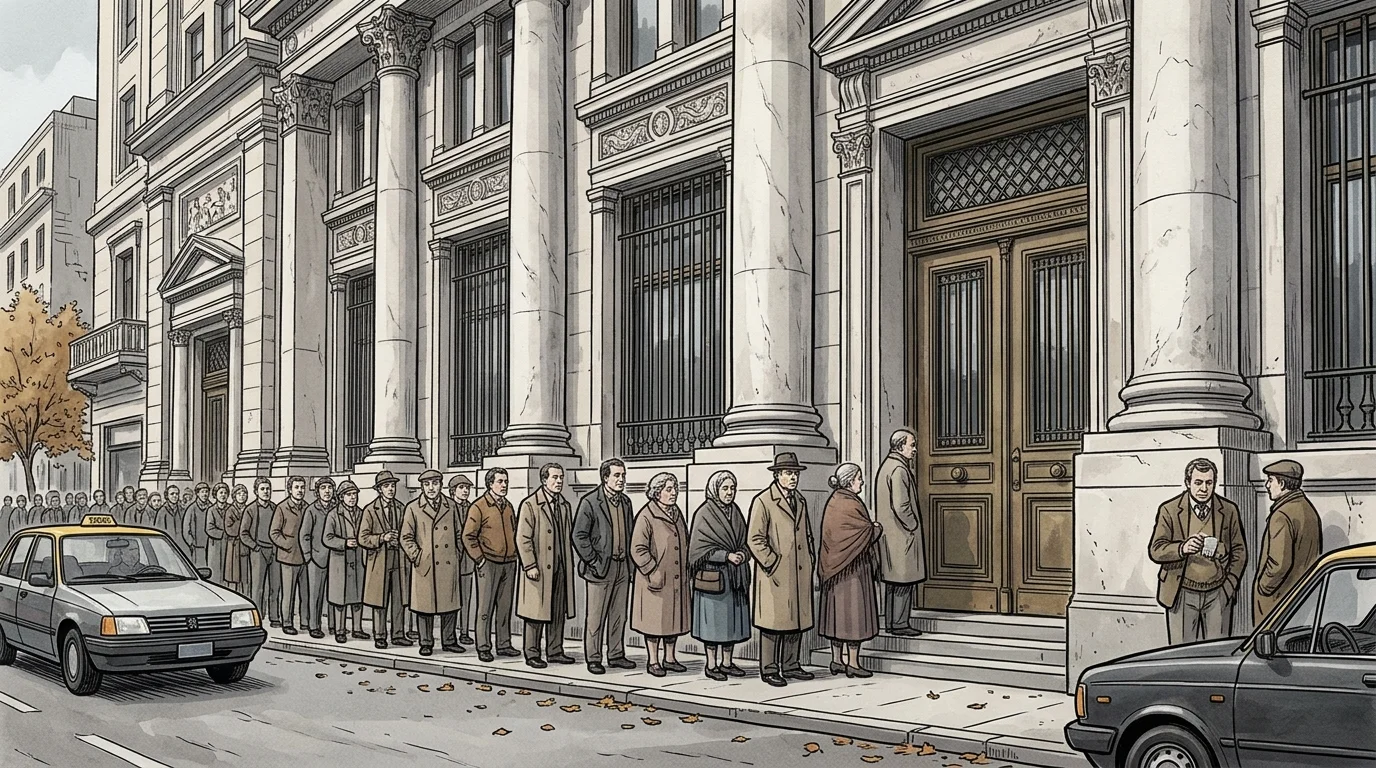
As tax revenues shrank and sovereign risk spreads widened past 1,500 basis points, Argentina’s public debt rose from 35% of GDP in 1994 to over 54% of GDP (US$144.5 billion total public debt) by late 2001, almost entirely denominated in foreign currencies. Neither the IMF-led US$40 billion Blindaje (“shield”) package of December 2000 nor Cavallo’s June 2001 Megacanje (“mega-swap”)—which pushed out near-term maturities only by saddling the country with 15% interest rates—could halt the bank run. After depositors withdrew more than US$15 billion from commercial banks during 2001, Cavallo imposed the Corralito on December 1, 2001, freezing bank accounts and limiting cash withdrawals to US$250 per week. [5]
When the IMF withheld a US$1.26 billion disbursement on December 5, 2001, the political order imploded. Looting and cacerolazo protests across Buenos Aires on December 19–20 left dozens dead and forced de la Rúa to flee the Casa Rosada by helicopter. Three days later, Rodríguez Saá declared the external debt moratorium. Within two weeks, Rodríguez Saá himself resigned, and incoming President Eduardo Duhalde enacted Law 25.561 in January 2002, abolishing the ten-year Convertibility peg, devaluing the peso toward 4 per US dollar, and forcibly converting domestic dollar bank loans and deposits into pesos under “asymmetric pesification.” [6]
| Documented Figure / Metric | Historical Significance & Archival Context |
|---|---|
| US$1.26 billion | When the IMF withheld a US$1.26 billion disbursement on December 5, 2001, the political order imploded. |
| US$62.3 billion | When the offer closed on February 25, 2005, holders of US$62.3 billion in principal—76.15% of the eligible debt—tendered their bonds, shrinking Argentina's face-value liability on that tranche to US$35.2 billion. |
| US$12.1 billion | Another US$12.1 billion in defaulted principal accepted the 2010 swap, raising total creditor participation across the two restructurings to 92.4%. |
| US$6.2 billion | While more than nine-tenths of creditors accepted the restructured "Exchange Bonds," holders of roughly 7.6% of the defaulted principal (around US$6.2 billion in original face value, plus tens of billions in accrued interest and penalty claims) held out. |
The 2005 and 2010 Kirchner-Lavagna Restructurings and the Lock Law
With GDP contracting by 10.9% in 2002 and over half the population falling below the poverty line, Argentina remained in complete moratorium on its defaulted foreign bonds for more than three years. Elected in May 2003, President Néstor Kirchner and his Economy Minister Roberto Lavagna rejected conventional IMF-mediated creditor negotiations, insisting that economic recovery had to precede debt service and that international creditors bore shared responsibility for lending recklessly during the final years of Convertibility. [7]
After rejecting creditors’ demands at the September 2003 IMF-World Bank meetings in Dubai with an initial proposal for a 75% nominal write-off excluding past-due interest, Lavagna formally launched Argentina’s unilateral debt exchange on January 14, 2005. Covering US$81.8 billion in eligible defaulted principal (plus over US$20 billion in unpaid interest accrued since December 2001), the offer gave bondholders three choices: Par bonds (preserving face value but stretching maturities to 35 years at step-up coupons starting at 1.33%), Discount bonds (imposing an immediate 66.3% cut in face value), and peso-denominated inflation-indexed Quasi-Par bonds aimed at domestic pension funds, all bundled with GDP-linked warrants that paid extra returns if annual growth exceeded ~3%. [8]
Evaluated at prevailing exit yields, the 2005 restructuring imposed a net-present-value (NPV) haircut of roughly 70% to 75%—yielding creditors approximately 27 to 30 cents on the dollar, one of the steepest write-downs ever imposed by a middle-income sovereign. When the offer closed on February 25, 2005, holders of US$62.3 billion in principal—76.15% of the eligible debt—tendered their bonds, shrinking Argentina’s face-value liability on that tranche to US$35.2 billion.
To compel undecided creditors to join and to reassure participating investors that holdouts would never receive a sweeter deal, the Argentine Congress passed Law 26.017—universally known as the Ley Cerrojo (“Lock Law”)—in February 2005. The statute explicitly prohibited the executive branch from reopening the exchange process or entering into any judicial, extrajudicial, or private settlement with non-participating holdouts. Five years later, under President Cristina Fernández de Kirchner and Economy Minister Amado Boudou, Congress temporarily suspended the Lock Law between April and June 2010 to execute a second exchange on virtually identical financial terms. Another US$12.1 billion in defaulted principal accepted the 2010 swap, raising total creditor participation across the two restructurings to 92.4%.
Vulture Funds at Sea: NML Capital and the Seizure of the ARA Libertad
While more than nine-tenths of creditors accepted the restructured “Exchange Bonds,” holders of roughly 7.6% of the defaulted principal (around US$6.2 billion in original face value, plus tens of billions in accrued interest and penalty claims) held out. Alongside tens of thousands of Italian retail pensioners (organized initially under Task Force Argentina), the most formidable holdouts were specialized distressed-debt hedge funds—castigated by Buenos Aires as fondos buitre (“vulture funds”)—led by NML Capital, Ltd., an offshore unit of billionaire Paul Singer’s Elliott Management, alongside Aurelius Capital Management, Davidson Kempner, and Blue Angel Capital.
Because Argentina’s pre-2001 global bonds had been issued under a 1994 Fiscal Agency Agreement (FAA) governed by New York law, the bonds lacked collective action clauses (CACs) that could bind a dissenting minority to a supermajority restructuring. Crucially, the FAA also contained a sweeping waiver of sovereign immunity and submitted disputes to the US District Court for the Southern District of New York (SDNY). Having purchased defaulted Argentine FAA bonds on the secondary market at deep discounts—often between 15 and 40 cents on the dollar—NML Capital obtained money judgments totaling over US$1.6 billion in Principal and statutory 9% New York pre-judgment interest from Senior US District Judge Thomas P. Griesa.
Converting paper court judgments into cash proved far harder. Because Argentina kept virtually no commercial assets inside the United States and central bank reserves at the Federal Reserve Bank of New York were protected by the Foreign Sovereign Immunities Act (FSIA), NML launched a worldwide asset hunt across France, Belgium, the United Kingdom, and Nevada. The pursuit reached its dramatic geopolitical climax on October 2, 2012, when lawyers for NML Capital obtained an emergency order from the Commercial Division of the High Court in Accra, Ghana, detaining the ARA Libertad, the iconic three-masted steel training frigate of the Argentine Navy, while she was docked on a goodwill cadet cruise at the Ghanaian port of Tema.
NML demanded a US$20 million bond to release the vessel, arguing that Argentina’s blanket immunity waiver in the 1994 bond contracts stripped even military assets of immunity. Refuse to post bond, Cristina Fernández de Kirchner’s government evacuated the bulk of the cadets while leaving an armed skeleton crew aboard to prevent Ghanaian port authorities from boarding and moving the ship. After a 77-day standoff, the International Tribunal for the Law of the Sea (ITLOS) in Hamburg ruled unanimously on December 15, 2012, that under the UN Convention on the Law of the Sea, a warship is a direct expression of state sovereignty enjoying unconditional immunity, compelling Ghana to allow the Libertad to sail home on December 19, 2012.
Weaponizing Pari Passu: Judge Griesa’s Injunction and the 2014 Technical Default
Although the global asset chase yielded little cash, NML Capital and its lead outside counsel, Theodore Olson and Matthew McGill, unlocked far more potent leverage inside Judge Griesa’s Manhattan courtroom. Their weapon was Paragraph 1(c) of the 1994 Fiscal Agency Agreement—the standard pari passu clause—which stated that the bonds “will constitute… direct, unconditional, unsecured and unsubordinated obligations of the Republic and shall at all times rank pari passu without any preference among themselves” and that Argentina’s “payment obligations under the Securities shall at all times rank at least equally with all its other present and future unsecured and unsubordinated External Indebtedness.”
For decades, sovereign debt lawyers had largely assumed that pari passu merely prevented a sovereign from legally subordinating one class of unsecured creditors via statute. NML argued—and on December 7, 2011, and February 23, 2012, Judge Griesa agreed—that Argentina had violated the “equal ranking of payment obligations” clause by faithfully paying interest every six months to the 92.4% of Exchange Bondholders while enacting the Lock Law to pay zero to the FAA holdouts.
To enforce this interpretation, Judge Griesa issued an equitable “ratable payment” injunction: whenever Argentina paid 100% of the scheduled coupon due to the 2005 and 2010 Exchange Bondholders, it was legally required to pay 100% of the US$1.33 billion (later US$1.5 billion) in principal and past-due interest owed to NML and its co-plaintiffs. What gave the injunction lethal teeth was its third-party reach: Griesa barred the Exchange Bonds’ indenture trustee (Bank of New York Mellon), registered depositories (DTC), and international clearing systems (Euroclear and Clearstream) from forwarding a single cent of Argentine money to the 92.4% majority if Argentina attempted to pay them without paying the holdouts.
The US Court of Appeals for the Second Circuit affirmed Griesa’s orders in October 2012 and August 2013, and on June 16, 2014, the US Supreme Court declined to hear Argentina’s appeal on the pari passu injunction (while simultaneously ruling 7–1 against Argentina in a companion case authorizing worldwide discovery of Argentine state accounts). Days later, on June 26, 2014, Argentina wired US$539 million to Bank of New York Mellon’s account at the Central Bank in Buenos Aires to pay the June 30 coupon on its restructured Exchange Bonds, defying the order to pay NML. Judge Griesa immediately prohibited BNY Mellon from distributing the funds. When the 30-day grace period expired on July 30, 2014, rating agencies declared Argentina in selective default—the first time in history a solvent sovereign with funds on deposit with its trustee was forced into default by a foreign court injunction.
The April 2016 $9.3 Billion Settlement and the Transformation of Sovereign Bond Contracts
For the final eighteen months of Cristina Fernández de Kirchner’s presidency, Argentina remained locked in legal stalemate, passing a domestic “Sovereign Payment Law” in September 2014 in an unsuccessful attempt to replace BNY Mellon and re-route payments through Buenos Aires or Paris, for which Judge Griesa held the Republic in civil contempt. Cut off from international dollar borrowing, the government leaned heavily on central bank money creation and currency controls (the cepo cambiario) as inflation climbed and foreign reserves dwindled.
The impasse broke following the November 22, 2015 presidential runoff, in which center-right Buenos Aires mayor Mauricio Macri defeated Peronist candidate Daniel Scioli on a platform of normalizing Argentina’s international financial relations. Within days of taking office in December 2015, Macri dispatched Finance Minister Alfonso Prat-Gay and Finance Secretary Luis Caputo to New York to negotiate with the holdout funds under the auspices of Judge Griesa’s court-appointed Special Master, Daniel Pollack.
On February 5 and February 29, 2016, Argentina announced historic settlement agreements with NML Capital, Aurelius, Davidson Kempner, Bracebridge, and thousands of retail holdouts. Under the standard settlement formula, creditors accepted roughly 72.5% to 75% of their full judicial claim (or 100% of principal plus 50% of accrued judgment interest). The lead consortium headed by Elliott Management’s NML Capital agreed to accept US$4.65 billion in cash; for NML Capital alone, the payout of roughly US$2.4 billion on bonds acquired for an estimated US$487 million in principal represented a nearly 392% return.
After fierce debate, the Argentine Congress repealed both the 2005 Lock Law and the 2014 Sovereign Payment Law on March 31, 2016. Following the Second Circuit’s affirmation on April 13, 2016, that Judge Griesa’s preconditions had been met, Argentina returned to the global bond market on April 19, 2016, after a fifteen-year exile, selling US$16.5 billion in new 3-, 5-, 10-, and 30-year sovereign bonds against an order book exceeding US$68 billion. On April 22, 2016, using the proceeds of the bond sale, Argentina wired approximately US$9.3 billion in cash to satisfy NML Capital and the settling holdouts, and Judge Griesa formally vacated the pari passu injunctions, allowing BNY Mellon to release the frozen coupon payments to Exchange Bondholders.
Beyond ending Argentina’s fifteen-year default saga, NML Capital v. Republic of Argentina permanently rewrote sovereign debt contracts worldwide. Determined never again to allow a holdout minority to paralyze a supermajority restructuring via a pari passu injunction, the International Capital Market Association (ICMA), the IMF, and the US Treasury spearheaded the global adoption of Enhanced Collective Action Clauses (CACs) in 2014, featuring “single-limb” aggregated voting across all bond series and explicit contractual language disavowing any obligation to make ratable payments to holdout creditors.
Theoretical & Balance-Sheet Transmission Mechanism
In the Kindleberger–Minsky taxonomy of financial instability (Kindleberger, 1978; Minsky, 1986) and Irving Fisher’s (1933) debt-deflation framework, speculative asset booms become systemic crises when credit expansion shifts balance sheets from hedge finance (cash flows covering principal and interest) to speculative and Ponzi finance (relying on rising asset prices and short-term margin roll-overs).
Once monetary tightening or an exogenous shock halts price appreciation, forced margin liquidations trigger Fisherian debt-deflation: fire-sale asset discounts erode bank collateral values, contracting credit supply across the real economy.
Sources and Further Reading
- Benjamin Hébert and Jesse Schreger, “The Costs of Sovereign Default: Evidence from Argentina,” National Bureau of Economic Research (NBER Working Paper No. 22270), 2016. Peer-Reviewed / Academic Research
- Sebastian Edwards, “Sovereign Default, Debt Restructuring, and Recovery Rates: Was the Argentine ‘Haircut’ Excessive?,” National Bureau of Economic Research (NBER Working Paper No. 20964), 2015. Peer-Reviewed / Academic Research
- Harvard Law Review, “Foreign Sovereign Immunities Act — Sovereign Debt — Republic of Argentina v. NML Capital, Ltd.,” Harvard Law Review, Vol. 128, No. 1, 2014. Peer-Reviewed / Academic Research
- Clementina Tuninetti, “NML Capital, Ltd. v. Republic of Argentina: Effective Remedies for Sovereign Debt Defaults,” Harvard International Law Journal, Vol. 57, 2016. Peer-Reviewed / Academic Research
- Direction Générale du Trésor (French Ministry of Finance), “Argentina, the ‘Vultures’ and the Debt,” Trésor-Economics No. 136, September 2014. Historical & Financial Reference
- Anna Gelpern, “Sovereign Damage Control,” Peterson Institute for International Economics (Policy Brief PB13-12), May 2013. Historical & Financial Reference
- Irving Fisher — "The Debt-Deflation Theory of Great Depressions," Econometrica 1, no. 4 (FRASER Federal Reserve Archive, 1933): 337–357 Central Bank / Monetary Authority
- Charles P. Kindleberger & Robert Z. Aliber — Manias, Panics, and Crashes: A History of Financial Crises (Palgrave Macmillan) Peer-Reviewed / Academic Research
Cite This Historical Dossier (APA / Chicago)
APA (7th ed.): Ç., S. (Ed.). (2026). Argentina's $93 Billion 2001 Default and the 15-Year NML Capital Holdout War. In Forgotten Fortunes Historical Monograph Series (Forgotten Fortunes Editorial Desk). https://forgottenfortunes.net/argentina-2001-sovereign-default/
MLA (9th ed.): Ç., Soner, ed. "Argentina's $93 Billion 2001 Default and the 15-Year NML Capital Holdout War." Forgotten Fortunes: Financial & Monetary History Archive, 2026, https://forgottenfortunes.net/argentina-2001-sovereign-default/.
Chicago (17th ed.): Ç., Soner, ed. "Argentina's $93 Billion 2001 Default and the 15-Year NML Capital Holdout War." Forgotten Fortunes Historical Monograph Series (Forgotten Fortunes Editorial Desk), September 13, 2026. https://forgottenfortunes.net/argentina-2001-sovereign-default/.
Have an idea for another financial history documentary or article? Request a story →