In This Article
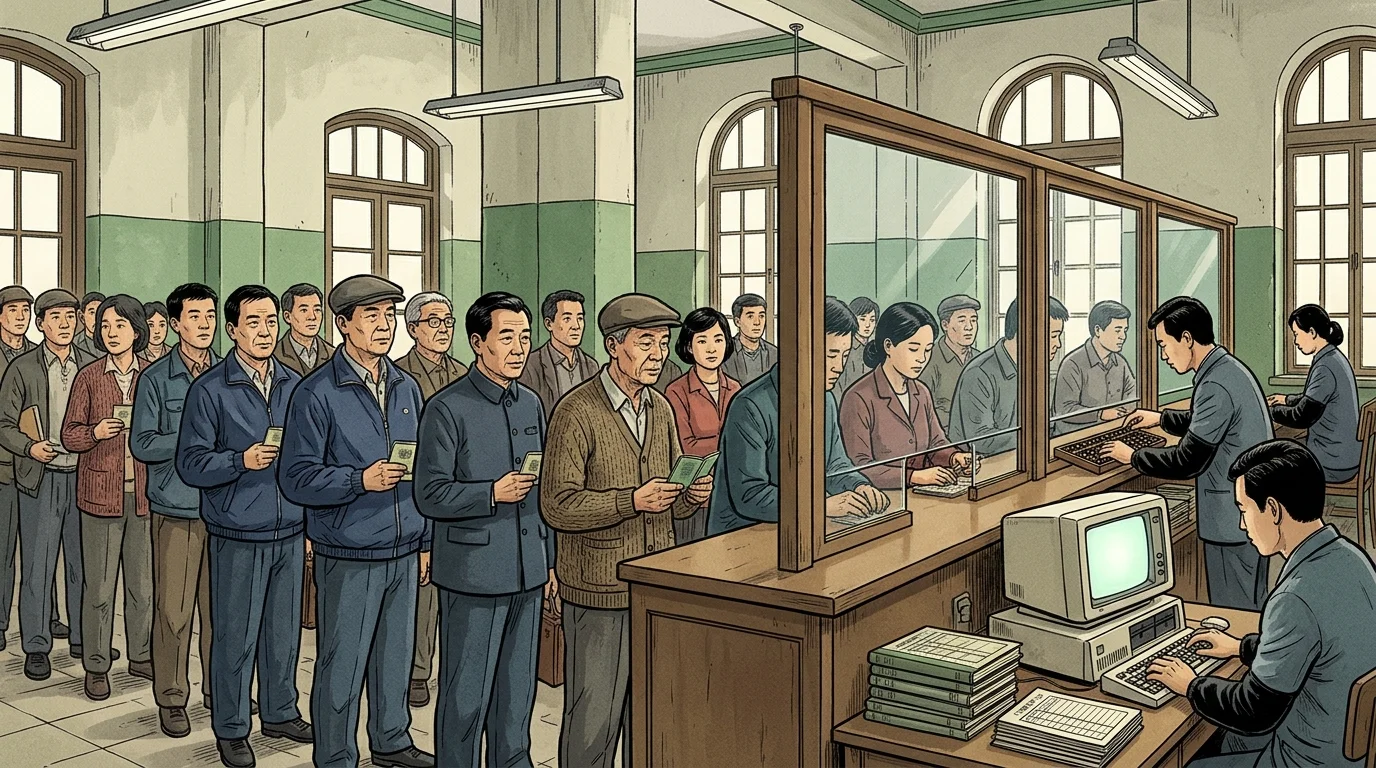
On the morning of January 5, 1950, railway worker Chi Chen-sheng stood at the head of a winter queue outside the People’s Bank of China branch in Kaifeng, Henan Province, waiting to commit his year-end bonus to the newly founded state’s first sovereign debt instrument. The security he purchased—the People’s Victory Parity Bond (Renmin Shengli Zheshi Gongzhai)—was not denominated in nominal paper currency. After twelve years of war and Kuomintang monetary collapse, Chinese urban savers treated paper banknotes with profound distrust. Instead, economic strategist Chen Yun and Finance Minister Bo Yibo anchored the bond to a physical basket of rice, wheat flour, white cotton cloth, and coal. Over the next three decades, the People’s Republic of China swung from this ingenious commodity-indexed stabilization loan to an ideological campaign that eradicated all sovereign borrowing by 1968, before post-Mao fiscal deficits forced Deng Xiaoping’s administration to resurrect national Treasury bonds in January 1981. [1]
The Kuomintang Hyperinflation Legacy and the 1950 Fiscal Deficit
When the Central People’s Government was proclaimed in Beijing on October 1, 1949, it inherited a monetary system shattered by one of the twentieth century’s worst hyperinflations. By August 1948, wholesale prices in Nationalist-held cities stood roughly six million times higher than their pre-war August 1937 levels, and the Kuomintang’s ill-fated Gold Yuan notes had disintegrated into waste paper within months of issue. Although the Communist authorities introduced the new renminbi through the People’s Bank of China, military campaigns to secure the southwest and south of the country—combined with the cost of feeding and paying approximately nine million military and administrative personnel—created an immediate fiscal gap. [2]
In December 1949, Finance Minister Bo Yibo presented the 1950 national budget outline to the Central People’s Government Council. Military expenses accounted for 38.8 percent of total planned expenditure, administrative costs took 21.4 percent, and investments in state-owned enterprises absorbed 23.9 percent. Ordinary revenues—led by agricultural taxes paid in grain (41.4 percent of revenue), urban industrial and commercial taxes (38.9 percent), and state enterprise profits (17.1 percent)—covered only 81.3 percent of planned spending. That left an 18.7 percent budgetary deficit. Determined to avoid financing the entire shortfall through inflationary banknote printing, the government resolved to cover 61.6 percent of the deficit through limited note issuance and 38.4 percent—equivalent to 7.2 percent of total national expenditure—through a domestic public loan. [3]
| Documented Figure / Metric | Historical Significance & Archival Context |
|---|---|
| ¥1.02 billion | After recording a modest budgetary surplus of ¥1.02 billion in 1978, the central budget plunged into a deficit of ¥13.54 billion in 1979 (3.3 percent of GDP) and ¥6.89 billion in 1980 (1.5 percent of GDP). |
| ¥4.87 billion | In that inaugural 1981 issue, the state raised ¥4.87 billion—equivalent to 1.0 percent of China's ¥489.16 billion GDP—helping return the 1981 central budget to a technical surplus of ¥3.74 billion. |
Mechanism of the People’s Victory Parity Unit (Fen)
Approved on December 2, 1949, under the economic direction of Chen Yun, who chaired the Government Administration Council’s Financial and Economic Affairs Committee, the 1950 People’s Victory Parity Bonds were designed to absorb excess urban liquidity while guaranteeing bondholders against currency depreciation. Both the purchase price and all subsequent principal and interest payments were calculated in a commodity accounting unit called the parity unit, or fen (literally “share” or “unit in kind”). [4]
Each single parity unit was legally defined as the combined wholesale market value of four daily necessities across six major commercial hubs—Shanghai, Tianjin, Hankou, Xi’an, Guangzhou, and Chongqing:
- Grain: 6 catties (3 kilograms) of rice—or millet in Tianjin—weighted by regional wholesale prices.
- Wheat Flour: 1.5 catties (0.75 kilograms) of standard wheat flour.
- Cotton Textile: 4 Chinese feet (approximately 1.33 meters) of fine white cotton cloth.
- Fuel: 16 catties (8 kilograms) of coal.
The People’s Bank of China computed and published the official renminbi wholesale value of the fen every ten days. The bonds carried an annual interest rate of 5 percent, also calculated in parity units, and were scheduled for redemption in five annual installments between 1951 and 1955. The state authorized a total issuance of 200 million units in 1950, launching the first tranche of 100 million units on January 5, 1950. While officially described as voluntary, subscriptions were organized through municipal quotas targeting private industrialists, merchants, and wealthy urban residents. In Shanghai alone, textile magnates at the Wing On Cotton Mill subscribed to 100,000 units on the opening day, while other major mills pledged between 45,000 and 50,000 units apiece. [5]
Paired with Chen Yun’s centralized state trading interventions in grain and cotton markets and the March 1950 unification of national fiscal revenues and expenditures, the parity bonds rapidly drained speculative cash from commercial centers. Wholesale prices stabilized across China by the spring of 1950, making the second 100-million-unit tranche unnecessary after roughly 140 million units had been subscribed. [6]
From National Economic Construction Bonds to “Neither Internal Nor External Debt”
Once price stability was secured, China transitioned from crisis stabilization to Soviet-style five-year industrial planning. Between 1950 and 1955, Beijing contracted medium-term ruble credits from the Soviet Union to finance military supplies during the Korean War and industrial equipment for flagship First Five-Year Plan projects. Domestically, between 1954 and 1958, the Ministry of Finance floated five annual issues of National Economic Construction Bonds (Guojia Jingji Jianshe Gongzhai), denominated in the newly revalued renminbi rather than commodity units, to mobilize household wages and private-sector savings for heavy industry. [7]
Meanwhile, the socialist transformation of private industry fundamentally altered the Chinese fiscal base. Under the system of “unitary remittance and unitary expenditure” (tongshou tongzhi), state-owned enterprises remitted nearly all of their accounting profits and depreciation allowances directly to the central treasury, while receiving their investment capital through non-repayable budgetary grants. By 1953, state revenue had climbed past 30 percent of gross domestic product, up from 16 percent in 1950. Because the state set high administrative prices for industrial manufactures alongside low procurement prices for agricultural goods—the “price scissors”—state enterprise profit remittances and industrial taxes generated sufficient revenue to fund capital construction without bond sales. [8]
Following the suspension of national bond issuances after 1958 and the eruption of the Sino-Soviet split in 1960, Mao Zedong’s leadership elevated debt eradication into a point of socialist pride. China accelerated repayments on its Soviet loans, clearing all external obligations to Moscow ahead of schedule in 1965. Three years later, in 1968, the treasury completed the final principal and interest redemptions on the 1950s National Economic Construction Bonds. For the next thirteen years (1968–1980), official state proclamations celebrated China as a rare sovereign power possessing “neither internal nor external debt” (ji wu neizhai, you wu waizhai).
The 1979–1980 Fiscal Crunch and the Breakdown of Unitary Finance
Beneath the rhetoric of debt-free self-reliance, the Maoist fiscal model suppressed household consumption and starved infrastructure of long-term capital. When Deng Xiaoping and Chen Yun initiated “Reform and Opening-Up” at the end of 1978, the state deliberately loosened its extraction of rural and urban surpluses. The government raised agricultural procurement prices to boost peasant incomes, granted wage hikes and bonuses to urban workers, and allowed state-owned enterprises to retain a share of their profits rather than remitting everything to Beijing.
These reforms, combined with elevated capital construction spending and the military costs of the 1979 border war with Vietnam, immediately fractured the balanced budget. After recording a modest budgetary surplus of ¥1.02 billion in 1978, the central budget plunged into a deficit of ¥13.54 billion in 1979 (3.3 percent of GDP) and ¥6.89 billion in 1980 (1.5 percent of GDP). Initial attempts to cover these shortfalls through overdrafts from the People’s Bank of China fueled a sharp uptick in retail inflation by 1980, alarming Chen Yun and the veterans of the 1950 stabilization campaign.
Deng Xiaoping’s 1981 Return to Treasury Bonds (Guokuquan)
To close the fiscal gap without printing currency, the State Council broke the twenty-two-year ideological taboo against domestic sovereign borrowing. In January 1981, the government promulgated the Regulations on the Treasury Bonds of the People’s Republic of China, authorizing the Ministry of Finance to issue National Treasury Bonds (Guokuquan). In that inaugural 1981 issue, the state raised ¥4.87 billion—equivalent to 1.0 percent of China’s ¥489.16 billion GDP—helping return the 1981 central budget to a technical surplus of ¥3.74 billion.
Because China lacked a secondary securities market in 1981, the early Guokuquan issues relied on administrative apportionment modeled on the 1950s campaigns. Quotas were assigned downward through provincial governments, state-owned enterprises, and urban work units (danwei), which deducted bond subscriptions directly from workers’ wages and enterprise funds. Physical paper certificates could not be freely traded or discounted, leading to widespread black-market discounting at steep losses until the Ministry of Finance launched a pilot physical bond counter market across 61 cities in 1988 and centralized electronic custody on the newly established Shanghai Stock Exchange in December 1990–1991.
By 1993–1994, when Beijing legally barred the Ministry of Finance from taking overdrafts at the People’s Bank of China, domestic debt outstanding had risen from ¥4.87 billion in 1981 to ¥128.27 billion. The trajectory from the 1950 commodity parity unit to the 1981 Guokuquan illustrated a permanent lesson of modern Chinese public finance: while administrative command could briefly eliminate formal government bonds by confiscating enterprise surpluses, market-oriented growth required a liquid sovereign debt market to price capital and manage macroeconomic stability.
Theoretical & Balance-Sheet Transmission Mechanism
In the Kindleberger–Minsky taxonomy of financial instability (Kindleberger, 1978; Minsky, 1986) and Irving Fisher’s (1933) debt-deflation framework, speculative asset booms become systemic crises when credit expansion shifts balance sheets from hedge finance (cash flows covering principal and interest) to speculative and Ponzi finance (relying on rising asset prices and short-term margin roll-overs).
Once monetary tightening or an exogenous shock halts price appreciation, forced margin liquidations trigger Fisherian debt-deflation: fire-sale asset discounts erode bank collateral values, contracting credit supply across the real economy.
Sources and Further Reading
- Yang P’ei-hsin, “China Tackles Her Financial Problems,” People’s China, Vol. 1, No. 3, February 1, 1950. Historical & Financial Reference
- Central People’s Government of the PRC, “Article 40: Public Finance — The Common Program of the People’s Republic of China (1949–1954),” Common Program Historical Archive, 1949. Historical & Financial Reference
- Chen Hsing, “The Home Market Is Doing Well,” People’s China, No. 2, January 16, 1956. Historical & Financial Reference
- Shuanglin Lin, “China’s Fiscal Policy and Fiscal Sustainability,” Economic Research Institute for ASEAN and East Asia (ERIA) Research Project Report, No. 2010-01, March 2011. Historical & Financial Reference
- Marlene Amstad and Zhiguo He, “Chinese Bond Market and Interbank Market,” National Bureau of Economic Research (NBER) Working Paper, No. 25549, February 2019. Peer-Reviewed / Academic Research
- William P. Alford and Shen Yuanyuan, “Emerging Securities Markets in China: Capitalism with Chinese Characteristics,” The China Quarterly (Cambridge University Press), Vol. 140, December 1994. Peer-Reviewed / Academic Research
- Irving Fisher — "The Debt-Deflation Theory of Great Depressions," Econometrica 1, no. 4 (FRASER Federal Reserve Archive, 1933): 337–357 Central Bank / Monetary Authority
- Charles P. Kindleberger & Robert Z. Aliber — Manias, Panics, and Crashes: A History of Financial Crises (Palgrave Macmillan) Peer-Reviewed / Academic Research
Cite This Historical Dossier (APA / Chicago)
APA (7th ed.): Ç., S. (Ed.). (2026). From Commodity Parity Units to Zero Debt: China's Sovereign Bond Experiment (1950–1981). In Forgotten Fortunes Historical Monograph Series (Forgotten Fortunes Editorial Desk). https://forgottenfortunes.net/china-1950-parity-bonds/
MLA (9th ed.): Ç., Soner, ed. "From Commodity Parity Units to Zero Debt: China's Sovereign Bond Experiment (1950–1981)." Forgotten Fortunes: Financial & Monetary History Archive, 2026, https://forgottenfortunes.net/china-1950-parity-bonds/.
Chicago (17th ed.): Ç., Soner, ed. "From Commodity Parity Units to Zero Debt: China's Sovereign Bond Experiment (1950–1981)." Forgotten Fortunes Historical Monograph Series (Forgotten Fortunes Editorial Desk), September 13, 2026. https://forgottenfortunes.net/china-1950-parity-bonds/.
Have an idea for another financial history documentary or article? Request a story →