In This Article
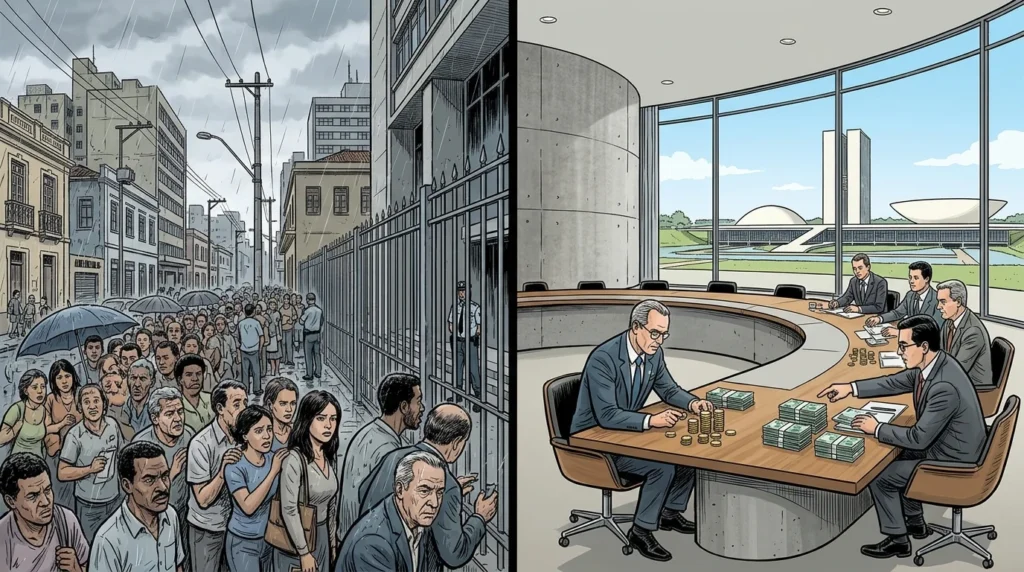
Between March 1990 and July 1994, Brazil executed two of the most diametrically opposed monetary stabilization experiments in modern financial history. On March 16, 1990—just twenty-four hours after taking office—President Fernando Collor de Mello and Economy Minister Zélia Cardoso de Mello stunned the nation with Provisional Measure No. 168, the centerpiece of the Plano Collor I. In an unprecedented peacetime intervention in private property rights, the decree froze roughly 80 percent of Brazil’s entire broad money supply, blocking all bank deposits, savings accounts, and overnight money-market balances above 50,000 cruzados novos (equivalent to approximately US$1,200 at the official exchange rate) for eighteen months. Yet this draconian liquidity confiscation shattered contract credibility without curing the structural mechanics of inertial inflation, which surged back to 2,477 percent for the calendar year 1993. Four years later, under President Itamar Franco and Finance Minister Fernando Henrique Cardoso, a team of economists—including Pérsio Arida, André Lara Resende, Edmar Bacha, and Gustavo Franco—achieved lasting stabilization through the exact opposite philosophy: a transparent, voluntary, three-stage monetary reform centered on the March 1, 1994 introduction of a virtual unit of account, the Unidade Real de Valor (URV), before launching the Real (BRL) on July 1, 1994 at 2,750 cruzeiros reais. [1]
The Overnight Money Market and the March 1990 Hyperinflationary Brink
By early 1990, Brazil’s economy was trapped in the terminal stages of chronic indexed inflation after the collapse of four successive heterodox price-freeze packages during the late 1980s: the Plano Cruzado (1986), the Plano Bresser (1987), and the Plano Verão (1989). Monthly inflation reached 81 percent in March 1990, equivalent to an annualized rate exceeding 4,800 percent. Over decades of high inflation, Brazilian households, corporations, and commercial banks had developed an elaborate financial defense mechanism known as the overnight market—a system of daily-repurchase agreements backed by short-term federal Treasury bills (Letras Financeiras do Tesouro, or LFTs). [2]
Under this regime, the domestic currency—then the cruzado novo (NCz$), introduced in January 1989—ceased to function as a store of value. Paychecks, retail revenues, and corporate working capital were swept every afternoon into interest-bearing overnight accounts that credited daily monetary correction linked to the previous day’s inflation index. While this indexed liquidity (“indexed money” or moeda indexada) shielded middle- and upper-income depositors from currency depreciation, it rendered conventional monetary policy impotent. Because the public debt was rolled over every twenty-four hours at indexed interest rates, raising real interest rates immediately expanded the nominal fiscal deficit and accelerated money creation, while any threat of a default on federal bills risked triggering an instant hyperinflationary flight into physical goods and foreign currency. [3]
| Documented Figure / Metric | Historical Significance & Archival Context |
|---|---|
| 47 percent | Over four months—from March through June 1994—Brazilian consumers and firms grew accustomed to stable prices expressed in URVs even as inflation measured in cruzeiros reais soared to 47 percent in the month of June 1994 alone (nearly 5,000 percent on a twelve-month trailing basis). |
| 2,750 cruzeiros | On June 30, 1994, the daily quotation of the URV reached exactly 2,750 cruzeiros reais. |
| US$40 billion | Backed by US$40 billion in international reserves at the Central Bank, tight monetary base targets, and an asymmetric exchange-rate band that initially allowed the new currency to appreciate to roughly R$ 0.84 per US dollar, the conversion extinguished inertial inflation overnight. |
March 16, 1990: Provisional Measure No. 168 and the Confisco
Inaugurated on March 15, 1990 as Brazil’s first directly elected president in twenty-nine years, Fernando Collor de Mello had campaigned on a vow to slay inflation with a “single gunshot.” Following a three-day bank holiday, Economy Minister Zélia Cardoso de Mello and Central Bank President Ibrahim Eris unveiled the Plano Brasil Novo (popularly known as Plano Collor I) on March 16, 1990. Its monetary cornerstone, Provisional Measure No. 168 (later enacted as Law No. 8,024 of April 12, 1990), replaced the cruzado novo with the restored cruzeiro (Cr$) at a 1:1 parity—but only for a fraction of existing financial balances. [4]
Under the strict conversion ceiling of Provisional Measure No. 168, individuals and firms were permitted to convert into freely spendable cruzeiros up to NCz$ 50,000 (roughly US$1,200) from checking accounts and savings passbooks (cadernetas de poupança), and up to NCz$ 25,000 or 20 percent of the balance (whichever was greater) from overnight money-market funds and short-term fixed-income instruments. Every single cruzado novo above those thresholds remained denominated in the old, non-circulating currency and was compulsorily impounded at the Central Bank of Brazil (Banco Central do Brasil). The frozen balances—totaling approximately US$80 billion to US$85 billion across millions of accounts, or roughly 30 percent of Brazilian gross domestic product and 80 percent of liquid financial assets (M4)—were scheduled to be returned in twelve equal monthly installments in cruzeiros only after an eighteen-month grace period beginning in September 1991, accruing monetary correction plus 6 percent annual interest. [5]
The immediate macroeconomic shock was severe. Deprived of working capital to meet payrolls or pay suppliers, industrial output plummeted throughout the second quarter of 1990, and Brazil’s real GDP contracted by 4.3 percent for the year. Desperate to restore basic economic circulation, the Ministry of Economy and the Central Bank opened a series of administrative “liquidity faucets” (torneirinhas)—granting exemptions for tax payments, payrolls, charitable institutions, retirees, emergency medical expenses, and municipal obligations. As blocked cruzados novos leaked back into the money supply and the fiscal surplus proved transitory, monthly inflation rebounded to nearly 20 percent by January 1991. A second shock package, Plano Collor II, imposed another temporary price freeze and abolished the overnight retail market in January 1991, but it too unraveled within months. Following corruption scandals that led to Fernando Collor’s impeachment and resignation in late 1992, Brazil’s annual inflation rate climbed to 2,477 percent in 1993. [6]
The Theoretical Breakthrough: Inertial Inflation and the Larida Proposal
When Vice President Itamar Franco assumed the presidency in late 1992 and appointed Senator Fernando Henrique Cardoso as Minister of Finance in May 1993, the incoming economic team—drawn largely from the Department of Economics at the Pontifical Catholic University of Rio de Janeiro (PUC-Rio), including Pérsio Arida, André Lara Resende, Edmar Bacha, Gustavo Franco, and Winston Fritsch—rejected every hallmark of the Collor-era shock therapy. Cardoso and his advisers pledged that there would be no surprise decrees, no bank holidays, no price freezes, no breach of contracts, and no confiscation of savings. [7]
Instead, the economists revived and refined a concept first articulated in 1984 by Pérsio Arida and André Lara Resende in their celebrated “Larida” paper on inertial inflation. In a chronically indexed economy, wages, rents, utility tariffs, and supplier contracts were adjusted for past inflation at staggered intervals. If the government froze prices on any given day, workers and suppliers whose adjustments had occurred months earlier were locked in at depressed real values, while those who had just raised prices enjoyed windfall gains—ensuring immediate supply shortages and distributive conflict as soon as the freeze ended. Arida and Lara Resende reasoned that if all prices and wages could first be converted into a stable, daily-adjusted unit of account pegged to the US dollar, every contract in the economy would become simultaneously synchronized. Once relative prices were aligned in that stable unit, the old inflating currency could simply be retired and replaced by the unit of account itself. [8]
Phase I and Phase II: Fiscal Adjustment and the March 1994 URV
In December 1993, Finance Minister Cardoso publicly announced the three-stage blueprint of the Plano Real. Phase I focused on dismantling the fiscal roots of money creation. Because Brazil’s 1988 Constitution earmarked the vast majority of federal tax revenues to states, municipalities, and rigid statutory expenditures, Edmar Bacha and the Finance Ministry negotiated Congressional approval in February 1994 for the Emergency Social Fund (Fundo Social de Emergência, or FSE), paired with the Programa de Ação Imediata (PAI). The FSE detached 20 percent of federal tax revenues from mandatory constitutional earmarks for the 1994–1995 fiscal years, enabling the Treasury to operate without inflationary monetary financing from the Central Bank.
Phase II commenced on March 1, 1994 (under Provisional Measure No. 434 of February 27, 1994) with the creation of the Unidade Real de Valor (URV). The URV was a purely virtual currency—an accounting unit that existed on price tags, pay stubs, and contracts, while physical cash transactions continued to be settled in the existing legal tender, the cruzeiro real (CR$, which had replaced the cruzeiro in August 1993 by lopping off three zeros). Every evening, the Central Bank calculated the exchange value of one URV in cruzeiros reais based on the average of three major national price indices (the IPCA-E, the IGP-M, and the IPC-FIPE) and kept the URV anchored at an approximate 1:1 parity with the US dollar. On March 1, 1994, 1 URV equaled CR$ 647.50.
All wages, minimum salaries, social security benefits, and public-service tariffs were immediately converted into URVs at their average real purchasing power of the preceding four months, guaranteeing workers that their pay in URVs would automatically translate into more cruzeiros reais each month as the old currency depreciated. Private businesses were encouraged to denominate supplier contracts and retail prices in URVs. Over four months—from March through June 1994—Brazilian consumers and firms grew accustomed to stable prices expressed in URVs even as inflation measured in cruzeiros reais soared to 47 percent in the month of June 1994 alone (nearly 5,000 percent on a twelve-month trailing basis).
July 1, 1994: The Birth of the Real and the End of Hyperinflation
With wages, rents, industrial contracts, and retail prices now fully synchronized in URVs, the government executed Phase III on July 1, 1994 (pursuant to Provisional Measure No. 542 of June 30, 1994). On June 30, 1994, the daily quotation of the URV reached exactly 2,750 cruzeiros reais. At midnight on July 1, the cruzeiro real was demonetized and the URV ceased to be merely an accounting index, becoming a physical currency and sole legal tender: the Real (R$, ISO code BRL), converted at the exact closing rate of CR$ 2,750 per R$ 1.00.
Backed by US$40 billion in international reserves at the Central Bank, tight monetary base targets, and an asymmetric exchange-rate band that initially allowed the new currency to appreciate to roughly R$ 0.84 per US dollar, the conversion extinguished inertial inflation overnight. Monthly inflation collapsed from 46.6 percent in June 1994 to 6.1 percent in July and 1.5 percent by September 1994. Where the 1990 Plano Collor had attempted to crush hyperinflation by confiscating private savings and paralyzing the banking system, the 1994 URV and Plano Real succeeded by restoring monetary credibility, preserving property rights, and coordinating relative prices across an entire continental economy.
Theoretical & Balance-Sheet Transmission Mechanism
In the Kindleberger–Minsky taxonomy of financial instability (Kindleberger, 1978; Minsky, 1986) and Irving Fisher’s (1933) debt-deflation framework, speculative asset booms become systemic crises when credit expansion shifts balance sheets from hedge finance (cash flows covering principal and interest) to speculative and Ponzi finance (relying on rising asset prices and short-term margin roll-overs).
Once monetary tightening or an exogenous shock halts price appreciation, forced margin liquidations trigger Fisherian debt-deflation: fire-sale asset discounts erode bank collateral values, contracting credit supply across the real economy.
Sources and Further Reading
- Brazilian Journal of Political Economy, “ Documento: Plano Collor (Medida Provisória n. 168),” Revista de Economia Política, 1990. Peer-Reviewed / Academic Research
- Luiz Carlos Bresser-Pereira, “ A economia e a política do Plano Real,” Revista de Economia Política, 1994. Historical & Financial Reference
- Banco Central do Brasil, “ O Plano Real: História do Controle da Inflação,” Banco Central do Brasil, 2020. Official / State Archive
- Renato Villela and Paulo Mansur Levy, “ O Plano Real e a consolidação da estabilidade,” Instituto de Pesquisa Econômica Aplicada (IPEA), 1994. Official / State Archive
- Fundação FHC, “ Um Plano Real: Cronologia (1989–1994),” Fundação Fernando Henrique Cardoso, 2019. Historical & Financial Reference
- Brasilio Sallum Jr., “ Políticas Públicas e Estado: o Plano Real,” Lua Nova: Revista de Cultura e Política, 2009. Historical & Financial Reference
- Irving Fisher — "The Debt-Deflation Theory of Great Depressions," Econometrica 1, no. 4 (FRASER Federal Reserve Archive, 1933): 337–357 Central Bank / Monetary Authority
- Charles P. Kindleberger & Robert Z. Aliber — Manias, Panics, and Crashes: A History of Financial Crises (Palgrave Macmillan) Peer-Reviewed / Academic Research
Cite This Historical Dossier (APA / Chicago)
APA (7th ed.): Ç., S. (Ed.). (2026). Brazil’s Frozen Bank Deposits and the Birth of the Real. In Forgotten Fortunes Historical Monograph Series (Forgotten Fortunes Editorial Desk). https://forgottenfortunes.net/brazil-plano-collor-plano-real/
MLA (9th ed.): Ç., Soner, ed. "Brazil’s Frozen Bank Deposits and the Birth of the Real." Forgotten Fortunes: Financial & Monetary History Archive, 2026, https://forgottenfortunes.net/brazil-plano-collor-plano-real/.
Chicago (17th ed.): Ç., Soner, ed. "Brazil’s Frozen Bank Deposits and the Birth of the Real." Forgotten Fortunes Historical Monograph Series (Forgotten Fortunes Editorial Desk), September 17, 2026. https://forgottenfortunes.net/brazil-plano-collor-plano-real/.
Have an idea for another financial history documentary or article? Request a story →