In This Article
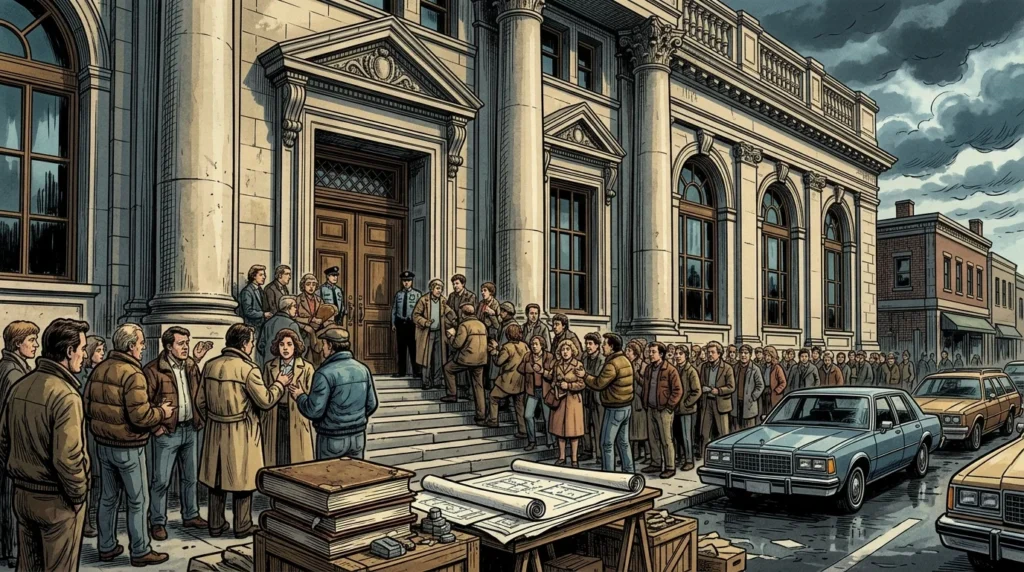
In May 1984, Continental Illinois National Bank and Trust Company—the seventh-largest commercial bank in the United States, holding roughly $40 billion in assets—suffered a high-speed electronic bank run that drained approximately 30 percent of its funding in ten days [1][3]. Barred by Illinois unit-banking statutes from operating a retail branch network, the Chicago lender had financed an aggressive late-1970s expansion into corporate and energy loans by borrowing heavily in the uninsured wholesale and Eurodollar markets, leaving 85 percent of its deposits uninsured [1][3]. When loan losses from the 1982 failure of Oklahoma’s Penn Square Bank and Latin American sovereign debt eroded market confidence, overseas and institutional creditors pulled billions of dollars via wire transfer [1][3]. Fearing that a disorderly collapse would topple scores of correspondent banks and trigger runs on other money-center institutions, the Federal Reserve and the Federal Deposit Insurance Corporation (FDIC) mounted an unprecedented rescue—guaranteeing all uninsured depositors and creditors, injecting $2 billion in interim capital, and ultimately taking an 80 percent government ownership stake that popularized the phrase “too big to fail” [1][2][3].

Unit-Banking Constraints and the Essentiality Doctrine (1933–1980)
Continental Illinois’s structural vulnerability to a wholesale run was rooted in Illinois banking law and the long history of federal intervention in the Midwest [1][3]. During the Great Depression in 1933, Continental had received a direct public capital injection from the federal Reconstruction Finance Corporation (RFC), after authorities concluded that its collapse would devastate agricultural communities, businesses, and smaller correspondent banks across the region [1].
For the next half-century, Illinois remained a strict unit-banking state, prohibiting commercial banks from operating domestic branch networks and limiting a bank to its main headquarters building plus two nearby facilities within 1,500 feet and 3,500 yards [1][3]. Because Continental could not open suburban or statewide branches to gather stable, federally insured retail deposits from household savers, the bank funded its balance sheet through wholesale money markets—issuing large negotiable certificates of deposit, borrowing overnight federal funds, and tapping offshore Eurodollar deposits from European and Japanese institutional investors [1][3].
Concurrently, federal bank resolution policy evolved under the Federal Deposit Insurance Act of 1950 and its 1951 amendment, which created the “essentiality doctrine” [2]. Under the statute, the FDIC was required to resolve a failing bank through a deposit payoff or a less-costly assisted merger unless the FDIC board determined that the bank’s continued operation was “essential to provide adequate banking service in the community” [2][3]. Between 1970 and 1984, the FDIC resolved roughly 72 percent of commercial bank failures through assisted acquisitions [2]. When a failing bank was large and state anti-branching or interstate banking laws prevented a healthy rival from acquiring it, however, regulators stretched the word “community” to cover entire metropolitan or national markets—invoking the essentiality doctrine to bail out Detroit’s $1.2 billion Bank of the Commonwealth in 1972 and Philadelphia’s $9 billion First Pennsylvania Bank in 1980 [2][3].
| Documented Figure / Metric | Historical Significance & Archival Context |
|---|---|
| $1 billion | By 1981, Continental had purchased more than $1 billion in oil and gas loan participations originated by Penn Square Bank, a rapidly growing Oklahoma City lender notorious for lax underwriting. |
| $484 million | On July 5, 1982, Penn Square Bank failed with $484 million in on-balance-sheet assets. |
| 15 percent | In the spring of 1984, only 15 percent of Continental's deposits were covered by the $100,000 federal insurance limit; the remaining 85 percent consisted of large uninsured wholesale certificates, Eurodollars, and correspondent balances. |
| $10 billion | Over ten trading days, the high-speed electronic run drained roughly 30 percent of Continental's funding (over $10 billion). |
The Energy Lending Drive and the Penn Square Shock (1976–1983)
In the mid-1970s, Continental Illinois embarked on a strategy to become the premier commercial and industrial lender in the United States [1][3]. Between 1977 and 1981, Continental’s loans-to-assets ratio climbed from 57.9 percent to 68.8 percent—the highest among the ten largest U.S. banks—while its average return on equity reached 14.35 percent, second only to Morgan Guaranty [3]. Financial magazines praised Continental’s management, even as competitors noted that the bank was winning corporate market share through below-market pricing and aggressive risk-taking in the booming oil and gas sector [1][3].
That growth concealed severe internal control failures. By 1981, Continental had purchased more than $1 billion in oil and gas loan participations originated by Penn Square Bank, a rapidly growing Oklahoma City lender notorious for lax underwriting [1][3][5]. An internal memo written by an employee in Continental’s oil and gas division warned that credit problems in the Penn Square portfolio were going unnoticed and urged immediate corrective action, but senior management and federal examiners from the Office of the Comptroller of the Currency (OCC) failed to halt the purchases [1][3].
On July 5, 1982, Penn Square Bank failed with $484 million in on-balance-sheet assets [2][3]. Because widespread fraud, chaotic recordkeeping, and extensive off-balance-sheet loan sales made it impossible for the FDIC to estimate contingent liabilities for an assisted merger, regulators closed Penn Square through a direct deposit payoff—forcing uninsured depositors to take immediate losses and making Penn Square the largest bank payoff of the 1970–1984 era [2][3]. For Continental Illinois, Penn Square’s collapse was catastrophic: hundreds of millions of dollars in energy participations turned nonperforming alongside troubled corporate loans to borrowers such as Nucorp Energy and International Harvester [3]. By the first quarter of 1984, Continental’s nonperforming loans had risen to a record $2.3 billion, and only the one-time sale of its profitable credit-card division to Chemical Bank for $157 million prevented a quarterly net loss [3].
The May 1984 Electronic Run and Interim Federal Rescue
Because Penn Square had been resolved via a payoff that imposed haircuts on uninsured depositors, institutional money-market investors knew their funds at Continental were at risk if the bank failed [3][4]. In the spring of 1984, only 15 percent of Continental’s deposits were covered by the $100,000 federal insurance limit; the remaining 85 percent consisted of large uninsured wholesale certificates, Eurodollars, and correspondent balances [1].
Around May 7, 1984, rumors swept Tokyo, London, and New York financial desks that Continental was sliding toward bankruptcy or a forced takeover [1][3]. On May 9, Reuters queried the bank about bankruptcy rumors, and institutional investors—including overseas Eurodollar depositors and the Chicago Board of Trade Clearing Corporation—began wiring funds out of the bank [3]. In an extraordinary departure from standard policy on May 10, the OCC issued a public statement denying rumors that it was seeking a rescue for Continental, but the statement failed to stem the outflow [3].
Over ten trading days, the high-speed electronic run drained roughly 30 percent of Continental’s funding (over $10 billion) [1][3]. By Friday, May 11, Continental was forced to borrow $3.6 billion at the Federal Reserve Bank of Chicago’s discount window to stay liquid, and a $4.5 billion private credit line arranged over the weekend with 16 major banks quickly proved inadequate as domestic correspondent banks joined the run [2][3].
Confronted with the imminent collapse of the nation’s seventh-largest bank—which held correspondent accounts for more than 2,000 smaller institutions, including 179 banks with at least 50 percent of their equity capital exposed to Continental—the FDIC, the Federal Reserve, and the OCC announced a joint interim rescue package on May 17, 1984 [1][2][3]:
- Full Creditor Guarantee: Invoking the essentiality doctrine, the FDIC took the unprecedented step of publicly guaranteeing that all depositors and general creditors of Continental would be protected in full, regardless of the $100,000 statutory insurance limit [2][3].
- $2 Billion Capital Infusion: The FDIC and a consortium of commercial banks injected $2 billion in subordinated notes ($1.5 billion from the FDIC and $500 million participated to private banks) at 100 basis points over one-year Treasury bill rates [2][3].
- Federal Reserve and Private Liquidity Lines: The Federal Reserve pledged to meet any extraordinary liquidity needs at the discount window, while a syndicate of 24 major U.S. commercial banks provided a $5.3 billion to $5.5 billion short-term funding facility [1][2][3].
Permanent Nationalization, Congressional Fallout, and FDICIA (1984–1994)
The May 17 interim package slowed the panic, but wholesale funding withdrawals resumed during the summer of 1984 as regulators spent two months searching in vain for a healthy domestic or foreign bank willing to acquire Continental [1][3]. Even after the Illinois legislature passed emergency legislation permitting an out-of-state acquisition, major money-center banks balked at assuming Continental’s unquantified energy loan losses [3][4].
On July 26, 1984, federal regulators announced a permanent resolution plan that effectively nationalized the bank [1][3]. Under the permanent package, the FDIC purchased $4.5 billion in troubled loans from Continental (triggering a $1 billion charge-off), injected $1 billion in fresh equity by acquiring preferred stock in the parent holding company, Continental Illinois Corporation, and assumed responsibility for Continental’s multi-billion-dollar debt to the Federal Reserve Bank of Chicago [1][3]. In exchange, the FDIC took an 80 percent equity ownership stake in the holding company, wiped out most of the existing shareholders’ value, and fired Continental’s top executives and board of directors [1][3]. The FDIC ultimately estimated its net loss on the Continental resolution at approximately $1.1 billion—roughly 3 percent of the bank’s assets—before the clean, restructured bank was sold to BankAmerica Corporation in 1994 [1][3].
In September 1984, the House Banking Subcommittee on Financial Institutions Supervision, Regulation and Insurance convened hearings to examine why regulators had protected uninsured wholesale creditors at Continental just months after imposing losses on uninsured depositors at Penn Square and smaller failed banks [3][5]. When Comptroller of the Currency C. Todd Conover acknowledged under questioning that federal authorities could not permit any of the nation’s 11 largest money-center banks to fail in a deposit payoff, Representative Stewart B. McKinney remarked that regulators had created a new category of institution—”too big to fail” [3][5]. The backlash against the Continental rescue drove Congress to enact the Federal Deposit Insurance Corporation Improvement Act of 1991 (FDICIA), which repealed the open-ended essentiality doctrine, mandated “least-cost” resolutions that imposed losses on uninsured creditors, and restricted future open-bank bailouts to formal systemic-risk determinations approved by the Federal Reserve, the FDIC, and the Treasury Secretary [2][3].
Theoretical & Balance-Sheet Transmission Mechanism
In the Kindleberger–Minsky taxonomy of financial instability (Kindleberger, 1978; Minsky, 1986) and Irving Fisher’s (1933) debt-deflation framework, speculative asset booms become systemic crises when credit expansion shifts balance sheets from hedge finance (cash flows covering principal and interest) to speculative and Ponzi finance (relying on rising asset prices and short-term margin roll-overs).
Once monetary tightening or an exogenous shock halts price appreciation, forced margin liquidations trigger Fisherian debt-deflation: fire-sale asset discounts erode bank collateral values, contracting credit supply across the real economy.
Sources and Further Reading
- Jonathan Rose, “ Continental Illinois: A Bank That Was Too Big to Fail,” Federal Reserve History, 2023-05-15. Central Bank / Monetary Authority
- George C. Nurisso and Edward S. Prescott, “ The 1970s Origins of Too Big to Fail,” Economic Commentary (Federal Reserve Bank of Cleveland), No. 2017-17, 2017-10-18. Central Bank / Monetary Authority
- Federal Deposit Insurance Corporation, “ Continental Illinois and ‘Too Big to Fail’ (Chapter 7),” History of the Eighties: Lessons for the Future, Vol. 1, 1997. Official / State Archive
- Herbert L. Baer and Christine A. Pavel, “ Does Regulation Drive Innovation?,” Economic Perspectives (Federal Reserve Bank of Chicago), Vol. 10, Iss. 5, 1986. Central Bank / Monetary Authority
- U.S. House Committee on Banking, Finance and Urban Affairs, “ The Financial Performance of Continental Illinois National Bank: A Chronology and Peer Group Evaluation (Staff Report),” 98th Congress, 2nd Session (FRASER), 1984-09-17. Historical & Financial Reference
- Irving Fisher — "The Debt-Deflation Theory of Great Depressions," Econometrica 1, no. 4 (FRASER Federal Reserve Archive, 1933): 337–357 Central Bank / Monetary Authority
- Charles P. Kindleberger & Robert Z. Aliber — Manias, Panics, and Crashes: A History of Financial Crises (Palgrave Macmillan) Peer-Reviewed / Academic Research
Cite This Historical Dossier (APA / Chicago)
APA (7th ed.): Ç., S. (Ed.). (2026). Continental Illinois (1984) and the Origins of Too-Big-to-Fail Banking. In Forgotten Fortunes Historical Monograph Series (Forgotten Fortunes Editorial Desk). https://forgottenfortunes.net/continental-illinois-too-big-to-fail/
MLA (9th ed.): Ç., Soner, ed. "Continental Illinois (1984) and the Origins of Too-Big-to-Fail Banking." Forgotten Fortunes: Financial & Monetary History Archive, 2026, https://forgottenfortunes.net/continental-illinois-too-big-to-fail/.
Chicago (17th ed.): Ç., Soner, ed. "Continental Illinois (1984) and the Origins of Too-Big-to-Fail Banking." Forgotten Fortunes Historical Monograph Series (Forgotten Fortunes Editorial Desk), August 27, 2026. https://forgottenfortunes.net/continental-illinois-too-big-to-fail/.
Have an idea for another financial history documentary or article? Request a story →