In diesem Artikel
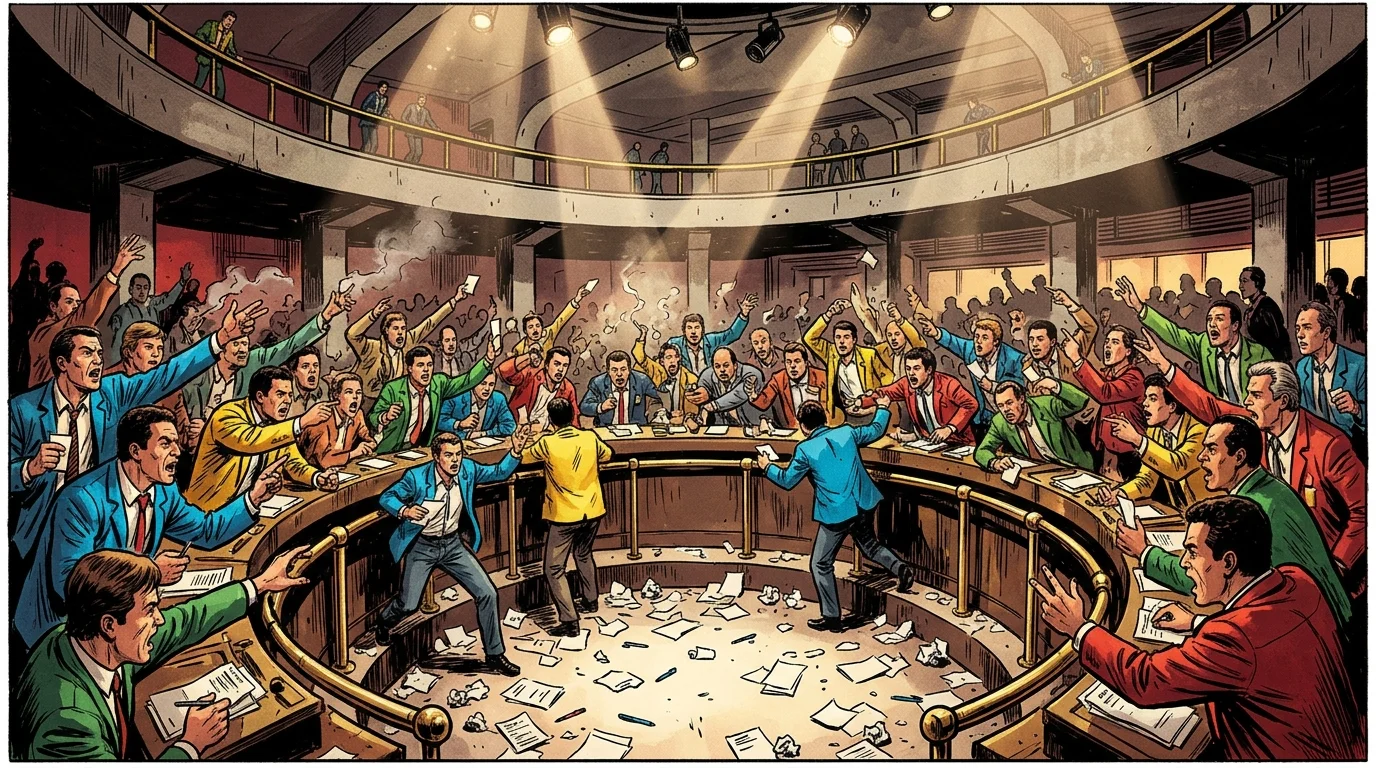
For more than a century after its founding in 1845 under the Brazilian Empire, the Rio de Janeiro Stock Exchange (Bolsa de Valores do Rio de Janeiro, or BVRJ) stood as the undisputed financial heart of Brazil, overshadowing the younger Sao Paulo Stock Exchange (Bolsa de Valores de Sao Paulo, or Bovespa, founded in 1890). Between 1970 and 1989, however, two extraordinary speculative bubbles and settlement crises shattered retail investor trust and permanently crippled the Rio exchange, transferring the center of gravity of Latin American equity trading to Sao Paulo. [1]
The first upheaval—remembered in Brazilian economic history as the Boom de 1971—unfolded at the height of the military regime’s „Brazilian Economic Miracle“ (Milagre Economico). Fueled by mandatory tax-rebate equity mutual funds created under Decree-Law No. 157 of February 10, 1967 (Fundos 157), stock indexes in Rio de Janeiro and Sao Paulo skyrocketed more than fivefold between 1970 and June 1971 before crashing by more than 60 percent. Eighteen years later, amidst the hyperinflation of 1989, Lebanese-born billionaire speculator Naji Robert Nahas used short-term bank credit, forward contracts, and the stock-options market (mercado de opcoes) to corner massive positions in state-owned giants Petrobras and Vale do Rio Doce, as well as tin miner Paranapanema. When Bovespa President Eduardo da Rocha Azevedo and major commercial banks abruptly cut off his rollover financing in early June 1989, Nahas defaulted on checks worth roughly $31 million (NCz$ 39 million) on June 9, 1989—triggering a systemic brokerage collapse from which the historic Rio de Janeiro Stock Exchange never recovered. [2]
Decree-Law 157 and the Anatomy of the 1970–1971 „Milagre“ Bubble
Following the March 1964 military coup, Economic Planning Minister Roberto Campos and Finance Minister Otavio Gouveia de Bulhoes enacted the Government Economic Action Program (PAEG), establishing the National Monetary Council and the Central Bank of Brazil (Law No. 4,595 of December 1964) and passing the Capital Markets Law (Law No. 4,728 of July 1965). Despite these institutional foundations, Brazilian savers remained deeply averse to equities, preferring real estate or inflation-indexed government treasury bonds (ORTNs). When Finance Minister Antonio Delfim Netto took office in 1967 and launched the high-growth policies of the „Economic Miracle“ (when Brazilian GDP grew by roughly 10 to 11 percent annually between 1968 and 1973), the government decided to force-feed liquidity into the stock exchanges through the tax code. [3]
On February 10, 1967, President Humberto de Alencar Castelo Branco signed Decree-Law No. 157. Under this statute, Brazilian individuals and corporations could deduct a set percentage (initially 10 percent for individuals, later rising to 12 percent and adjusted across income brackets) of the federal income tax (Imposto de Renda) they owed to the Treasury and instead deposit that money—via government-issued tax-incentive certificates (CCAs)—into specialized equity mutual funds known as Fundos Fiscais 157, managed by investment banks and brokerage houses. Taxpayers could not redeem their Fundo 157 quotas for two to four years, meaning millions of middle-class citizens were automatically transformed into captive equity investors at zero out-of-pocket cost. [4]
The structural flaw of Decree-Law 157 quickly became apparent: the tidal wave of compulsory tax-rebate cash pouring into the Rio and Sao Paulo exchanges vastly exceeded the tiny supply of reputable, liquid public companies. Although the statute stipulated that Fundos 157 should channel capital primarily into newly issued shares and debentures to capitalize Brazilian industry, modifications soon allowed fund managers to invest heavily in existing secondary-market shares. As share prices began climbing rapidly in 1969 and 1970, urban Brazilians who had initially entered the market only through their tax returns began pouring their voluntary personal savings—and proceeds from selling cars, apartments, and small businesses—directly into speculative stocks. [5]
| Kennzahl / Betrag | Historische Bedeutung & Dokumentierter Kontext |
|---|---|
| 35 percent | By the end of 1971, the market had fallen roughly 35 percent from its June peak; by 1973, real inflation-adjusted stock values on the BVRJ and Bovespa had collapsed by more than 60 to 70 percent. |
| 300 percent | By May 1989, Nahas's operations accounted for nearly half of the daily trading volume on the Rio de Janeiro Stock Exchange and had driven the BVRJ index up more than 300 percent in the first four months of 1989. |
| $ 39 million | On Friday, June 9, 1989, Selecta's checks—totaling approximately NCz$ 39 million (roughly US$31 million at the official exchange rate, with total cascading brokerage exposures exceeding $100 million to $400 million across the options book)—bounced for insufficient funds. |
The June 1971 Peak and the Multi-Year Market Collapse
Between January 1970 and June 1971, euphoria swept the trading floors of the BVRJ (measured by the IBV index) and Bovespa (measured by the Ibovespa index, created in January 1968). Over an eighteen-month span, the Rio and Sao Paulo benchmark indexes surged more than fivefold in nominal terms—jumping over 100 percent in 1970 and climbing another 150 percent during the first five months of 1971 alone. Daily trading volumes multiplied nearly tenfold, and average price-to-earnings multiples soared above 30 to 40 times trailing earnings, surpassing Wall Street levels. [6]
Because Brazil did not yet possess an independent securities regulator, unscrupulous promoters floated dozens of shell companies and speculative initial public offerings (filhotes) with minimal financial disclosure, while commercial banks lent short-term money against inflated share certificates. By late May and early June 1971, institutional insiders and the state-controlled giant Banco do Brasil realized the bubble had become unsustainable and began selling blocks of shares into retail euphoria, while the government tightened rules requiring a larger share of Fundo 157 inflows to be reserved for genuine primary-market offerings. [7]
The speculative fever broke violently in mid-June 1971. On June 14, 1971, after peaking earlier that month at 5,280 points on the Rio IBV index (and 2,573 points on the Ibovespa), prices plunged in a wave of panic selling. Because thousands of new offerings approved during the boom continued to hit the market throughout late 1971 just as retail demand evaporated, the supply overhang crushed valuations. By the end of 1971, the market had fallen roughly 35 percent from its June peak; by 1973, real inflation-adjusted stock values on the BVRJ and Bovespa had collapsed by more than 60 to 70 percent. An entire generation of Brazilian middle-class investors abandoned the stock market, prompting the federal government in December 1976 to enact Law No. 6,385—creating Brazil’s Securities and Exchange Commission (Comissao de Valores Mobiliarios, or CVM), patterned after the U.S. SEC—and Law No. 6,404, the modern Brazilian Corporation Law (Lei das S.A.). [8]
Naji Robert Nahas and the 1989 Options and D+0 Leverage Machine
After the 1971 crash, Sao Paulo’s Bovespa gradually overtook Rio de Janeiro in spot cash equities, propelled by Sao Paulo’s industrial base. Determined to reclaim market share, the Rio de Janeiro Stock Exchange (BVRJ), led in the late 1980s by President Sergio Barcellos, aggressively promoted forward contracts (mercado a termo), stock-options trading (mercado de opcoes), and permissive same-day financing structures known as operacoes D+0 / D+5.
Under the settlement rules prevailing in 1988–1989, an investor who purchased stocks or options on Day 0 (D+0) only had to deliver good clearing funds five business days later (D+5), while brokerage houses and commercial banks routinely accepted post-dated or same-day checks to finance rollover trades (operacoes Z-Z and box options strategies) amidst Brazil’s raging 1,700 percent annual hyperinflation. No figure exploited this regulatory cleavage between Rio and Sao Paulo more aggressively than Naji Robert Nahas, a Lebanese-born, Cairo-raised financier who had moved to Brazil in the late 1960s and gained international notoriety in 1979–1980 as a partner of Nelson Bunker Hunt and William Herbert Hunt in their ill-fated attempt to corner the world silver market.
Throughout 1988 and the first five months of 1989, operating through his Sao Paulo holding company, Selecta Comércio e Indústria S.A., and a network of proxy brokers in Rio and Sao Paulo—including Capitania DTVM, deeply connected to the family of Central Bank of Brazil President Elmo de Araujo Camoes—Nahas built a colossal, self-reinforcing leverage machine centered on three stocks: preferred shares of state oil monopoly Petrobras (PETR4), state mining giant Companhia Vale do Rio Doce (VALE5), and private tin producer Paranapanema (PMAM4).
Nahas’s mechanism worked as a classic leveraged corner: using short-term overnight bank loans from institutions such as Banco Planibanc, Banespa, and other commercial lenders, Nahas bought massive blocks of call options and underlying shares in Petrobras, Vale, and Paranapanema on both the BVRJ and Bovespa, frequently trading between his own proxy accounts to push the quoted closing prices higher each afternoon. Because the rising stock prices automatically increased the mark-to-market collateral value of his existing portfolio, banks eagerly extended larger credit lines the following morning, enabling Nahas to roll over his five-day settlement obligations without injecting fresh equity. By May 1989, Nahas’s operations accounted for nearly half of the daily trading volume on the Rio de Janeiro Stock Exchange and had driven the BVRJ index up more than 300 percent in the first four months of 1989.
The June 9, 1989 Bounced Check and the Death of the Rio Exchange
In Sao Paulo, Bovespa President Eduardo da Rocha Azevedo watched Nahas’s ballooning concentration with alarm. Convinced that Nahas was running a leveraged pyramid that could bankrupt the clearing system if any single bank pulled its credit line, Rocha Azevedo persuaded Bovespa’s board in May 1989 to tighten margin requirements, restrict same-day synthetic financing trades, and cap single-investor concentration in the options market. Furious at Sao Paulo’s restrictions, Nahas publicly announced in late May 1989 that he was shifting virtually all of his trading volume from Bovespa to the welcoming floor of the Rio de Janeiro Stock Exchange.
The climax arrived in the first week of June 1989. Following regulatory warnings and direct discussions between Rocha Azevedo and major Sao Paulo banking executives, Banco Planibanc and several other creditor banks abruptly refused on June 8, 1989 to roll over the daily short-term loans that Nahas needed to settle his five-day-old stock purchases from early June. Desperate to keep the chain alive, Nahas instructed his holding company Selecta to issue checks to cover his brokerage obligations while attempting to negotiate emergency bridge credit.
On Friday, June 9, 1989, Selecta’s checks—totaling approximately NCz$ 39 million (roughly US$31 million at the official exchange rate, with total cascading brokerage exposures exceeding $100 million to $400 million across the options book)—bounced for insufficient funds. The shockwave paralyzed Brazil’s capital markets:
- Trading Halts and Resignations: On Monday, June 12, 1989, share prices of Petrobras, Vale, and Paranapanema plunged by more than 30 to 50 percent, forcing the CVM to suspend trading on the Brazilian exchanges across June 12–13. Central Bank President Elmo Camoes—whose son was a partner in Capitania, one of the brokerages ruined by Nahas’s default—was forced to resign in June 1989.
- Brokerage Insolvencies: The Central Bank ordered the extrajudicial liquidation of half a dozen brokerage houses and securities dealers (including Capitania, Progresso, Ney Carvalho’s clearing lines, and Celton).
- The Permanent Eclipse of the BVRJ: While Sao Paulo’s Bovespa had insulated its clearinghouse through Rocha Azevedo’s May 1989 margin rules, the Rio de Janeiro Stock Exchange suffered catastrophic reputational and financial ruin. Institutional and foreign investors fled Rio permanently for Sao Paulo. By the late 1990s, BVRJ accounted for less than 5 percent of Brazilian stock trading; in January 2000, the BVRJ surrendered its remaining equity operations to Bovespa, and its government-bond platform was ultimately absorbed by BM&F in 2002.
Nahas himself went into hiding for more than a year after a federal preventive arrest warrant was issued in 1989, before surrendering and winning a writ of habeas corpus. Although convicted by a lower federal court in Rio de Janeiro in 1998 and sentenced to 24 years for crimes against the national financial system, Nahas won a full acquittal on appeal before Brazil’s Superior Court of Justice (STJ) in 2004 and 2007, which ruled that utilizing credit mechanisms and options structures openly permitted by the exchange’s own rules did not constitute criminal fraud. Even so, the June 9, 1989 check default remained the defining watershed that ended Rio de Janeiro’s 155-year history as a premier stock exchange.
Theoretischer & Bilanzieller Transmissionsmechanismus
Nach der Kindleberger-Minsky-Hypothese finanzieller Instabilität (Kindleberger, 1978; Minsky, 1986) sowie Irving Fishers (1933) Schuldendeflationstheorie entstehen systemische Marktkrisen, wenn Kreditexpansion die Bilanzstrukturen von abgesicherter Finanzierung (Hedge Finance) zu spekulativer und Ponzi-Finanzierung verschiebt.
Sobald steigende Refinanzierungskosten den Preisanstieg stoppen, erzwingen Nachschusspflichten (Margin Calls) Notverkäufe, die über sinkende Sicherheitenwerte eine Schuldendeflationsspirale im Bankensystem auslösen.
Sources and Further Reading
- Presidencia da Republica, „ Decreto-Lei nº 157, de 10 de fevereiro de 1967,“ Casa Civil — Subchefia para Assuntos Juridicos, 1967-02-10. Staatliches Archiv / Amtsblatt
- Governo Federal do Brasil / Comissao de Valores Mobiliarios (CVM), „ Consultar Fundo 157 — Comissao de Valores Mobiliarios,“ Gov.br, 2024. Staatliches Archiv / Amtsblatt
- Estudos Economicos (USP), „ Desenvolvimento financeiro e crescimento economico no Brasil: O mercado de capitais e os Fundos 157,“ SciELO Brasil / Universidade de Sao Paulo, 2010. Historische & Finanzielle Referenz
- Instituto de Economia da Unicamp, „ Texto para Discussao nº 122: Evolucao e crises do mercado de capitais brasileiro,“ Universidade Estadual de Campinas (Unicamp), 2007. Historische & Finanzielle Referenz
- Folha de S.Paulo, „ Pivo de crise em 89, Naji Nahas volta aos holofotes,“ Folha de S.Paulo, 2008-07-09. Historische & Finanzielle Referenz
- InfoMoney, „ O caso de Naji Nahas e a quebra da Bolsa do Rio em 1989,“ InfoMoney Mercados, 2023. Historische & Finanzielle Referenz
- Irving Fisher — "The Debt-Deflation Theory of Great Depressions," Econometrica 1, no. 4 (FRASER Federal Reserve Archive, 1933): 337–357 Zentralbank / Währungsbehörde
- Charles P. Kindleberger & Robert Z. Aliber — Manias, Panics, and Crashes: A History of Financial Crises (Palgrave Macmillan) Wissenschaftliche Fachpublikation
Dieses historische Dossier zitieren (APA / Chicago)
APA (7th ed.): Ç., S. (Ed.). (2026). Brasiliens Börsenmanien: 1971 und der Naji-Nahas-Crash. In Forgotten Fortunes Historical Monograph Series (Redaktion von Forgotten Fortunes). https://forgottenfortunes.net/de/brasiliens-blase-1971-naji-nahas-borsencrash/
MLA (9th ed.): Ç., Soner, ed. "Brasiliens Börsenmanien: 1971 und der Naji-Nahas-Crash." Forgotten Fortunes: Financial & Monetary History Archive, 2026, https://forgottenfortunes.net/de/brasiliens-blase-1971-naji-nahas-borsencrash/.
Chicago (17th ed.): Ç., Soner, ed. "Brasiliens Börsenmanien: 1971 und der Naji-Nahas-Crash." Forgotten Fortunes Historical Monograph Series (Redaktion von Forgotten Fortunes), Oktober 14, 2026. https://forgottenfortunes.net/de/brasiliens-blase-1971-naji-nahas-borsencrash/.
Have an idea for another financial history documentary or article? Request a story →