Dans cet article
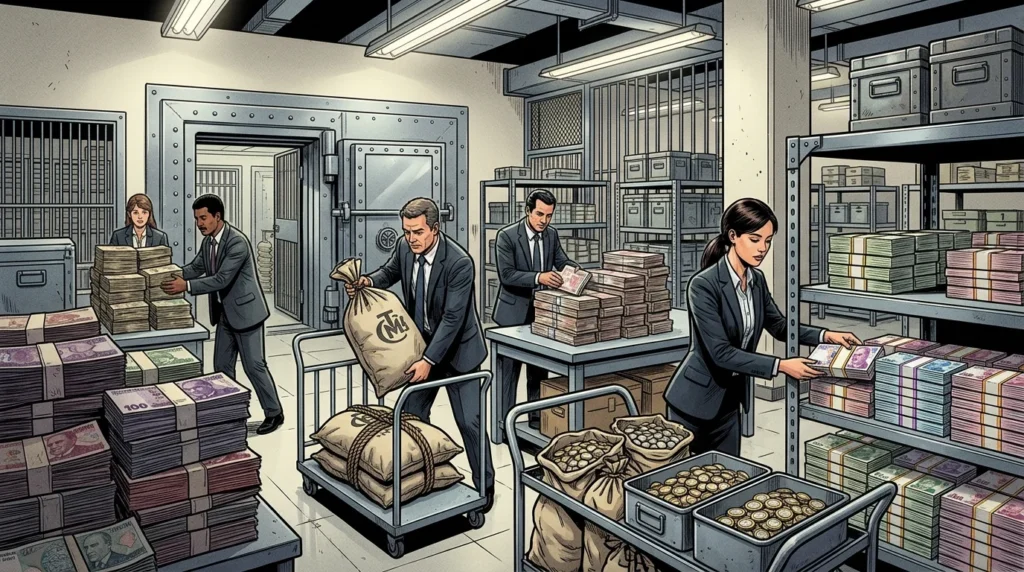
On October 1, 2021, the Central Bank of Venezuela (Banco Central de Venezuela, or BCV) executed the third monetary redenomination in the nation’s modern history, replacing the bolívar soberano with the bolívar digital at a ratio of one million to one. Combined with three zeros removed in January 2008 to create the bolívar fuerte and five zeros removed in August 2018 to launch the bolívar soberano, the Venezuelan state had stripped a cumulative fourteen zeros from its national currency in thirteen years. A single 2021 bolívar digital represented one hundred trillion (1014) pre-2008 bolívares. Driven by the collapse of global crude oil prices after mid-2014, the systematic destruction of state oil monopoly Petróleos de Venezuela, S.A. (PDVSA), and relentless central bank money creation to plug fiscal deficits, Venezuela’s hyperinflationary spiral between 2016 and 2021 became one of the longest and most severe monetary collapses of the twenty-first century—ultimately ending only when the government capitulated to spontaneous, street-level US dollarization. [1]
Oil Dependency, Exchange Controls, and the 2008 Bolívar Fuerte
The structural vulnerabilities that destroyed the Venezuelan bolívar were forged during the commodity boom of the 2000s. Following the 2002–2003 oil strike and capital flight crisis, President Hugo Chávez established the Commission for the Administration of Currency Exchange (CADIVI) in February 2003, imposing strict foreign-exchange controls alongside sweeping retail price ceilings on basic food and consumer staples. Under this tiered exchange-rate system, preferred importers and state agencies received US dollars at heavily subsidized official rates, while businesses and households excluded from state allocations turned to a burgeoning parallel currency market. At the same time, public spending expanded dramatically through off-budget development funds such as FONDEN, financed by redirecting oil windfalls and tapping international reserves. [2]
Even while oil prices climbed toward $100 per barrel, domestic fiscal expansion and monetary accommodation kept annual inflation in the 20 percent to 30 percent range throughout the mid-2000s—well above regional peers in Latin America. To simplify accounting and project monetary strength, the Chávez government decreed the first currency reconversion on January 1, 2008, lopping three zeros off the traditional bolívar (VEB) to introduce the bolívar fuerte (« strong bolívar, » ISO code VEF) at a conversion rate of 1,000 old bolívares to 1 VEF. Rather than addressing the underlying fiscal and productivity imbalances, the state tightened administrative controls and nationalized key domestic industries in steel, cement, telecommunications, electricity, and agricultural distribution, leaving Venezuela reliant on hydrocarbon exports for roughly 95 percent of its foreign-exchange earnings. [3]
| Chiffre / Indicateur | Portée historique et contexte d’archives |
|---|---|
| 14,600,000 bolívares | In Caracas street markets, a 2.4-kilogram chicken cost 14,600,000 bolívares fuertes—roughly $2.22 at the prevailing parallel market rate—while a roll of toilet paper required stacks of 2,600,000 bolívares. |
| $60 | Authorities fixed the Petro at $60 (or 3,600 VES) and set the new minimum wage at half a Petro per month. |
The 2014 Oil Crash and BCV Monetization of PDVSA Deficits
When international crude prices plunged from over $100 per barrel in June 2014 to under $30 per barrel by early 2016, Venezuela possessed neither fiscal buffers nor access to international capital markets. Years of underinvestment, skilled-labor purges, and the diversion of cash flow to social spending had already crippled PDVSA’s physical extraction capacity; crude output fell from roughly 2.4 million barrels per day in 2015 to below 1.4 million barrels per day in 2018 and under 700,000 barrels per day by 2020. Facing an existential collapse in dollar revenues, President Nicolás Maduro’s administration refused to unify the exchange rate or curtail fiscal deficits, which exceeded 15 to 20 percent of gross domestic product. [4]
Instead, the government turned the Central Bank of Venezuela into an engine of unrestrained seigniorage. Through a direct triangular financing mechanism, PDVSA issued promissory notes and debt instruments in domestic currency that the BCV discounted directly by expanding base money (liquidez monetaria). Between 2015 and 2018, the monetary base regularly expanded by more than 100 percent to 200 percent within a matter of months. Because domestic production had contracted by more than a third between 2013 and 2017 and foreign-currency rationing starved private factories of imported raw materials, freshly printed bolívares chased a rapidly shrinking supply of goods. [5]
By late 2016 and throughout 2017, monthly price increases crossed the 50 percent threshold defined by economist Phillip Cagan as the textbook onset of hyperinflation. Recognizing the political damage of the figures, the BCV ceased regular publication of consumer price indices after December 2015. In that statistical vacuum, the opposition-controlled National Assembly launched its own consumer price measurement in 2017, while the International Monetary Fund (IMF) projected in July 2018 that annual inflation would reach 1,000,000 percent by year-end. When the BCV finally broke its three-year silence in May 2019, its own official ledger confirmed that annual inflation had risen from 274.4 percent in 2016 to 862.6 percent in 2017, before surging to an astonishing 130,060 percent in calendar year 2018. [6]
August 2018: The Bolívar Soberano and the Petro Anchor
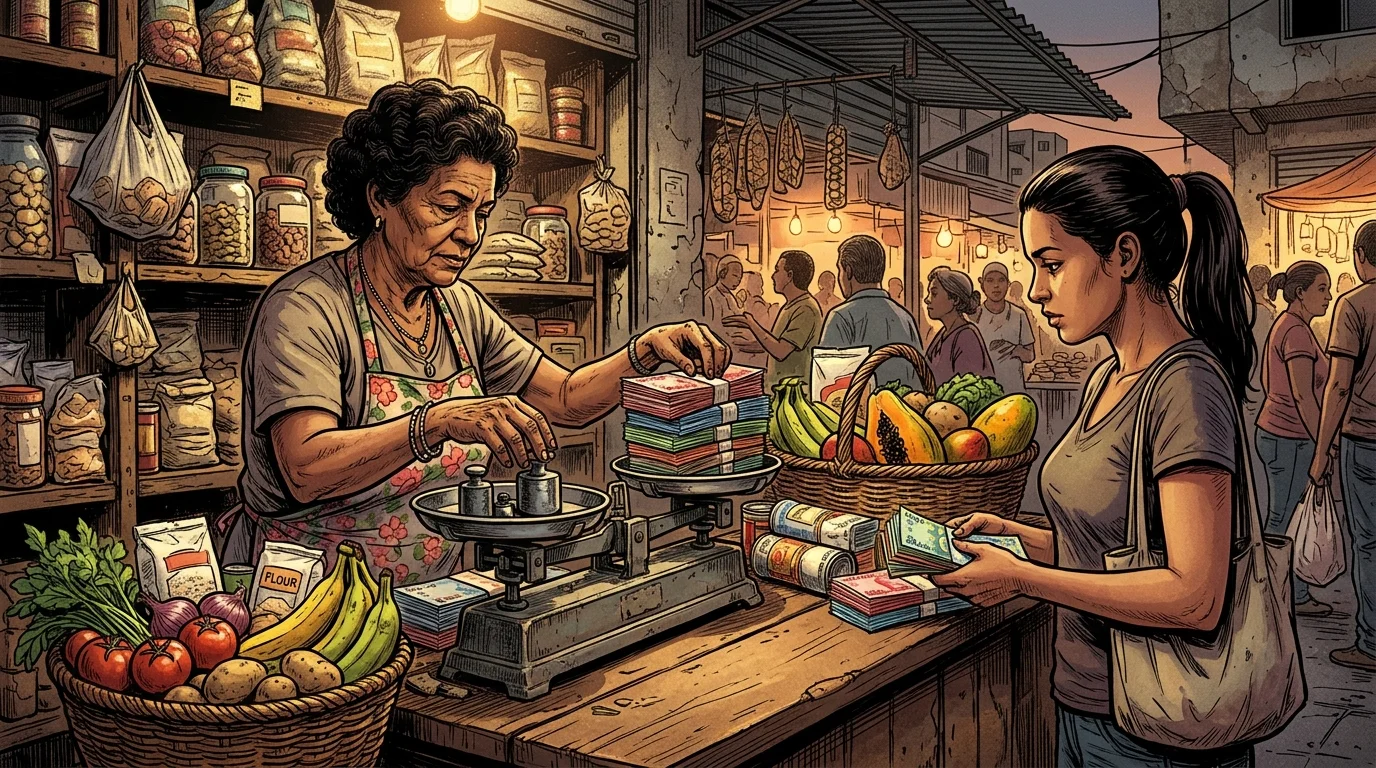
By mid-2018, hyperinflation had paralyzed everyday commerce across Venezuela. In Caracas street markets, a 2.4-kilogram chicken cost 14,600,000 bolívares fuertes—roughly $2.22 at the prevailing parallel market rate—while a roll of toilet paper required stacks of 2,600,000 bolívares. The highest banknote denomination from the original 2008 bolívar fuerte series, the 100-bolívar note, could no longer buy a single piece of candy, and even the emergency conos monetarios of 10,000, 20,000, and 100,000 VEF notes introduced in 2016 and 2017 could not keep pace with prices doubling every two to three weeks. Physical cash became so scarce relative to nominal prices that merchants weighed bundles of banknotes on butcher scales instead of counting them, while urban commuters paid bus fares at steep discounts if they possessed paper bills rather than relying on congested electronic bank transfers. [7]
On August 20, 2018, the Maduro government unveiled an economic package centered on a second currency redenomination: the bolívar soberano (« sovereign bolívar, » ISO code VES), which stripped five zeros from the bolívar fuerte (1 VES = 100,000 VEF). Alongside the new banknote family—ranging from 2 to 500 VES—the government devalued the official exchange rate by roughly 95 percent to align it with the parallel rate of roughly 60 VES per US dollar, raised the value-added tax by four percentage points to 16 percent, and decreed an immediate 3,000 percent increase in the statutory monthly minimum wage to 1,800 VES. [8]
The centerpiece of the August 2018 reform was the government’s claim that the bolívar soberano was « anchored » to the Petro (PTR), a state-created cryptocurrency unit launched earlier in 2018 and purportedly backed by a barrel of Venezuelan crude oil from the Ayacucho block of the Orinoco Oil Belt. Authorities fixed the Petro at $60 (or 3,600 VES) and set the new minimum wage at half a Petro per month. In practice, however, the Petro was neither freely convertible into crude oil nor traded on liquid international exchanges, and the BCV continued expanding the money supply to cover the massive wage hike and state payrolls. Within ten months of the August 2018 launch, hyperinflation had consumed the 2- to 500-VES notes, forcing the BCV on June 12, 2019 to issue emergency 10,000, 20,000, and 50,000 bolívar soberano banknotes—the largest of which was worth roughly $8 on the day of release.
October 2021: The Bolívar Digital and Fourteen Zeros Erased
Even the 50,000 VES note proved ephemeral. By late 2020 and early 2021, the exchange rate had slid past 1,000,000 bolívares soberanos per US dollar, and by September 2021 it exceeded 4,000,000 VES per dollar. The BCV issued another stopgap series of 200,000, 500,000, and 1,000,000 VES notes in March 2021, yet the one-million-bolívar bill bought less than $0.50 worth of groceries. Corporate accounting databases, commercial bank software, and point-of-sale card terminals crashed under the strain of ten- and twelve-digit transaction figures.
To restore computational legibility, the BCV implemented its third monetary reconversion on October 1, 2021, introducing the bolívar digital (VED) by deleting six more zeros from the currency (1 VED = 1,000,000 VES). Despite its « digital » designation, the reform introduced a physical banknote series of 5, 10, 20, 50, and 100 bolívares (later supplemented in August 2024 by 200 and 500 VED denominations as currency depreciation continued). Across the 2008 (three zeros), 2018 (five zeros), and 2021 (six zeros) overhauls, fourteen zeros had been erased from the Venezuelan currency unit.
Spontaneous Dollarization and the Exit from Hyperinflation
What ultimately broke Venezuela’s hyperinflationary cycle was not currency redenomination, but the population’s wholesale abandonment of the bolívar in favor of the US dollar. For fifteen years under the Illicit Foreign Exchange Law, quoting retail prices or settling domestic contracts in foreign currency had been a criminal offense. However, after the August 2018 repeal of key exchange-crime provisions and the catastrophic nationwide electrical blackouts of March 2019—which knocked out point-of-sale debit networks and left bolívar bank balances inaccessible for days—merchants and consumers across Venezuela shifted spontaneously to physical US dollar bills, Colombian pesos in western border states, US bank-to-bank Zelle transfers, and dollar-pegged stablecoins.
Facing tightened US financial and oil sanctions in 2019, the Maduro administration pragmatically embraced what President Maduro publicly termed an « escape valve. » Authorities halted enforcement of retail price ceilings, allowed private imports without customs duties, authorized domestic banks to open US-dollar custody accounts, and later imposed a tax on large foreign-currency transactions (IGTF) to capture fiscal revenue from the dollarized economy. By 2020 and 2021, roughly two-thirds of retail transactions in major Venezuelan cities were settled in US dollars.
Spontaneous dollarization fundamentally altered Venezuela’s monetary dynamics. Because households and businesses immediately converted any bolívares they received into dollars, the real value of the bolívar monetary base shrank to a tiny fraction of GDP, curtailing the government’s ability to extract real resources through seigniorage. Combined with deep spending cuts in public-sector real wages and central bank foreign-exchange interventions using dollar cash at commercial bank tables (mesas de cambio), monthly inflation remained below the 50 percent threshold throughout 2021, allowing Venezuela to officially exit its four-year hyperinflation episode in early 2022—even as chronic high inflation and severe inequality between dollar earners and bolívar pensioners persisted.
Mécanisme Théorique et Transmission de Bilan
Selon le modèle d’instabilité financière de Kindleberger–Minsky (Kindleberger, 1978 ; Minsky, 1986) et la théorie de la déflation par la dette d’Irving Fisher (1933), les bulles spéculatives deviennent systémiques lorsque l’expansion du crédit fait basculer les bilans d’un financement couvert vers un financement spéculatif et de type Ponzi fondé sur l’effet de levier à court terme.
Dès que le retournement du marché déclenche des appels de marge, les liquidations forcées d’actifs provoquent une spirale déflationniste qui dégrade la solvabilité bancaire.
Sources and Further Reading
- The Guardian, « 14m bolivars for a chicken: Venezuela hyperinflation explained, » The Guardian, 2018-08-20. Référence historique et financière
- Larry Elliott, « Venezuela’s plan to fight runaway inflation lacks key ingredients, » The Guardian, 2018-08-20. Référence historique et financière
- Tom Phillips, « Venezuela devalues currency and raises minimum wage by 3,000%, » The Guardian, 2018-08-20. Référence historique et financière
- Tom Phillips and Patricia Torres, « Life’s a struggle as Venezuela inflation heads for one million per cent, » The Guardian, 2018-07-25. Référence historique et financière
- The Guardian, « Venezuela: hyperinflation leads to new banknotes for second time in a year, » The Guardian, 2019-06-12. Référence historique et financière
- Keesing Platform, « Venezuela’s New 200- and 500-Bolívar (Digital) Banknotes, » Keesing Technologies, 2024. Référence historique et financière
- Irving Fisher — "The Debt-Deflation Theory of Great Depressions," Econometrica 1, no. 4 (FRASER Federal Reserve Archive, 1933): 337–357 Banque centrale / Autorité monétaire
- Charles P. Kindleberger & Robert Z. Aliber — Manias, Panics, and Crashes: A History of Financial Crises (Palgrave Macmillan) Recherche académique évaluée
Citer ce dossier historique (APA / Chicago)
APA (7th ed.): Ç., S. (Ed.). (2026). Quatorze zéros : comment le bolívar vénézuélien a perdu sa valeur. In Forgotten Fortunes Historical Monograph Series (Rédaction Forgotten Fortunes). https://forgottenfortunes.net/fr/hyperinflation-au-venezuela-14-zeros/
MLA (9th ed.): Ç., Soner, ed. "Quatorze zéros : comment le bolívar vénézuélien a perdu sa valeur." Forgotten Fortunes: Financial & Monetary History Archive, 2026, https://forgottenfortunes.net/fr/hyperinflation-au-venezuela-14-zeros/.
Chicago (17th ed.): Ç., Soner, ed. "Quatorze zéros : comment le bolívar vénézuélien a perdu sa valeur." Forgotten Fortunes Historical Monograph Series (Rédaction Forgotten Fortunes), octobre 15, 2026. https://forgottenfortunes.net/fr/hyperinflation-au-venezuela-14-zeros/.
Have an idea for another financial history documentary or article? Request a story →