
In This Article
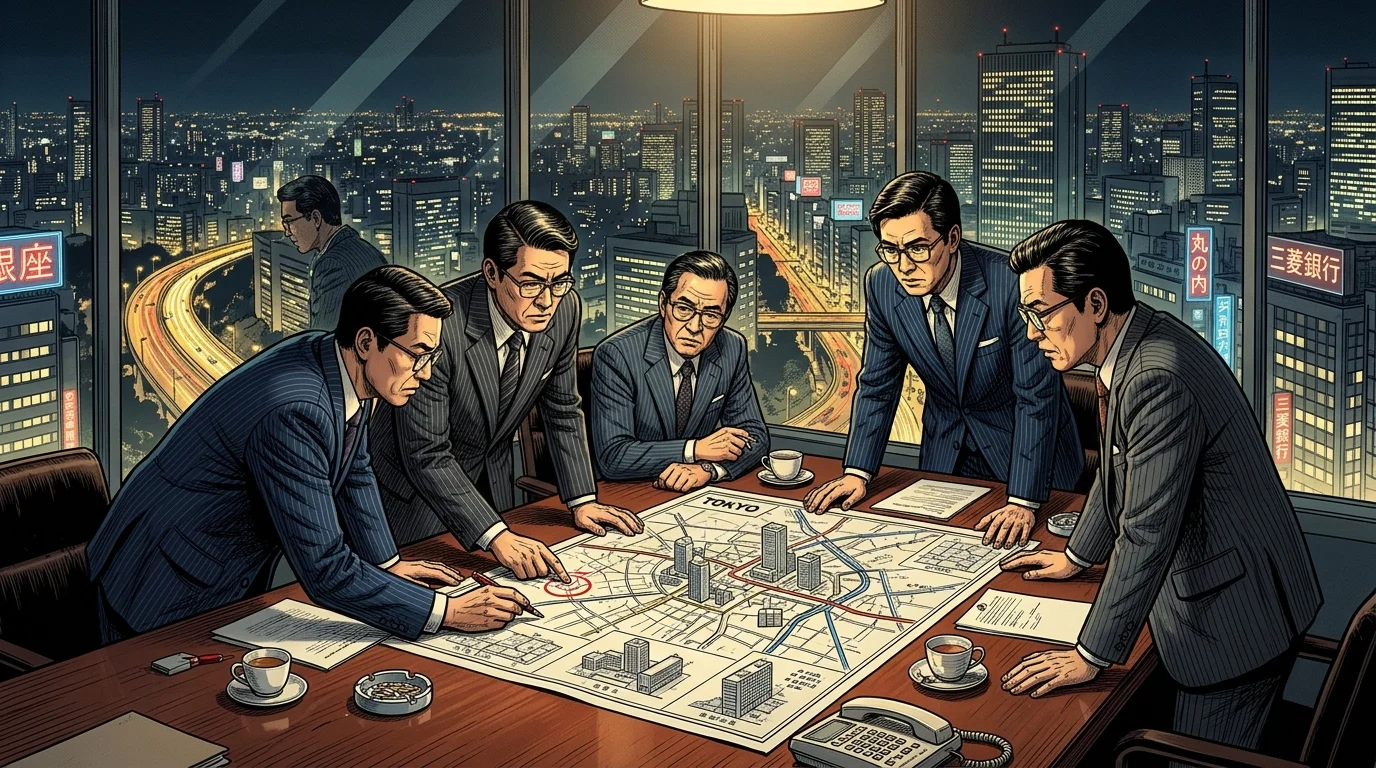
For more than four decades after the Second World War, the Japanese Ministry of Finance (MOF) and the Bank of Japan (BOJ) presided over a regulatory regime that achieved a remarkable statistical feat: not a single postwar Japanese commercial bank was allowed to fail or liquidate with losses to depositors. Known as the “convoy system” (goso sendan hōshiki)—after naval convoys in which every warship and merchant vessel steams at the speed of the slowest ship—this administrative architecture protected weak institutions through strict interest-rate ceilings, product segmentation, and rigorous rationing of new bank branches. Whenever mismanagement or fraud pushed a lender toward insolvency, regulators avoided public deposit-insurance payouts by orchestrating a private “rescue merger” (kyūsai gappei), rewarding a healthy city bank with the failing institution’s coveted branch licenses. The zenith—and the fateful turning point—of this mechanism arrived on October 1, 1986, when Osaka-based Sumitomo Bank absorbed scandal-plagued Heiwa Sogo Bank, taking on over ¥180 billion in irrecoverable real-estate and family-faction loans in exchange for 103 branches across metropolitan Tokyo. [1]
Mechanics of the Japanese Convoy System (Goso Sendan Hōshiki)
Consolidated by the Ministry of Finance’s Banking Bureau during the early 1950s reconstruction era, the convoy system rested on an implicit regulatory contract between bureaucratic supervisors and private financial institutions. To prevent ”excessive competition” that might erode bank capital and destabilize industrial credit channels, the MOF compartmentalized the financial system into city banks, regional banks, long-term credit banks, trust banks, mutual savings banks (sogo ginko), and credit cooperatives.
Under the Temporary Interest Rates Adjustment Law of 1947, deposit interest rates were capped well below market-clearing levels, guaranteeing every licensed bank a positive net interest margin between regulated retail deposits and corporate lending rates. At the same time, the MOF exercised strict “administrative guidance” (gyōsei shidō) over every physical branch opening, relocation, and operating hour. Because retail deposit gathering in postwar Japan depended directly on physical branch density—particularly in high-growth urban commuter hubs—each branch license carried substantial franchise rent, or “charter value”. [2]
Although Japan established the Deposit Insurance Corporation (DIC) in 1971, the fund maintained minimal financial reserves and did not execute a single financial assistance payout during its first two decades of existence. Instead, when a credit cooperative or mutual bank ran into distress, the MOF deployed retiring bureaucrats (placed on bank boards through the practice of amakudari, or “descent from heaven”) and informal suasion to arrange an absorption by a stronger competitor, implicitly taxing the healthy bank’s shareholders while compensating the acquirer with the failed bank’s branch network. [3]
Shadow Lending and Governance Breakdown at Heiwa Sogo Bank
Founded in 1949 by Eizo Komiyama and converted into a mutual loan and savings bank (sogo bank) in 1951, Tokyo-based Heiwa Sogo Bank grew rapidly during Japan’s high-growth era by pioneering aggressive retail convenience. Unlike traditional city banks whose counters closed at 3:00 p.m., Heiwa Sogo operated an extensive network of more than 100 branches positioned adjacent to major Tokyo commuter rail stations that remained open until 7:00 p.m., backed by early computerized teller linkages. [4]
Behind its bustling retail counters, however, Heiwa Sogo operated as the personal fiefdom of the founding Komiyama family. Throughout the 1970s and early 1980s, management bypassed internal credit controls to funnel hundreds of billions of yen through a web of unlisted shell companies—commonly dubbed the “Taiheiyo Club” and “Jona” group affiliates—into speculative golf courses, resort developments, uninhabited island land tracts, and political influence campaigns.
Following the death of President Eizo Komiyama in 1979, a bitter succession feud erupted between members of the Komiyama family and an internal faction of four senior executives known in the Japanese press as the “Gang of Four,” led by former statutory auditor Takashi Inaida. In a desperate attempt to strip the founding family of their controlling shares and conceal mounting non-performing loans from MOF inspectors, the executive faction authorized even more dubious transactions—including financing the wildly inflated purchase of a gold-plated folding screen (the Kinbyōbu scandal) and dubious corporate promissory notes. By 1985, special examinations by the Ministry of Finance and the Bank of Japan revealed that out of roughly ¥1.2 trillion in total loans, more than ¥490 billion was classified as problem debt, with at least ¥180 billion to ¥200 billion deemed completely irrecoverable. [5]
The 1986 Rescue Merger: Sumitomo Bank’s Tokyo Branch Prize
With newspaper exposés and prosecutorial raids threatening to spark a retail deposit run on Heiwa Sogo in late 1985 and early 1986, the Ministry of Finance moved swiftly to engineer a convoy-style rescue merger. For Sumitomo Bank—historically the financial anchor of the Osaka-centered Sumitomo zaibatsu and keiretsu—the crisis presented a once-in-a-generation strategic opening. Under Chairman Ichiro Isoda and President Koh Komatsu, Sumitomo boasted the highest profitability among Japan’s major city banks, yet it lagged behind Tokyo-headquartered rivals such as Dai-Ichi Kangyo Bank, Fuji Bank, and Mitsubishi Bank in retail branch coverage across the Tokyo metropolitan area. [6]
Under MOF administrative guidance, Heiwa Sogo’s management announced in February 1986 that it would merge into Sumitomo Bank, and on October 1, 1986, the formal absorption took effect. No Deposit Insurance Corporation funds or taxpayer subsidies were used. Instead, the transaction operated purely on the convoy system’s franchise-value trade-off: Sumitomo Bank received Heiwa Sogo’s 103 branches (almost all located in Tokyo and neighboring Kanto prefectures) along with more than ¥1.1 trillion in retail deposits, vaulted overnight into the top tier of Tokyo retail banking, and absorbed the entire cost of writing off Heiwa Sogo’s bad-loan hole against Sumitomo’s own annual operating profits and hidden securities reserves. [7]
Moral Hazard, the Bubble Economy, and Collapse of the Convoy Model
While the October 1986 Heiwa Sogo merger prevented any disruption to depositors and was celebrated by the Ministry of Finance as a triumph of administrative guidance, financial historians and central bank economists later identified the transaction as a critical catalyst for the late-1980s Japanese asset-price bubble and the 1990s banking crisis. [8]
First, the rescue suffered from severe post-merger indigestion. Writing off nearly ¥200 billion in irrecoverable Heiwa Sogo loans knocked Sumitomo Bank from its position as Japan’s most profitable city bank, prompting Chairman Ichiro Isoda to push branches—including the former Heiwa Sogo network and affiliate Itoman Corporation—into aggressive real-estate and speculative corporate lending during the 1987–1990 bubble years to recapture first-place earnings.
Second, as Federal Reserve economist Mark Spiegel and NBER researchers Takeo Hoshi and Anil Kashyap demonstrated, the convoy system’s reliance on unassisted private rescue mergers depended entirely on high franchise values created by interest-rate controls and restricted entry. As Japan deregulated deposit interest rates and opened corporate bond markets between the mid-1980s and early 1990s, bank charter values eroded just as real-estate and equity prices collapsed after 1990.
By the mid-1990s, healthy city banks no longer possessed sufficient excess profits or hunger for physical branches to swallow insolvent competitors at zero public cost. After exhausting the Deposit Insurance Corporation’s reserves in small assisted mergers between 1992 and 1996, the convoy system shattered completely in November 1997 with the failures of Hokkaido Takushoku Bank and Yamaichi Securities—forcing Japan to abandon administrative rescues in favor of explicit taxpayer recapitalizations, the creation of the Financial Supervisory Agency, and the “Financial Big Bang” reforms.
Theoretical & Balance-Sheet Transmission Mechanism
In the Kindleberger–Minsky taxonomy of financial instability (Kindleberger, 1978; Minsky, 1986) and Irving Fisher’s (1933) debt-deflation framework, speculative asset booms become systemic crises when credit expansion shifts balance sheets from hedge finance (cash flows covering principal and interest) to speculative and Ponzi finance (relying on rising asset prices and short-term margin roll-overs).
Once monetary tightening or an exogenous shock halts price appreciation, forced margin liquidations trigger Fisherian debt-deflation: fire-sale asset discounts erode bank collateral values, contracting credit supply across the real economy.
Sources and Further Reading
- Mark M. Spiegel, “ Moral Hazard under the Japanese ‘Convoy’ Banking System,” Federal Reserve Bank of San Francisco Economic Review (via RePEc), 1999. Central Bank / Monetary Authority
- Mark M. Spiegel, “ Bank Charter Value and the Viability of the Japanese Convoy System,” Federal Reserve Bank of San Francisco Pacific Basin Working Paper No. PB99-06, 1999. Central Bank / Monetary Authority
- Sumitomo Mitsui Financial Group (SMFG), “ History of Sumitomo Mitsui Banking Corporation (October 1986 Merger of The Sumitomo Bank and Heiwa Sogo Bank),” SMBC Group Twenty-Year Chronicle, 2022. Historical & Financial Reference
- Encyclopedia.com, “ The Sumitomo Bank, Ltd. — International Directory of Company Histories,” St. James Press / Encyclopedia.com, 2000. Historical & Financial Reference
- Ulrike Schaede, “ The 1995 Financial Crisis in Japan,” University of California Berkeley BRIE Working Paper No. 85 (eScholarship), 1996. Peer-Reviewed / Academic Research
- Stijn Claessens, Daniela Klingebiel, and Luc Laeven, “ Financial Restructuring in Banking and Corporate Sector Crises: What Policies to Pursue?,” National Bureau of Economic Research (NBER Working Paper No. 8386), 2001. Peer-Reviewed / Academic Research
- Irving Fisher — "The Debt-Deflation Theory of Great Depressions," Econometrica 1, no. 4 (FRASER Federal Reserve Archive, 1933): 337–357 Central Bank / Monetary Authority
- Charles P. Kindleberger & Robert Z. Aliber — Manias, Panics, and Crashes: A History of Financial Crises (Palgrave Macmillan) Peer-Reviewed / Academic Research
Cite This Historical Dossier (APA / Chicago)
APA (7th ed.): Ç., S. (Ed.). (2026). Japan's Postwar Banking Convoy System and the 1986 Heiwa Sogo Bank Merger. In Forgotten Fortunes Historical Monograph Series (Forgotten Fortunes Editorial Desk). https://forgottenfortunes.net/japan-banking-convoy-heiwa-sogo/
MLA (9th ed.): Ç., Soner, ed. "Japan's Postwar Banking Convoy System and the 1986 Heiwa Sogo Bank Merger." Forgotten Fortunes: Financial & Monetary History Archive, 2026, https://forgottenfortunes.net/japan-banking-convoy-heiwa-sogo/.
Chicago (17th ed.): Ç., Soner, ed. "Japan's Postwar Banking Convoy System and the 1986 Heiwa Sogo Bank Merger." Forgotten Fortunes Historical Monograph Series (Forgotten Fortunes Editorial Desk), September 11, 2026. https://forgottenfortunes.net/japan-banking-convoy-heiwa-sogo/.
Have an idea for another financial history documentary or article? Request a story →


