In This Article
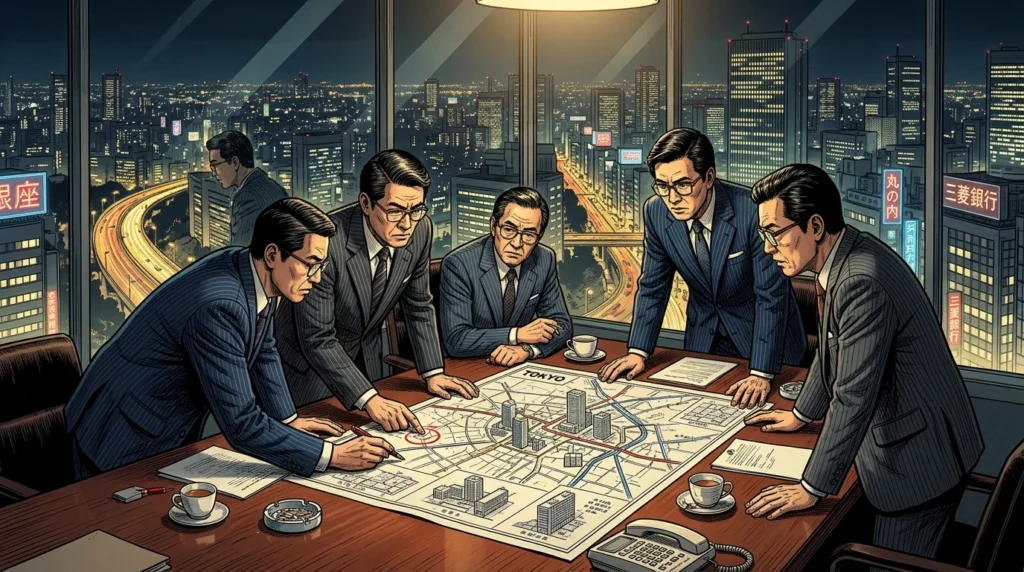
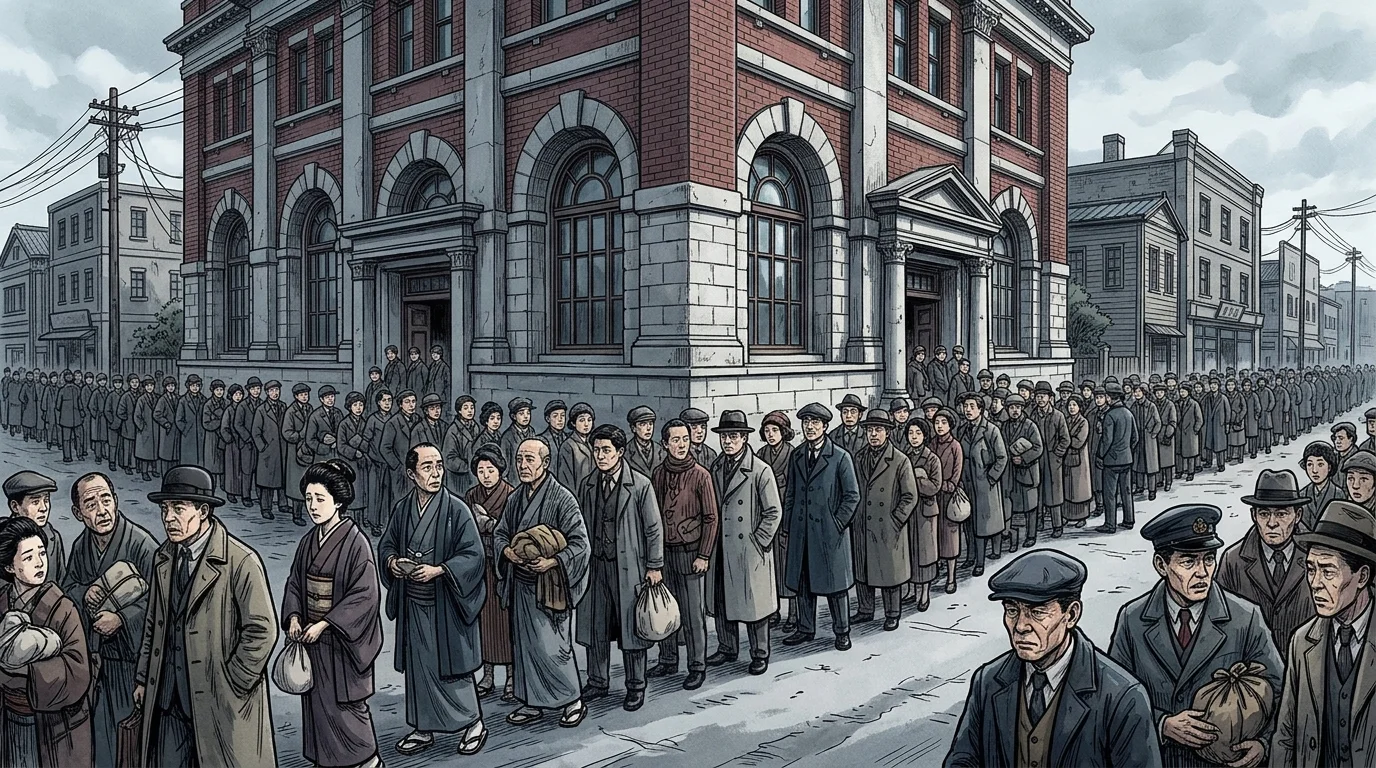
On the afternoon of March 14, 1927, during a heated Budget Committee hearing in the Imperial Diet over toxic post-earthquake bank debts, Japanese Finance Minister Naoharu Kataoka (also read Naoto Kataoka) announced that Tokyo Watanabe Bank had “finally suspended operations around noon today.” In fact, the troubled bank had managed to scrape together emergency funds before its noon clearing deadline and was still open. Yet Kataoka’s premature obituary became an instant self-fulfilling prophecy: stunned executives at Tokyo Watanabe Bank closed their doors the next morning, igniting a nationwide depositor panic known as the Shōwa Financial Crisis (Shōwa Kin’yū Kyōkō, 昭和金融恐慌). Over the next six weeks, cascading runs shuttered 37 banks across Japan—including the aristocratic Fifteenth Bank (Jūgo Ginkō) and the semi-official Bank of Taiwan—destroyed the giant Kobe trading conglomerate Suzuki Shoten, brought down Prime Minister Reijirō Wakatsuki’s cabinet after a historic clash with the Privy Council, and permanently concentrated Japan’s financial wealth inside the “Big Five” zaibatsu banks. [1]

Post-WWI Speculation, Organ Banks, and the 1923 Earthquake Bills
The structural roots of the 1927 panic reached back to Japan’s World War I industrial boom (1914–1919) and its violent collapse in March 1920. During the war, while European powers were locked in conflict, Japanese exports, shipping, shipbuilding, and chemical manufacturing expanded at breakneck speed, with real GNP growing by more than 6 percent annually and wholesale prices more than doubling. Beneath the elite zaibatsu banks, hundreds of lightly capitalized regional and metropolitan commercial banks functioned as “organ banks” (kikan ginkō)—captive lenders controlled by industrial entrepreneurs who used household deposit bases to fund their own speculative trading and manufacturing companies with minimal regulatory oversight. [2]
When the global postwar commodity bubble burst in 1920, Japanese stock and silk prices plunged by more than half. Rather than forcing insolvent industrial borrowers and their captive organ banks to write off bad debts and liquidate, successive governments and the Bank of Japan (BOJ) repeatedly extended emergency relief loans to preserve social stability, leaving the banking system clogged with non-performing assets throughout the 1920s. [3]
This fragile equilibrium was shattered on September 1, 1923, when the Great Kantō Earthquake and subsequent firestorms devastated Tokyo and Yokohama, killing over 100,000 people and destroying commercial inventories, factories, and collateral worth an estimated 4.5 to 5.5 billion yen—roughly one-third of Japan’s national income. After imposing an emergency 30-day debt moratorium on September 7, the government promulgated Imperial Ordinance No. 424 on September 27, 1923: the Earthquake Bill Rediscounting Loss Compensation Ordinance. Under this measure, the Bank of Japan agreed to rediscount up to two years of commercial bills originating in the disaster zone or drawn by earthquake-affected debtors—known as “Earthquake Bills” (Shinsai Tegata, 震災手形)—backed by a 100 million yen government loss-indemnity guarantee. [4]
| Documented Figure / Metric | Historical Significance & Archival Context |
|---|---|
| 207 million yen | By the end of 1926, approximately 207 million yen in unredeemed Earthquake Bills remained lodged in the banking system. |
| 350 million yen | By March 1927, Suzuki Shoten's total debt to the Bank of Taiwan had ballooned to roughly 350 million yen—far exceeding the bank's own capital and reserves. |
| 3.37 million yen | On the morning of March 14, 1927, facing a 3.37 million yen clearing shortfall due at 1:00 p.m., Tokyo Watanabe Bank's managing director rushed to the Ministry of Finance to warn Vice Minister Den Seikō that unless emergency funds were found, the bank would have to suspend payments at noon. |
| 500 million yen | An extraordinary session of the Diet then passed two stabilization acts authorizing up to 500 million yen in BOJ special advances across Japan and 200 million yen for financial institutions in Taiwan. |
Suzuki Shoten and the Bank of Taiwan’s 200-Million-Yen Secret
Intended as temporary disaster relief for Tokyo and Yokohama merchants, the BOJ’s Earthquake Bill facility was quickly exploited by insolvent banks and conglomerates across Japan as a dumping ground for pre-existing bad loans from the 1920 crash. By March 1924, the Bank of Japan had stamped 430 million yen in bills as eligible Earthquake Bills, and because debtors could not repay them, the Diet twice extended their maturity deadlines—first to September 1926 and then to September 1927. [5]
By the end of 1926, approximately 207 million yen in unredeemed Earthquake Bills remained lodged in the banking system. What the public did not know was that nearly half of the entire national total—roughly 100 million yen—was held by a single institution: the Bank of Taiwan (Taiwan Ginkō), Japan’s colonial bank of issue in Taipei, which also operated aggressively in the Kobe and Tokyo money markets. Worse still, roughly 70 percent of the Bank of Taiwan’s Earthquake Bills had been drawn by a single client: Suzuki Shoten. [6]
Headquartered in Kobe and steered by the legendary general manager Kaneko Naokichi under matriarch Suzuki Yone, Suzuki Shoten had grown during World War I into a colossal trading and industrial empire of more than 60 affiliated companies (including predecessors of Teijin, Kobe Steel, and IHI) whose annual turnover briefly surpassed that of Mitsui Bussan. Heavily battered by the 1920 crash and the 1923 earthquake, Suzuki Shoten survived only through ever-larger rollovers of short-term loans from the Bank of Taiwan, which in turn funded itself by borrowing short-term call money from Tokyo commercial banks and rediscounting bills at the Bank of Japan. By March 1927, Suzuki Shoten’s total debt to the Bank of Taiwan had ballooned to roughly 350 million yen—far exceeding the bank’s own capital and reserves. [7]
March 14, 1927: Parliamentary Exposure and Kataoka’s Slip of the Tongue
Eager to return Japan to the prewar gold standard—a step that required cleaning up the banking system’s balance sheet first—Finance Minister Naoharu Kataoka submitted two bills to the 52nd Imperial Diet in January 1927 to finally liquidate the remaining 207 million yen in Earthquake Bills by converting them into ten-year government bonds and long-term loans. [8]
Instead of passing quietly, the bills provoked a fierce political battle. Opposition Seiyūkai lawmakers, suspecting that the legislation was a disguised taxpayer bailout for politically connected business groups and Suzuki Shoten, demanded that Kataoka disclose the names of the individual banks holding the toxic Earthquake Bills and the amounts they owed. As heated Diet debates leaked into the press during early March 1927, nervous depositors in Tokyo began withdrawing funds from second-tier metropolitan banks rumored to hold heavy concentrations of Earthquake Bills.
Among the most vulnerable was Tokyo Watanabe Bank, an organ bank controlled by the Watanabe family real estate and industrial group. On the morning of March 14, 1927, facing a 3.37 million yen clearing shortfall due at 1:00 p.m., Tokyo Watanabe Bank’s managing director rushed to the Ministry of Finance to warn Vice Minister Den Seikō that unless emergency funds were found, the bank would have to suspend payments at noon. While the Vice Minister passed a note to Finance Minister Kataoka informing him that Tokyo Watanabe Bank had halted payments at noon, the bank’s executives actually succeeded at the last minute in borrowing emergency call money from the Dai-Ichi Bank and cleared their balances before 1:00 p.m.
Unaware of this last-minute rescue, Finance Minister Kataoka rose in the House of Representatives Budget Committee that afternoon and declared that it was deeply regrettable that “Tokyo Watanabe Bank finally went bankrupt around noon today.” When bewildered reporters telephoned Tokyo Watanabe Bank and discovered it was still open, the bank’s owners—realizing that a newspaper headline quoting the Finance Minister’s bankruptcy announcement would trigger an unstoppable run at opening bell—decided that evening to close both Tokyo Watanabe Bank and its affiliate, Akaji Savings Bank, on the morning of March 15.
The First Wave, the Collapse of Suzuki Shoten, and the Privy Council Veto
Kataoka’s blunder unleashed the first wave of the Shōwa Financial Crisis across the Tokyo-Yokohama region. Within a week, runs forced the closure of Nakai Bank, Murai Bank, Eighty-Fourth Bank, Nakazawa Bank, and Soda Bank. Although emergency Bank of Japan advances temporarily calmed retail queues in late March after the Diet passed the Earthquake Bill relief laws, the panic instantly migrated into the interbank call-loan market.
During the Diet hearings, the massive entanglement between the Bank of Taiwan and Suzuki Shoten had become an open secret. Terrified commercial banks—led by Mitsui Bank and other major Tokyo institutions—began recalling their short-term call loans from the Bank of Taiwan. Cornered by this interbank liquidity drain, the Bank of Taiwan notified Suzuki Shoten on March 26, 1927, that it was severing all further credit lines. When that news broke on April 1 and Suzuki Shoten suspended payments on April 2, creditors panicked across western Japan, knowing that Suzuki Shoten’s insolvency meant the Bank of Taiwan’s own balance sheet was fatally impaired.
When the Bank of Japan refused to extend further unsecured loans to the Bank of Taiwan without an explicit statutory government guarantee, Prime Minister Reijirō Wakatsuki’s cabinet drafted an urgent Imperial Ordinance under Article 8 of the Meiji Constitution authorizing the Bank of Japan to provide up to 200 million yen in special uncollateralized advances to the Bank of Taiwan. On April 17, 1927, however, the conservative Privy Council—hostile to the Wakatsuki cabinet’s conciliatory diplomacy toward China and insistent that parliament should be convened instead—voted 19 to 11 to reject the emergency Imperial Ordinance.
The April 1927 Moratorium and the Rise of the “Big Five” Zaibatsu
The Privy Council’s veto on April 17 caused immediate political and financial collapse. Prime Minister Wakatsuki and his cabinet resigned that same evening. On April 18, the Bank of Taiwan closed all its branches across mainland Japan and overseas (keeping only its offices inside Taiwan open to protect the colonial currency), and the prestigious Omi Bank in Osaka suspended operations. Three days later, on April 21, 1927, the panic reached its zenith when the Fifteenth Bank (Jūgo Ginkō)—one of Japan’s largest commercial banks, founded by the hereditary peerage (kazoku), serving as banker to the Imperial Household Ministry, and heavily exposed to the Matsukata family’s failing Kawasaki Dockyard empire—was forced to shut its doors as long lines of depositors besieged banks from Tokyo to Kyushu.
Appointed Prime Minister on April 20, General Giichi Tanaka appointed veteran statesman Korekiyo Takahashi as Finance Minister to quell the inferno. Moving with decisive speed, Takahashi and the Tanaka Cabinet obtained Privy Council approval for a nationwide three-week debt moratorium on April 22, 1927, while all banks in Japan voluntarily closed for a two-day bank holiday on April 22 and 23. During the pause, the Bank of Japan printed unprecedented quantities of emergency currency—including famous 200-yen banknotes printed on one side only (urasaki) because there was no time to engrave the reverse—and shipped truckloads of cash to bank branches across the country. An extraordinary session of the Diet then passed two stabilization acts authorizing up to 500 million yen in BOJ special advances across Japan and 200 million yen for financial institutions in Taiwan.
While Takahashi’s intervention ended the runs by May 1927, the Shōwa Financial Crisis permanently redrew the map of Japanese capitalism. In total, 37 banks holding nearly 9 percent of national deposits suspended operations in the spring of 1927. Enacted in the midst of the turmoil and taking effect in January 1928, the new Banking Act of 1927 imposed strict minimum capital requirements (1 million yen for rural banks and 2 million yen for Tokyo and Osaka banks) and barred bank executives from managing outside commercial firms, driving a wave of forced mergers that cut the number of ordinary banks in Japan by more than half—from 1,420 in 1926 to 683 by 1931. Most dramatically, terrified households pulled their savings out of small and medium banks and deposited them into the Postal Savings system and the “Big Five” zaibatsu banks—Mitsui, Mitsubishi, Sumitomo, Yasuda, and Dai-Ichi—cementing the unchallenged financial dominance of the great zaibatsu conglomerates on the eve of the 1930s.
Theoretical & Balance-Sheet Transmission Mechanism
In the Kindleberger–Minsky taxonomy of financial instability (Kindleberger, 1978; Minsky, 1986) and Irving Fisher’s (1933) debt-deflation framework, speculative asset booms become systemic crises when credit expansion shifts balance sheets from hedge finance (cash flows covering principal and interest) to speculative and Ponzi finance (relying on rising asset prices and short-term margin roll-overs).
Once monetary tightening or an exogenous shock halts price appreciation, forced margin liquidations trigger Fisherian debt-deflation: fire-sale asset discounts erode bank collateral values, contracting credit supply across the real economy.
Sources and Further Reading
- Masato Shizume, “ The Japanese Economy during the Interwar Period: Instability in the Financial System and the Impact of the World Depression,” Bank of Japan Review (2009-E-2), 2009-05. Central Bank / Monetary Authority
- National Diet Library, Japan, “ Kataoka Naoharu | Portraits of Modern Japanese Historical Figures,” National Diet Library, 2013. Historical & Financial Reference
- Tetsuji Okazaki, Toshihiro Okubo, and Eric Strobl, “ The Bright and Dark Side of Financial Support from Local and Central Banks after a Natural Disaster: Evidence from the Great Kanto Earthquake, 1923 Japan,” The Canon Institute for Global Studies (CIGS Working Paper Series No. 21-001E), 2021-05. Peer-Reviewed / Academic Research
- University of Tokyo OpenCourseWare, “ Contemporary Economic History of Japan: Lecture 8,” University of Tokyo Faculty of Economics, 2004. Historical & Financial Reference
- Keio University Mita Business Review, “ Banking Mismanagement as the Origin of the Financial Panic of 1927 in Japan: A Case Study,” Keio University Academic Repository (Mita Business Review Vol. 49, No. 6), 2007-01. Peer-Reviewed / Academic Research
- Matthew Baron, Emil Verner, and Wei Xiong, “ Banking Crises Without Panics,” National Bureau of Economic Research (Working Paper No. 26908 / Quarterly Journal of Economics), 2020. Peer-Reviewed / Academic Research
- Irving Fisher — "The Debt-Deflation Theory of Great Depressions," Econometrica 1, no. 4 (FRASER Federal Reserve Archive, 1933): 337–357 Central Bank / Monetary Authority
- Charles P. Kindleberger & Robert Z. Aliber — Manias, Panics, and Crashes: A History of Financial Crises (Palgrave Macmillan) Peer-Reviewed / Academic Research
Cite This Historical Dossier (APA / Chicago)
APA (7th ed.): Ç., S. (Ed.). (2026). Japan's 1927 Shōwa Financial Crisis, Suzuki Shoten, and the Bank of Taiwan. In Forgotten Fortunes Historical Monograph Series (Forgotten Fortunes Editorial Desk). https://forgottenfortunes.net/japan-1927-showa-financial-crisis/
MLA (9th ed.): Ç., Soner, ed. "Japan's 1927 Shōwa Financial Crisis, Suzuki Shoten, and the Bank of Taiwan." Forgotten Fortunes: Financial & Monetary History Archive, 2026, https://forgottenfortunes.net/japan-1927-showa-financial-crisis/.
Chicago (17th ed.): Ç., Soner, ed. "Japan's 1927 Shōwa Financial Crisis, Suzuki Shoten, and the Bank of Taiwan." Forgotten Fortunes Historical Monograph Series (Forgotten Fortunes Editorial Desk), September 11, 2026. https://forgottenfortunes.net/japan-1927-showa-financial-crisis/.
Have an idea for another financial history documentary or article? Request a story →