In This Article
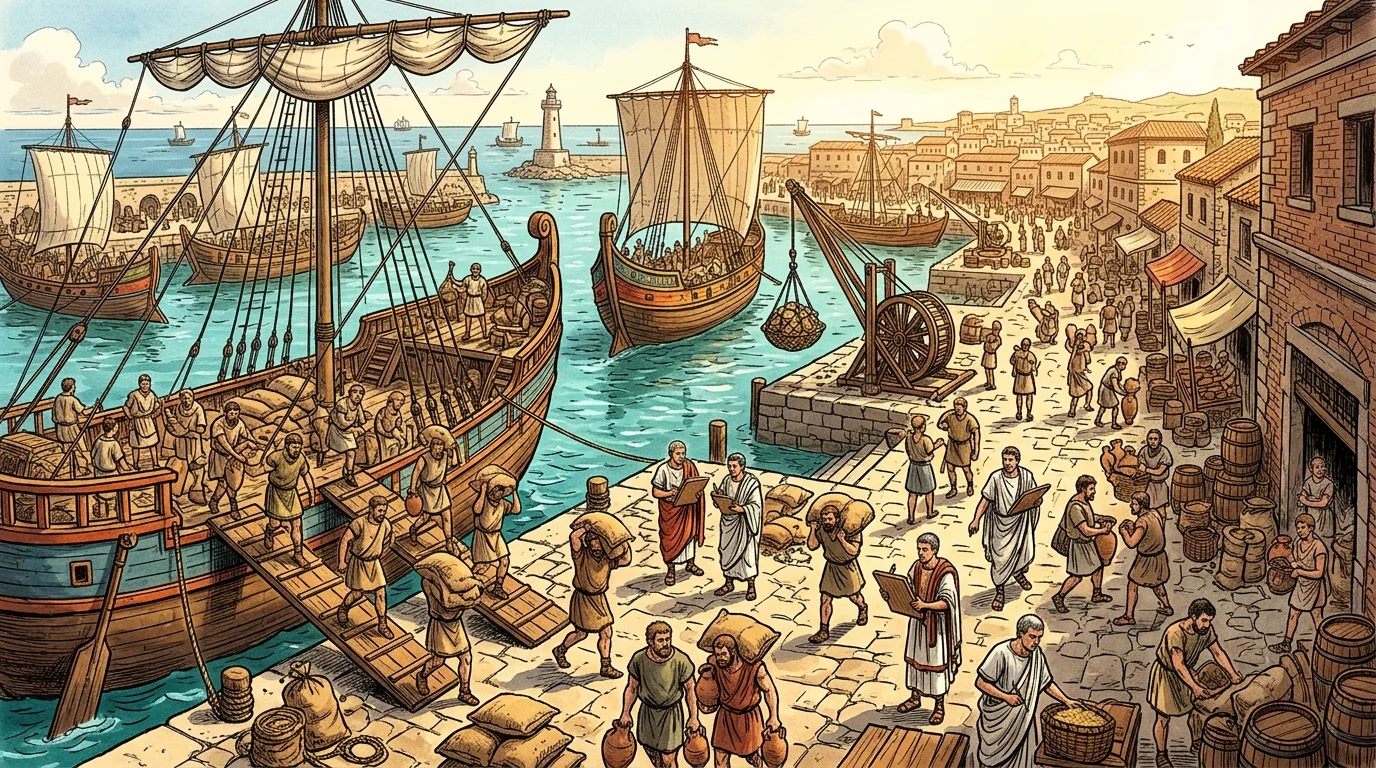
Throughout the early Roman Principate (27 BCE–180 CE), the political survival of every emperor depended on a single economic imperative: keeping the urban population of Rome—roughly one million inhabitants—reliably supplied with affordable grain. Because overland transport of bulk cereals was prohibitively expensive, the capital relied on an intricate maritime supply chain known as the annona, drawing tens of millions of modii of wheat each sailing season from Egypt, North Africa, and Sicily. When natural disasters, shipping bottlenecks, or agricultural price distortions threatened that equilibrium, emperors intervened aggressively in Mediterranean commodity markets. Two episodes stand out in the economic record of the first century CE: Emperor Nero’s emergency grain price cap of 3 sesterces per modius following the Great Fire of July 64 CE, and Emperor Domitian’s 92 CE Vine Edict ordering the halt of new vineyard planting in Italy and the uprooting of half the vineyards across the provinces. [1]
The Praefectus Annonae and the Maritime Grain Logistics of Rome
During the late Republic, politically ambitious tribunes beginning with Gaius Gracchus in 123 BCE and Publius Clodius Pulcher in 58 BCE had established the frumentatio, a subsidized or free monthly ration of five modii (roughly 33 kilograms) of unmilled wheat distributed to registered male citizen householders in Rome (plebs frumentaria). Under Augustus, the recipient roll was stabilized at approximately 200,000 adult male citizens. Yet the state dole accounted for only a fraction of the total grain consumed in the metropolis. Women, children, non-citizens, peregrines, slaves, and households purchasing extra bread depended on the private urban grain market, where retail prices fluctuated sharply between the summer harvest arrival and the winter closure of Mediterranean shipping lanes (mare clausum). [2]
After severe food shortages between 6 and 8 CE forced Augustus to ration supplies and expel non-essential residents from the capital, the emperor created a permanent equestrian office, the Praefectus Annonae (Prefect of the Grain Supply), between 8 and 14 CE. Operating from headquarters near the Porticus Minucia and the river warehouses (horrea) of the Emporium and Ostia, the Praefectus Annonae supervised contracts with private shipowners (navicularii) and grain merchants (negotiatores frumentarii), managed strategic state reserves derived from provincial taxes in kind (vectigalia), and released state wheat into the private market whenever speculative hoarding threatened a bread riot. [3]
Claudius’s Port Infrastructure and Shipping Subsidies
Despite the creation of the prefecture, Rome’s supply chain remained vulnerable because the mouth of the Tiber at Ostia lacked a deep-water harbor capable of sheltering large Alexandrian grain freighters. Instead, deep-draft ships unloaded at Puteoli on the Bay of Naples, nearly 200 kilometers south, or transferred their cargoes at sea onto smaller river barges (lenunculi and codicariae) that were towed up the Tiber to Rome. In 51 CE, when a winter shortfall left the city with barely fifteen days of wheat in the public granaries, an angry crowd surrounded Emperor Claudius in the Forum and pelted him with stale crusts of bread. [4]
As Suetonius (Claudius 18–20) recorded, Claudius responded with both physical infrastructure and permanent financial incentives for private maritime capital. Beginning in 42 CE, he excavated an artificial deep-water basin two miles north of Ostia—known as Portus—protected by two curving moles and a monumental lighthouse modeled on the Pharos of Alexandria. To induce private navicularii to sail during the dangerous late-autumn and winter months, Claudius guaranteed state maritime insurance from the imperial treasury against storm losses and offered legal privileges to anyone who built a merchant vessel capable of carrying at least 10,000 modii (~65–70 metric tons) of grain and kept it in service for six years: Roman citizens received exemption from the Lex Papia Poppaea penalties on childlessness, Latins received full Roman citizenship, and women acquired the legal property rights of mothers of four children (ius trium vel quattuor liberorum). Early in Nero’s reign (58 CE), the administration reinforced these supply-side incentives by exempting grain-transport vessels from provincial property assessments and harbor taxes. [5]
The Great Fire of July 64 CE and Nero’s 3-Sesterce Price Cap
The resilience of the annona was put to its severest test on the night of July 18–19, 64 CE, when a catastrophic fire broke out among the merchant shops near the Circus Maximus. Fanned by summer winds, the conflagration raged for six days and a subsequent three-day flare-up, destroying completely three of Rome’s fourteen administrative regions and devastating seven others. Along with thousands of tenement blocks (insulae), the blaze consumed numerous private granaries and disrupted urban bakeries (pistores), sending open-market wheat prices soaring from their customary range of 4 to 6 sesterces per modius to famine levels. [6]
As the historian Tacitus recorded in Book 15, Chapter 39 of his Annals, Nero returned hastily from Antium and enacted an immediate emergency relief package designed to prevent starvation and quell political unrest: [7]
- Emergency Shelter and Subsidized Transport: Nero opened the Campus Martius, the public monuments of Agrippa, and his own imperial gardens to house displaced citizens in temporary shelters, while rushing food supplies down the Tiber from Ostia and neighboring municipalities.
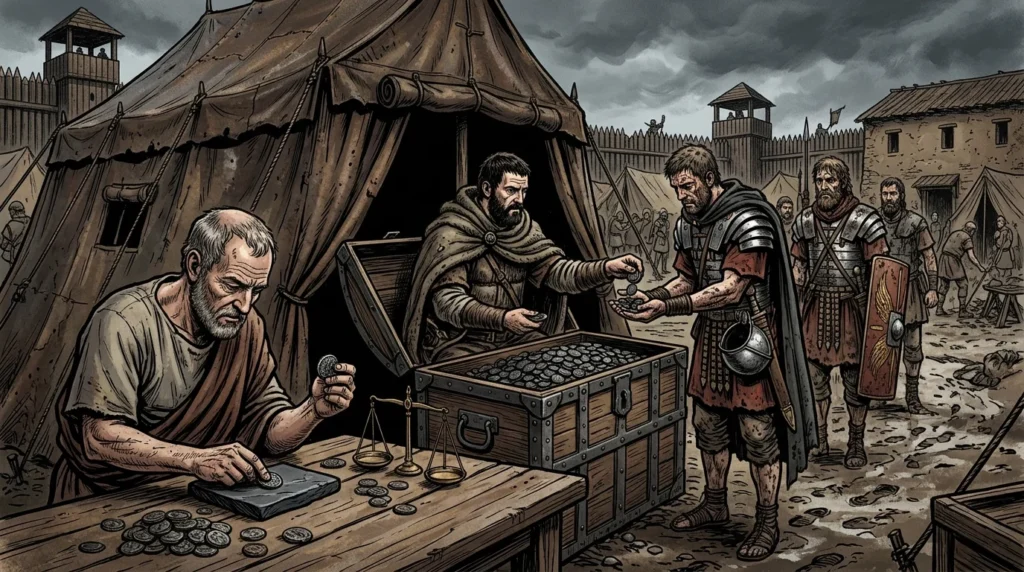
- The 3-Sesterce Price Control: Most decisively, Nero slashed the market price of state-supplied wheat to 3 sesterces per modius (pretiumque frumenti minutum usque ad ternos nummos)—roughly half the prevailing retail price—allowing non-dole residents and destitute fire victims to purchase staple grain at a heavily subsidized ceiling.
- Bounties and Tax Exemptions: As Cassius Dio and Tacitus noted, Nero also suspended port duties on emergency food shipments and offered cash bonuses to grain captains who delivered cargoes ahead of schedule, celebrating the restoration of food security on brass sestertii struck between 64 and 66 CE depicting the goddesses Annona and Ceres flanking a grain measure (modius) and the prow of a grain ship.
Structural Imbalance: Wine Booms, Cereal Deficits, and Domitian’s 92 CE Vine Edict
While emergency subsidies could cushion a sudden urban shock like the fire of 64 CE, the broader agrarian economy of Italy and the provinces faced a deeper structural distortion during the late first century CE: the rapid expansion of commercial viticulture at the expense of cereal cultivation. Because vineyards planted on fertile plains yielded substantially higher cash returns per iugerum than wheat or barley, wealthy Roman and provincial landowners increasingly converted arable grain land into wine estates. When the eruption of Mount Vesuvius in August 79 CE destroyed the premier wine-producing slopes around Pompeii, Stabiae, and Herculaneum, wine prices spiked temporarily, sparking a speculative vineyard-planting boom across central Italy and the provinces during the 80s CE. [8]
By 92 CE, under the Flavian emperor Domitian (81–96 CE), that planting boom culminated in a severe macroeconomic mismatch: a massive harvest of grapes produced a wine glut that crashed wine prices, while poor weather and reduced cereal acreage triggered acute grain shortages in Asia Minor and other provinces—vividly echoed in contemporaneous texts from the eastern Mediterranean contrasting scarce, expensive wheat and barley with abundant wine and oil.
According to Suetonius (Domitian 7.2), Domitian responded in 92 CE with one of the most sweeping agricultural market interventions in ancient history, the famous Vine Edict:
- Italian Moratorium: He prohibited the planting of any new vineyards anywhere in Italy (ne quis in Italia novellaret).
- Provincial Uprooting Mandate: He ordered that existing vineyards across the provinces be cut down, leaving at most half of the vines standing (utque in provinciis vineta succiderentur, relicta ubi plurimum dimidia parte), so that arable plains would return to cereal production for local cities and the imperial annona.
Provincial Resistance and the Limits of Imperial Market Intervention
Domitian’s 92 CE Vine Edict provoked fierce lobbying across the Greek East, where viticulture formed the backbone of municipal revenues and aristocratic wealth. As Philostratus later recounted in his Lives of the Sophists, the Ionian assembly dispatched the celebrated rhetorician Scopelian of Clazomenae as an ambassador to Rome; Scopelian argued so persuasively before the emperor that Domitian exempted Asia Minor from the uprooting order and even threatened penalties against those who neglected viticulture. As Suetonius concisely remarked, Domitian “did not persist in carrying out the measure” (nec exsequi rem perseveravit).
Although the provincial uprooting mandate proved administratively impossible to enforce across the empire and was formally repealed nearly two centuries later by Emperor Probus (c. 280 CE), the edict of 92 CE—like Nero’s 3-sesterce grain ceiling in 64 CE—revealed the central tension of the Roman imperial economy. Operating within a predominantly private commercial network, the Principate allowed market prices and profit signals to allocate land and shipping under normal conditions, yet never hesitated to deploy direct price controls, tax exemptions, and agricultural mandates whenever urban bread prices or provincial grain supplies threatened imperial stability.
Theoretical & Balance-Sheet Transmission Mechanism
In the Kindleberger–Minsky taxonomy of financial instability (Kindleberger, 1978; Minsky, 1986) and Irving Fisher’s (1933) debt-deflation framework, speculative asset booms become systemic crises when credit expansion shifts balance sheets from hedge finance (cash flows covering principal and interest) to speculative and Ponzi finance (relying on rising asset prices and short-term margin roll-overs).
Once monetary tightening or an exogenous shock halts price appreciation, forced margin liquidations trigger Fisherian debt-deflation: fire-sale asset discounts erode bank collateral values, contracting credit supply across the real economy.
Sources and Further Reading
- Cornelius Tacitus, “ The Annals, Book 15, Chapters 38–43 (The Great Fire of 64 CE and Nero’s Reduction of the Grain Price to Three Sesterces),” LacusCurtius, University of Chicago, c. 116 CE. Peer-Reviewed / Academic Research
- Gaius Suetonius Tranquillus, “ The Lives of the Twelve Caesars: Life of Domitian, Chapter 7.2 and Chapter 14.2 (The 92 CE Vineyard Edict),” LacusCurtius, University of Chicago, c. 121 CE. Peer-Reviewed / Academic Research
- Gaius Suetonius Tranquillus, “ The Lives of the Twelve Caesars: Life of Claudius, Chapters 18–20 (Portus Harbor and Grain Fleet Insurance),” LacusCurtius, University of Chicago, c. 121 CE. Peer-Reviewed / Academic Research
- Gaius Suetonius Tranquillus, “ The Lives of the Twelve Caesars: Life of Nero, Chapter 38 (The Great Fire and Grain Provisioning),” LacusCurtius, University of Chicago, c. 121 CE. Peer-Reviewed / Academic Research
- Merav Haklai, “ Money in the Roman Empire from Hadrian to the Severi: A Study of Attitudes and Practice,” Oxford University Research Archive (ORA), University of Oxford, 2013. Peer-Reviewed / Academic Research
- Donald L. Wasson, “ Domitian,” World History Encyclopedia, 2013. Historical & Financial Reference
- Irving Fisher — "The Debt-Deflation Theory of Great Depressions," Econometrica 1, no. 4 (FRASER Federal Reserve Archive, 1933): 337–357 Central Bank / Monetary Authority
- Charles P. Kindleberger & Robert Z. Aliber — Manias, Panics, and Crashes: A History of Financial Crises (Palgrave Macmillan) Peer-Reviewed / Academic Research
Cite This Historical Dossier (APA / Chicago)
APA (7th ed.): Ç., S. (Ed.). (2026). The Imperial Annona, Nero's 64 CE Price Cap, and Domitian's 92 CE Vine Edict. In Forgotten Fortunes Historical Monograph Series (Forgotten Fortunes Editorial Desk). https://forgottenfortunes.net/roman-annona-grain-price-controls/
MLA (9th ed.): Ç., Soner, ed. "The Imperial Annona, Nero's 64 CE Price Cap, and Domitian's 92 CE Vine Edict." Forgotten Fortunes: Financial & Monetary History Archive, 2026, https://forgottenfortunes.net/roman-annona-grain-price-controls/.
Chicago (17th ed.): Ç., Soner, ed. "The Imperial Annona, Nero's 64 CE Price Cap, and Domitian's 92 CE Vine Edict." Forgotten Fortunes Historical Monograph Series (Forgotten Fortunes Editorial Desk), September 12, 2026. https://forgottenfortunes.net/roman-annona-grain-price-controls/.
Have an idea for another financial history documentary or article? Request a story →