In This Article
South Korea faced a crisis in 1997 that exposed vulnerabilities in short-term foreign borrowing. In November 1997, the Republic of Korea—then the world’s eleventh-largest economy and recently admitted to the Organisation for Economic Co-operation and Development (OECD)—stood days away from a sovereign moratorium on its external debt. At the epicenter of the implosion stood two mutually reinforcing vulnerabilities: thirty lightly regulated merchant banking corporations (*jonggeumsa*, or *jonghap geumyung hoesa*) that had borrowed tens of billions of dollars in short-term offshore interbank funds to finance long-term domestic investments, and sprawling family-controlled industrial conglomerates (*chaebol*) whose debt-to-equity ratios exceeded 400%. As serial corporate bankruptcies—from Hanbo Steel and Sammi Steel to Jinro and Kia Motors—crippled domestic balance sheets throughout 1997, international banks refused to roll over short-term dollar lines, leaving the Bank of Korea with only about $6 billion of usable foreign-exchange reserves by early December. On December 3, 1997, Seoul agreed to a rescue program, followed by the IMF’s December 4 approval of a $21 billion Stand-By Arrangement within a broader $58.4 billion international support package, initiating the closure or merger of 16 merchant banks and 5 commercial banks, massive bad-loan purchases by the Korea Asset Management Corporation (KAMCO), and an extraordinary civic mobilization in which 3.51 million citizens contributed 227 tonnes of household gold to help retire the nation’s foreign obligations. [1]
Asymmetric Liberalization and the Rise of the *Jonggeumsa* (1993–1996)
For three decades following the 1960s, South Korea’s state-guided industrialization relied on directed policy loans channeled through commercial banks to export-oriented *chaebol* conglomerates. Implicit state guarantees created a pervasive perception that major industrial groups and financial intermediaries were “too big to fail.” In the early 1990s, as the administration of President Kim Young-sam pursued *Segyehwa* (globalization) and prepared for Korea’s December 1996 accession to the OECD, authorities embarked on a partial, asymmetric deregulation of capital flows and non-bank financial institutions. [2]
Between 1994 and 1996, the Ministry of Finance and Economy permitted twenty-four regional short-term investment and finance companies to convert into wholesale merchant banking corporations (*jonggeumsa*), expanding the sector from just six foreign-affiliated joint ventures established in the 1970s to thirty active institutions. Unlike deposit-taking commercial banks, which remained subject to stricter supervisory ratios by the Office of Bank Supervision, the *jonggeumsa* answered to looser oversight within the Ministry of Finance and Economy, faced minimal foreign-exchange liquidity requirements, and were often directly controlled by second-tier *chaebol* groups. [3]
Crucially, Korea’s capital-account liberalization relaxed controls on short-term offshore borrowing by financial institutions while retaining tight restrictions on long-term foreign borrowing and foreign direct equity ownership. Exploiting low interest rates in Tokyo and London, the thirty *jonggeumsa* aggressively raised 30-to-90-day U.S. dollar and Japanese yen loans on international interbank markets. They deployed these short-term foreign liabilities into two high-risk channels: discounting long-term domestic commercial paper issued by over-extended *chaebol* conglomerates, and purchasing high-yielding, illiquid emerging-market debt in Indonesia, Thailand, Russia, and Latin America. By late 1996, roughly 80% of the *jonggeumsa* sector’s foreign currency liabilities were short-term, whereas more than 85% of their foreign currency assets were long-term—creating an acute maturity and currency mismatch across the Korean financial system. [4]
| Documented Figure / Metric | Historical Significance & Archival Context |
|---|---|
| $22 billion | Treasury, and the IMF coordinated a Christmas Week agreement with major American, European, and Japanese commercial banks to roll over and subsequently convert $22 billion of Korean short-term interbank debt into one-to-three-year government-guaranteed bonds. |
| 80 trillion won | Meanwhile, in August 1999, the government demonstrated that no conglomerate remained "too big to fail" by allowing the dismantle and workout of Daewoo Group—Korea's second-largest *chaebol*—after it collapsed under roughly 80 trillion won ($65 billion) in domestic and foreign liabilities. |
| $2.13 billion | In total, the campaign collected 227 tonnes of gold valued at roughly $2.13 billion to $2.2 billion on the London bullion market. |
The 1997 *Chaebol* Chain Reaction: From Hanbo Steel to Kia Motors
During 1994 and 1995, a surge in global semiconductor, petrochemical, and steel prices masked the fragility of Korean corporate balance sheets, tempting the top thirty *chaebol* into massive debt-financed capacity expansions. By the end of 1996, the average debt-to-equity ratio of the thirty largest *chaebol* reached approximately 387%—nearly four times the equity base—and surpassed 400% (exceeding 500% at several major groups) as export prices for 16-megabit DRAM memory chips crashed by more than 70% in 1996 and the Korean won appreciated in real terms alongside the U.S. dollar against the Japanese yen. [5]
The corporate dominoes began falling on January 23, 1997, when Hanbo Steel, Korea’s fourteenth-largest conglomerate, collapsed under 5.7 trillion won ($6.6 billion) in debt incurred building an over-budget steelworks in Dangjin. Within weeks, Sammi Steel (the twenty-sixth-largest *chaebol*) and Jinro Group (the nineteenth-largest, a beverage giant that had diversified recklessly into retail and construction) defaulted in March and April 1997. In July 1997—just as Thailand abandoned the baht peg and ignited the broader East Asian financial crisis—Korea’s eighth-largest conglomerate, the automaker Kia Group, was placed under bankruptcy protection ordinances with nearly 10 trillion won in liabilities after merchant banks pulled billions of won in short-term commercial paper lines. [6]
Because merchant banks had heavily concentrated their unsecured commercial paper discounting in these distressed industrial groups, non-performing loans (NPLs) soared across both the *jonggeumsa* and commercial banks such as Korea First Bank and Seoul Bank. When the government hesitated over Kia’s resolution before nationalizing the automaker via the state-owned Korea Development Bank in October 1997, international credit rating agencies downgraded Korean sovereign and bank ratings, and following the October 1997 speculative attack on the Hong Kong dollar, foreign commercial banks abruptly cut credit lines to all Korean borrowers. [7]
Reserve Exhaustion and the December 1997 International Rescue
As foreign rollover rates on Korean interbank credit plunged below 30% in November 1997, Korean commercial and merchant banks scrambled to buy dollars in the domestic spot market to repay maturing external obligations. Rather than allowing the won to float freely or letting troubled banks default on foreign counterparties, the Bank of Korea quietly deposited tens of billions of dollars of its official reserves into the overseas branches and offshore subsidiaries of Korean commercial banks so those branches could honor their daily clearing obligations in New York, London, and Tokyo. [8]
Consequently, while officially reported gross reserves still appeared to exceed $20 billion in mid-November, the Bank of Korea’s liquid, usable foreign-exchange reserves—net of illiquid deposits trapped inside distressed overseas branches and forward commitments—fell from roughly $22.5 billion at the end of October to approximately $6 billion by early December 1997. By December 18, usable reserves had fallen further to about $4.2 billion, according to the IMF’s retrospective account. After widening the daily won trading band from 2.25% to 10% on November 19 failed to stem capital flight, Seoul abandoned exchange-rate defense entirely and requested IMF assistance on November 20, 1997. [9]
Following the December 3 program agreement and letter of intent, the IMF Executive Board on December 4 approved a $21 billion Stand-By Arrangement as part of a record $58.4 billion international support package: $21.0 billion from the IMF, $10.0 billion from the World Bank, $4.0 billion from the Asian Development Bank (ADB), and $23.4 billion in “second line of defense” bilateral commitments pledged by the Group of Seven (G7) and other industrialized nations. Despite the announcement, the won plunged from roughly 844 per dollar at the start of 1997 to an intraday nadir near 1,965 per dollar in late December 1997 after leaked reports revealed the true depth of short-term debt and reserve depletion. Stability returned only at the end of December 1997 when the U.S. Federal Reserve, the U.S. Treasury, and the IMF coordinated a Christmas Week agreement with major American, European, and Japanese commercial banks to roll over and subsequently convert $22 billion of Korean short-term interbank debt into one-to-three-year government-guaranteed bonds. [10]
Financial Triage: Closing 16 *Jonggeumsa*, 5 Commercial Banks, and KAMCO’s Cleanup
Under the IMF program and the incoming administration of President-elect Kim Dae-jung (elected in December 1997 and inaugurated in February 1998), South Korea executed a sweeping institutional overhaul of its financial and corporate architecture. In December 1997, the National Assembly passed legislation establishing a unified Financial Supervisory Commission (FSC), which assumed authority in April 1998 to enforce strict Bank for International Settlements (BIS) capital adequacy standards across all financial sectors. [11]
The merchant banks bore the immediate brunt of the triage. Between December 2 and December 10, 1997, the government suspended the operations of fourteen insolvent *jonggeumsa*. Following an intensive evaluation of rehabilitation plans in early 1998, sixteen of the thirty merchant banks had their licenses permanently revoked or were absorbed into healthier institutions by mid-1998, and over the subsequent three years almost the entire standalone *jonggeumsa* sector disappeared through further closures and mergers. On June 29, 1998, the FSC took the unprecedented step of ordering five undercapitalized commercial banks—Donghwa Bank, Dongnam Bank, Daedong Bank, Chungchong Bank, and Kyungki Bank—to exit the market immediately through purchase-and-assumption (P&A) transfers of their performing assets and insured deposits into five stronger acquiring banks, while nationalizing and recapitalizing Korea First Bank and Seoul Bank ahead of foreign sales. [12]
To purge the banking system of toxic corporate debt, the government reorganized and vastly expanded the Non-Performing Asset Management Fund administered by the Korea Asset Management Corporation (KAMCO) alongside deposit-insurance injections by the Korea Deposit Insurance Corporation (KDIC). Raising 20.5 trillion won through government-guaranteed bonds, KAMCO purchased non-performing loans with a face value of approximately 110 trillion won ($90+ billion) from distressed commercial and merchant banks at an average price near 36% of face value, subsequently pioneering international distressed-debt auctions, asset-backed securities (ABS), and corporate restructuring vehicles. Meanwhile, in August 1999, the government demonstrated that no conglomerate remained “too big to fail” by allowing the dismantle and workout of Daewoo Group—Korea’s second-largest *chaebol*—after it collapsed under roughly 80 trillion won ($65 billion) in domestic and foreign liabilities.
The 1998 Citizens’ Gold-Collecting Campaign (*Geum Moeugi Undong*)
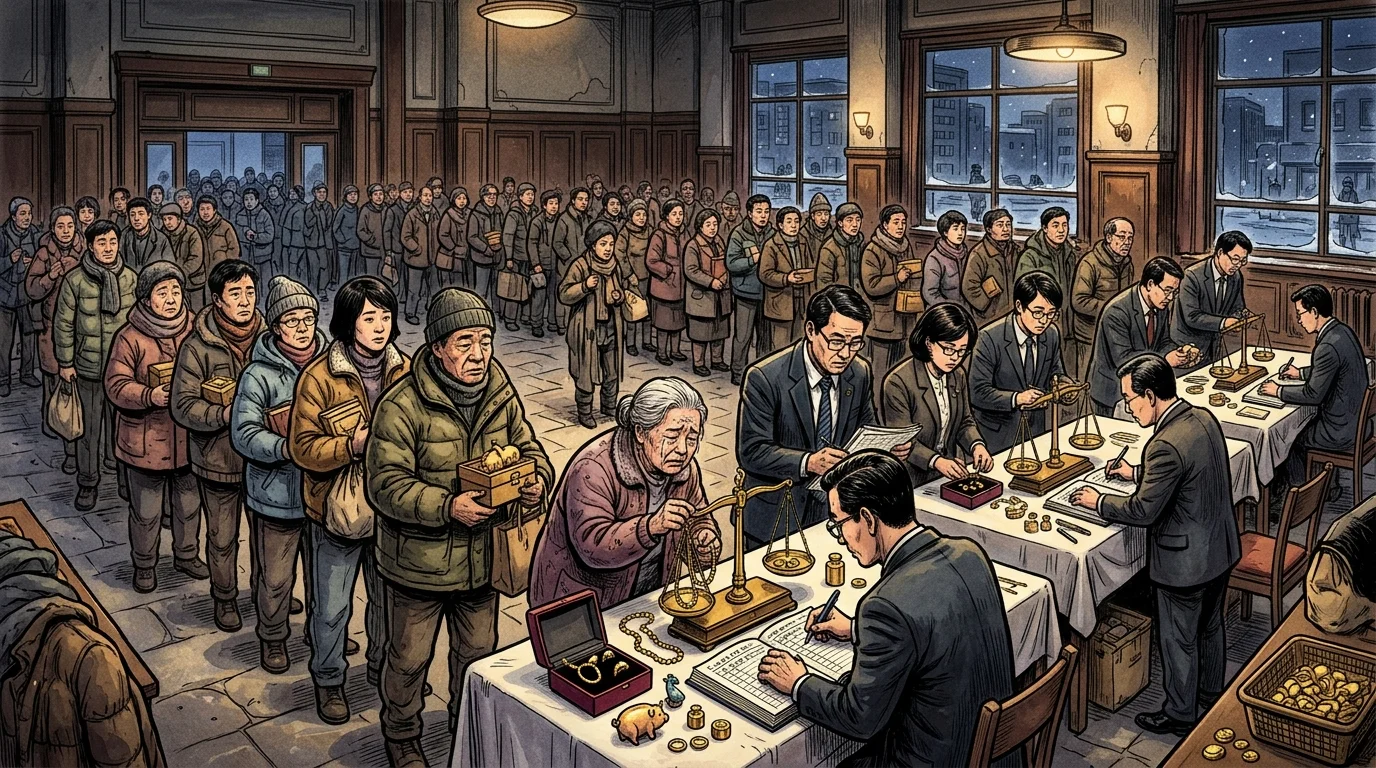
While high overnight interest rates above 25% and corporate restructurings caused South Korea’s real GDP to contract by 5.5% in 1998 and pushed unemployment from 2.6% to over 7%, the crisis also inspired one of modern economic history’s most extraordinary episodes of voluntary civic mobilization: the nationwide Gold-Collecting Campaign (*Geum Moeugi Undong*). Launched on January 5, 1998 through a partnership involving civic organizations, the Korean Broadcasting System (KBS), major newspapers, Korea Housing Bank, NongHyup, and Daewoo Corporation’s export trading arm, the campaign invited citizens to sell or consign household gold for Korean won so the bullion could be refined into standard 99.99% bars and exported for U.S. dollars.
Over the first four months of 1998, approximately 3.51 million South Koreans—representing roughly 23% of the nation’s 15 million households—queued outside bank branches in winter weather to hand over wedding bands, traditional 24-karat first-birthday rings (*dol-banji*), family hairpins, athletic trophies, and commemorative medals. In total, the campaign collected 227 tonnes of gold valued at roughly $2.13 billion to $2.2 billion on the London bullion market. Although $2.2 billion represented a modest fraction of the $58.4 billion rescue package, the physical export of household gold immediately boosted the trade surplus in early 1998 and sent an unmistakable signal of national resolve to international creditors. Driven by a surging current-account surplus of $40 billion in 1998 and rapid IT-led export recovery, South Korea repaid its entire $19.5 billion drawn IMF loan on August 23, 2001—nearly three years ahead of schedule.
Theoretical & Balance-Sheet Transmission Mechanism
In the Kindleberger–Minsky taxonomy of financial instability (Kindleberger, 1978; Minsky, 1986) and Irving Fisher’s (1933) debt-deflation framework, speculative asset booms become systemic crises when credit expansion shifts balance sheets from hedge finance (cash flows covering principal and interest) to speculative and Ponzi finance (relying on rising asset prices and short-term margin roll-overs).
Once monetary tightening or an exogenous shock halts price appreciation, forced margin liquidations trigger Fisherian debt-deflation: fire-sale asset discounts erode bank collateral values, contracting credit supply across the real economy.
Sources and Further Reading
- Tomás J. T. Baliño and Angel Ubide, “ The Korean Financial Crisis of 1997—A Strategy of Financial Sector Reform“, IMF Working Papers, 1999. International Financial Institution
- Dong He, “ The Role of KAMCO in Resolving Nonperforming Loans in the Republic of Korea“, IMF Working Papers, 2004. International Financial Institution
- Pascal Ungersboeck and Sharon Nunn, “ Korea Asset Management Corporation (KAMCO): Resolution of Nonperforming Loans in South Korea“, Journal of Financial Crises, 2021. Peer-Reviewed / Academic Research
- Giancarlo Corsetti, Paolo Pesenti, and Nouriel Roubini, “ What Caused the Asian Currency and Financial Crisis? Part I: A Macroeconomic Overview“, National Bureau of Economic Research, 1998. Peer-Reviewed / Academic Research
- Charles Harvie and Hyun-Hoon Lee, “ Financial Crisis and the IMF Bailout“, Palgrave Macmillan, 2003. International Financial Institution
- Jaedo Choi, Andrei A. Levchenko, and Dimitrije Ruzic, “ Superstars or Supervillains? Large Firms in the South Korean Growth Miracle“, National Bureau of Economic Research, 2024. Peer-Reviewed / Academic Research
- International Monetary Fund, “ IMF Approves SDR 15.5 Billion Stand-by Credit for Korea (Press Release No. 97/55)“, International Monetary Fund, 1997-12-04. International Financial Institution
- International Monetary Fund, “ Republic of Korea: Staff Report for 1999 Article IV Consultation (2000)“, International Monetary Fund, 2000. International Financial Institution
- International Monetary Fund, “ Korea Letter of Intent, December 3, 1997“, International Monetary Fund, 1997-12-03. International Financial Institution
- International Monetary Fund, “ IMF-Supported Programs in Indonesia, Korea, and Thailand: A Preliminary Assessment“, International Monetary Fund, 1999-06-30. International Financial Institution
- Irving Fisher — "The Debt-Deflation Theory of Great Depressions," Econometrica 1, no. 4 (FRASER Federal Reserve Archive, 1933): 337–357 Central Bank / Monetary Authority
- Charles P. Kindleberger & Robert Z. Aliber — Manias, Panics, and Crashes: A History of Financial Crises (Palgrave Macmillan) Peer-Reviewed / Academic Research
Cite This Historical Dossier (APA / Chicago)
APA (7th ed.): Ç., S. (Ed.). (2026). South Korea's 1997 Merchant Bank Collapse, the $58.4B Global Rescue, and Gold Drive. In Forgotten Fortunes Historical Monograph Series (Forgotten Fortunes Editorial Desk). https://forgottenfortunes.net/south-korea-1997-merchant-bank-crisis-imf-bailout/
MLA (9th ed.): Ç., Soner, ed. "South Korea's 1997 Merchant Bank Collapse, the $58.4B Global Rescue, and Gold Drive." Forgotten Fortunes: Financial & Monetary History Archive, 2026, https://forgottenfortunes.net/south-korea-1997-merchant-bank-crisis-imf-bailout/.
Chicago (17th ed.): Ç., Soner, ed. "South Korea's 1997 Merchant Bank Collapse, the $58.4B Global Rescue, and Gold Drive." Forgotten Fortunes Historical Monograph Series (Forgotten Fortunes Editorial Desk), September 6, 2026. https://forgottenfortunes.net/south-korea-1997-merchant-bank-crisis-imf-bailout/.
Have an idea for another financial history documentary or article? Request a story →