In This Article
For nearly four decades after the Second World War, the Venezuelan bolívar stood as one of the hardest and most stable currencies on earth, anchored by vast petroleum royalties and massive gold reserves at the Central Bank of Venezuela (Banco Central de Venezuela, or BCV). Under this hard-money regime—fixed at 3.35 bolívares per US dollar from 1937 to 1960 and at 4.30 bolívares per dollar from 1973 to 1983—Caracas merchants established the Bolsa de Comercio de Caracas in January 1947, laying the institutional foundations for modern Venezuelan capital markets. When the 1973–1974 OPEC oil embargo quadrupled crude prices and President Carlos Andrés Pérez nationalized the oil industry into PDVSA in 1976, an unprecedented flood of petrodollars created the era known as “Saudi Venezuela” (Venezuela Saudita), swelling the newly created Venezuelan Investment Fund (Fondo de Inversiones de Venezuela, or FIV), commercial bank deposits, and Caracas real estate. Yet behind the illusion of boundless wealth, decentralized state enterprises borrowed more than US$30 billion abroad while domestic capital flight drained Central Bank reserves—culminating on Friday, February 18, 1983 (Viernes Negro), when President Luis Herrera Campíns suspended foreign-exchange sales, shattered the 4.30 bolívar peg, and inaugurated the corrupt multi-tier exchange control apparatus known as RECADI. [1]

1947: The Founding of the Bolsa de Comercio de Caracas and the Hard Bolívar
Informal securities trading in Caracas dated back to 1805 and the late nineteenth century, when brokers gathered beneath the shade of the historic Ceiba tree at the corner of San Francisco (Esquina de la Bolsa) near the Capitol to trade shares in the Bank of Caracas, the Bank of Venezuela, utility companies, and government debt. By the mid-1940s, the rapid expansion of Venezuela’s petroleum concessions under the 1943 Hydrocarbons Law and the creation of the Central Bank of Venezuela (which began operations in 1940) generated growing domestic liquidity that outgrew curbstone trading. [2]
Promoted by the Caracas Chamber of Commerce (Cámara de Comercio de Caracas), the Bolsa de Comercio de Caracas, C.A. was formally incorporated on January 21, 1947 with an initial capital of Bs. 500,000 divided into twenty-two broker seats (puestos). On April 21, 1947, the exchange held its inaugural trading floor session (rueda) in leased premises inside the old Central Bank building between Esquinas de Santa Capilla and Carmelitas, opening with eighteen listed corporate equity issues and six government bond series. [3]
The infant stock exchange operated within an extraordinary monetary environment. Because oil companies were legally required to sell US dollars to the Central Bank at a penalty petroleum exchange rate (Bs. 3.09 per dollar) while the commercial rate was fixed at Bs. 3.35 per US dollar (and later re-pegged in the early 1960s and adjusted to Bs. 4.30 per dollar in February 1973), Venezuelan inflation averaged just 1.9 percent per year between 1959 and 1973—lower than in the United States or Western Europe. To modernize equity issuance and investor protection ahead of the coming oil boom, Congress enacted the first Capital Markets Law (Ley de Mercado de Capitales) on January 31, 1973, establishing the National Securities Commission (Comisión Nacional de Valores) and prompting the exchange to reconstitute itself in 1974–1976 as the Bolsa de Valores de Caracas. [4]
| Documented Figure / Metric | Historical Significance & Archival Context |
|---|---|
| 8 percent | Commercial bank deposits, mortgage banks (bancos hipotecarios issuing tax-exempt 8 percent cédulas hipotecarias), and finance companies (sociedades financieras) expanded credit at over 30 percent annually. |
| US$19 billion | Even after the 1979 Iranian Revolution triggered a second oil price spike—pushing Venezuelan crude above US$29 per barrel and annual oil export revenues to nearly US$19 billion in 1980–1981 under President Luis Herrera Campíns—the state continued to borrow heavily while GDP growth ground to a halt. |
| US$33 billion | By 1982, Venezuela's total public and private external debt exceeded US$33 billion to US$35 billion, with nearly half of state-enterprise obligations maturing within twelve months. |
| US$5 billion | 4.30 peg in September 1982, the government centralized PDVSA's offshore dollar reserves (~US$5 billion) at the Central Bank and revalued the BCV's gold holdings from US$42.22 to US$300 per troy ounce. |
1974–1978: The “Saudi Venezuela” Petrodollar Boom, PDVSA, and the FIV
Between October 1973 and early 1974, the Yom Kippur War and the Arab oil embargo quadrupled the realized export price of Venezuelan crude oil from roughly US$3.70 to more than US$14.00 per barrel. Almost overnight, Venezuelan government oil revenues tripled from Bs. 11.2 billion in 1973 to Bs. 36.4 billion (roughly US$8.5 billion) in 1974, coinciding with the March 1974 inauguration of President Carlos Andrés Pérez and his ambitious development program, La Gran Venezuela. [5]
Recognizing that injecting the entire windfall directly into the domestic economy would trigger runaway inflation and Dutch disease, the Pérez administration created the Venezuelan Investment Fund (Fondo de Inversiones de Venezuela, or FIV) by Decree No. 151 in June 1974, initially endowed with Bs. 13 billion (US$3.02 billion). The FIV was tasked with two functions: sterilizing surplus petrodollars abroad through deposits, foreign bonds, and loans to multilateral institutions such as the World Bank and Inter-American Development Bank, and financing capital-intensive domestic industrial mega-projects in the Guayana region—including the expansion of the SIDOR steel mill, the ALCASA and VENALUM aluminum smelters, the Guri hydroelectric dam, and petrochemical complexes, alongside the January 1, 1976 nationalization of the oil industry under Petróleos de Venezuela, S.A. (PDVSA). [6]
Within Venezuela, the petrodollar deluge set off a four-year speculative boom between 1974 and 1978. Commercial bank deposits, mortgage banks (bancos hipotecarios issuing tax-exempt 8 percent cédulas hipotecarias), and finance companies (sociedades financieras) expanded credit at over 30 percent annually. Luxury apartment towers and shopping centers sprouted across eastern Caracas, equity valuations and real-estate prices surged, and middle-class Venezuelans flocked to Miami armed with overvalued 4.30-per-dollar bolívares, popularizing the catchphrase “¡Está barato, dame dos!” (“It’s cheap, give me two!”). [7]
State Enterprise Borrowing and the 1979–1982 Capital Flight Drain
Beneath the euphoria of Venezuela Saudita, a fatal fiscal and balance-of-payments trap was closing. Rather than scaling back public outlays when oil revenues plateaued between 1976 and 1978, hundreds of autonomous state-owned enterprises, regional development corporations, and public banks bypassed congressional debt limits by taking out short-term Eurodollar loans from international commercial bank syndicates in New York and London. Even after the 1979 Iranian Revolution triggered a second oil price spike—pushing Venezuelan crude above US$29 per barrel and annual oil export revenues to nearly US$19 billion in 1980–1981 under President Luis Herrera Campíns—the state continued to borrow heavily while GDP growth ground to a halt. [8]
By 1982, Venezuela’s total public and private external debt exceeded US$33 billion to US$35 billion, with nearly half of state-enterprise obligations maturing within twelve months. Simultaneously, three external shocks hit Caracas in rapid succession: the world oil glut depressed petroleum prices and forced OPEC production cuts; US Federal Reserve Chairman Paul Volcker’s interest-rate hike sent floating Eurodollar debt-service costs above 16 percent; and Mexico’s August 1982 sovereign debt moratorium froze short-term rollovers across Latin America.
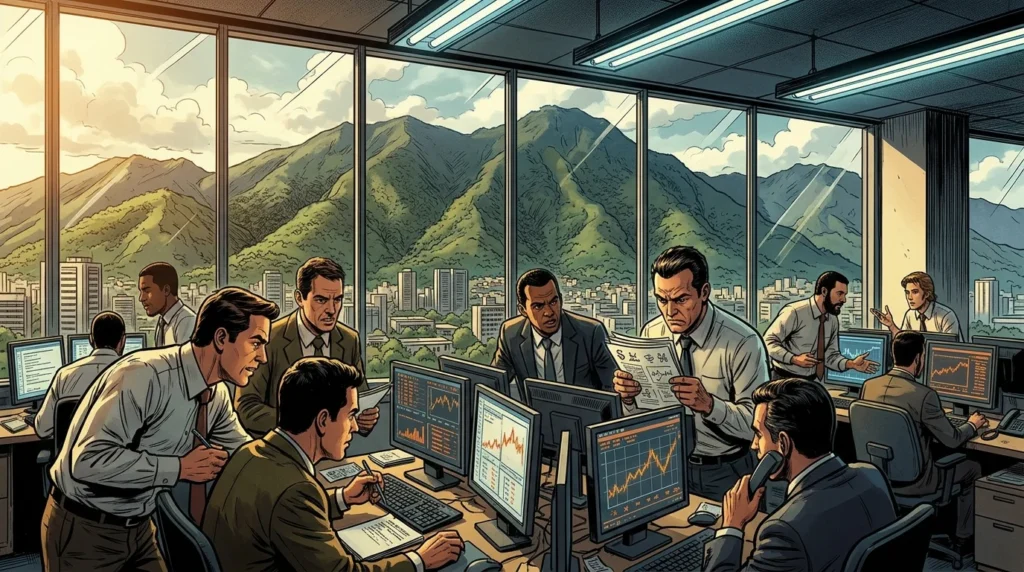
Inside Venezuela, a bitter policy feud erupted between Finance Minister Arturo Sosa and Central Bank President Leopoldo Díaz Bruzual (nicknamed “El Búfalo”). Attempting to defend the Bs. 4.30 peg in September 1982, the government centralized PDVSA’s offshore dollar reserves (~US$5 billion) at the Central Bank and revalued the BCV’s gold holdings from US$42.22 to US$300 per troy ounce. Rather than reassuring markets, these accounting maneuvers convinced Venezuelan conglomerates, banks, and affluent households that devaluation was imminent. Because the bolívar remained freely convertible without limit at Bs. 4.30 per dollar, domestic actors borrowed in bolívares and bought billions of dollars from the Central Bank to transfer to Miami, New York, and Swiss accounts. Throughout 1982 and January 1983, capital flight exceeded US$8 billion, draining liquid Central Bank reserves at a rate of US$150 million to US$200 million per day by mid-February 1983.
February 18, 1983: Viernes Negro and the RECADI Exchange Regime
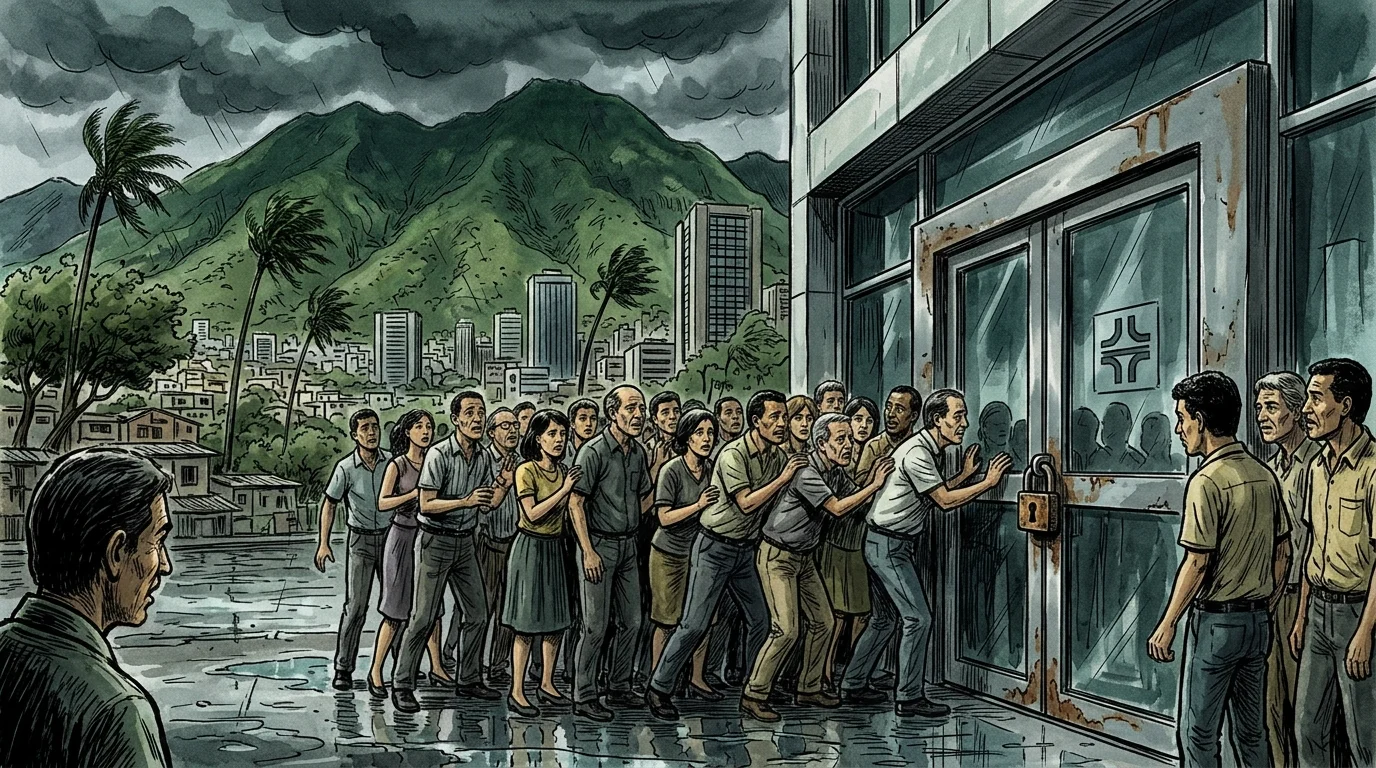
On Friday, February 18, 1983—a date forever etched into Venezuelan memory as Viernes Negro (Black Friday)—Central Bank liquid foreign-exchange reserves fell dangerously low, threatening an outright default on external payments within days. That afternoon, the Herrera Campíns administration ordered the suspension of all foreign-exchange transactions at the Central Bank and commercial banks across the country for an emergency holiday.
Five days later, on February 22, 1983, the government issued Decree No. 1,842, ending nearly half a century of free currency convertibility and replacing the unitary Bs. 4.30 peg with a three-tier exchange-rate system administered by a new agency: the Office of Differential Exchange Regime (Oficina del Régimen de Cambios Diferenciales, or RECADI). Under the initial RECADI architecture:
- First Tier (Bs. 4.30 per US$): Reserved strictly for servicing recognized public and registered private external debt, essential food and medicine imports, and scholarships for Venezuelan students abroad.
- Second Tier (Bs. 6.00 per US$): Applied to non-luxury commercial and industrial raw-material imports approved by government ministries.
- Third Tier (Floating / Free Market on the Bolsa de Valores de Caracas): A free financial rate traded directly through brokerage houses on the floor of the Bolsa de Valores de Caracas for travel, remittances, and non-priority transactions—which immediately leaped to Bs. 7.50 and surpassed Bs. 12 to Bs. 15 per dollar within months.
Intended as a temporary emergency filter, RECADI remained in force for six years (February 1983 to February 1989) under Presidents Luis Herrera Campíns and Jaime Lusinchi, adjudicating more than US$30 billion to US$50 billion in preferential foreign exchange. Because receiving a RECADI import license at Bs. 4.30 or Bs. 7.50 when the free-market dollar traded at Bs. 15 to Bs. 35 guaranteed an instant risk-free windfall, the agency became the epicenter of the largest administrative corruption scandal in twentieth-century Venezuelan history—riddled with phantom shell companies, forged shipping containers, and 200 to 500 percent over-invoicing of imports. When the exhaustion of international reserves finally forced newly inaugurated President Carlos Andrés Pérez to abolish RECADI and unify the exchange rate at roughly Bs. 38 per dollar in February 1989, the resulting price shock triggered the Caracazo urban riots—closing the golden era that had begun when the Caracas Stock Exchange opened its doors under a hard bolívar in 1947.
Theoretical & Balance-Sheet Transmission Mechanism
In the Kindleberger–Minsky taxonomy of financial instability (Kindleberger, 1978; Minsky, 1986) and Irving Fisher’s (1933) debt-deflation framework, speculative asset booms become systemic crises when credit expansion shifts balance sheets from hedge finance (cash flows covering principal and interest) to speculative and Ponzi finance (relying on rising asset prices and short-term margin roll-overs).
Once monetary tightening or an exogenous shock halts price appreciation, forced margin liquidations trigger Fisherian debt-deflation: fire-sale asset discounts erode bank collateral values, contracting credit supply across the real economy.
Sources and Further Reading
- Bolsa de Valores de Caracas, “ Bolsa de Valores de Caracas arribó a 75 años de su fundación,” Bolsa de Valores de Caracas, 2022. Historical & Financial Reference
- Bela Balassa et al., “ Country Economic Report on Venezuela: Policy Choices and Economic Growth,” World Bank, 1987. International Financial Institution
- World Bank Group Archives, “ Fondo de Inversiones de Venezuela (FIV): Correspondence and Loan Agreements,” World Bank Group, 1974. International Financial Institution
- Emmanuel Borgucci and Jennifer Fuenmayor, “ Antecedentes del debilitamiento institucional en Venezuela durante el gobierno de Luis Herrera Campíns,” Espiral (Guadalajara), 2013. Historical & Financial Reference
- Revista SIC, “ El ‘viernes negro’ y las oportunidades perdidas,” Centro Gumilla / Revista SIC, 2018. Historical & Financial Reference
- World Bank, “ Venezuela: Country Economic Memorandum and Public Enterprise Reform,” World Bank, 1993. International Financial Institution
- Irving Fisher — "The Debt-Deflation Theory of Great Depressions," Econometrica 1, no. 4 (FRASER Federal Reserve Archive, 1933): 337–357 Central Bank / Monetary Authority
- Charles P. Kindleberger & Robert Z. Aliber — Manias, Panics, and Crashes: A History of Financial Crises (Palgrave Macmillan) Peer-Reviewed / Academic Research
Cite This Historical Dossier (APA / Chicago)
APA (7th ed.): Ç., S. (Ed.). (2026). Venezuela’s Black Friday: How an Oil Boom Ended in Devaluation. In Forgotten Fortunes Historical Monograph Series (Forgotten Fortunes Editorial Desk). https://forgottenfortunes.net/venezuela-viernes-negro-1983/
MLA (9th ed.): Ç., Soner, ed. "Venezuela’s Black Friday: How an Oil Boom Ended in Devaluation." Forgotten Fortunes: Financial & Monetary History Archive, 2026, https://forgottenfortunes.net/venezuela-viernes-negro-1983/.
Chicago (17th ed.): Ç., Soner, ed. "Venezuela’s Black Friday: How an Oil Boom Ended in Devaluation." Forgotten Fortunes Historical Monograph Series (Forgotten Fortunes Editorial Desk), September 17, 2026. https://forgottenfortunes.net/venezuela-viernes-negro-1983/.
Have an idea for another financial history documentary or article? Request a story →