In This Article
Having abolished stock exchanges and private bond trading after the end of the New Economic Policy in 1929, the Soviet Union operated for six decades without formal secondary capital markets. Yet the absence of a stock ticker did not eliminate financial imbalances, sovereign debt crises, or speculative asset trading. Because Soviet state enterprises paid wages in cash while the centrally planned retail sector chronically underproduced consumer goods at fixed state prices, the postwar USSR accumulated a massive “monetary overhang”—excess household purchasing power with nowhere to go. Between 1946 and 1989, the Kremlin managed this suppressed inflation through three sweeping state interventions and one privileged parallel currency regime: Joseph Stalin’s confiscatory monetary reform of December 1947, Nikita Khrushchev’s April 1957 twenty-year moratorium on 260 billion rubles of compulsory state lottery bonds, the January 1, 1961 ten-to-one “hard ruble” redenomination and external devaluation, and the thriving secondary market in Vneshposyltorg foreign-currency certificates used at elite Beryozka retail stores. [1]

The Postwar Monetary Overhang and the Dual-Circuit Economy
Soviet central planning relied on a strict separation between two monetary circuits: non-cash accounting money (beznalichnye) used purely for inter-enterprise transfers inside the State Bank (Gosbank), and physical cash (nalichnye) paid out to workers as wages and returned to the state through state retail stores. During the Great Patriotic War (1941–1945), military expenditures forced Gosbank to expand the volume of cash in circulation nearly fourfold, from 18.4 billion rubles in June 1941 to roughly 73.9 billion rubles by the end of 1945, even as civilian consumer goods production contracted sharply. [2]
With strict wartime rationing keeping official state store prices frozen at prewar levels, households hoarded vast stacks of paper rubles or spent them on collective-farm peasant markets (kolkhoznye rynki) and urban black markets, where free-market food prices soared to ten or fifteen times official ration prices. For citizens who accumulated wartime fortunes through market trade, bonuses, or illicit speculation, paper rubles functioned as a precarious store of value awaiting the promised abolition of rationing.
Stalin’s December 1947 Confiscatory Cash and Bond Reform
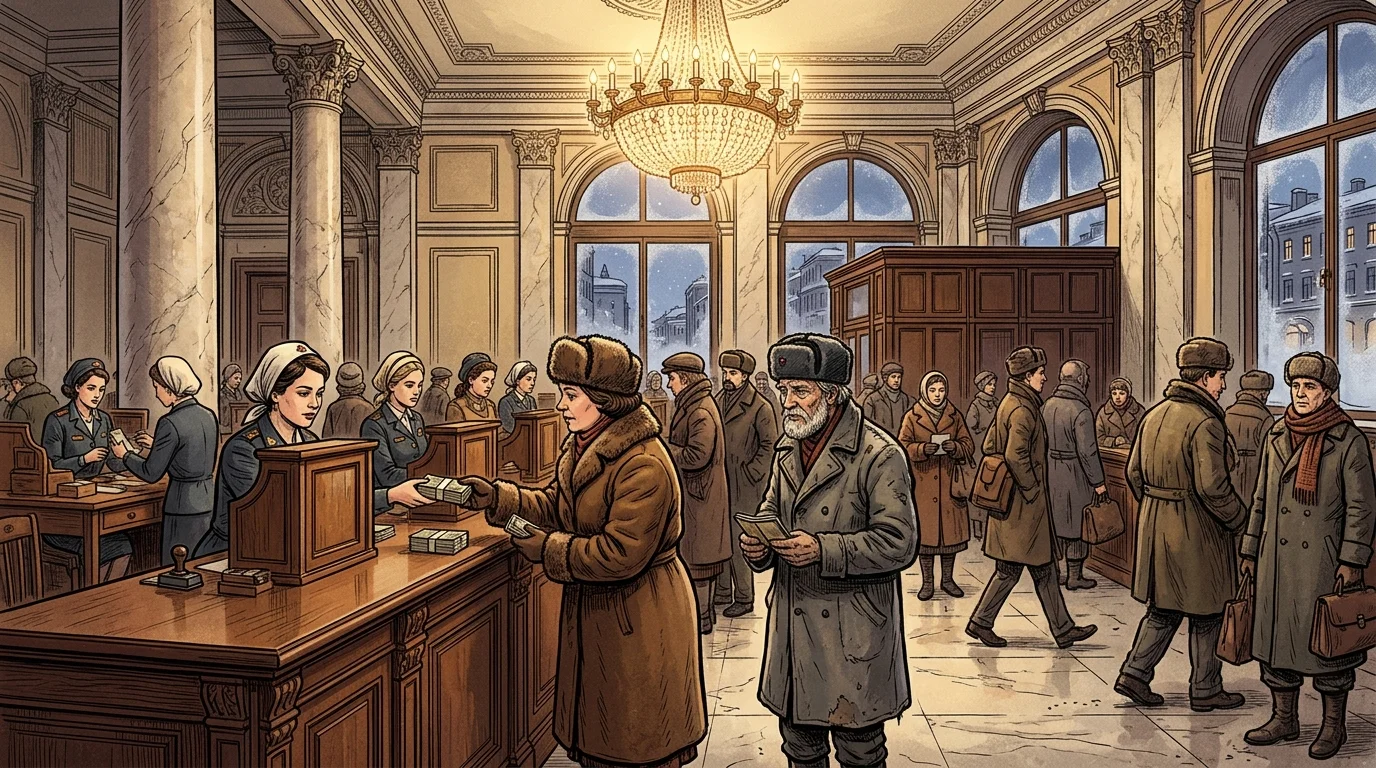
On December 14, 1947, the USSR Council of Ministers and the Central Committee of the Communist Party promulgated a joint decree announcing an immediate currency reform combined with the abolition of the ration-card system. Executed over a single week between December 16 and December 22, 1947 (extended to two weeks in remote Arctic and Far Eastern districts), the reform was explicitly designed to wipe out private cash hoards held outside the state banking system. [3]
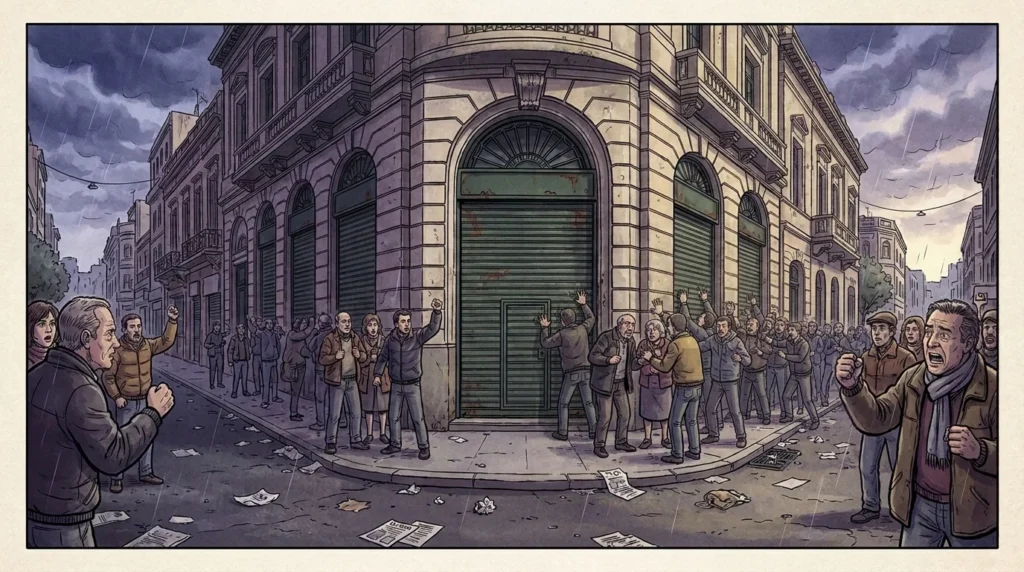
Physical currency in the hands of the population was exchanged at a punitive ratio of ten old rubles for one new 1947-series ruble, erasing 90 percent of the nominal value of cash holdings overnight. Wages, pensions, and official state retail prices remained unchanged in nominal terms, while deposits held inside State Labor Savings Banks (Sberkassy) received tiered treatment to reward compliant savers: balances up to 3,000 rubles were exchanged one-for-one, the portion between 3,000 and 10,000 rubles was converted at three old rubles for two new rubles (a 33.3 percent haircut), and balances above 10,000 rubles were cut at a two-for-one ratio (a 50 percent haircut). Because leaks of the decree reached well-connected officials and black-market operators days before December 16, thousands rushed to savings banks to split large cash piles into multiple accounts under 3,000 rubles or bought up furs, jewelry, and pianos from commercial stores. [4]
Simultaneously, the December 1947 decree targeted the state’s internal debt. All wartime and prewar state bonds held by citizens—except the 1947 Second Five-Year Plan loan—were forcibly consolidated into a single 1948 conversion loan offering only 2 percent annual interest at a confiscatory ratio of three old bond rubles for one new bond ruble, slashing two-thirds of household bond wealth in a single stroke. [5]
Compulsory Payroll Subscriptions and the April 1957 State Bond Freeze
Even after writing off two-thirds of existing bond principal in 1947, the Soviet Ministry of Finance continued to rely on annual “state lottery loans for the development of the national economy” (gosudarstvennye zaimy) to siphon purchasing power out of workers’ paychecks. Although officially described as voluntary patriotic subscriptions, bond drives functioned as a mandatory payroll tax. Every spring, workplace party committees and trade union activists pressured employees to pledge three to four weeks’ wages—roughly 8 percent to 10 percent of annual gross pay—payable via automatic monthly payroll deductions. In exchange, workers received physical bearer bond certificates that paid no regular coupon interest to individual holders; instead, 3 percent to 4 percent of the aggregate issue was paid out each year via lottery drawings for cash prizes, while non-winning bonds were scheduled to be redeemed at face value after twenty years. [6]
By the mid-1950s, this pyramid of forced borrowing had reached a fiscal breaking point. Cumulative state bond debt owed to Soviet citizens had ballooned to approximately 260 billion rubles. Annual lottery prize payouts and maturing redemptions from late-1930s and postwar tranches were consuming nearly 15 billion to 17 billion rubles per year, threatening to swallow more than half of the proceeds raised from each new bond drive. Rather than allow maturing bond redemptions to flood consumer markets with cash, First Secretary Nikita Khrushchev announced in March and April 1957—standardized by the joint Party and government decree of April 19, 1957—a radical restructuring framed as a “worker-supported” initiative. Beginning in 1958, the Soviet state abolished compulsory annual payroll bond subscriptions, but simultaneously froze all 260 billion rubles of previously issued state lottery bonds for twenty years. Lottery drawings and principal redemptions on those bonds were suspended until 1977–1997, effectively defaulting on a generation of forced household savings without compensation for inflation or lost time value. [7]
Khrushchev’s January 1, 1961 “Hard Ruble” Redenomination
Four years after freezing the domestic bond debt, Khrushchev launched a sweeping monetary overhaul that took effect on January 1, 1961. Announced in May 1960 to give citizens and enterprises months to prepare, the 1961 reform replaced 1947-series banknotes with smaller, colorful 1961-series notes (popularly nicknamed “Khrushchev candy wrappers”) at a uniform ten-to-one ratio across the entire economy. Unlike the 1947 confiscation, all cash, savings deposits, wages, pensions, and state retail prices were divided by ten equally during the first quarter of 1961. [8]
Beneath this neutral domestic accounting shift, however, lay two major economic adjustments. First, while state store prices were divided by ten, collective-farm market vendors rounded prices upward in new kopeks and rubles, and the state refused to divide by ten the small copper 1-, 2-, and 3-kopek coins already in circulation, sparking widespread coin hoarding prior to January 1961. Second, the reform executed a 55.6 percent external devaluation of the ruble’s gold parity. In March 1950, Stalin had pegged the ruble’s theoretical gold content at 0.222168 grams of fine gold (4 rubles per U.S. dollar). Had the 1961 ten-to-one domestic redenomination been applied neutrally to external parity, one new ruble would have equaled 2.22168 grams of gold (0.40 rubles per U.S. dollar). Instead, the Soviet Council of Ministers fixed the new ruble’s gold content at 0.987412 grams of fine gold, establishing an official exchange rate of 0.90 new rubles per U.S. dollar ($1.11 per ruble) to align foreign trade prices more closely with world market realities while allowing Soviet propaganda to boast that the ruble was now “heavier” than the greenback.
Vneshposyltorg Certificates and the Parallel Beryozka Market
In the same year that the 1961 “hard ruble” debuted, the Soviet state formalized a domestic dual-currency retail network that openly contradicted the official claim of a full-value currency. Founded in 1961 in Moscow and Leningrad before expanding across the USSR, the Beryozka (“Birch Tree”) chain of hard-currency shops sold scarce Western clothing, Japanese electronics, imported liquor, delicacies, and priority Volga and Zhiguli automobiles outside the long queues of ordinary state stores.
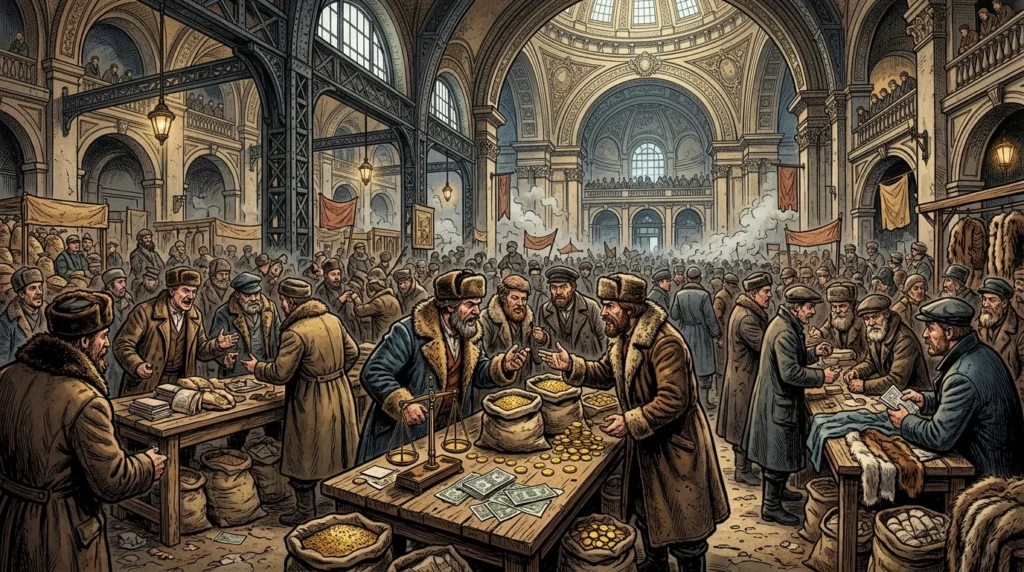
Because private possession of foreign banknotes (such as U.S. dollars or West German marks) by ordinary Soviet citizens remained a serious criminal offense under Article 88 of the RSFSR Criminal Code, Soviet diplomats, engineers, sailors, and artists earning hard currency abroad were required to convert their foreign earnings into special paper scrip—Vneshposyltorg checks (certificates) and Vneshtorgbank checks denominated in “certificate rubles.” Depending on the origin of the hard currency (convertible Western currencies, clearing currencies from socialist bloc states, or developing-world currencies), Vneshposyltorg initially issued distinct certificate types—striped, blue, or unstriped—before unifying them in the 1970s. Inside a Beryozka store, one certificate ruble could purchase goods worth many times what an ordinary paper ruble could buy in the deficit economy. Consequently, a vibrant underground secondary market sprang up outside every Beryozka shop, where black-market currency brokers (fartsovshchiki) and affluent Soviet citizens openly bought and sold Vneshposyltorg certificates at a floating market rate of five to eight ordinary Soviet rubles per one certificate ruble—operating as an informal shadow exchange rate that priced the true depreciation of the Soviet ruble until the Beryozka check system was abolished in 1988.
Theoretical & Balance-Sheet Transmission Mechanism
In the Kindleberger–Minsky taxonomy of financial instability (Kindleberger, 1978; Minsky, 1986) and Irving Fisher’s (1933) debt-deflation framework, speculative asset booms become systemic crises when credit expansion shifts balance sheets from hedge finance (cash flows covering principal and interest) to speculative and Ponzi finance (relying on rising asset prices and short-term margin roll-overs).
Once monetary tightening or an exogenous shock halts price appreciation, forced margin liquidations trigger Fisherian debt-deflation: fire-sale asset discounts erode bank collateral values, contracting credit supply across the real economy.
Sources and Further Reading
- Kristy Ironside, “ A Full-Value Ruble: The Promise of Prosperity in the Postwar Soviet Union,” Harvard University Press, 2021. Peer-Reviewed / Academic Research
- Kristy Ironside, “ Rubles for Victory: The Social Dynamics of State Fundraising on the Soviet Home Front,” Kritika: Explorations in Russian and Eurasian History, 2014. Peer-Reviewed / Academic Research
- Kristy Ironside, “ Khrushchev’s Cash-and-Goods Lotteries and the Turn Toward Positive Incentives,” The Soviet and Post-Soviet Review, 2014. Peer-Reviewed / Academic Research
- Anna Ivanova, “ ‘This could only have been done by a person of the capitalist breed’: Retail price increases in the late Soviet Union (1977-1983),” Cahiers du monde russe, 2023. Peer-Reviewed / Academic Research
- Moshe Lewin, “ Beryozka Shops,” in The Soviet Century, Verso Books, 2023. Peer-Reviewed / Academic Research
- Yuri Kropin, “ Foreign Policy Reasons and Economic Effect of the 1947 Monetary Reform in the USSR,” Atlantis Press, 2018. Peer-Reviewed / Academic Research
- Irving Fisher — "The Debt-Deflation Theory of Great Depressions," Econometrica 1, no. 4 (FRASER Federal Reserve Archive, 1933): 337–357 Central Bank / Monetary Authority
- Charles P. Kindleberger & Robert Z. Aliber — Manias, Panics, and Crashes: A History of Financial Crises (Palgrave Macmillan) Peer-Reviewed / Academic Research
Cite This Historical Dossier (APA / Chicago)
APA (7th ed.): Ç., S. (Ed.). (2026). The 1947 and 1961 Soviet Monetary Reforms, the 1957 Bond Freeze, and Beryozka Scrip. In Forgotten Fortunes Historical Monograph Series (Forgotten Fortunes Editorial Desk). https://forgottenfortunes.net/soviet-bond-freeze-beryozka/
MLA (9th ed.): Ç., Soner, ed. "The 1947 and 1961 Soviet Monetary Reforms, the 1957 Bond Freeze, and Beryozka Scrip." Forgotten Fortunes: Financial & Monetary History Archive, 2026, https://forgottenfortunes.net/soviet-bond-freeze-beryozka/.
Chicago (17th ed.): Ç., Soner, ed. "The 1947 and 1961 Soviet Monetary Reforms, the 1957 Bond Freeze, and Beryozka Scrip." Forgotten Fortunes Historical Monograph Series (Forgotten Fortunes Editorial Desk), September 10, 2026. https://forgottenfortunes.net/soviet-bond-freeze-beryozka/.
Have an idea for another financial history documentary or article? Request a story →