In This Article
On the evening of Saturday, October 6, 1979—the weekend before Columbus Day—Federal Reserve Chairman Paul A. Volcker summoned reporters to an unscheduled press conference at the Eccles Building in Washington, D.C. [1]. Less than two months into his chairmanship, Volcker announced that the Federal Open Market Committee (FOMC) had just voted to overhaul the way the nation’s central bank conducted monetary policy [1][2]. Rather than continuing to manage day-to-day fluctuations in the overnight federal funds rate within a narrow band, the Federal Reserve would directly constrain the volume of bank reserves in the financial system to choke off the runaway growth of the money supply [1][2].
Remembered in financial history as the “Saturday Night Special,” Volcker’s October 1979 reform launched a four-year campaign to break the back of American stagflation [1][2]. By allowing short-term borrowing costs to surge to a postwar record of 20 percent in late 1980 and early 1981, the Federal Reserve triggered back-to-back recessions in 1980 and 1981–1982, driving national unemployment to a peak of 10.8 percent in late 1982 and provoking fierce backlash from farmers, homebuilders, and both parties in Congress [1][4]. Yet by refusing to capitulate until inflation fell from double digits to below 4 percent by 1983, the Volcker Fed shattered entrenched inflationary psychology, restored central bank credibility, and ushered in the two-decade expansion known as the Great Moderation [1][3][5].
1965–1979: The Great Inflation and the Failure of “Stop-Go” Policy
The crisis that confronted Paul Volcker in the summer of 1979 was the culmination of nearly fifteen years of mounting price instability known to historians as the Great Inflation [5]. In 1964, U.S. consumer price inflation had averaged slightly more than 1 percent per year [5]. Guided by Keynesian stabilization doctrine and the belief in a stable “Phillips Curve” trade-off between lower unemployment and modestly higher inflation, policymakers in the late 1960s and 1970s repeatedly prioritized full employment under the framework of the Employment Act of 1946 [4][5].
Throughout the 1970s, under Chairmen Arthur F. Burns (1970–1978) and G. William Miller (1978–1979), the Federal Reserve fell into a self-defeating pattern that economists termed “stop-go” monetary policy [1][4][5]. Whenever inflation accelerated, the central bank entered a brief “stop” phase, nudging short-term interest rates higher [4]. As soon as borrowing costs slowed economic activity and unemployment began to rise, however, political pressure and recession fears prompted a “go” phase of premature monetary easing before price pressures were fully extinguished [1][4].
After tightening policy in 1973 amid the first global oil shock, the Fed eased prematurely during the severe 1973–1975 recession [1][5]. Year-over-year inflation as measured by the personal consumption expenditures (PCE) index bottomed out at 5 percent in December 1976—well above its 1960s baseline—before ratcheting higher once again [1]. Because businesses, labor unions, and bond investors came to expect that the central bank would always accommodate higher prices to protect jobs, each cycle left both inflation and unemployment higher than the last, a debilitating combination popularized as “stagflation” [1][4].
By January 1979, under Chairman Miller, year-over-year PCE inflation had climbed to 7.7 percent, while the U.S. dollar had lost 12 percent of its value against major foreign currencies since late 1976 [1]. When a second oil shock erupted in 1979, headline consumer price inflation surged into double digits [4][5]. Facing a crisis of confidence in both the currency and his economic team, President Jimmy Carter nominated Miller to serve as Treasury Secretary in mid-1979 and turned to Paul Volcker—then president of the Federal Reserve Bank of New York and a vocal hawk who had repeatedly dissented against accommodative FOMC decisions—to lead the Board of Governors [1][4]. At his Senate Banking Committee confirmation hearing in July 1979, with inflation running near 9 percent, Volcker made clear that reining in money supply growth and restoring price stability would be his overriding priority [1].
| Documented Figure / Metric | Historical Significance & Archival Context |
|---|---|
| 20 percent | Politically, by framing the reform as a technical shift to control the money supply rather than a discretionary vote to set 20 percent interest rates, Volcker insulated the FOMC just enough to let market rates rise to levels that would never have survived a traditional gradualist vote. |
| 11.6 percent | In March 1980, year-over-year PCE inflation reached 11.6 percent—while the broader Consumer Price Index (CPI) topped 14 percent—and the Carter administration invoked the Credit Control Act to impose temporary restraints on consumer and commercial borrowing. |
| 11 percent | Treasury bonds actually climbed from roughly 11 percent in October 1980 to more than 15 percent in October 1981, even as the economy slowed. |
| 30 percent | Although goods-producing industries accounted for only 30 percent of total U.S. employment at the time, they suffered 90 percent of all job losses in 1982, with three-quarters of those cuts concentrated in manufacturing. |
October 6, 1979: The Reserve-Targeting Mechanism
Upon taking office in August 1979, Volcker initially nudged the federal funds rate slightly higher [1]. Yet as unemployment ticked up toward 6 percent in September, an unnamed Treasury official told the Wall Street Journal that the central bank would inevitably abandon tightening once joblessness reached 7 percent, “because the unemployment rate will be too high and Congress isn’t willing to bear that burden” [1]. FOMC transcripts later analyzed by Federal Reserve economists David E. Lindsey, Athanasios Orphanides, and Robert H. Rasche reveal that Volcker and his colleagues recognized that incremental, “gradualist” tweaks to the federal funds rate had completely lost credibility with financial markets [2].
Moreover, targeting nominal interest rates during a period of rapidly shifting inflation was operationally treacherous [1][4]. Even when the Fed set nominal interest rates at seemingly high levels, rising inflation expectations meant that real interest rates—nominal yields minus expected inflation—remained low or even negative, continuing to stimulate borrowing and money creation [4]. Under the Full Employment and Balanced Growth Act of 1978 (the Humphrey-Hawkins Act), the Fed was already required to report annual growth targets for monetary aggregates such as M1 and M2 to Congress, yet its narrow federal funds rate bands prevented it from hitting those targets [1][2][5].
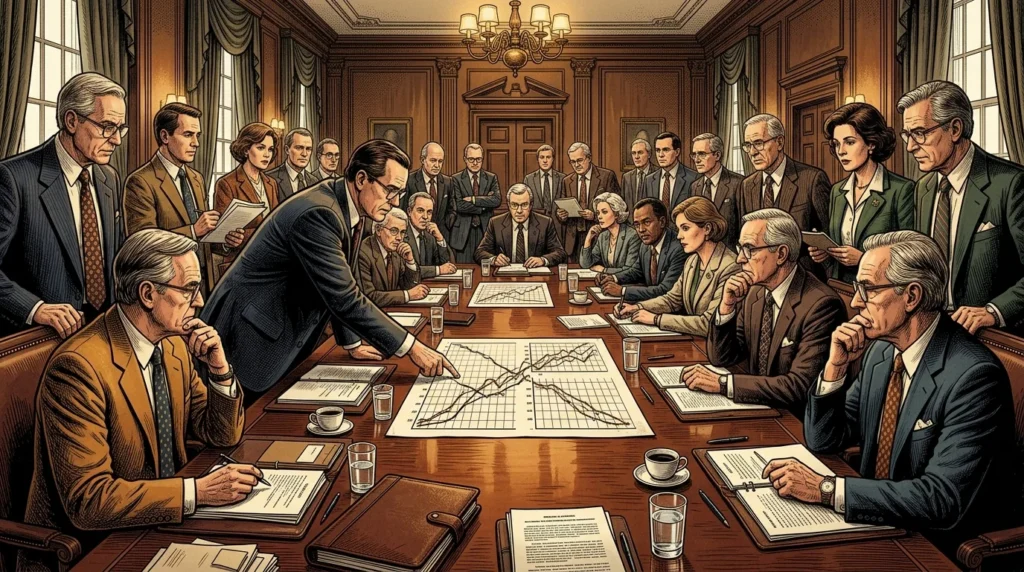
At the unscheduled FOMC meeting on Saturday, October 6, 1979, Volcker persuaded the Committee to change the plumbing of monetary policy [1][2]. Instead of supplying whatever bank reserves were needed to peg the daily federal funds rate, the Open Market Desk would target the quantity of nonborrowed reserves supplied to commercial banks [1][2]. As Volcker explained to reporters that evening, “By emphasizing the supply of reserves and constraining the growth of the money supply through the reserve mechanism, we think we can get firmer control over the growth in money supply in a shorter period of time,” warning that the overnight federal funds rate was now “apt to fluctuate over a wider range than had been the practice in recent years” [1].
The new operating procedure served a dual purpose—both technical and political [2][4]. Mechanically, capping bank reserves forced commercial banks bidding for scarce overnight liquidity to drive interest rates up automatically whenever credit demand exceeded the Fed’s money-growth targets [1][2]. Politically, by framing the reform as a technical shift to control the money supply rather than a discretionary vote to set 20 percent interest rates, Volcker insulated the FOMC just enough to let market rates rise to levels that would never have survived a traditional gradualist vote [2][3].
The 1980 Credit Crunch and the Credibility Problem
Even after the October 1979 announcement, breaking a decade of entrenched expectations proved harder than a single policy shift [3][4]. In March 1980, year-over-year PCE inflation reached 11.6 percent—while the broader Consumer Price Index (CPI) topped 14 percent—and the Carter administration invoked the Credit Control Act to impose temporary restraints on consumer and commercial borrowing [1][4][5]. The sudden freeze in retail credit plunged the U.S. economy into a brief, sharp recession in the spring and summer of 1980, pushing unemployment to roughly 7.5 percent [4].
As output contracted in mid-1980, the Federal Reserve briefly allowed interest rates to fall and eased reserve pressures—an episode that many market participants interpreted as a return to familiar 1970s “stop-go” backsliding [3][4]. When the credit controls were lifted and inflation rebounded in the autumn of 1980, Volcker and the FOMC tightened reserve supply ferociously [1][4]. By late 1980 and early 1981, the overnight federal funds rate reached an unprecedented record peak of 20 percent [1][4].
In a landmark 2005 study for the National Bureau of Economic Research, economists Marvin Goodfriend and Robert G. King demonstrated through FOMC transcripts that “imperfect policy credibility” accounted for much of the severity of the Volcker disinflation [3]. Because bondholders and corporate price-setters doubted that the Fed would endure a deep recession without blinking, yields on 10-year U.S. Treasury bonds actually climbed from roughly 11 percent in October 1980 to more than 15 percent in October 1981, even as the economy slowed [3][4]. Speaking in April and September 1981, Volcker sought to convince skeptical markets that there would be no retreat: “We have set our course to restrain growth in money and credit. We mean to stick with it,” adding that “failure to carry through now in the fight on inflation will only make any subsequent effort more difficult” [4].
1981–1982: Severe Recession and Political Firestorm
With short-term borrowing rates near 20 percent and long-term bond yields above 15 percent, the U.S. economy entered its second, far deeper downturn in July 1981 [4]. Lasting sixteen months through November 1982, the 1981–1982 contraction became the steepest American economic slump since the Great Depression until 2008 [4].
Interest-sensitive industries bore the brunt of the monetary vise [1][4]. Although goods-producing industries accounted for only 30 percent of total U.S. employment at the time, they suffered 90 percent of all job losses in 1982, with three-quarters of those cuts concentrated in manufacturing [4]. By the end of 1982, sector-specific unemployment reached 22 percent in residential construction and 24 percent in automobile manufacturing [4]. Across the country, national unemployment climbed from 7.4 percent at the start of the recession in mid-1981 to a postwar peak of 10.8 percent in late 1982 [1][4].
Public anger converged directly on the Eccles Building [1]. Debt-strapped farmers drove their tractors into Washington to blockade Federal Reserve headquarters; auto dealers mailed Volcker miniature coffins filled with the ignition keys of unsold cars; and homebuilders sent wooden two-by-fours stamped with pleas for lower mortgage rates [1]. Inside Capitol Hill hearing rooms in 1981, attacks came from across the ideological spectrum [1]. Conservative Idaho Republican Representative George Hansen declared, “We are destroying the small businessman. We are destroying Middle America. We are destroying the American dream” [1]. During the same hearing, Illinois Democrat Frank Annunzio pounded his desk and accused the central bank of favoring large corporations over small enterprises, while Texas Democrat Henry B. Gonzalez threatened to introduce articles of impeachment against Volcker and a majority of the Board of Governors [1].
Pressure also mounted from within the executive branch and congressional leadership [1]. Newly elected President Ronald Reagan privately affirmed the Fed’s statutory independence upon taking office in 1981, but his Treasury Secretary, Donald Regan, publicly warned the New York Times that continued tight money would trigger a severe recession [1]. Two months later, speaking before the American Bankers Association in San Francisco, Volcker brushed aside what he dryly called “some unusual public communication from the secretary of the Treasury,” insisting that “inflating the money supply now would only aggravate the situation” [1]. Even after House Majority Leader James C. Wright Jr. demanded Volcker’s resignation in the summer of 1982 following eight contentious meetings, the Chairman refused to relent until price data confirmed a decisive break in inflation [1][4].
1982–1983: Breaking Inflation and the Legacy of Central Bank Credibility
By mid-1982, the ruthless squeeze on aggregate demand and corporate pricing power finally broke the inflationary spiral [1][4]. Annual PCE inflation, which had peaked at 11.6 percent in March 1980, dropped to 6.1 percent in early 1982, reached 5 percent by October 1982, and fell to 3.7 percent in 1983 [1][4].
In July 1982, recognizing that the economy was bottoming out and that money-demand shifts were distorting M1 targets, Volcker informed Congress that the FOMC was relaxing its tight reserve stance [1]. By October 1982, the Fed allowed the federal funds rate to decline back toward 9 percent [4]. Crucially, because financial markets were now convinced that the Federal Reserve had won the war against inflation, long-term Treasury bond yields fell alongside short-term rates, igniting a rapid economic recovery in 1983 that brought unemployment down from 10.8 percent to 8 percent within a year [1][3][4].
The Volcker disinflation permanently transformed both the theory and practice of central banking [2][3][5]. By demonstrating that inflation was ultimately a monetary phenomenon and that a central bank’s most valuable asset was its hard-won credibility in anchoring long-run price expectations, the 1979–1983 episode ended the 1970s era of Phillips Curve fine-tuning and laid the institutional foundation for the low-inflation decades that followed [1][3][5].
Theoretical & Balance-Sheet Transmission Mechanism
In the Kindleberger–Minsky taxonomy of financial instability (Kindleberger, 1978; Minsky, 1986) and Irving Fisher’s (1933) debt-deflation framework, speculative asset booms become systemic crises when credit expansion shifts balance sheets from hedge finance (cash flows covering principal and interest) to speculative and Ponzi finance (relying on rising asset prices and short-term margin roll-overs).
Once monetary tightening or an exogenous shock halts price appreciation, forced margin liquidations trigger Fisherian debt-deflation: fire-sale asset discounts erode bank collateral values, contracting credit supply across the real economy.
Sources and Further Reading
- Federal Reserve History, “ Volcker’s Announcement of Anti-Inflation Measures,” Federal Reserve System, 2013-11-22. Central Bank / Monetary Authority
- David E. Lindsey, Athanasios Orphanides, and Robert H. Rasche, “ The Reform of October 1979: How It Happened and Why,” Board of Governors of the Federal Reserve System (Finance and Economics Discussion Series), 2005. Central Bank / Monetary Authority
- Marvin Goodfriend and Robert G. King, “ The Incredible Volcker Disinflation,” National Bureau of Economic Research (Working Paper No. 11562), 2005-08. Peer-Reviewed / Academic Research
- Federal Reserve History, “ Recession of 1981–82,” Federal Reserve System, 2013-11-22. Central Bank / Monetary Authority
- Federal Reserve History, “ The Great Inflation,” Federal Reserve System, 2013-11-22. Central Bank / Monetary Authority
- Irving Fisher — "The Debt-Deflation Theory of Great Depressions," Econometrica 1, no. 4 (FRASER Federal Reserve Archive, 1933): 337–357 Central Bank / Monetary Authority
- Charles P. Kindleberger & Robert Z. Aliber — Manias, Panics, and Crashes: A History of Financial Crises (Palgrave Macmillan) Peer-Reviewed / Academic Research
Cite This Historical Dossier (APA / Chicago)
APA (7th ed.): Ç., S. (Ed.). (2026). The Volcker Disinflation and the High Cost of Breaking Stagflation. In Forgotten Fortunes Historical Monograph Series (Forgotten Fortunes Editorial Desk). https://forgottenfortunes.net/volcker-disinflation-and-recession/
MLA (9th ed.): Ç., Soner, ed. "The Volcker Disinflation and the High Cost of Breaking Stagflation." Forgotten Fortunes: Financial & Monetary History Archive, 2026, https://forgottenfortunes.net/volcker-disinflation-and-recession/.
Chicago (17th ed.): Ç., Soner, ed. "The Volcker Disinflation and the High Cost of Breaking Stagflation." Forgotten Fortunes Historical Monograph Series (Forgotten Fortunes Editorial Desk), August 27, 2026. https://forgottenfortunes.net/volcker-disinflation-and-recession/.
Have an idea for another financial history documentary or article? Request a story →