In This Article
On August 29, 1985, three weeks after returning to the presidency of Bolivia for a fourth nonconsecutive term, seventy-seven-year-old Víctor Paz Estenssoro promulgated Supreme Decree 21060, launching the New Economic Policy (Nueva Política Económica, or NPE) [1][5]. At that moment, the Andean republic was in the grip of the seventh-highest hyperinflation in world monetary history—and the only twentieth-century hyperinflation not triggered by foreign war, civil war, or political revolution [1][2]. Between May 1984 and August 1985, retail prices in La Paz surged at an annualized rate exceeding 20,000 percent, peaking at an annualized pace of roughly 26,000 percent during the first half of 1985 and reaching a twelve-month trailing rate of 23,500 percent by September 1985 [2][6].

Basic commerce required suitcases of unbacked peso banknotes; the central government’s tax collection apparatus had disintegrated until revenues covered less than 7 percent of state expenditures; and real gross national product had contracted by more than 10 percent since 1980 [1][4]. Yet within ten days of Paz Estenssoro’s shock program, the exchange rate stabilized and weekly price increases ceased abruptly, making the Bolivian stabilization of 1985 a landmark case study in halting fiscal-monetary collapse [1][5].
Post-Revolutionary State Capitalism and the Debt Buildup (1952–1981)
The structural vulnerabilities that culminated in the 1984–1985 hyperinflation originated in the state-capitalist model forged by the April 1952 National Revolution, led by Paz Estenssoro and his Nationalist Revolutionary Movement (MNR) [2][3]. Seeking to break the power of the traditional mining oligarchy, the post-1952 state nationalized the country’s three largest tin-mining groups into the Mining Corporation of Bolivia (COMIBOL), enacted agrarian reform, and positioned state-owned enterprises—including the national oil and gas company, Yacimientos Petrolíferos Fiscales Bolivianos (YPFB)—at the center of capital accumulation [2][3]. While this framework expanded public employment, it rested on fragile fiscal institutions that lacked a broad domestic income or property tax base and remained chronically vulnerable to competing demands from organized labor, regional civic committees, and private business factions [1][3].
Throughout the 1970s, under the authoritarian regime of General Hugo Banzer Suárez (1971–1978), Bolivia masked these fiscal imbalances through heavy external borrowing and high commodity prices [2][4]. Rather than reforming domestic taxation or imposing hard budget constraints on public corporations, the state financed public investment exceeding 10 percent of GDP annually by drawing on syndicated foreign commercial bank loans and bilateral credits [1][3]. Even as domestic politics fractured between 1978 and 1982—a turbulent span marked by inconclusive elections, military coups, and the predatory regime of General Luis García Meza—successive governments relied on external credit to bridge public deficits [2][4].
By the early 1980s, this debt-led model reached a breaking point. As Paul Volcker’s Federal Reserve tightened U.S. monetary policy, world interest rates spiked while international prices for tin and natural gas dropped sharply [2][6]. International commercial banks halted voluntary lending to Bolivia during the political turmoil of 1980–1981, well before the August 1982 Mexican debt crisis [2][4]. Net foreign resource transfers on medium- and long-term public debt—new borrowing minus principal and interest service—reversed violently from net inflows of 6.2 percent of GNP in 1980 and 3.1 percent in 1981 to net outflows of 3.4 percent of GNP in 1982 and 6.9 percent in 1983 [2][4]. Simultaneously, domestic capital flight drained an estimated $590 million during 1980 and 1981, equivalent to roughly 10 percent of 1980 GNP [4].
| Documented Figure / Metric | Historical Significance & Archival Context |
|---|---|
| 6.2 percent | Net foreign resource transfers on medium- and long-term public debt—new borrowing minus principal and interest service—reversed violently from net inflows of 6.2 percent of GNP in 1980 and 3.1 percent in 1981 to net outflows of 3.4 percent of GNP in 1982 and 6.9 percent in 1983. |
| 0.9 percent | When civilian rule returned in October 1982 under President Hernán Siles Zuazo and his left-wing Democratic and Popular Unity (UDP) coalition, the government inherited an insolvent treasury, depleted reserves, and an economy whose real GNP had fallen 0.9 percent in 1981 and 8.7 percent in 1982. |
| 14.8 percent | Savers fled peso deposits for physical U.S. dollar bills, causing domestic bank deposits to shrink from 14.8 percent of GDP in 1982 to just 4.0 percent by 1985. |
| 9 percent | Central government tax revenues plunged from more than 9 percent of GNP in 1980 to just 1.3 percent of GNP during the first nine months of 1985, covering only 6.9 percent of TGN expenditures compared with 65.5 percent in 1979. |
Monetization and the Olivera-Tanzi Fiscal Collapse (1982–1985)
When civilian rule returned in October 1982 under President Hernán Siles Zuazo and his left-wing Democratic and Popular Unity (UDP) coalition, the government inherited an insolvent treasury, depleted reserves, and an economy whose real GNP had fallen 0.9 percent in 1981 and 8.7 percent in 1982 [2][4]. Deprived of foreign credit and lacking a congressional majority to enact tax increases or spending cuts, the Siles Zuazo administration substituted domestic money creation for lost external borrowing [1][4]. To meet external debt service, public payrolls, and operating losses at COMIBOL, the government compelled the Central Bank of Bolivia (Banco Central de Bolivia) to extend direct credit to the state, driving seigniorage—revenue extracted by printing high-powered money—from 2 percent of GNP in the late 1970s to nearly 12 percent of GNP annually between 1982 and 1985 [2][4].
In November 1982, the administration compounded the shock by issuing a “de-dollarization” decree that forcibly converted domestic dollar-denominated bank deposits and private debt contracts into Bolivian pesos at an overvalued official rate of 145.4 pesos per U.S. dollar, when the parallel market rate stood near 220 pesos [4][7]. Forced conversion shattered confidence in the formal banking system and triggered severe financial disintermediation [4][7]. Savers fled peso deposits for physical U.S. dollar bills, causing domestic bank deposits to shrink from 14.8 percent of GDP in 1982 to just 4.0 percent by 1985 [7]. Because the real stock of peso money balances contracted as households dumped local currency, each round of deficit financing required an exponentially larger percentage expansion of the nominal money supply [1][4].
As inflation accelerated, the fiscal mechanism entered a self-reinforcing death spiral through the Olivera-Tanzi effect—the erosion of real tax revenues caused by collection lags and fixed nominal excise rates during high inflation [1][4]. Because property, income, and customs taxes were assessed in nominal pesos and collected weeks or months later, rising prices wiped out their real purchasing power before funds reached the National General Treasury (TGN) [4]. Simultaneously, keeping subsidized retail prices for YPFB gasoline and basic foodstuffs far below world market levels destroyed excise revenues and encouraged widespread cross-border smuggling into Peru, Brazil, and Argentina [4][5].
Central government tax revenues plunged from more than 9 percent of GNP in 1980 to just 1.3 percent of GNP during the first nine months of 1985, covering only 6.9 percent of TGN expenditures compared with 65.5 percent in 1979 [1][4]. The consolidated nonfinancial public sector deficit surged to 21.2 percent of GDP in 1984—and nearly 30 percent of GDP when including Central Bank quasi-fiscal losses [4][7]. Even after pressure from the Bolivian Workers’ Central (COB) forced the government to suspend interest payments to foreign commercial banks in May 1984, domestic money printing continued unabated because internal tax collapse had replaced foreign debt service as the primary driver of monetization [1][4].
Six Failed Packages and the Peak of Hyperinflation (1984–1985)
Between November 1982 and February 1985, the Siles Zuazo administration attempted six separate stabilization packages—in November 1982, November 1983, April 1984, August 1984, November 1984, and February 1985—each of which collapsed within weeks [4]. In every episode, the government decreed a step devaluation of the official exchange rate and raised public sector fuel and food prices, only to confront general strikes and road blockades organized by the COB under veteran mineworkers’ leader Juan Lechín Oquendo [2][4]. Lacking support in Congress, the executive capitulated after each package by granting sweeping nominal wage increases that immediately reignited central bank money printing [4].
Following the abortive April 1984 package, Bolivia crossed economist Phillip Cagan’s classic threshold of true hyperinflation—monthly price increases exceeding 50 percent [1][4]. From May 1984 through September 1985, monthly inflation averaged 46 percent, and during the first half of 1985 the monthly rate averaged roughly 60 percent, equivalent to an annualized inflation rate of 26,000 percent [1][2]. When the government attempted its final adjustment package in February 1985, 10,000 state miners marched into La Paz and occupied the capital for a month, forcing Siles Zuazo to retreat and move national presidential elections forward by one year to July 1985 [4][5].
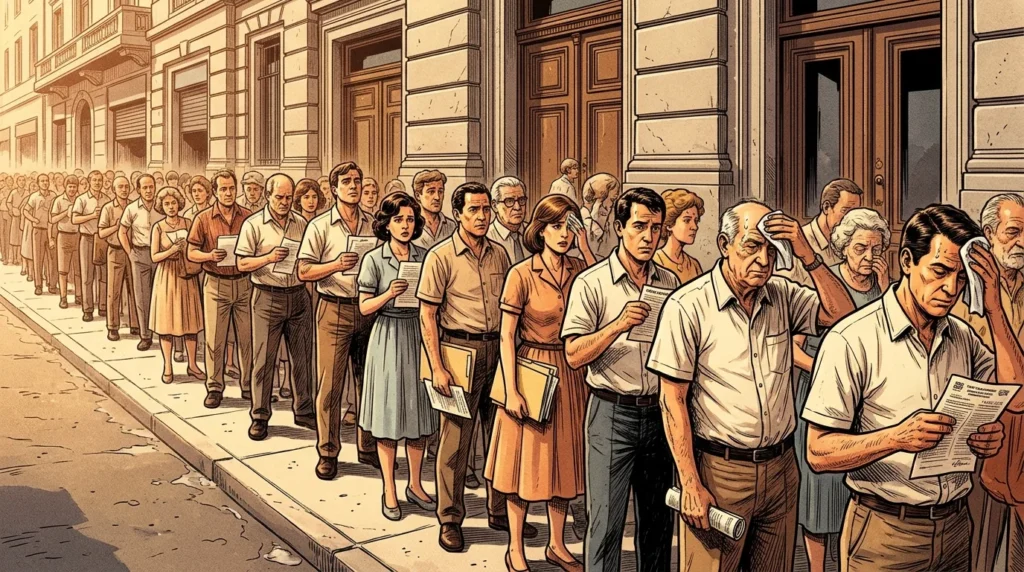
By mid-1985, the Bolivian peso survived only as a fleeting medium of exchange for small daily transactions while prices were quoted in U.S. dollars or adjusted several times a day alongside the street dollar quote [1][4]. The gap between the controlled official exchange rate and the parallel street rate widened to more than fifteen to one by August 1985, generating massive rent-seeking windfalls for privileged importers while ordinary wage earners saw their paychecks lose half their value in days [2][5]. Paper banknotes became Bolivia’s third-largest import item by value, flown in from European printing presses to keep the payment system operating [4].
Supreme Decree 21060 and the New Economic Policy (1985–1988)
In the July 1985 election, former dictator Hugo Banzer won a narrow plurality of the popular vote ahead of Paz Estenssoro, throwing the selection to Congress, which elected Paz Estenssoro on August 6, 1985 [2][5]. Working in secrecy with an economic team led by future Planning Minister Gonzalo Sánchez de Lozada, business executive Fernando Romero, and external adviser Jeffrey D. Sachs, Paz Estenssoro declared that “Bolivia is dying on us” (Bolivia se nos muere) and issued Supreme Decree 21060 on August 29, 1985 [1][5]. To prevent legislative obstruction, Paz Estenssoro forged the “Pact for Democracy” with Banzer’s Nationalist Democratic Action (ADN) party in October 1985—and when the COB called a general strike in September, the government declared a constitutional state of siege and temporarily interned strike leaders until union resistance subsided [2][5].
Supreme Decree 21060 attacked hyperinflation by simultaneously unifying the exchange rate and eliminating the cash fiscal deficit [1][5]. First, the decree abolished multiple exchange rates and capital controls, establishing a unified, market-determined rate through a daily sealed-bid foreign exchange auction—the Bolsin—managed by the Central Bank [5][7]. Because prices throughout the economy were already indexed to the parallel dollar rate, stabilizing the exchange rate anchored domestic prices: once the official and parallel rates converged at roughly 1.1 million pesos per U.S. dollar in early September 1985, aggregate price increases halted by September 9—just ten days after the decree took effect—and retail prices fell by 1.9 percent in October 1985 [1][5].
Second, to sever the link between treasury shortfalls and central bank money creation without waiting for congressional tax legislation, Decree 21060 turned state energy monopoly YPFB into an immediate cash generator [1][5]. The decree raised domestic prices of gasoline and petroleum products roughly sevenfold to international parity—about $0.28 to $0.30 per liter—and required YPFB to deposit daily tax transfers directly into the treasury account at the Central Bank, supplying more than half of central government revenues within weeks [2][5]. Concurrently, the decree froze public sector wages, abolished domestic price controls, replaced import quotas with a uniform 20 percent tariff, and required ten-day Central Bank monetary reporting to enforce zero net domestic credit creation for the state [5][7].
The Tin Crash, Tax Reform, and Sovereign Debt Resolution
In October 1985, just two months into stabilization, the International Tin Council suspended buffer-stock operations on the London Metal Exchange, causing world tin prices to plunge by more than 50 percent—from $5.60 to under $3.00 per pound—while Argentina forced down prices for Bolivian natural gas exports [2][5]. When liquidity injections during the December 1985 wage cycle sparked a brief monetary slip, Paz Estenssoro appointed Sánchez de Lozada as Minister of Planning in January 1986 and reimposed strict monetary targets [1][5].
In May 1986, Congress enacted Law 843, sweeping away hundreds of minor levies and introducing a uniform 10 percent national value-added tax (VAT) alongside taxes on visible wealth [5][7]. Central government revenues rebounded from 1.3 percent of GNP in 1985 to over 10 percent of GNP in 1986, cutting the public sector deficit below 4 percent of GDP [2][5]. Simultaneously, the state downsized insolvent public enterprises, cutting COMIBOL’s workforce from 30,000 in 1985 to 7,000 by 1987 and YPFB’s payroll from 9,000 to 5,000, before introducing a new currency, the boliviano, at one million pesos to one on January 1, 1987 [2][5][7].
Recognizing that Bolivia could not resume full service on its $4 billion external debt overhang, the government maintained its suspension of commercial bank interest payments while winning an IMF Stand-By Arrangement in June 1986, Paris Club reschedulings, and donor grants for an Emergency Social Fund [5][6]. In March 1988, using bilateral donor funds, Bolivia executed a landmark voluntary commercial bank debt buyback, retiring $253 million—nearly half of its $670 million commercial bank principal—at 11 cents on the dollar [6]. Twelve-month inflation fell from 23,500 percent in September 1985 to 66 percent in 1986 and 10.7 percent in 1987, while real GDP growth returned to 2.6 percent in 1987, proving that even an extreme peacetime hyperinflation could be halted within days when exchange unification was backed by an immediate termination of deficit monetization and deep debt relief [2][5][6][7].
Theoretical & Balance-Sheet Transmission Mechanism
In the Kindleberger–Minsky taxonomy of financial instability (Kindleberger, 1978; Minsky, 1986) and Irving Fisher’s (1933) debt-deflation framework, speculative asset booms become systemic crises when credit expansion shifts balance sheets from hedge finance (cash flows covering principal and interest) to speculative and Ponzi finance (relying on rising asset prices and short-term margin roll-overs).
Once monetary tightening or an exogenous shock halts price appreciation, forced margin liquidations trigger Fisherian debt-deflation: fire-sale asset discounts erode bank collateral values, contracting credit supply across the real economy.
Sources and Further Reading
- Jeffrey D. Sachs, “ The Bolivian Hyperinflation and Stabilization,” National Bureau of Economic Research (NBER Working Paper No. 2073), 1986. Peer-Reviewed / Academic Research
- Juan Antonio Morales and Jeffrey D. Sachs, “ Bolivia’s Economic Crisis,” NBER / University of Chicago Press (in Developing Country Debt and the World Economy), 1989. Peer-Reviewed / Academic Research
- Juan Antonio Morales and Jeffrey D. Sachs, “ State Capitalism and the Operation of the Public Sector,” NBER / University of Chicago Press (in Developing Country Debt and Economic Performance, Vol. 2), 1990. Peer-Reviewed / Academic Research
- Juan Antonio Morales and Jeffrey D. Sachs, “ The Emergence of Hyperinflation, 1982–85,” NBER / University of Chicago Press (in Developing Country Debt and Economic Performance, Vol. 2), 1990. Peer-Reviewed / Academic Research
- Juan Antonio Morales and Jeffrey D. Sachs, “ Ending the Hyperinflation, 1985–88,” NBER / University of Chicago Press (in Developing Country Debt and Economic Performance, Vol. 2), 1990. Peer-Reviewed / Academic Research
- Juan Antonio Morales and Jeffrey D. Sachs, “ Bolivian Debt Management, 1985–88,” NBER / University of Chicago Press (in Developing Country Debt and Economic Performance, Vol. 2), 1990. Peer-Reviewed / Academic Research
- Timothy J. Kehoe, Carlos Gustavo Machicado, and José Peres-Cajías, “ The Monetary and Fiscal History of Bolivia, 1960–2017,” National Bureau of Economic Research (NBER Working Paper No. 25523), 2019. Peer-Reviewed / Academic Research
- Irving Fisher — "The Debt-Deflation Theory of Great Depressions," Econometrica 1, no. 4 (FRASER Federal Reserve Archive, 1933): 337–357 Central Bank / Monetary Authority
- Charles P. Kindleberger & Robert Z. Aliber — Manias, Panics, and Crashes: A History of Financial Crises (Palgrave Macmillan) Peer-Reviewed / Academic Research
Cite This Historical Dossier (APA / Chicago)
APA (7th ed.): Ç., S. (Ed.). (2026). Bolivian Hyperinflation and the 1985 Stabilization Shock. In Forgotten Fortunes Historical Monograph Series (Forgotten Fortunes Editorial Desk). https://forgottenfortunes.net/bolivian-hyperinflation-stabilization/
MLA (9th ed.): Ç., Soner, ed. "Bolivian Hyperinflation and the 1985 Stabilization Shock." Forgotten Fortunes: Financial & Monetary History Archive, 2026, https://forgottenfortunes.net/bolivian-hyperinflation-stabilization/.
Chicago (17th ed.): Ç., Soner, ed. "Bolivian Hyperinflation and the 1985 Stabilization Shock." Forgotten Fortunes Historical Monograph Series (Forgotten Fortunes Editorial Desk), August 27, 2026. https://forgottenfortunes.net/bolivian-hyperinflation-stabilization/.
Have an idea for another financial history documentary or article? Request a story →