In This Article
Between 1977 and 1981, under the military dictatorship’s Minister of Economy José Alfredo Martínez de Hoz, Argentina became the laboratory for one of the most radical experiments in financial liberalization and exchange-rate-based stabilization in twentieth-century monetary history. Determined to dismantle four decades of Peronist interest-rate controls and import-substitution industrialization, Martínez de Hoz enacted the June 1977 Financial Entities Law (Law 21,526)—combining complete interest-rate deregulation and open bank branching with full state deposit insurance—and paired it in December 1978 with la Tablita, a pre-announced crawling-peg devaluation schedule designed to force domestic inflation down toward international levels. Instead of achieving price convergence, the combination of stubborn triple-digit domestic inflation and a lagging devaluation schedule produced massive real appreciation of the peso, known popularly as la plata dulce (“sweet money”), alongside a speculative carry-trade frenzy dubbed la bicicleta financiera (“the financial bicycle”). On March 28, 1980, the Central Bank of the Argentine Republic (BCRA) ordered the liquidation of the country’s largest private commercial bank, Banco de Intercambio Regional (BIR), triggering a systemic banking panic that felled more than 70 financial institutions and cost over 10 percent of Argentina’s gross domestic product. [1]

The June 1977 Financial Reform and Moral Hazard
When the Argentine military junta seized power on March 24, 1976, appointing businessman and landowner José Alfredo Martínez de Hoz to head the Ministry of Economy and Adolfo Diz to lead the Central Bank (BCRA), Argentina’s financial system was operating under a regime of “nationalized deposits” established in 1973. Under that system, commercial banks acted merely as administrative agents for the BCRA: 100 percent of bank deposits were surrendered to the central bank, which set fixed interest rates well below inflation and allocated credit by sector through rediscount quotas. [2]
On June 1, 1977, Martínez de Hoz and Diz implemented the Financial Entities Law (Law 21,526), a sweeping deregulation that decentralized deposits, lowered reserve requirements across stages from 100 percent to 45 percent (and ultimately below 15 percent by 1979), abolished all administrative ceilings on borrowing and lending interest rates, eliminated barriers to opening new bank branches, and invited non-bank finance companies (financieras) to transform themselves into full commercial banks. Between 1977 and 1979, the number of private commercial banks in Argentina nearly doubled from 112 to over 210, while financial institutions opened more than 1,000 new branches across Buenos Aires and the provinces. [3]
Yet the June 1977 liberalization contained a fatal institutional flaw identified by economists Carlos Díaz-Alejandro, Roque Fernández, and Tomás Baliño: complete freedom for banks to set interest rates was paired with virtually 100 percent state deposit insurance funded by the BCRA at zero risk-adjusted cost to the banks (modified only marginally in late 1979 to cover 90 percent of deposits above a small threshold). Worse still, the BCRA’s bank supervision department had spent decades monitoring compliance with bureaucratic credit quotas rather than evaluating borrower solvency or connected-party exposure. Protected by the state guarantee, aggressive regional banks and newly chartered conglomerates competed for short-term 30-day time deposits (plazos fijos) by offering ever-higher nominal interest rates, channeling those funds into speculative real estate and into their owners’ industrial holdings. [4]
| Documented Figure / Metric | Historical Significance & Archival Context |
|---|---|
| 61 percent | During 1979, while the peso was devalued by roughly 61 percent according to la Tablita, domestic consumer prices rose by 139.7 percent, producing a cumulative real exchange-rate appreciation of more than 40 percent. |
| 8 percent | This wide gap between domestic peso interest rates (averaging 6 to 8 percent per month) and the pre-committed monthly devaluation rate (falling from 5 percent toward 2 percent per month) created a lucrative carry trade known across Buenos Aires as la bicicleta financiera. |
| 50 percent | On April 28, 1980, exactly one month after closing BIR, the BCRA ordered protective trusteeship interventions (intervenciones cautelares) into Banco de los Andes, Banco Internacional, and Banco Oddone after the three banks lost between 30 and 50 percent of their deposits in four weeks. |
| 10 percent | In February 1981, weeks before stepping down as Minister of Economy, Martínez de Hoz broke his pledge and devalued the peso by 10 percent outside the schedule of la Tablita. |
La Tablita and the “Plata Dulce” Carry Trade
Although the 1977 financial reform shifted real interest rates from deeply negative to sharply positive, annual Argentine inflation remained stubbornly entrenched near 160 to 175 percent throughout 1977 and 1978. Searching for a nominal anchor without triggering a fiscal shock, Martínez de Hoz’s economic team adopted the “monetary approach to the balance of payments” then championed at the University of Chicago. Under this theory, in a small open economy with free capital mobility and reduced import tariffs, the domestic rate of inflation must converge to the world inflation rate plus the pre-announced rate of currency devaluation—the “law of one price.” [5]
On December 20, 1978, Martínez de Hoz unveiled la Tablita cambiaria (“the little exchange-rate table”), taking effect in January 1979. Under la Tablita, the Ministry of Economy published a binding schedule several months in advance specifying the exact daily exchange rate at which the BCRA would buy and sell U.S. dollars. The monthly rate of peso devaluation was set to begin at 5.2 percent in January 1979 and decline steadily each month toward zero by early 1981. [6]
In practice, price convergence failed to materialize cleanly. While imported consumer electronics, foreign automobiles, and overseas travel became extraordinarily cheap in peso terms—inspiring the popular phrase “deme dos” (“give me two”) among middle-class Argentine tourists flooding Miami and Rio de Janeiro during the era of la plata dulce—prices in non-tradable domestic sectors, public utilities, and nominal wages continued to climb far faster than the pre-announced devaluation rate. During 1979, while the peso was devalued by roughly 61 percent according to la Tablita, domestic consumer prices rose by 139.7 percent, producing a cumulative real exchange-rate appreciation of more than 40 percent. [7]
This wide gap between domestic peso interest rates (averaging 6 to 8 percent per month) and the pre-committed monthly devaluation rate (falling from 5 percent toward 2 percent per month) created a lucrative carry trade known across Buenos Aires as la bicicleta financiera. Domestic and foreign speculators borrowed U.S. dollars abroad at international interest rates, converted them into Argentine pesos at the BCRA window, placed the proceeds into 30-day peso time deposits at high-yielding domestic banks, and then reconverted the principal and interest back into dollars before the next scheduled step of la Tablita, pocketing annualized dollar returns exceeding 30 to 40 percent. Meanwhile, Argentina’s domestic manufacturing and agricultural exporters were crushed between an overvalued currency, cheap competing imports, and punishing real borrowing costs once inflation began to slow in late 1979. [8]
José Rafael Trozzo and the Rise of Banco de Intercambio Regional
No institution embodied the speculative excesses of the 1977–1980 boom more dramatically than the Banco de Intercambio Regional (BIR). Originally a tiny provincial bank operating in Corrientes province under the name Banco Popular de Corrientes, the institution was acquired in the mid-1960s by lawyer and financier José Rafael Trozzo, who renamed it Banco de Intercambio Regional and moved its operational headquarters to prestigious offices on Avenida Roque Sáenz Peña in downtown Buenos Aires, supplemented by representative branches in New York, Washington, and Paris.
Taking full advantage of the June 1977 Financial Entities Law, Trozzo embarked on an extraordinary nationwide expansion, opening more than 100 lavishly appointed branches and consistently offering depositors interest rates several percentage points above those paid by established private and state banks. By early 1980, BIR had vaulted from ninety-sixth place in the Argentine banking system to become the largest private bank in the country by deposits—second overall only to the state-owned Banco de la Nación Argentina—holding more than USD $1 billion in deposits from over 350,000 retail savers and commanding nearly 4 percent of all deposits in the national financial system.
Behind BIR’s rapid growth lay a deeply insolvent balance sheet. To pay top-of-market deposit rates while financing a sprawling conglomerate of more than 60 Trozzo-controlled companies in forestry, agro-industry, real estate, and publishing, BIR concentrated its loan portfolio in illiquid related-party enterprises and distressed industrial borrowers that could no longer compete under the overvalued peso of la Tablita. Instead of foreclosing on bankrupt debtors, BIR rolled over unpaid principal and capitalized punitive interest charges onto new loans—a practice economists termed “distress borrowing”—keeping non-performing assets disguised as performing credit while relying on an uninterrupted inflow of new 30-day retail deposits to avoid illiquidity.
March 28, 1980: The Collapse of BIR and the “Four Horsemen”
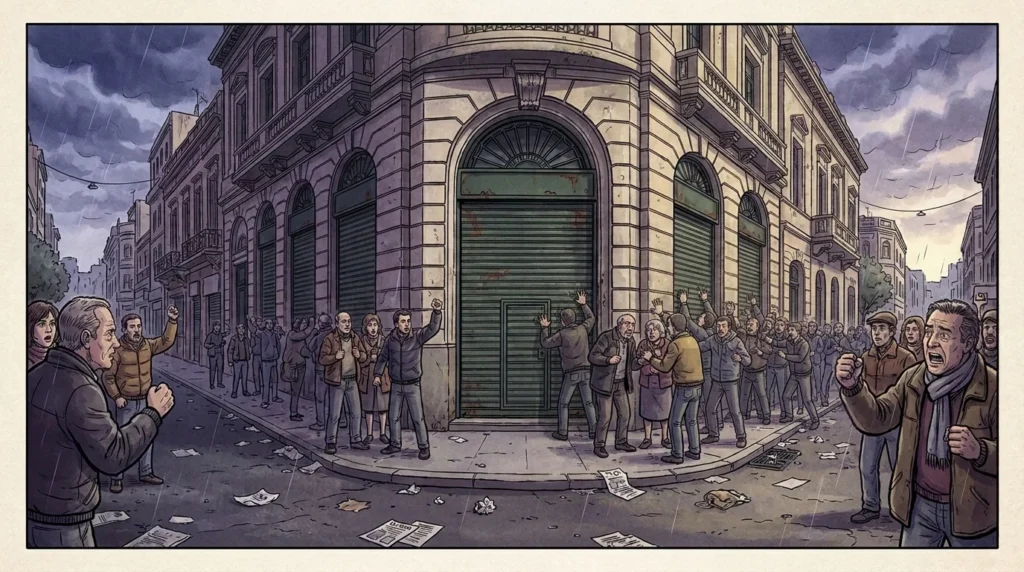
By late 1979 and early 1980, BCRA inspectors had placed BIR under confidential surveillance as its bad loans exceeded three times its paid-in capital and its reliance on central bank rediscounts mounted. When rumors of BIR’s insolvency spread through Buenos Aires financial circles in March 1980 and the bank failed to raise fresh capital from prospective foreign buyers, the BCRA refused to absorb an open-ended bailout of Trozzo’s industrial empire. Late on Friday, March 28, 1980, the Central Bank issued Circular RF 1,023 ordering the immediate revocation of BIR’s banking license and placing Argentina’s largest private bank into compulsory liquidation as José Rafael Trozzo fled to Mexico.
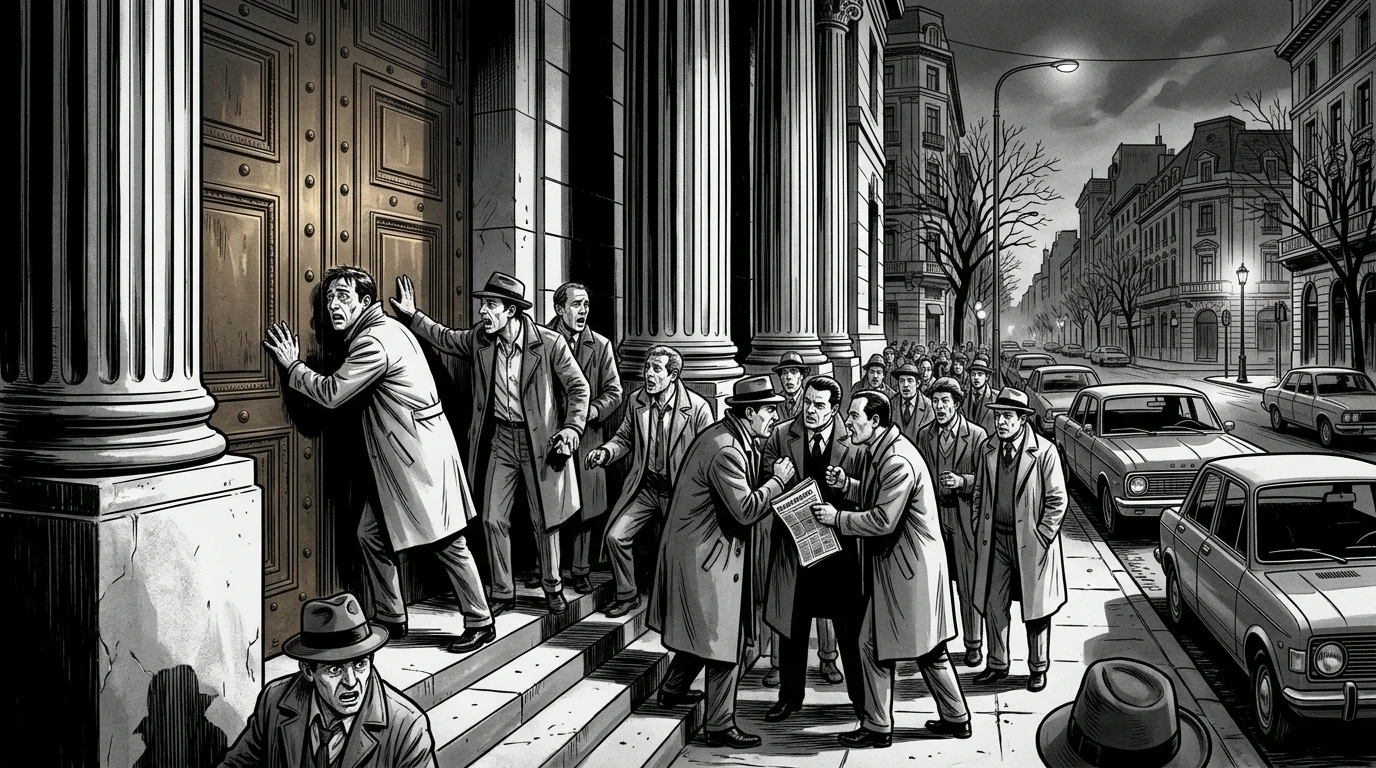
The closure of BIR shattered the illusion that the military government would never allow a major deposit-taking bank to fail. On Monday, March 31, 1980, thousands of panicked savers queued outside BIR branches and immediately began withdrawing 30-day time deposits from every private domestic bank suspected of holding industrial conglomerate loans. Within days, a full-scale systemic bank run engulfed Argentina’s three next-largest aggressive private banking groups—widely dubbed by the financial press, alongside BIR, as the “Four Horsemen of the Apocalypse”:
- Banco de los Andes: Controlled by the Greco wine and agro-industrial conglomerate (Grupo Greco) of Mendoza, which had used the bank to monopolize regional vineyards and finance group companies;
- Banco Internacional: Controlled by the Sasetru grain-exporting and food-processing empire, Argentina’s largest private industrial group, which had been crippled by real peso appreciation and high domestic interest rates;
- Banco Oddone: Headed by financier Luis Alberto Oddone, who had rapidly assembled a leveraged empire of agricultural, real estate, and industrial firms funded by retail time deposits.
On April 28, 1980, exactly one month after closing BIR, the BCRA ordered protective trusteeship interventions (intervenciones cautelares) into Banco de los Andes, Banco Internacional, and Banco Oddone after the three banks lost between 30 and 50 percent of their deposits in four weeks. To halt the systemic hemorrhage of funds out of private domestic banks toward state-owned banks, foreign bank branches, and U.S. dollar bills, the BCRA issued Circular RF 1,051 in April 1980 creating an emergency rediscount line that pumped trillions of pesos—exceeding 20 percent of the entire monetary base—into besieged financial institutions, and retroactively restored the 100 percent deposit guarantee up to 100 million pesos.
Collapse of the Tablita and the 1981–1982 Debt Nationalization
The April 1980 central bank liquidity flood destroyed the monetary discipline required to sustain la Tablita. As depositors converted rescued peso deposits and emergency BCRA rediscounts directly into U.S. dollars at the overvalued official exchange rate, the Central Bank lost more than USD $4.5 billion in international reserves during 1980 while forcing state-owned enterprises (such as YPF and Banco de la Nación) to borrow billions of dollars in syndicated Eurodollar loans abroad merely to replenish the BCRA’s foreign exchange coffers.
Between March 1980 and December 1982, the BCRA liquidated or intervened in 71 financial institutions—including 43 commercial banks and 28 non-bank finance companies—representing roughly 16 percent of total commercial bank deposits and more than 35 percent of finance-company deposits, at a direct fiscal and quasi-fiscal resolution cost estimated by the International Monetary Fund at over 10 percent of GDP. In February 1981, weeks before stepping down as Minister of Economy, Martínez de Hoz broke his pledge and devalued the peso by 10 percent outside the schedule of la Tablita. His successor, Lorenzo Sigaut—who famously declared that “he who bets on the dollar will lose” days before ordering a 30 percent devaluation in April 1981—abandoned the crawling peg entirely as the peso lost more than 400 percent of its value over the year. In mid-1982, with private corporations and surviving banks crushed under external dollar debts and domestic peso liabilities, new BCRA President Domingo Cavallo enacted exchange-rate insurance schemes and debt-liquidation measures that effectively nationalized private foreign debt and inflated away domestic bank liabilities, ushering in Argentina’s lost decade of debt default and hyperinflation.
Theoretical & Balance-Sheet Transmission Mechanism
In the Kindleberger–Minsky taxonomy of financial instability (Kindleberger, 1978; Minsky, 1986) and Irving Fisher’s (1933) debt-deflation framework, speculative asset booms become systemic crises when credit expansion shifts balance sheets from hedge finance (cash flows covering principal and interest) to speculative and Ponzi finance (relying on rising asset prices and short-term margin roll-overs).
Once monetary tightening or an exogenous shock halts price appreciation, forced margin liquidations trigger Fisherian debt-deflation: fire-sale asset discounts erode bank collateral values, contracting credit supply across the real economy.
Sources and Further Reading
- Tomás J. T. Baliño, “ The Argentine Banking Crisis of 1980,” Banking Crises: Cases and Issues, International Monetary Fund, 1991. International Financial Institution
- Rudiger Dornbusch, “ Argentina Since Martinez De Hoz,” National Bureau of Economic Research, Working Paper No. 1466, 1984. Peer-Reviewed / Academic Research
- Roque B. Fernández, “ La crisis financiera argentina: 1980–1982,” Universidad del CEMA (UCEMA), Documentos de Trabajo No. 35, 1983. Peer-Reviewed / Academic Research
- Fernando J. Cardim de Carvalho, “ Financial Liberalization in Brazil and Argentina,” Financial Liberalization and Economic Performance in Emerging Countries, Palgrave Macmillan, 2008. Peer-Reviewed / Academic Research
- Eduardo Basualdo and Andrés Wainer, “ Brazo financiero de la dictadura: El rol que cumplió el Banco de la Nación Argentina en 1976–1982,” Facultad Latinoamericana de Ciencias Sociales (FLACSO Argentina), 2016. Historical & Financial Reference
- Mariano Arana, “ La tablita cambiaria de Martínez de Hoz: críticas, respuestas y los debates en el interior del equipo económico,” Márgenes: Revista de Economía Política, Universidad Nacional de General Sarmiento, 2021. Peer-Reviewed / Academic Research
- Irving Fisher — "The Debt-Deflation Theory of Great Depressions," Econometrica 1, no. 4 (FRASER Federal Reserve Archive, 1933): 337–357 Central Bank / Monetary Authority
- Charles P. Kindleberger & Robert Z. Aliber — Manias, Panics, and Crashes: A History of Financial Crises (Palgrave Macmillan) Peer-Reviewed / Academic Research
Cite This Historical Dossier (APA / Chicago)
APA (7th ed.): Ç., S. (Ed.). (2026). Argentina's 1977–1981 Tablita Boom and the Collapse of Banco de Intercambio Regional. In Forgotten Fortunes Historical Monograph Series (Forgotten Fortunes Editorial Desk). https://forgottenfortunes.net/argentina-tablita-1980-bank-crisis/
MLA (9th ed.): Ç., Soner, ed. "Argentina's 1977–1981 Tablita Boom and the Collapse of Banco de Intercambio Regional." Forgotten Fortunes: Financial & Monetary History Archive, 2026, https://forgottenfortunes.net/argentina-tablita-1980-bank-crisis/.
Chicago (17th ed.): Ç., Soner, ed. "Argentina's 1977–1981 Tablita Boom and the Collapse of Banco de Intercambio Regional." Forgotten Fortunes Historical Monograph Series (Forgotten Fortunes Editorial Desk), September 10, 2026. https://forgottenfortunes.net/argentina-tablita-1980-bank-crisis/.
Have an idea for another financial history documentary or article? Request a story →