In This Article
On October 30, 2013, lawyers for OGX Petróleo e Gás Participações S.A. walked into the Corporate Division of the Court of Justice of Rio de Janeiro State to file for judicial bankruptcy protection (recuperação judicial), listing approximately 11.2 billion reais ($5.1 billion to $5.4 billion) in liabilities. At the time, the filing represented the largest corporate default and bankruptcy restructuring in Latin American history. Only eighteen months earlier, OGX had been the flagship asset of Brazilian promoter Eike Batista—who in March 2012 boasted a personal net worth exceeds $34.2 billion as the world’s seventh-richest person and publicly vowed to overtake Carlos Slim as the wealthiest individual on the planet. Built through record-breaking initial public offerings on the São Paulo Stock Exchange (BM&FBovespa) and billions of dollars in international high-yield bonds, Batista’s interconnected EBX conglomerate unraveled when actual crude extraction at OGX’s flagship Tubarão Azul (Blue Shark) offshore field proved a fraction of promised reserves, wiping out 99% of OGX’s market value and collapsing the interdependent “X-companies” across Brazil’s energy, shipbuilding, mining, and port sectors. [1]
The “X” Multiplier: Building the EBX Conglomerate on the Bovespa
Eike Fuhrken Batista—the son of Eliezer Batista, an influential former Minister of Mines and Energy and longtime president of state mining giant Companhia Vale do Rio Doce (now Vale)—made his initial fortune in Amazonian gold trading and mining concessions during the 1980s and 1990s. In the mid-2000s, as China’s rapid industrialization ignited a global supercycle in iron ore, crude oil, and agricultural commodities, Brazil emerged as the premier destination for international emerging-market equity and debt capital. Batista capitalized on this macro-financial wave by organizing the EBX Group in Rio de Janeiro, a holding company that launched a suite of greenfield infrastructure and natural-resource ventures on the BM&FBovespa’s Novo Mercado corporate-governance tier.
Every subsidiary carried the letter “X” in its name—which Batista told the Brazilian financial press stood for the mathematical symbol of “multiplication” of wealth. Beginning with iron-ore miner MMX Mineração e Metálicos (listed in 2006), Batista floated power generator MPX Energia (2007), oil and gas explorer OGX Petróleo e Gás (2008), port and industrial-complex developer LLX Logística (2008), offshore shipbuilder OSX Brasil (2010), and Colombian coal spin-off CCX Carvão da Colômbia (2012). Crucially, none of these companies possessed mature operating cash flows at the time of their public offerings; instead, Batista sold domestic and foreign institutional investors on “project finance through equity”—raising billions of dollars on the Bovespa based on geological surveys, engineering blueprints, and contracts signed among the EBX sister companies themselves. [2]
| Documented Figure / Metric | Historical Significance & Archival Context |
|---|---|
| $44.5 million | With cash reserves exhausted and its bonds trading at eight cents on the dollar, OGX skipped a $44.5 million (~$45 million) interest payment due October 1, 2013 on its 2018 and 2022 international notes, triggering a 30-day grace period. |
| $5.1 billion | On October 30, 2013, OGX filed for judicial bankruptcy protection in Rio de Janeiro with roughly $5.1 billion to $5.4 billion in total debt—including $3.6 billion to $3.8 billion owed to international bondholders and banks and the remainder owed to sister shipbuilder OSX and oilfield suppliers. |
| $2 billion | Deprived of charter revenues from OGX, sister shipbuilder OSX filed for bankruptcy protection eleven days later, on November 11, 2013, with more than $2 billion in debt. |
| $1 billion | Regulators concluded that Batista had dumped billions of reais of his own shares in OGX and OSX during May and June 2013 while privately possessing internal geological reports showing that the offshore fields were non-viable and while publicly reassuring retail shareholders of his $1 billion put option. |
Pre-Salt Euphoria and OGX’s Record 2008 IPO
The centerpiece of the EBX empire was OGX, founded in 2007 just as state-controlled oil major Petrobras announced the discovery of vast ultra-deepwater hydrocarbon reserves beneath a thick layer of salt (the Pré-Sal or Pre-Salt basin) off Brazil’s southeastern coast. Hiring former Petrobras exploration director Paulo Mendonça and a team of veteran state geologists, Batista raised $1.3 billion from private-equity investors in late 2007 and outbid established oil majors at Brazil’s National Agency of Petroleum (ANP) ninth licensing round, paying roughly $1.5 billion in signature bonuses for 21 offshore exploration blocks across the Campos, Santos, and Espírito Santo basins. Noticeably, OGX’s blocks lay primarily in shallower post-salt waters adjacent to existing Petrobras discoveries rather than the ultra-deep Pre-Salt itself. [3]
In June 2008, with global crude oil prices approaching $140 per barrel and Brazil newly awarded investment-grade sovereign credit status, Batista took OGX public on the BM&FBovespa. Despite having drilled zero exploratory wells and producing not a single barrel of oil, OGX raised 6.7 billion reais (roughly $3.7 billion to $4.1 billion at prevailing exchange rates) in what was then the largest initial public offering in Brazilian corporate history. [4]
Over the next three years, OGX issued a steady stream of regulatory filings announcing hydrocarbon “discoveries” across its Campos and Santos basin blocks, projecting potential and contingent resources of 10.8 billion barrels of oil equivalent. On the strength of those projections, OGX shares surged to a peak of 23.27 reais ($10.60) on October 15, 2010, giving the pre-production oil explorer a market capitalization of 75.2 billion reais (more than $34 billion). In 2009 alone, LLX shares soared 500% and EBX group valuations nearly tripled. Batista leveraged the equity boom by issuing $3.6 billion in dollar-denominated senior unsecured bonds for OGX in 2011 and early 2012 to international asset managers including PIMCO and BlackRock, while simultaneously floating shipbuilder OSX in 2010 with an order book reliant almost entirely on building floating production, storage, and offloading (FPSO) vessels and drilling platforms for OGX. [5]
Tubarão Azul and the June 2012 Production Shock
The circular financial architecture of the EBX group required OGX’s wells to gush crude on schedule so that OGX could pay charter fees to OSX, port fees to LLX’s Açu Superport project north of Rio de Janeiro, and coupon payments to international bondholders. In January 2012, OGX extracted its first oil from the Tubarão Azul (Blue Shark) field in the Campos Basin amid a televised ceremony onboard the FPSO OSX-1 attended by Brazilian President Dilma Rousseff. At the time, OGX told investors that each production well in the field would yield roughly 15,000 to 20,000 barrels per day, projecting total output of 50,000 barrels per day by the end of 2012 and 730,000 barrels per day by 2015. [6]
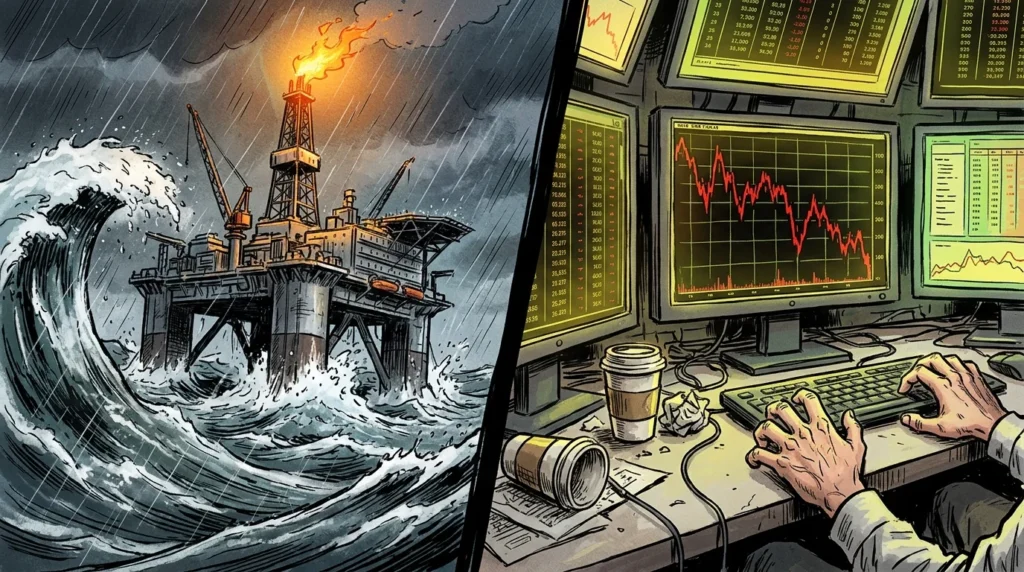
Within five months of first oil, the geological reality of the Campos Basin shattered Batista’s projections. On June 26, 2012, OGX stunned the Bovespa by slashing its 2012 output target by 75%, revealing that its first two producing wells at Tubarão Azul were yielding only about 5,000 barrels per day combined—roughly a quarter of the promised flow rate. Rather than continuous, high-permeability sandstone reservoirs, the carbonate and fractured reservoirs at Tubarão Azul proved heavily compartmentalized and suffered rapid pressure depletion, preventing oil from flowing to the wellbores at commercial rates. [7]
OGX shares plunged 25% on June 27, 2012 and another 19% the following day, erasing billions of reais from the Bovespa index. Attempting to arrest the market panic in October 2012, Batista personally pledged a $1 billion put option—promising to inject up to $1 billion of his own capital into OGX at 6.30 reais per share if the company required funds—a pledge that further entangled his personal liquidity as the share price fell below 2 reais in early 2013. [8]
July–October 2013: Field Abandonments, Default, and Bankruptcy
Any remaining hope of a operational turnaround evaporated on July 1, 2013. In a regulatory filing to the Brazilian Securities and Exchange Commission (CVM), OGX announced that Tubarão Azul had no further viable drilling locations and would cease production altogether during 2014, while simultaneously writing off three nearby offshore fields—Tubarão Tigre, Tubarão Gato, and Tubarão Areia—as commercially unviable. Average total production at Tubarão Azul had dwindled to roughly 10,000 barrels per day across three wells. In October 2013, Dallas-based petroleum engineering consultancy DeGolyer and MacNaughton reduced by more than one-third the estimated reserves at Tubarão Martelo (Hammerhead Shark), the only remaining field Batista hoped to use to attract a farm-out partner.
With cash reserves exhausted and its bonds trading at eight cents on the dollar, OGX skipped a $44.5 million (~$45 million) interest payment due October 1, 2013 on its 2018 and 2022 international notes, triggering a 30-day grace period. Negotiations in New York and Rio de Janeiro with international bondholders collapsed in late October after creditors refused to advance new debtor-in-possession money without wiping out existing shareholders.
On October 30, 2013, OGX filed for judicial bankruptcy protection in Rio de Janeiro with roughly $5.1 billion to $5.4 billion in total debt—including $3.6 billion to $3.8 billion owed to international bondholders and banks and the remainder owed to sister shipbuilder OSX and oilfield suppliers. On the day of the filing, OGX shares fell to 0.16 reais ($0.07)—a 99.3% collapse from their October 2010 peak of 23.27 reais—before being delisted from the benchmark Ibovespa index, where retail and institutional traders had made OGX the most heavily traded stock in Brazil.
Contagion Across the X-Empire and Legal Aftermath
Because the EBX companies were bound together by intercompany contracts and shared equity pledges, OGX’s bankruptcy triggered a domino collapse. Deprived of charter revenues from OGX, sister shipbuilder OSX filed for bankruptcy protection eleven days later, on November 11, 2013, with more than $2 billion in debt. To stave off personal insolvency and satisfy bank margin calls, Batista was forced to sell control of power utility MPX (renamed Eneva) to Germany’s E.ON, surrender port developer LLX (renamed Prumo Logística) to US private-equity firm EIG Global Energy Partners, and liquidate iron-ore miner MMX—which itself entered bankruptcy protection in 2014—alongside his private jets and luxury yacht. By early 2014, Batista’s net worth had fallen from $34.2 billion to negative territory (over $1 billion in personal debt), the fastest destruction of a personal fortune in modern financial history.
In the wake of the collapse, Brazil’s securities regulator (CVM) and federal prosecutors pursued Batista for market manipulation and insider trading. Regulators concluded that Batista had dumped billions of reais of his own shares in OGX and OSX during May and June 2013 while privately possessing internal geological reports showing that the offshore fields were non-viable and while publicly reassuring retail shareholders of his $1 billion put option. Following subsequent convictions for insider trading, market manipulation, and—in a separate 2017 probe—paying $16.5 million in bribes to former Rio de Janeiro governor Sérgio Cabral, the rise and fall of OGX came to stand as the defining cautionary tale of Brazil’s late-2000s commodity and Bovespa IPO euphoria.
Theoretical & Balance-Sheet Transmission Mechanism
In the Kindleberger–Minsky taxonomy of financial instability (Kindleberger, 1978; Minsky, 1986) and Irving Fisher’s (1933) debt-deflation framework, speculative asset booms become systemic crises when credit expansion shifts balance sheets from hedge finance (cash flows covering principal and interest) to speculative and Ponzi finance (relying on rising asset prices and short-term margin roll-overs).
Once monetary tightening or an exogenous shock halts price appreciation, forced margin liquidations trigger Fisherian debt-deflation: fire-sale asset discounts erode bank collateral values, contracting credit supply across the real economy.
Sources and Further Reading
- Jonathan Watts, “ Brazilian oil tycoon nears bankruptcy,” The Guardian, 2013-10-31. Historical & Financial Reference
- Juan Arias, “ Promising Brazilian oil firm files for bankruptcy protection,” El País, 2013-10-31. Historical & Financial Reference
- Agence France-Presse, “ Brazilian Oil Giant OGX Files For Bankruptcy,” IndustryWeek, 2013-10-30. Historical & Financial Reference
- World Finance, “ From billions to bust: where did it go wrong for Eike Batista?,” World Finance, 2014. Historical & Financial Reference
- Offshore Energy, “ OGX to Abandon Tubarão Azul Field,” Offshore Energy, 2013-07-02. Historical & Financial Reference
- Thomas Gstraunthaler and Liliana Proskuryakova, “ From the Bubble to the Core: Long-Term Competitive Advantages for Emerging Markets through Innovation in the Extractive Industry,” Foresight-Russia, 2010. Peer-Reviewed / Academic Research
- Irving Fisher — "The Debt-Deflation Theory of Great Depressions," Econometrica 1, no. 4 (FRASER Federal Reserve Archive, 1933): 337–357 Central Bank / Monetary Authority
- Charles P. Kindleberger & Robert Z. Aliber — Manias, Panics, and Crashes: A History of Financial Crises (Palgrave Macmillan) Peer-Reviewed / Academic Research
Cite This Historical Dossier (APA / Chicago)
APA (7th ed.): Ç., S. (Ed.). (2026). The Rise and 2013 Collapse of Eike Batista's OGX and EBX Empire on the Bovespa. In Forgotten Fortunes Historical Monograph Series (Forgotten Fortunes Editorial Desk). https://forgottenfortunes.net/brazil-eike-batista-ogx-collapse/
MLA (9th ed.): Ç., Soner, ed. "The Rise and 2013 Collapse of Eike Batista's OGX and EBX Empire on the Bovespa." Forgotten Fortunes: Financial & Monetary History Archive, 2026, https://forgottenfortunes.net/brazil-eike-batista-ogx-collapse/.
Chicago (17th ed.): Ç., Soner, ed. "The Rise and 2013 Collapse of Eike Batista's OGX and EBX Empire on the Bovespa." Forgotten Fortunes Historical Monograph Series (Forgotten Fortunes Editorial Desk), September 10, 2026. https://forgottenfortunes.net/brazil-eike-batista-ogx-collapse/.
Have an idea for another financial history documentary or article? Request a story →