In This Article
On December 16, 1957, Congress Member of Parliament Feroze Gandhi rose in the Lok Sabha to open a special debate that shook Prime Minister Jawaharlal Nehru’s government to its foundations. Six months earlier, in June 1957, the newly nationalized Life Insurance Corporation of India (LIC) had quietly bypassed its own statutory Investment Committee to pour ₹1,26,86,100 (₹1.26 crore) of public policyholders’ savings into shares of six distressed companies controlled by a thirty-five-year-old Calcutta stock speculator named Haridas Mundhra. Armed with confidential correspondence between Union Finance Minister T. T. Krishnamachari and Principal Finance Secretary H. M. Patel, Gandhi exposed independent India’s first mega-financial scandal—an affair that led to Chief Justice M. C. Chagla’s famous 24-day public inquiry in 1958, forced the Finance Minister’s resignation, sent Mundhra to prison for share forgery and corporate looting, and accelerated the statutory abolition of India’s colonial Managing Agency System under the Companies (Amendment) Act of 1969. [1]
Haridas Mundhra’s Takeover Pyramid and the Managing Agency System
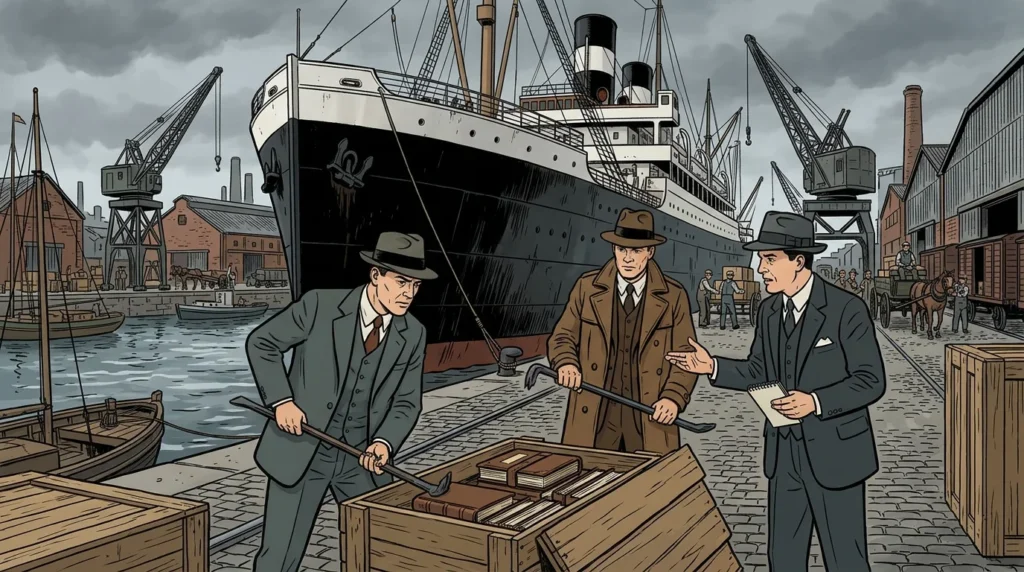
To understand how a former lightbulb trader with minimal formal education came to command some of colonial India’s oldest industrial enterprises, one must examine the corporate vehicle that dominated Indian business from the mid-nineteenth century through the 1960s: the Managing Agency System. Originating with British mercantile houses in Calcutta and Bombay—such as Andrew Yule, Bird & Co., Jardine Skinner, and Gillanders Arbuthnot—a managing agency was a private partnership or closely held firm that controlled multiple public joint-stock companies through long-term management contracts rather than majority share ownership. Even while holding a small fraction of equity, the managing agent controlled the managed companies’ boards, treasury reserves, raw material purchases, and inter-company loans, collecting guaranteed commissions on sales or profits while passive retail shareholders bore the downside risk.
Following Indian independence in 1947, many expatriate British owners grew anxious to liquidate their Indian equity holdings and repatriate capital. Haridas Mundhra stepped into this vacuum through his own managing agency vehicle, S. B. Industrial Development Company Limited. Rather than modernizing factories, Mundhra operated a leveraged takeover pyramid: [2]
- Chain Acquisitions and Asset Stripping: Mundhra acquired control of cash-rich former British engineering and industrial firms in Calcutta and Kanpur—including Jessop & Company (heavy engineering), Richardson & Cruddas, Smith Stanistreet & Co., Osler Electric Lamp Manufacturing, British India Corporation (a Kanpur textile and sugar giant acquired from the British McRobert Trust), and Turner Morrison & Co. Once inside a company, he used its liquid reserves and inter-company advances as collateral to buy controlling blocks in the next target.
- Circular Trading and Forged Share Certificates: To sustain bank loans pledged against his shares, Mundhra engaged in circular cornering operations to inflate market quotations on the Calcutta and Bombay stock exchanges. When credit tightened in 1956–1957, he pledged duplicate and forged physical share certificates—particularly in Richardson & Cruddas and Jessop & Co.—across multiple commercial banks simultaneously.
As early as 1954–1955, government regulators were aware of Mundhra’s methods. While serving as Minister for Commerce and Industry in 1955, T. T. Krishnamachari had written to then-Finance Minister C. D. Deshmukh expressing alarm that Mundhra could raid major firms like British India Corporation “right under the nose of the Government of India,” and Prime Minister Nehru himself had asked the Finance Ministry to investigate what this dubious “new star” was doing. [3]
The June 1957 LIC Bailout at ₹1.26 Crore
By June 1957, Mundhra’s leveraged pyramid was on the verge of collapse. Margin calls from commercial banks and stockbrokers threatened to trigger a forced liquidation of his pledged shares on the Calcutta Stock Exchange, which Mundhra warned would drag down the broader market just as T. T. Krishnamachari—now Union Finance Minister—was implementing his controversial May 1957 “socialist” Kaldor tax budget (introducing wealth and expenditure taxes). [4]
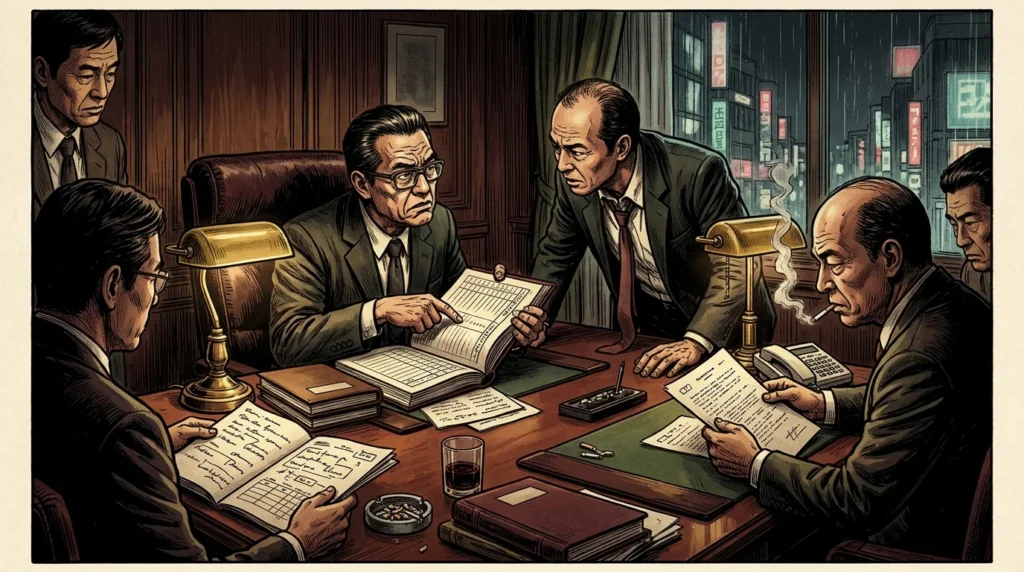
Nine months earlier, on September 1, 1956, the government had merged 245 private Indian and foreign insurers to create a state monopoly: the Life Insurance Corporation of India (LIC). Following weekend meetings in June 1957 at a Bombay/Delhi hotel involving Mundhra, Principal Finance Secretary H. M. Patel, Reserve Bank of India (RBI) Governor H. V. R. Iengar, and LIC Chairman G. R. Kamat, the LIC agreed on June 24–25, 1957—on a day when the stock exchanges were closed—to purchase ₹1,26,86,100 worth of shares across six Mundhra companies (British India Corporation, Jessop & Co., Richardson & Cruddas, Smith Stanistreet, Osler Lamp, and Angelo Brothers) in a direct private deal. [5]
The transaction violated every rule of fiduciary prudence: LIC’s statutory Investment Committee was never consulted in advance; Mundhra had artificially ramped up market quotations by 30 to 40 percent immediately before the deal so that LIC paid inflated prices above true market value; and several of the companies were already financially hollowed out and encumbered by forged share certificates. [6]
Feroze Gandhi’s Lok Sabha Exposé (September–December 1957)
The deal first surfaced publicly on August 3, 1957, when The Statesman reported that LIC had invested over ₹1 crore in a private enterprise headquartered in Kanpur. When Congress MP Dr. Ram Subhag Singh tabled an unstarred written question in the Lok Sabha on September 4, 1957, the Finance Ministry dodged the query on a technicality, replying that LIC had not invested ₹1 crore in “any single private enterprise with headquarters in Kanpur”—concealing the fact that ₹1.26 crore had been spread across six Mundhra firms, only one of which (British India Corporation) was based in Kanpur. [7]
After Singh pressed a follow-up question on November 29, 1957, Feroze Gandhi—Prime Minister Nehru’s son-in-law and an investigative parliamentarian who had previously exposed the Dalmia-Jain insurance fraud—launched a relentless probe. During the historic Lok Sabha debate on December 16, 1957, Gandhi dismantled Finance Minister Krishnamachari’s claim that the purchase was an autonomous LIC investment decision aimed at stabilizing the stock market. Producing confidential letters between Krishnamachari and Principal Secretary H. M. Patel, Gandhi demonstrated that the Finance Ministry had orchestrated the bailout of a known speculator using public trust funds. [8]
The 1958 Chagla Commission and T. T. Krishnamachari’s Resignation
Bowing to parliamentary outrage, Prime Minister Nehru appointed Bombay High Court Chief Justice Mohammadali Carim (M. C.) Chagla in January 1958 as a one-man Commission of Inquiry under the Commissions of Inquiry Act. Refusing to hold proceedings behind closed doors, Justice Chagla conducted open public hearings in Bombay—installing loudspeakers outside the courtroom for overflowing crowds—and submitted his report in just twenty-four days.
Justice Chagla’s report delivered a scathing indictment of both Mundhra and the Finance Ministry’s interference in a statutory public corporation. Describing Mundhra as “a flamboyant personality and a financial adventurer whose only ambition is to build up an industrial empire by dubious methods,” Chagla noted that Mundhra’s questionable antecedents were fully documented in Finance Ministry files before the deal. Establishing a landmark doctrine of Westminster cabinet accountability, Chagla ruled that Principal Secretary H. M. Patel could not have acted without ministerial acquiescence and that “the minister must take responsibility for actions done by his subordinates. He cannot take shelter behind them, nor can he disown his actions.”
On February 18, 1958, Finance Minister T. T. Krishnamachari resigned from the Union Cabinet (followed by the resignations of H. M. Patel and LIC Chairman Kamat). Subsequent investigation by the Vivian Bose Board of Enquiry revealed that Mundhra had donated ₹1.5 lakh to the Uttar Pradesh Congress Party and ₹1 lakh to the central Congress Party shortly before the 1957 elections. Arrested at New Delhi’s Claridges Hotel, Haridas Mundhra was convicted of fraud and share forgery and sentenced to prison, while the government placed Jessop & Co. and Richardson & Cruddas under state management.
The 1969 Abolition of the Managing Agency System
Beyond its political casualties, the LIC-Mundhra scandal—alongside the Vivian Bose Commission’s 1963 report on the Dalmia-Jain group—discredited the Managing Agency System in the eyes of Indian lawmakers and the public. Although the Companies Act of 1956 and subsequent 1960 and 1965 amendments had placed managing agents in a regulatory “straitjacket” by capping their commissions and requiring government approval for renewals, business lobbies such as the Bombay-based Forum of Free Enterprise (founded in July 1956 by A. D. Shroff and Tata executives) argued as late as October 1966 that the system should be reformed rather than abolished.
Following the March 1966 I. G. Patel Committee report on managing agencies in five major industries, Prime Minister Indira Gandhi’s cabinet resolved to terminate the colonial corporate structure entirely. Under the Companies (Amendment) Act, 1969 (Act 17 of 1969), Parliament inserted Section 324A into the Companies Act to abolish all managing agencies and secretaries-and-treasurers across India effective April 3, 1970—while simultaneously banning corporate donations to political parties, the very quid pro quo mechanism exposed in the aftermath of the Mundhra affair.
Theoretical & Balance-Sheet Transmission Mechanism
In the Kindleberger–Minsky taxonomy of financial instability (Kindleberger, 1978; Minsky, 1986) and Irving Fisher’s (1933) debt-deflation framework, speculative asset booms become systemic crises when credit expansion shifts balance sheets from hedge finance (cash flows covering principal and interest) to speculative and Ponzi finance (relying on rising asset prices and short-term margin roll-overs).
Once monetary tightening or an exogenous shock halts price appreciation, forced margin liquidations trigger Fisherian debt-deflation: fire-sale asset discounts erode bank collateral values, contracting credit supply across the real economy.
Sources and Further Reading
- Nasir Tyabji, “Private Industry and the Second Five Year Plan: The Mundhra Episode as Exemplar of Capitalist Myopia,” Institute for Studies in Industrial Development (ISID) Working Paper, No. 2010/04 (WP129), May 2010. Peer-Reviewed / Academic Research
- Live History India, “LIC-Mundhra Scam: Independent India’s First Mega Financial Scandal,” Live History India, accessed 2026. Historical & Financial Reference
- Sandipan Deb, “Remembering India’s First Scam, Sixty Years Later (M. C. Chagla and the Mundhra Affair),” Mint (Livemint), July 26, 2021. Historical & Financial Reference
- C. C. Chokshi, Dhirajlal Maganlal, and R. L. N. Vijayanagar, “The Future of Managing Agency System,” Forum of Free Enterprise, Bombay (Indian Liberals Primary Archive), October 11, 1966. Historical & Financial Reference
- Business Today, “Of Tagore, Tata, and Andrew Yule: How the Managing Agency System Paved the Way for an Evolved Corporate Structure in India,” Business Today, January 21, 2017. Historical & Financial Reference
- Alam Srinivas, “75 Years of Business: India Inc in Corrupt Company,” The Parliamentarian, 2022. Historical & Financial Reference
- Irving Fisher — "The Debt-Deflation Theory of Great Depressions," Econometrica 1, no. 4 (FRASER Federal Reserve Archive, 1933): 337–357 Central Bank / Monetary Authority
- Charles P. Kindleberger & Robert Z. Aliber — Manias, Panics, and Crashes: A History of Financial Crises (Palgrave Macmillan) Peer-Reviewed / Academic Research
Cite This Historical Dossier (APA / Chicago)
APA (7th ed.): Ç., S. (Ed.). (2026). The 1957 LIC-Mundhra Scandal: Forged Shares, the Chagla Inquiry, and the End of Managing Agencies. In Forgotten Fortunes Historical Monograph Series (Forgotten Fortunes Editorial Desk). https://forgottenfortunes.net/india-1957-mundhra-scandal/
MLA (9th ed.): Ç., Soner, ed. "The 1957 LIC-Mundhra Scandal: Forged Shares, the Chagla Inquiry, and the End of Managing Agencies." Forgotten Fortunes: Financial & Monetary History Archive, 2026, https://forgottenfortunes.net/india-1957-mundhra-scandal/.
Chicago (17th ed.): Ç., Soner, ed. "The 1957 LIC-Mundhra Scandal: Forged Shares, the Chagla Inquiry, and the End of Managing Agencies." Forgotten Fortunes Historical Monograph Series (Forgotten Fortunes Editorial Desk), September 13, 2026. https://forgottenfortunes.net/india-1957-mundhra-scandal/.
Have an idea for another financial history documentary or article? Request a story →