
In This Article
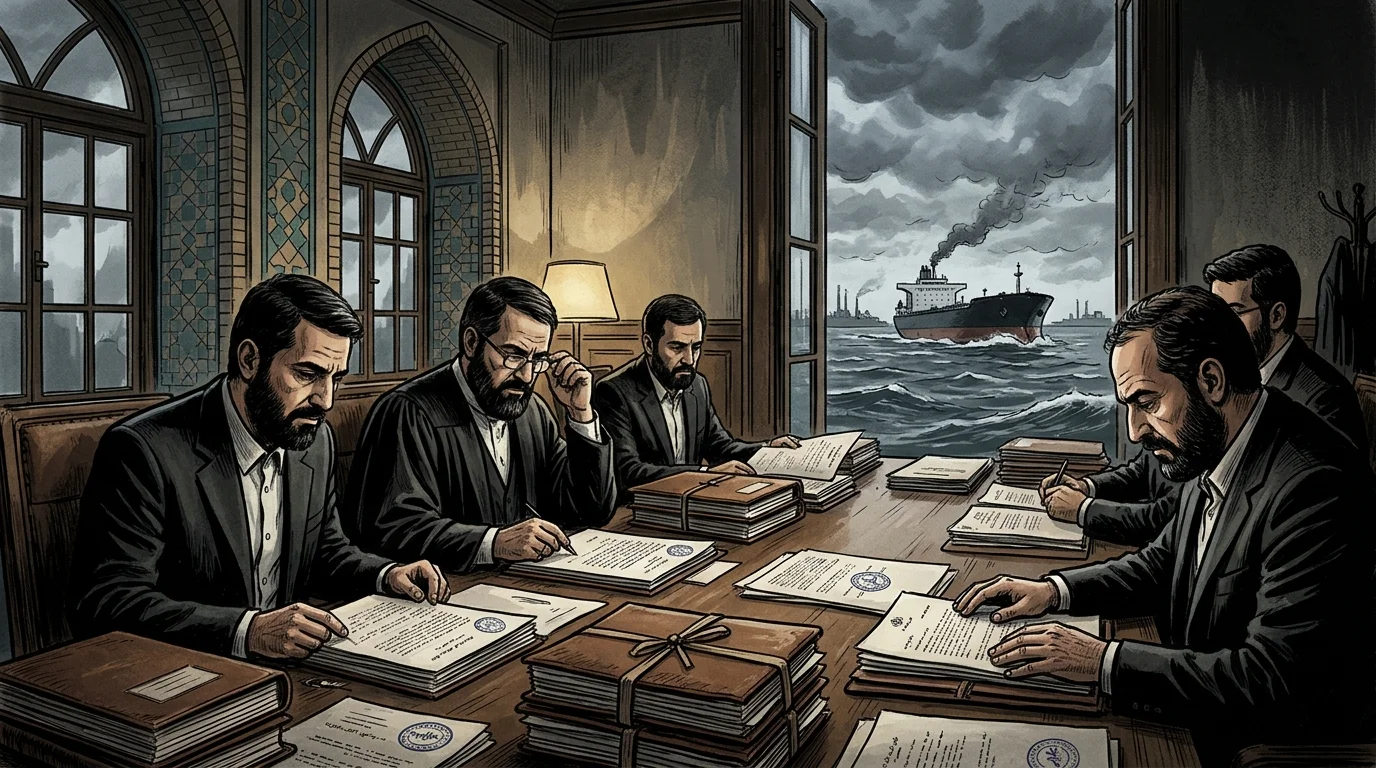
Across the three decades following the Iran-Iraq War, Iran’s state-dominated banking sector and parastatal foundations were repeatedly shaken by escalating financial scandals that revealed how political patronage, revolutionary foundations (bonyads), and international sanctions evasion subverted internal bank controls. Three landmark prosecutions trace the trajectory of post-revolutionary Iranian corporate fraud on an ever-expanding scale: the 1995 embezzlement of 123 billion rials (and over 1,230 billion rials in gross check turnover) from Bank Saderat by businessman Fazel Khodadad and Morteza Rafighdoost; the September 2011 discovery of a 30,000-billion-rial (US$2.6 billion) forged letter-of-credit scheme orchestrated by industrialist Mahafarid Amir-Khosravi across Bank Saderat and Bank Melli; and the 2013–2016 prosecution of billionaire middleman Babak Zanjani, accused by the Ministry of Petroleum of withholding €2.7 billion (nearly US$3 billion) in proceeds from sanctioned Iranian crude oil sales. [1]
Fazel Khodadad, Morteza Rafighdoost, and the 1995 Bank Saderat Embezzlement
During President Akbar Hashemi Rafsanjani’s post-war reconstruction era (1989–1997), Iran’s state-owned commercial banks operated under severe administrative distortions, including multiple official and free-market exchange rates, repressed credit ceilings, and intense pressure to accommodate enterprises tied to revolutionary foundations. Among the most powerful parastatal conglomerates in the country was the Foundation of the Oppressed and Disabled (Bonyad Mostazafan va Janbazan), headed by former Islamic Revolutionary Guard Corps (IRGC) Minister Mohsen Rafighdoost. [2]
Beginning in October 1991, Mohsen Rafighdoost’s younger brother, Morteza Rafighdoost—who served on the board of a foundation-linked chemical company and headed the Imam Khomeini Relief Committee inside Tehran’s Evin Prison—entered into a financial partnership with private trader Fazel (Fadhil) Khodadad. The pair cultivated Ebrahimets Aria and Abu Taleb Ebrahimi, branch managers and clearing clerks at Branch 207 of state-owned Bank Saderat Iran in northern Tehran. Exploiting manual inter-branch check clearing lags, the branch officials repeatedly credited unbacked checks drawn by Khodadad and Morteza Rafighdoost before funds were collected from counterparty banks. [3]
Over a fifteen-month span between late 1991 and early 1993, Khodadad and Rafighdoost rotated approximately 1,230 billion rials in floating check kiting across Branch 207, extracting a net embezzled sum reported by prosecutors at 123 billion rials (equivalent to roughly US$40 million to US$70 million at contemporary free-market rates, or vastly more at the overvalued official exchange rate). The diverted liquidity was used to speculate in foreign currency, gold coins, Tehran real estate, and imported commodities. When Central Bank and Bank Saderat inspectors finally uncovered the chasm in Branch 207’s accounts, the political sensitivity of the Rafighdoost name turned the trial before Tehran’s Islamic Revolutionary Court into a national sensation. [4]
In November 1995, Iran’s Supreme Court upheld the Revolutionary Court’s verdicts. Fazel Khodadad was convicted as a “corruptor on earth” (mofsed-e-fil-arz), ordered to make restitution, sentenced to 149 lashes, and executed by hanging at Evin Prison on November 22, 1995—becoming the first financial white-collar defendant executed for bank fraud in the Islamic Republic. By contrast, Morteza Rafighdoost was spared the death penalty and sentenced to life imprisonment alongside former bank clerk Abu Taleb Ebrahimi, sparking enduring public cynicism when Rafighdoost was granted prison furloughs and eventually pardoned after serving roughly eight years. [5]
Mahafarid Amir-Khosravi and the 2011 US$2.6 Billion Letter-of-Credit Fraud
Sixteen years after Khodadad’s execution, Bank Saderat returned to the center of an infinitely larger financial fraud that dwarfed the 1995 affair roughly two-hundred-fold in nominal rial terms. During President Mahmoud Ahmadinejad’s administration (2005–2013), the Iranian government launched an ambitious privatization drive under Article 44 of the Constitution while simultaneously ordering state banks to extend cheap credit to domestic industrial groups. Into this environment stepped Mahafarid Amir-Khosravi—widely known by his business alias Amir Mansour Aria—who had begun his career in the mid-2000s running cattle-import and mineral-water businesses in northern Iran. [6]
Together with his four brothers, Amir-Khosravi established the Aria Investment Development Company, a sprawling holding conglomerate encompassing more than thirty-five subsidiaries. Beginning in 2007, Aria Group targeted a Bank Saderat corporate branch in the southern steel and oil hub of Ahvaz, Khuzestan province. By bribing branch managers and regional executives at Bank Saderat in Ahvaz, Aria Group arranged the issuance of hundreds of domestic sight and deferred letters of credit (LCs) backed by forged project invoices and non-existent collateral. [7]
Once a Bank Saderat branch stamped and guaranteed an LC on behalf of one Aria Group shell subsidiary in favor of another Aria affiliate, Amir-Khosravi’s lieutenants carried those unrecorded, state-bank-guaranteed LCs to seven other major Iranian financial institutions—most notably Bank Melli Iran (the country’s largest commercial bank), Bank Sepah, Bank Refah, and Bank Mellat—and discounted them prior to maturity for immediate cash at hair-cut commissions of 12 to 18 percent. As earlier LCs came due, Aria Group simply bribed the Ahvaz bankers to issue even larger forged LCs in a classic Ponzi-style rollover structure. [8]
Privatization Plunder, Mahmoud Reza Khavari’s Flight, and the 2014 Execution
Over four years between 2007 and August 2011, the volume of fraudulent letters of credit discounted by Aria Group snowballed from tens of billions of rials to an astonishing 30,000 billion rials—approximately US$2.6 billion to US$2.8 billion at the time. Unlike conventional embezzlers who merely wired cash abroad, Amir-Khosravi deployed the discounted bank funds inside Iran to buy up crown jewels of the state privatization program: Aria Group acquired a controlling stake in the giant Khuzestan Steel Company, major rail and cement enterprises, a top-division professional football club (Damash Gilan), and a license to launch one of Iran’s first private commercial lenders, Bank Aria.
The scheme unraveled in late August and September 2011 when Central Bank auditors and internal examiners at Bank Saderat froze further LC discounting in Ahvaz. As parliamentary factions traded accusations over which senior officials in the Ahmadinejad administration had written letters of recommendation for Aria Group’s privatizations, the fallout decapitated Iran’s banking leadership. On September 27, 2011, Mahmoud Reza Khavari—the managing director and chairman of Bank Melli Iran, which had discounted vast quantities of Aria’s unbacked Bank Saderat paper—fled Tehran for Toronto, Canada, where he owned luxury real estate and held dual Canadian citizenship, tendering his resignation by fax and remaining beyond the reach of Iranian courts and Interpol red notices.
Following a massive judicial investigation involving sixty-seven defendants, four individuals were sentenced to death for “spreading corruption on earth.” On May 24, 2014, Mahafarid Amir-Khosravi was executed by hanging at Evin Prison, while scores of bank executives, former deputy ministers, and corporate officers received prison sentences ranging from ten years to life.
Babak Zanjani and the €2.7 Billion Oil Sanctions-Busting Trial
Even as the Aria Group defendants stood trial, tightened United States and European Union sanctions targeting Iran’s Central Bank, SWIFT messaging access, and crude oil exports in 2011–2012 gave rise to a third, transnational financial scandal. Cut off from conventional international trade finance and oil-tanker clearing channels, the Ahmadinejad government’s Ministry of Petroleum and Central Bank authorized private intermediaries—known in Iran as “sanctions circumvention” (dor zadan-e tahrim) operatives—to sell Iranian crude oil on global spot markets and repatriate foreign-currency proceeds through offshore front networks.
The most prominent of these state-sanctioned middlemen was Babak Morteza Zanjani, a flamboyant Tehran businessman in his late thirties who headed the Dubai- and Turkey-based Sorinet Group, a conglomerate of roughly sixty-five companies spanning cosmetics, aviation (Qeshm Airlines), hospitality, real estate, and financial services. Using Malaysia-based First Islamic Investment Bank (FIIB) and an affiliated bank in Tajikistan alongside shell entities in the United Arab Emirates and Turkey, Zanjani contracted with the National Iranian Oil Company (NIOC) and its Hong Kong-registered subsidiary Naftiran Intertrade Company (NICO) to market millions of barrels of Iranian crude oil and condensates, as well as to hold foreign-currency deposits on behalf of Iranian state banks.
Both the US Treasury Department and the European Union placed Zanjani and his Sorinet and FIIB entities on international sanctions blacklists between December 2012 and April 2013 for moving billions of dollars on behalf of Iranian oil authorities. Yet after President Hassan Rouhani took office in August 2013 and opened nuclear negotiations with Western powers, the new Ministry of Petroleum audited NIOC’s offshore receivables and discovered that Zanjani had failed to remit €2.7 billion (roughly US$2.8 billion to US$3 billion) in proceeds from oil cargoes delivered to his network, relying instead on unverified or forged foreign bank transfer orders.
Arrested on December 30, 2013, Zanjani stood trial in a televised proceeding before Branch 15 of Tehran’s Revolutionary Court in late 2015. Testifying in court that sanctions had frozen his overseas banking channels and blocked him from wiring the funds to Tehran, Zanjani was nonetheless convicted on March 6, 2016, of “spreading corruption on earth” by defrauding the Oil Ministry, sentenced to death, and ordered to pay full restitution plus a one-fourth statutory fine. Although Iran’s Supreme Court upheld his death sentence in December 2016, judicial authorities repeatedly stayed Zanjani’s execution for more than seven years while intelligence and central bank teams negotiated to locate and seize his domestic real estate and overseas assets—culminating in April 2024 when the Iranian judiciary announced that sufficient foreign assets had been repatriated to commute Zanjani’s death sentence to a twenty-year prison term.
Theoretical & Balance-Sheet Transmission Mechanism
In the Kindleberger–Minsky taxonomy of financial instability (Kindleberger, 1978; Minsky, 1986) and Irving Fisher’s (1933) debt-deflation framework, speculative asset booms become systemic crises when credit expansion shifts balance sheets from hedge finance (cash flows covering principal and interest) to speculative and Ponzi finance (relying on rising asset prices and short-term margin roll-overs).
Once monetary tightening or an exogenous shock halts price appreciation, forced margin liquidations trigger Fisherian debt-deflation: fire-sale asset discounts erode bank collateral values, contracting credit supply across the real economy.
Sources and Further Reading
- Abdorrahman Boroumand Center for Human Rights in Iran, “ Fazel Khodadad: The 1995 Bank Saderat Embezzlement Case,” Abdorrahman Boroumand Center, 1995-11-22. Historical & Financial Reference
- World Corporal Punishment Research / Reuters Archive, “ Iran Supreme Court Confirms Death Sentence in Bank Saderat Embezzlement Scandal,” Corpun Archive (Reuters), 1995-11-14. Historical & Financial Reference
- Voice of America, “ Iran Hangs Billionaire Convicted of $2.6 Billion Bank Fraud,” Voice of America, 2014-05-24. Historical & Financial Reference
- The Guardian, “ Iranian Billionaire Babak Zanjani Sentenced to Death for Embezzlement,” The Guardian, 2016-03-06. Historical & Financial Reference
- Radio Free Europe / Radio Liberty, “ Rags To Riches To Death Row: The Rise And Fall Of An Iranian Billionaire,” RFE/RL, 2016-03-07. Historical & Financial Reference
- CBS News, “ Iran’s Supreme Court Upholds Death Sentence for Billionaire Businessman Babak Zanjani,” CBS News, 2016-12-03. Historical & Financial Reference
- Irving Fisher — "The Debt-Deflation Theory of Great Depressions," Econometrica 1, no. 4 (FRASER Federal Reserve Archive, 1933): 337–357 Central Bank / Monetary Authority
- Charles P. Kindleberger & Robert Z. Aliber — Manias, Panics, and Crashes: A History of Financial Crises (Palgrave Macmillan) Peer-Reviewed / Academic Research
Cite This Historical Dossier (APA / Chicago)
APA (7th ed.): Ç., S. (Ed.). (2026). Iran's Banking Mega-Scandals: Bank Saderat, Aria Group's $2.6B Fraud, and Babak Zanjani. In Forgotten Fortunes Historical Monograph Series (Forgotten Fortunes Editorial Desk). https://forgottenfortunes.net/iran-banking-scandals-aria-zanjani/
MLA (9th ed.): Ç., Soner, ed. "Iran's Banking Mega-Scandals: Bank Saderat, Aria Group's $2.6B Fraud, and Babak Zanjani." Forgotten Fortunes: Financial & Monetary History Archive, 2026, https://forgottenfortunes.net/iran-banking-scandals-aria-zanjani/.
Chicago (17th ed.): Ç., Soner, ed. "Iran's Banking Mega-Scandals: Bank Saderat, Aria Group's $2.6B Fraud, and Babak Zanjani." Forgotten Fortunes Historical Monograph Series (Forgotten Fortunes Editorial Desk), September 15, 2026. https://forgottenfortunes.net/iran-banking-scandals-aria-zanjani/.
Have an idea for another financial history documentary or article? Request a story →