In This Article
Between the railway boom of the 1860s and the banking crisis of 1901, Imperial Germany served as Europe’s laboratory for both high-speed industrial capitalism and corporate governance reform. During the heady unification era known as the Gründerzeit, visionary promoter Bethel Henry Strousberg—hailed across Berlin as the “Railway King” (Eisenbahnkönig)—pioneered vertically integrated conglomerate finance while recruiting Prussian dukes and counts to lend aristocratic prestige to speculative foreign railway bonds. When National Liberal parliamentarian Eduard Lasker stood up on February 7, 1873 to expose systemic charter corruption reaching into Chancellor Otto von Bismarck’s own chancellery, the ensuing scandal helped detonate the 1873 Gründerkrach and inspired the landmark Corporate Law Amendment (Aktienrechtsnovelle) of July 18, 1884. By raising the minimum nominal value of a German share to 1,000 Marks and mandating a strict two-tier supervisory board (Aufsichtsrat), lawmakers sought to banish small savers and crooked promoters from the stock market forever—only for corporate accounting fraud to resurface with devastating force in the 1900–1901 collapses of the Pommersche Hypotheken-Aktien-Bank, Kassel’s Aktiengesellschaft für Trebertrocknung, and the venerable Leipziger Bank. [1]
Bethel Henry Strousberg and the Aristocratic Romanian Railway Debacle
Born Baruch Hirsch Strausberg in East Prussia in 1823, Bethel Henry Strousberg learned financial journalism and insurance in Victorian London before returning to Prussia in the 1850s as agent for British railway capitalists. During the 1860s, Strousberg transformed German railway construction through the “general enterprise” (Generalunternehmer) system. Rather than waiting for state treasuries or banking syndicates to raise cash before laying track, Strousberg obtained state railway concessions, inflated the authorized construction capital, and paid ironworks, earthmoving subcontractors, and suppliers directly in newly printed railway shares at full par value. To capture every margin along the supply chain, he assembled a vast industrial empire encompassing the East Prussian Southern Railway, the Berlin–Görlitz and Halle–Sorau–Guben lines, Georg Egestorff’s locomotive works in Hannover, coal mines in Bohemia, rolling mills in Dortmund, and a private palace on Berlin’s Wilhelmstraße. [2]
In 1868, Strousberg embarked on his most audacious venture: a concession from Prince Carol I’s government in Bucharest to construct more than 900 kilometers of railways across the principalities of Moldavia and Wallachia. To finance construction, Strousberg floated roughly 245 million francs (over 65 million Prussian thalers, or nearly 200 million Marks) in 7.5 percent Romanian railway bonds (Rumänische Eisenbahn-Obligationen) bearing an interest guarantee from the Romanian state that was supposed to take effect only after each line became operational. Because German retail investors were wary of Balkan sovereign risk, Strousberg placed three of Prussia’s wealthiest aristocrats—Hugo Prince zu Hohenlohe-Öhringen (Duke of Ujest), Victor Prince zu Hohenlohe-Schillingsfürst (Duke of Ratibor), and Count Karl von Lehndorff—at the head of the consortium as co-concessionaires and supervisory directors. [3]
Reassured by noble titles and lavish newspaper advertisements, tens of thousands of German middle-class savers bought the high-yielding bonds. Behind the scenes, however, Strousberg diverted bond proceeds to pay current interest coupons before the tracks were finished, while floods, engineering failures, and the outbreak of the Franco-Prussian War in July 1870 halted construction. On January 1, 1871, Strousberg defaulted on the semi-annual coupon, and the Romanian government refused to honor its guarantee on uncompleted lines. Facing the ruin of German bondholders and the disgrace of Silesian grandees close to the Hohenzollern court, Chancellor Otto von Bismarck applied intense diplomatic pressure on Bucharest and enlisted his personal banker, Gerson von Bleichröder, alongside Adolph von Hansemann’s Disconto-Gesellschaft, to form a rescue syndicate in 1871–1872 that bought out Strousberg and shielded the Dukes of Ujest and Ratibor from personal bankruptcy. [4]
Eduard Lasker’s February 7, 1873 Speech and the Moscow Fall of the Railway King
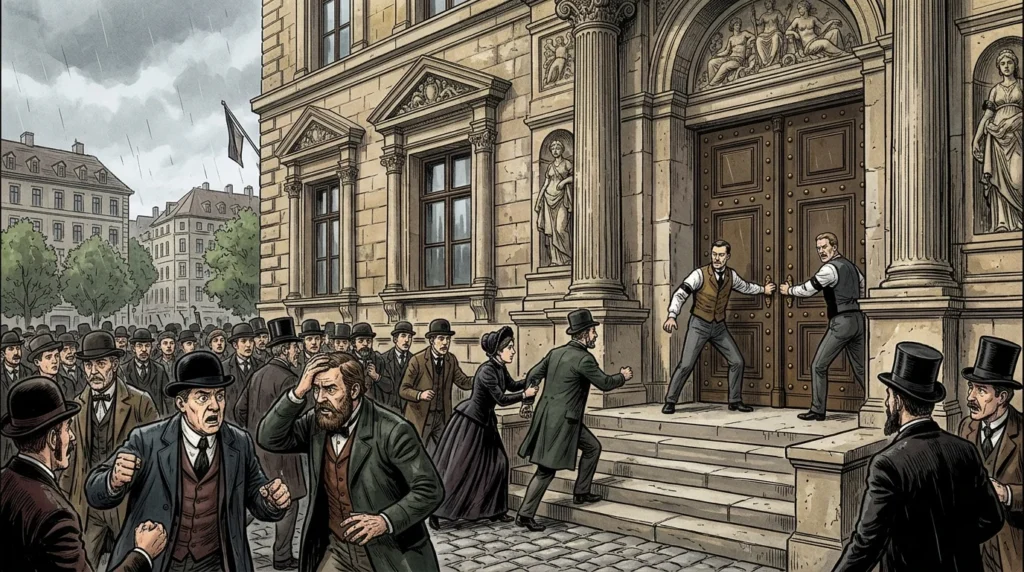
The Romanian bailout coincided with an unprecedented speculative mania inside the newly proclaimed German Empire. On June 11, 1870, the North German Confederation had abolished the requirement that joint-stock companies obtain a discretionary government charter (Konzessionssystem), replacing it with automatic registration under normative rules while permitting shares with nominal values as low as 50 to 100 thalers (150 to 300 Marks). Fueled by the influx of 5 billion francs in French war indemnities after 1871, promoters founded 857 new joint-stock corporations with 3.3 billion Marks of capital in less than three years—more than had been created in Prussia between 1790 and 1870 combined. [5]
Railways, however, still required state concessions from the Prussian Ministry of Commerce, headed by Count Heinrich Friedrich von Itzenplitz. On February 7, 1873—expanding on initial revelations made in January—National Liberal deputy Eduard Lasker rose in the Prussian House of Representatives (Abgeordnetenhaus) and delivered a devastating three-hour indictment of the Strousberg system and corruption inside the Prussian state bureaucracy. Armed with notarized contracts and corporate minutes, Lasker proved that Senior Privy Councillor (Erster Vortragender Rat) Hermann Wagener—Bismarck’s closest conservative aide in the State Ministry—along with aristocrats Prince Wilhelm Malte zu Putbus and Prince Calixt Biron von Curland, had obtained lucrative railway charters for the Pommersche Centralbahn and Berliner Nordbahn without possessing the required capital. [6]
Lasker demonstrated how Wagener and his aristocratic partners had immediately sold or handed construction onto sham general contractors modeled on Strousberg’s methods, pocketing hundreds of thousands of thalers in promoter kickbacks while paying only 10 to 40 percent in real cash for millions in watered stock. The speech electrified Germany. King Wilhelm I appointed a Royal Investigating Commission whose findings forced Commerce Minister Itzenplitz to resign in May 1873 and ended Hermann Wagener’s career in disgrace. Within weeks, the Vienna Stock Exchange crash of May 9, 1873 spread to Berlin, triggering the Gründerkrach that wiped out dozens of newly floated banks and industrial firms. Desperate to salvage his crumbling industrial holdings, Strousberg shifted his operations to the Russian Empire, where he pledged worthless securities and bribed directors at the Commercial Loan Bank of Moscow to secure 7 million rubles in irregular loans. On October 25, 1875, Russian authorities arrested Strousberg in Moscow; his Berlin and Bohemian estates immediately collapsed into bankruptcy, and after his November 1876 conviction and deportation from Russia, the former Railway King died impoverished in Berlin on May 31, 1884. [7]
The July 18, 1884 Corporate Law Overhaul: Pricing Out Retail Savers
For a full decade after Lasker’s disclosures and the 1873 crash, imperial jurists debated how to prevent promoters from fleecing the public through watered stock and figurehead boards. Their answer was the Imperial Corporate Law Amendment of July 18, 1884 (Gesetz, betreffend die Kommanditgesellschaften auf Aktien und die Aktiengesellschaften), universally known as the 1884 Aktienrechtsnovelle—the foundational statute of modern German corporate governance. [8]
Rather than relying solely on disclosure, the 1884 law took a paternalistic approach designed to bar small retail savers from the equity market altogether. The statute raised the minimum nominal par value of bearer shares to 1,000 Marks—roughly five times the 200-Mark minimum common for registered shares under the 1870 code and equivalent to roughly two-and-a-half times Germany’s per-capita net national income, or more than an entire year’s wages for a skilled industrial worker. In its official legislative memorandum (Begründung), the government explicitly declared that small household savings belonged in municipal savings banks (Sparkassen), credit cooperatives, or sovereign bonds rather than in volatile corporate equities, and that only wealthy investors capable of evaluating balance sheets should own shares.
Simultaneously, the 1884 law institutionalized Germany’s mandatory two-tier board structure. It strictly prohibited any individual from sitting on both the executive management board (Vorstand) and the supervisory board (Aufsichtsrat), while imposing personal civil and criminal liability on promoters and supervisory directors who failed to verify cash payments and non-cash asset contributions (Sacheinlagen) during a company’s founding. When a company was formed through non-cash assets or takeover contracts, independent auditors appointed by local chambers of commerce had to inspect and publish a formal founding report (Gründungsbericht), and newly issued shares could not be traded officially on German stock exchanges until the company had published its first full annual balance sheet.
The 1900–1901 Mortgage Bank and Kassel Trebertrocknung Accounting Frauds
While the 1884 Aktienrechtsnovelle curbed initial public offering scams and concentrated German corporate ownership inside universal great banks (Großbanken), it left a fatal blind spot: ongoing balance-sheet manipulation inside established corporations and their subsidiary networks. That vulnerability was exposed during the recession of 1900–1901 in two spectacular waves of accounting fraud.
The first struck Berlin’s private mortgage banking sector in late 1900. Two major issuers of mortgage bonds (Pfandbriefe)—the Preußische Hypotheken-Aktien-Bank (controlled by director Eduard Sanden) and the Pommersche Hypotheken-Aktien-Bank—collapsed into insolvency after investigators discovered that their executives had concealed tens of millions of Marks in speculative real-estate losses by transferring unmarketable urban land plots among dozens of unlisted shell subsidiaries at artificially inflated prices and booking the paper markups as distributable profit. Only emergency syndicate interventions by Berlin’s great banks and the passage of the uniform Imperial Mortgage Bank Act (Hypothekenbankgesetz) prevented a systemic run on the German Pfandbrief market.
Months later, in midsummer 1901, an even more brazen industrial Ponzi scheme toppled one of Germany’s oldest commercial banks. Founded in Kassel in 1889 by former coal merchant Adolf Schmidt, Dortmund brewer Ernst Otto, and the brothers Hermann and Alfred Sumpf with just 350,000 Marks in capital, the Aktiengesellschaft für Trebertrocknung originally manufactured rotary machines to dry spent brewers’ grain (Treber) into cattle feed. In 1895, CEO Adolf Schmidt acquired the Bergmann patent for the dry distillation of wood waste into methyl alcohol, wood vinegar, and charcoal. Over the next six years, Schmidt created more than 30 domestic and foreign subsidiaries across Russia, Bosnia, Finland, Sweden, France, Bohemia, and Italy.
Whenever the Kassel parent company needed to report soaring profits to justify dividends that reached 50 percent and pushed its share price above 700 percent of par, Schmidt sold overpriced wood-distillation patent licenses and machinery to his own newly founded subsidiaries, booking the unpaid intercompany receivables as cash earnings. To fund this fictitious empire, Schmidt relied on his former schoolmate August Heinrich Exner, chief director of the prestigious Leipziger Bank (founded in 1838). Bypassing internal credit limits and deceiving his own supervisory board, Exner funneled an astonishing 87 million Marks in largely unsecured loans into the Kassel company—nearly double the Leipziger Bank‘s entire 48 million Mark equity capital. On June 25, 1901, after Berlin banks refused a bailout, the Leipziger Bank closed its doors, and on July 4, 1901, the AG für Trebertrocknung filed for fraudulent bankruptcy with more than 90 million Marks in total liabilities. The crash triggered the Saxon Bank Panic (Sächsischer Bankenkrach), ruined thousands of depositors and shareholders across Saxony and Hesse, sent Adolf Schmidt and August Exner to prison for fraud and balance-sheet falsification, and paved the way for mandatory external balance-sheet auditing in German corporate law.
Theoretical & Balance-Sheet Transmission Mechanism
In the Kindleberger–Minsky taxonomy of financial instability (Kindleberger, 1978; Minsky, 1986) and Irving Fisher’s (1933) debt-deflation framework, speculative asset booms become systemic crises when credit expansion shifts balance sheets from hedge finance (cash flows covering principal and interest) to speculative and Ponzi finance (relying on rising asset prices and short-term margin roll-overs).
Once monetary tightening or an exogenous shock halts price appreciation, forced margin liquidations trigger Fisherian debt-deflation: fire-sale asset discounts erode bank collateral values, contracting credit supply across the real economy.
Sources and Further Reading
- Catherine Davies, “ Spekulation und Korruption: Zur Begriffs- und Praxisgeschichte eines Handlungsfeldes im Gründerboom,” Jahrbuch für Wirtschaftsgeschichte / FernUniversität in Hagen, 2016. Historical & Financial Reference
- Historische Gesellschaft der Deutschen Bank, “ Leading Figures in German Banking History: Hansemann, Bleichröder, and the Romanian Railway Consortium,” Bankgeschichte.de, 2023. Historical & Financial Reference
- Jacob Riesser, “ The German Great Banks and Their Concentration in Connection with the Economic Development of Germany (Senate Document No. 593),” U.S. National Monetary Commission / Federal Reserve Bank of St. Louis FRASER, 1911. Central Bank / Monetary Authority
- Bernd Schaeffer, “ Der betrügerische Konkurs der AG für Trebertrocknung in Cassel und seine Folgen,” Erinnerungen im Netz / Stadtarchiv Kassel, 2021. Historical & Financial Reference
- Stadtarchiv Kassel, “ Chronik der Jahre 1900–1932: Zusammenbruch der Kasseler Treber-Trocknungs-Gesellschaft,” Stadt Kassel, 2023. Historical & Financial Reference
- Rustam Jamilov, Tobias König, Karsten Müller, and Farzad Saidi, “ Two Centuries of Systemic Bank Runs,” University of Oxford Department of Economics, 2024. Peer-Reviewed / Academic Research
- Irving Fisher — "The Debt-Deflation Theory of Great Depressions," Econometrica 1, no. 4 (FRASER Federal Reserve Archive, 1933): 337–357 Central Bank / Monetary Authority
- Charles P. Kindleberger & Robert Z. Aliber — Manias, Panics, and Crashes: A History of Financial Crises (Palgrave Macmillan) Peer-Reviewed / Academic Research
Cite This Historical Dossier (APA / Chicago)
APA (7th ed.): Ç., S. (Ed.). (2026). Railway Kings, 1,000-Mark Shares, and the 1901 Kassel Fraud: Imperial Germany's Scandals. In Forgotten Fortunes Historical Monograph Series (Forgotten Fortunes Editorial Desk). https://forgottenfortunes.net/strousberg-railway-crash-german-banks/
MLA (9th ed.): Ç., Soner, ed. "Railway Kings, 1,000-Mark Shares, and the 1901 Kassel Fraud: Imperial Germany's Scandals." Forgotten Fortunes: Financial & Monetary History Archive, 2026, https://forgottenfortunes.net/strousberg-railway-crash-german-banks/.
Chicago (17th ed.): Ç., Soner, ed. "Railway Kings, 1,000-Mark Shares, and the 1901 Kassel Fraud: Imperial Germany's Scandals." Forgotten Fortunes Historical Monograph Series (Forgotten Fortunes Editorial Desk), September 14, 2026. https://forgottenfortunes.net/strousberg-railway-crash-german-banks/.
Have an idea for another financial history documentary or article? Request a story →