In This Article
Between the mid-nineteenth-century railway boom and the eve of the First World War, Germany transformed from a patchwork of agrarian states into Europe’s foremost industrial power. At the heart of that transformation stood a distinctive institutional innovation: the joint-stock universal bank (Universalbank), led by Berlin’s great commercial banks, the Grossbanken. Unlike the specialized deposit banks and merchant houses of Victorian Britain, German universal banks combined retail and corporate deposit-taking, long-term industrial credit, initial public offerings on the Berlin Stock Exchange, and proxy voting power on corporate supervisory boards (Aufsichtsräte). Yet the tight marriage between commercial banking and heavy industry exposed the German financial system to severe concentration risks and maturity mismatches. Those vulnerabilities erupted during the industrial and real-estate slump of 1900–1901—which brought down the Prussian mortgage banks (Spielhagen-Banken) and the sixty-two-year-old Leipziger Bank on June 25, 1901—and forced Reichsbank President Rudolf Havenstein to overhaul German liquidity supervision during the international crises of 1907 and 1911. [1]

The Post-1870 Universalbank Model and the “Four D-Banks”
The modern German joint-stock credit bank emerged in the 1850s with the founding of the Bank für Handel und Industrie in Darmstadt (the Darmstädter Bank, 1853) and the reorganization of the Disconto-Gesellschaft in Berlin (1856). After German unification in 1871, the liberalization of joint-stock company law and the influx of five billion francs in French war indemnity payments unleashed the Gründerboom (Founders’ Boom) and the subsequent Gründerkrach of 1873. While dozens of speculative provincial promotions failed in the 1873 crash, two newly established institutions—Deutsche Bank (founded in Berlin in 1870 by Adelbert Delbrück and Georg Siemens) and Dresdner Bank (founded in Dresden in 1872 by Eugen Gutmann)—weathered the storm and expanded rapidly into Berlin’s financial district along the Behrenstrasse. [2]
By the 1890s, German high finance was dominated by the “Four D-Banks”—Deutsche Bank, Dresdner Bank, Disconto-Gesellschaft, and Darmstädter Bank—alongside the Berliner Handels-Gesellschaft and the Schaaffhausenscher Bankverein. Operating on the universal “cradle-to-grave” relationship model, a Berlin Grossbank extended short-term current-account advances (Kontokorrentkredit) to finance a client’s factory construction or coal mine expansion, underwrote the company’s equity and bond issues once market conditions turned favorable, held blocks of shares in custody for retail depositors (exercising their proxy voting rights, or Depotstimmrecht), and placed bank directors onto the industrial firm’s supervisory board. This architecture channeled vast capital into Germany’s electrical engineering giants (AEG and Siemens & Halske), chemical cartels, and Ruhr steel syndicates, but it also tempted regional banks to imitate Berlin’s industrial merchant banking without comparable capital buffers.
The 1900 Mortgage Bank Scandal: Collapse of the Spielhagen-Banken
After five years of rapid industrial expansion and urban construction fueled by low interest rates, the German business cycle turned sharply downward in the spring of 1900 as the Reichsbank raised its discount rate to stem gold outflows during the South African Boer War. The first casualties of the credit squeeze were two major real-estate lenders in northern Germany: the Preußische Hypotheken-Actien-Bank (Prussian Joint-Stock Mortgage Bank) and the Pommersche Hypotheken-Aktien-Bank (Pomeranian Joint-Stock Mortgage Bank), together known as the Spielhagen-Banken after the financier family that had long controlled their management. [3]
Investigations launched by Prussian authorities in late 1900 revealed systemic balance-sheet falsification. Under the German mortgage banking system, banks issued supposedly conservative mortgage bonds (Pfandbriefe) backed by first-lien urban real-estate loans. Instead of lending against completed, income-producing apartment buildings, the directors of the Prussian and Pomeranian mortgage banks had funneled hundreds of millions of marks into speculative, unbuilt land development subsidiaries that they secretly controlled. To disguise non-performing loans, the subsidiary companies borrowed fresh funds from the parent banks to pay fictitious interest on their existing mortgages. When the Berlin property market stalled in October–December 1900, both institutions suspended redemption of their Pfandbriefe, wiping out tens of thousands of middle-class bondholders and accelerating passage of the strict Imperial Mortgage Bank Act (Hypothekenbankgesetz). [4]
Black Tuesday in Saxony: The June 25, 1901 Collapse of Leipziger Bank
While Berlin absorbed the shock of the mortgage-bank failures, an even more dramatic commercial banking catastrophe was brewing in the Kingdom of Saxony. In May 1901, the respected Dresdner Kreditanstalt failed due to heavy exposure to the bankrupt Kummer electrical works. Weeks later, on June 25, 1901—remembered in German financial history as Saxon “Black Tuesday” (Schwarzer Dienstag)—the venerable Leipziger Bank abruptly closed its doors and suspended payments. [5]
Founded in 1838 as Saxony’s first private bank of issue before surrendering its banknote privilege in 1875 to become an industrial credit bank, the Leipziger Bank was one of Germany’s largest regional institutions, boasting share capital of 48 million marks and reserves of 16 million marks (64 million marks in total equity). Under the aggressive leadership of its managing director, August Heinrich Exner, the bank had constructed a monumental new headquarters on the Leipzig Ring while secretly concentrating its entire balance sheet on a single industrial client: the Kassel-based Aktiengesellschaft für Trebertrocknung (Spent-Grain Drying Corporation). [6]
Established in 1889 by Kassel promoter Adolf Schmidt and chairman Ernst Otto, the Treber-Trocknungs-Gesellschaft originally marketed machinery to dry wet brewery mash (Treber) into cattle feed before pivoting into wood distillation and chemical manufacturing across Europe. In reality, Schmidt and Otto operated a massive pyramid of shell subsidiaries. Whenever the parent company needed to report soaring profits and pay 25 to 50 percent dividends, it sold dubious patents to newly incorporated foreign affiliates financed with fresh loans from the Leipziger Bank, booking the paper proceeds as operating revenue while falsifying inventory ledgers. [7]
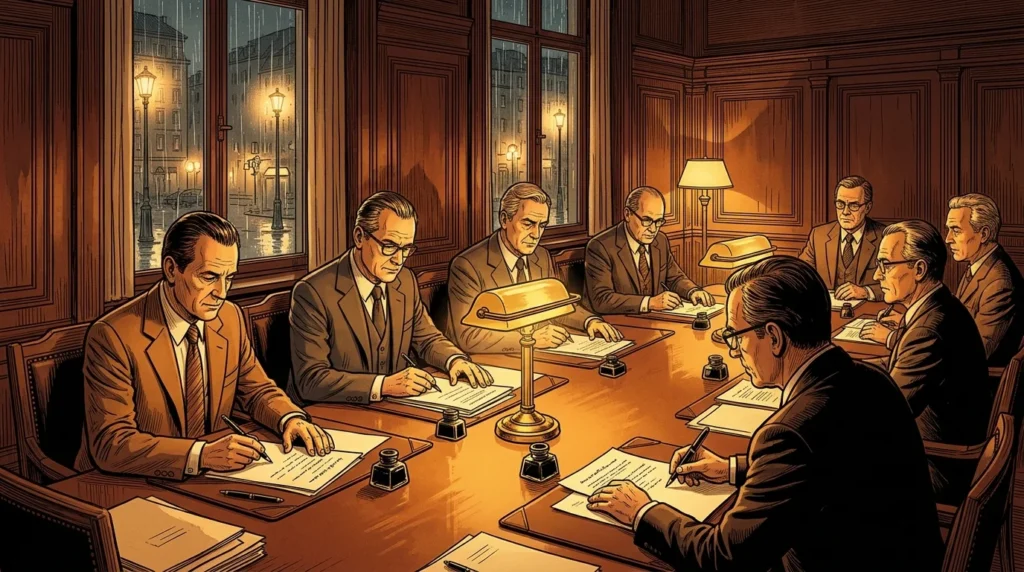
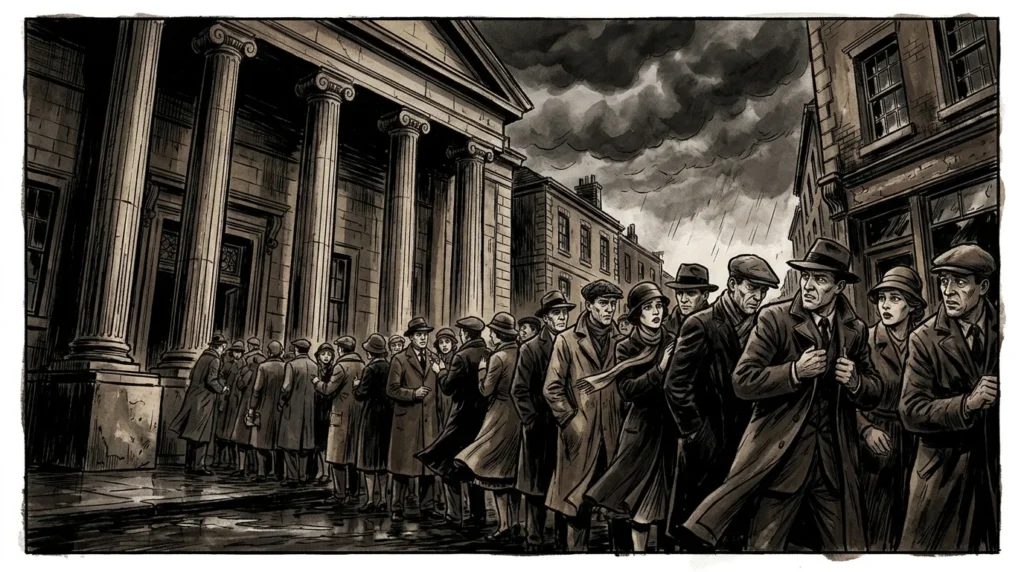
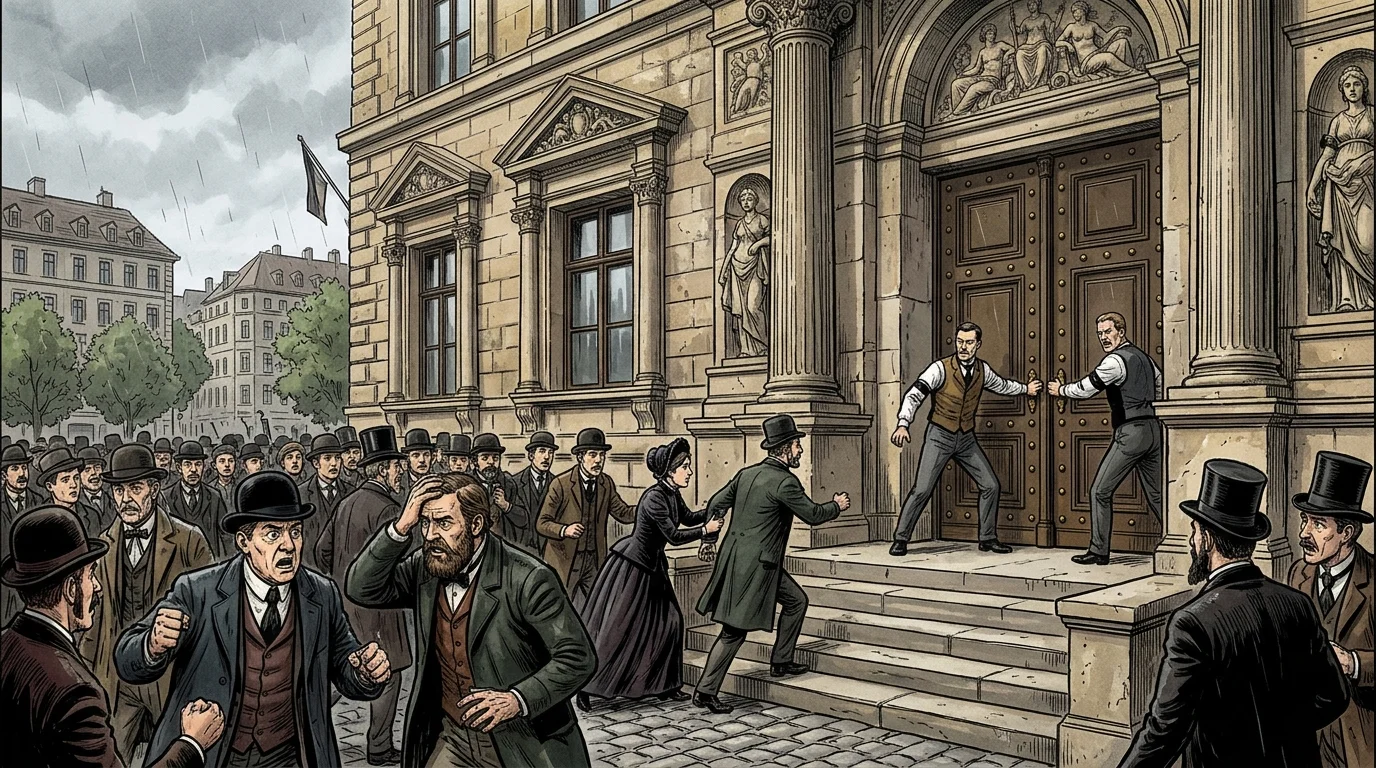
By June 1901, Director Exner had advanced an astonishing 87 million to 93 million marks to the Kassel Treber network—nearly double the Leipziger Bank‘s entire paid-in capital and reserve fund. When the Berlin Grossbanken and the Reichsbank inspected the books during an emergency rescue meeting on June 24–25, 1901, they discovered that the Treber collateral was worthless and refused to bail out the insolvent lender. Bankruptcy proceedings opened on June 26, 1901, against both the Leipziger Bank (which suffered net losses of roughly 40 million gold marks, ultimately paying creditors about 67 percent in liquidation) and the Treber-Trocknungs-Gesellschaft. Panic runs swept across Saxony, felled several smaller banking houses, and enabled Berlin’s Deutsche Bank to acquire the Leipziger Bank‘s unfinished palace on the Martin-Luther-Ring together with its prime corporate clientele, accelerating the concentration of German banking in Berlin. [8]
The 1907 Panic, the 1908 Bankenquête, and the 1911 Moroccan Crisis
Although the 1901 crash consolidated the market share of Berlin’s Four D-Banks, it raised urgent questions inside the Reichstag and the central bank regarding the thin cash reserves of the universal banking system. Those anxieties intensified during the global Panic of October–November 1907. Triggered by the copper-market crash and trust-company runs in New York, international gold outflows forced the Reichsbank to hike its official discount rate to an unprecedented 7.5 percent in November 1907, exposing how heavily German credit banks relied on rediscounting commercial bills at the central bank whenever money markets tightened.
In response, the Imperial government convened the 1908–1909 Bank Inquiry Commission (Bankenquête-Kommission), chaired by the newly appointed Reichsbank President Rudolf Havenstein (who led the central bank from 1908 until 1923). Bringing together thirty-one academic economists (including Adolph Wagner and Max Weber’s contemporaries), parliamentarians, and senior bankers such as Jacob Riesser, the commission debated proposals to legally separate deposit banks from speculative investment banks or impose statutory minimum cash reserve ratios. While the powerful Grossbanken successfully resisted statutory breakup, the inquiry produced the Reich Banking Act Amendment of June 1, 1909 (making Reichsbank notes legal tender to protect the central gold reserve) and forced the Berlin credit banks to begin publishing standardized bimonthly balance sheets (Zweimonatsbilanzen) disclosing their liquid ratios.
Havenstein’s regulatory leverage was tested again in July–September 1911 during the Second Moroccan (Agadir) Crisis. When the German gunboat Panther anchored at Agadir, war fears prompted French banks to abruptly recall hundreds of millions of marks in short-term money-market loans from Berlin, while German savers staged panic withdrawals at municipal savings banks (Sparkassen) and commercial bank branches. The Berlin Stock Exchange plunged on September 9, 1911, and the Reichsbank had to part with over 200 million marks in gold and foreign exchange to stabilize the mark. Determined to prevent a liquidity collapse in the event of a European war, Havenstein used the 1911 Agadir shock to compel the Grossbanken into the “Condition Cartel” (Konditionenkartell) of 1912–1913, requiring commercial banks to curb speculative credit expansion and raise their non-interest-bearing cash reserves at the Reichsbank—completing the prewar financial mobilization of the German Empire.
Theoretical & Balance-Sheet Transmission Mechanism
In the Kindleberger–Minsky taxonomy of financial instability (Kindleberger, 1978; Minsky, 1986) and Irving Fisher’s (1933) debt-deflation framework, speculative asset booms become systemic crises when credit expansion shifts balance sheets from hedge finance (cash flows covering principal and interest) to speculative and Ponzi finance (relying on rising asset prices and short-term margin roll-overs).
Once monetary tightening or an exogenous shock halts price appreciation, forced margin liquidations trigger Fisherian debt-deflation: fire-sale asset discounts erode bank collateral values, contracting credit supply across the real economy.
Sources and Further Reading
- Sebastian Alvarez and Wilfried Kisling, “A State of Supervision? The Political Economy of Banking Regulation in Germany, 1900s–1930s,” Business History Review, Cambridge University Press, 2023. Peer-Reviewed / Academic Research
- European Association for Banking and Financial History (eabh), “German Universal Banks, Liquidity Crises, and Central Bank Policy before 1914,” eabh Working Papers (No. 14-08), 2014. Central Bank / Monetary Authority
- Erinnerungen im Netz (Kassel Historical Archive), “Der betrügerische Konkurs der AG für Trebertrocknung in Cassel und seine Folgen,” Erinnerungen im Netz, 2020. Historical & Financial Reference
- André Loh-Kliesch, “Leipziger Bank (1838–1901),” Leipzig-Lexikon, 2021. Historical & Financial Reference
- Historical Association of Deutsche Bank, “Banking History Locations in Germany: Deutsche Bank and the Consolidation of Regional Banks,” Historical Association of Deutsche Bank, 2022. Historical & Financial Reference
- Erich Achterberg, “Havenstein, Rudolf,” Neue Deutsche Biographie (Vol. 8), Historical Commission at the Bavarian Academy of Sciences, 1969. Historical & Financial Reference
- Irving Fisher — "The Debt-Deflation Theory of Great Depressions," Econometrica 1, no. 4 (FRASER Federal Reserve Archive, 1933): 337–357 Central Bank / Monetary Authority
- Charles P. Kindleberger & Robert Z. Aliber — Manias, Panics, and Crashes: A History of Financial Crises (Palgrave Macmillan) Peer-Reviewed / Academic Research
Cite This Historical Dossier (APA / Chicago)
APA (7th ed.): Ç., S. (Ed.). (2026). The Rise of the Grossbanken, the 1901 Leipziger Bank Crash, and Reichsbank Crises. In Forgotten Fortunes Historical Monograph Series (Forgotten Fortunes Editorial Desk). https://forgottenfortunes.net/1901-leipziger-bank-crash/
MLA (9th ed.): Ç., Soner, ed. "The Rise of the Grossbanken, the 1901 Leipziger Bank Crash, and Reichsbank Crises." Forgotten Fortunes: Financial & Monetary History Archive, 2026, https://forgottenfortunes.net/1901-leipziger-bank-crash/.
Chicago (17th ed.): Ç., Soner, ed. "The Rise of the Grossbanken, the 1901 Leipziger Bank Crash, and Reichsbank Crises." Forgotten Fortunes Historical Monograph Series (Forgotten Fortunes Editorial Desk), September 19, 2026. https://forgottenfortunes.net/1901-leipziger-bank-crash/.
Have an idea for another financial history documentary or article? Request a story →